Coincover is just one of many ways to safeguard digital property, which takes more than strong passwords and secure wallets.
In this article, I will discuss the Best Coincover Alternatives for insuring your assets including Evertas, Relm Insurance, BitGo, Nexus Mutual and others. You’ll learn how each one works, what they cover and which one is right for you.
Why It Stands Out Top Coincover Alternatives for Asset Insurance
- Crypto-native insurer providing reinsurance-backed custody, crime and wallet insurance for large institutions
- Bermuda-based specialty writer providing bespoke insurance for emerging digital asset risks.
- Underwriter backed theft and cyber coverage paid from regulated capacity, not token pools.
- Custodian regulated with multi-sig security and third-party underwritten insurance program.
- MPC and cold storage custody with bundled insurance, robust across Asian markets.
- The most famous decentralized mutual. Transparent, on-chain, member-governed smart-contract and custody protection.
- A simple user interface to compare and buy DeFi cover from many protocols.
- Uncommon cover for slashing of validator, usually overlooked by traditional custody insurance.
Key Points & Top Coincover Alternatives for Asset Insurance
| Platform | Key Point | What It Mainly Provides | Best For |
|---|---|---|---|
| Evertas | Insures digital assets, blockchain infrastructure, and cryptocurrency-related institutional risks. | Covers crypto businesses, custodians, exchanges, miners, and digital-asset infrastructure against selected operational and security risks. | Strong focus on institutional digital-asset insurance and specialized underwriting. |
| Relm Insurance | Provides regulated insurance solutions designed specifically for digital-asset and emerging technology companies. | Offers insurance products for cryptocurrency, blockchain, Web3, and technology businesses. | Differentiates through specialized insurance capacity and regulatory expertise for emerging industries. |
| Breach Insurance | Provides insurance products focused on protecting cryptocurrency holders and digital-asset users. | Targets individual and business crypto risks, including certain losses involving digital assets and custody. | More consumer-oriented than traditional institutional crypto insurers, making coverage easier to understand. |
| BitGo | Combines institutional digital-asset custody, security infrastructure, and insurance-related protection capabilities. | Provides custody, wallets, security infrastructure, and institutional services for digital assets. | Its major strength is connecting custody infrastructure with institutional-grade security and risk controls. |
| Cobo | Provides institutional digital-asset custody infrastructure with security and risk-management capabilities. | Offers custody, wallet infrastructure, MPC technology, and digital-asset management tools. | Particularly relevant for institutions seeking technical security infrastructure and custody solutions. |
| Nexus Mutual | Uses decentralized risk-sharing pools to provide community-based protection against smart-contract failures. | Members participate in a decentralized mutual model covering selected blockchain and smart-contract risks. | Its distinguishing feature is on-chain mutual insurance rather than conventional insurance underwriting. |
| OpenCover | Connects decentralized finance users with blockchain-native protection against selected Web3 financial risks. | Helps users access protection products covering specific DeFi and smart-contract-related risks. | Focuses on making on-chain insurance more accessible and integrated into DeFi applications. |
| InsurAce | Provides decentralized insurance products covering smart-contract, exchange, custody, and Web3-related risks. | Offers blockchain-based protection across several cryptocurrency and decentralized-finance risk categories. | Broad Web3 coverage makes it useful for users managing multiple blockchain-related exposures. |
| Unslashed Finance | Provides decentralized insurance infrastructure designed to protect cryptocurrency users from digital risks. | Focuses on coverage for smart contracts, custodians, exchanges, and other crypto infrastructure. | Uses a decentralized model to address specific risks across the cryptocurrency ecosystem. |
| Etherisc | Builds decentralized insurance infrastructure for creating automated blockchain-based insurance products. | Provides technology for parametric insurance, claims automation, and decentralized insurance applications. | Stands out as an insurance technology infrastructure provider, rather than simply one insurance marketplace. |
10 Top Coincover Alternatives for Asset Insurance
1. Evertas
Evertas, based in Austin, Texas, is a crypto-native insurer and one of the most direct institutional alternatives to Coincover. It covers custody, crime, cold and hot wallet and mining risks. Its policies have the claims certainty of a regulated product, with the backing of reinsurance and traditional insurance capacity.

Evertas also looks at a client’s security controls, key management and operational procedures before pricing cover, so underwriting is also a security assessment. It is suited to custodians, exchanges, miners and funds that need large limits and formal policy wording rather than community-pool protection.
Evertas Pros & Cons
| Pros | Cons |
|---|---|
| Crypto-native underwriting expertise | Mainly built for institutions, not individuals |
| Backed by reinsurance and traditional capacity | Premiums can be high for large limits |
| Covers custody, crime, hot/cold wallet and mining risks | Requires a detailed security review before cover |
| Formal policy wording gives claims clarity | Exclusions and sub-limits must be read carefully |
| Underwriting doubles as a security assessment | Onboarding can take longer than on-chain cover |
2. Relm Insurance
Relm Insurance is a Bermuda-based specialty insurer underwriting emerging and hard-to-place risks, including electronic assets. It operates off a licensed carrier balance sheet which means it can provide policies that regulators, auditors and institutional counterparties accept.
Relm isn’t a retail wallet cover, it’s structured, underwritten programs for businesses so it suits institutions with complex needs. Bermuda’s insurance market is also known for its flexibility with new risk classes

Which assists in crypto exposures that many traditional carriers shy away from. If you want a conventional insurer with a niche focus rather than a bundled wallet guaranty like Coincover’s, Relm is a strong candidate.
Relm Insurance Pros & Cons
| Pros | Cons |
|---|---|
| Licensed Bermuda carrier, recognised by regulators and auditors | Focused on businesses, not retail users |
| Flexible with emerging and hard-to-place risks | Digital asset capacity may be limited or selective |
| Structured, customised programmes | Bespoke underwriting can be slow and costly |
| Suits complex institutional needs | Not a bundled wallet guarantee like Coincover |
| Conventional claims process | Less public detail on products and pricing |
3. Breach Insurance
Breach Insurance is a crypto-centric insurer, offering coverage to businesses for digital asset theft and losses related to cyber incidents. Its products are underwriter-backed, meaning claims are paid from regulated insurance capacity, not a token-funded pool.
This makes it relevant for crypto companies, fintechs and service providers that need documented cover for investors, banks or partners. Breach usually looks at a client’s security posture, which feeds into premiums and policy terms.

Coverages, limits and exclusions will vary from client to client so ask for the full policy wording and confirm who the underwriters are. It can be used as a standalone purchase for companies looking for an alternative to Coincover for insurance.
Breach Insurance Pros & Cons
| Pros | Cons |
|---|---|
| Covers digital asset theft and cyber-linked losses | Limits and exclusions vary by client |
| Underwriter-backed, so claims are not paid from a token pool | Less public transparency on terms |
| Documented cover helps with investors, banks and partners | Mainly aimed at businesses |
| Security assessment shapes fair, tailored terms | Underwriters behind each policy need to be confirmed |
| Available as standalone insurance | Premiums depend on your security posture |
4. BitGo
BitGo is a qualified digital asset custodian, not a pure insurer, and a practical choice if you want custody and insurance in one relationship. It has publicly detailed an insurance program, developed with third-party underwriters, to cover certain theft scenarios of assets held in its custody. Clients enjoy multi-signature security, regulated trust status and institutional reporting.

The caveat is that the insurance is for specific custody-related events and is for BitGo’s program – not individual cover that you control. Always check the limits, exclusions and whether your assets sit in the covered storage type before relying on it.
BitGo Pros & Cons
| Pros | Cons |
|---|---|
| Custody and insurance in one relationship | Insurance covers specific custody events only |
| Multi-signature security and regulated trust status | Coverage is BitGo’s programme, not your own policy |
| Institutional reporting and strong market reputation | Cover may depend on storage type (hot vs. cold) |
| Third-party underwriters back the programme | Shared limits across clients may not cover a large loss |
| Wide asset and integration support | Custody fees apply, and moving away takes effort |
5. Cobo
Cobo Cobo is a custody and wallet infrastructure provider based on multi-party computation (MPC) technology, founded in Singapore. It offers services to exchanges, funds and Web3 businesses, mostly in Asia, and provides insurance cover for its custody services.

Similar to BitGo, the insurance is bundled with the use of the custody platform so you get operational security and protection from one vendor. Cobo is perfect for enterprises in need of enterprise controls and flexible options for key-management like MPC or cold storage.
As the insured scope is tied to Cobo’s own program you should check what is covered, the limits and how claims would be handled before treating it as an equivalent to Coincover.
Cobo Pros & Cons
| Pros | Cons |
|---|---|
| MPC and cold storage options for key management | Insurance tied to Cobo’s own custody programme |
| Strong fit for exchanges and Web3 businesses | Scope, limits and claims handling need verification |
| Enterprise controls and flexible wallet infrastructure | Less recognised than BitGo in some Western markets |
| Strong presence in Asia | Regulatory coverage varies by jurisdiction |
| Operational security and insurance from one vendor | Vendor lock-in risk |
6. Nexus Mutual
And Nexus Mutual is the best-known name in DeFi insurance, a decentralized, member-owned mutual. Members stake NXM tokens to a common capital pool that supports cover for smart-contract failures, custody and exchange risks and other incidents.

The difference is that members vote on claims, not have them adjudicated by a corporate adjuster, which offers transparency but a different dispute experience. As a discretionary mutual, its structure means that payouts are not a contractual right in the normal sense.
Nexus Mutual works for DeFi users, DAOs and protocols looking for on-chain, community-governed protection and are comfortable with the limitations imposed by pool capacity.
Nexus Mutual Pros & Cons
| Pros | Cons |
|---|---|
| Best-known, longest-running DeFi cover provider | Payouts are discretionary, not a guaranteed contractual right |
| Transparent, on-chain, community-governed | Claims decided by member vote, which can be slow or contested |
| Covers smart-contract, custody and exchange risks | Cover limited by pool capacity |
| Open to individuals, DAOs and protocols | Requires KYC and crypto-native know-how |
| No traditional insurer middleman | Narrow cover definitions may exclude some losses |
7. OpenCover
OpenCover is a distribution layer for decentralized cover. It’s not underwriting risk itself, but rather providing users an interface to find, compare and buy protection from underlying protocols, with a lot of its capacity being tied to the Nexus Mutual ecosystem.
This reduces the friction of buying on chain cover especially for users not familiar with the technical process. It’s value is convenience and discovery. One place to see available products for protocols, wallets and positions.

Since the underwriting is by the underlying provider, the actual risk and claims process is reliant on that source, so read the cover terms carefully. OpenCover is built for individuals and teams who want easy access to DeFi insurance.
OpenCover Pros & Cons
| Pros | Cons |
|---|---|
| Easy interface to find and compare cover | Does not underwrite risk itself |
| Reduces friction of buying on-chain cover | Real risk depends on the underlying provider |
| Good for users new to DeFi insurance | Limited product range |
| Aggregates options in one place | Claims handled by the source protocol |
| Useful for covering several positions | Still requires understanding of cover terms |
8. InsurAce
InsurAce is a multi-chain decentralized insurance protocol launched to cover smart-contract failures, custodian risk and stablecoin depegs across many blockchain. It offered portfolio-style cover that allowed users to protect multiple positions simultaneously, a feature that was unique compared with single-protocol policies.

The protocol was built around token-backed capital pools and community governance. Like many DeFi insurers, its activity has also changed over time, so check its official channels to see if cover is being sold and in what capacity. Think of it as a potential option for multi-chain DeFi users but check its live status and claims record before you rely on it.
InsurAce Pros & Cons
| Pros | Cons |
|---|---|
| Multi-chain coverage across many blockchains | Activity has changed over time; live status must be checked |
| Portfolio-style cover for several positions at once | Token-backed pools can be strained by large losses |
| Covers smart-contract, custodian and stablecoin depeg risks | Smaller capacity than traditional insurers |
| Community governance | Claims record needs checking before reliance |
| Suited to multi-chain DeFi users | Token price volatility affects pool strength |
9. Unslashed Finance
Unslashed Finance is an Ethereum-based decentralized insurance protocol that provided coverage for risks like validator slashing, exchange hacks and smart-contract failures. Capital providers provided liquidity to the pools in return for premiums. The USF token underpinned governance and incentives.
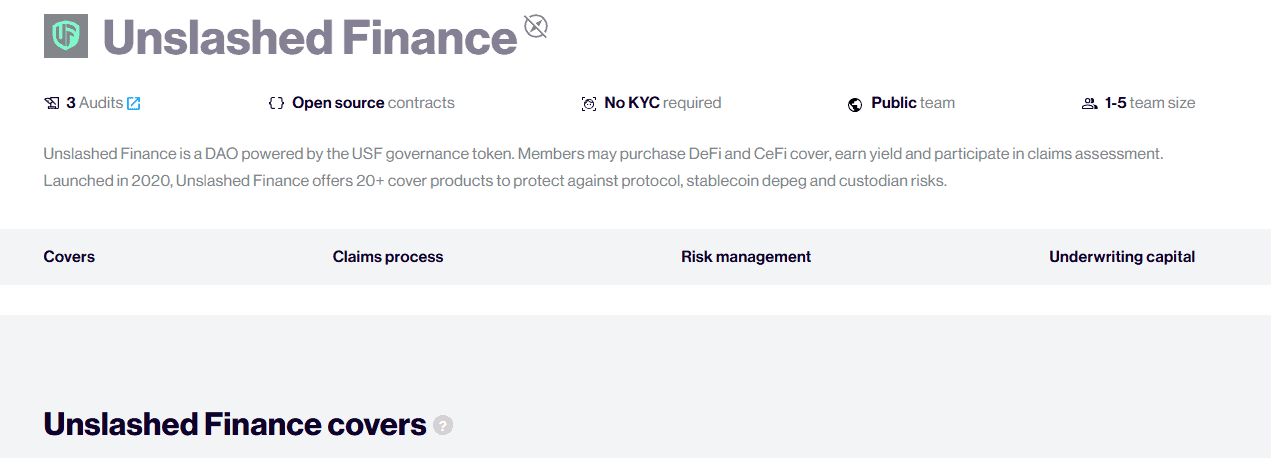
Its slashing cover was particularly relevant for stakers and staking-service users who were exposed to penalties not covered by standard custody insurance. Like other DeFi insurers, utility is based on the depth of the pool and the activity that is going on. Check if its products are active, what the limits are and the exact trigger conditions before buying (narrow definitions can affect whether a loss is paid).
Unslashed Finance Pros & Cons
| Pros | Cons |
|---|---|
| Covers validator slashing, which custody insurance often ignores | Active status and pool depth must be verified |
| Also covers exchange hacks and smart-contract failures | Narrow trigger definitions may block payouts |
| Capital providers earn premiums | Mainly Ethereum-focused |
| Relevant for stakers and staking services | Smaller capacity than institutional policies |
| Transparent on-chain model | Dependent on the USF token and liquidity providers |
10. Etherisc
Etherisc is a decentralized insurance platform for parametric products. Payouts are triggered automatically by verifiable data, without a claims investigation. It is known for its work on flight delay and crop insurance projects in emerging markets and offers a framework for creating blockchain-based insurance products with licensed risk partners.
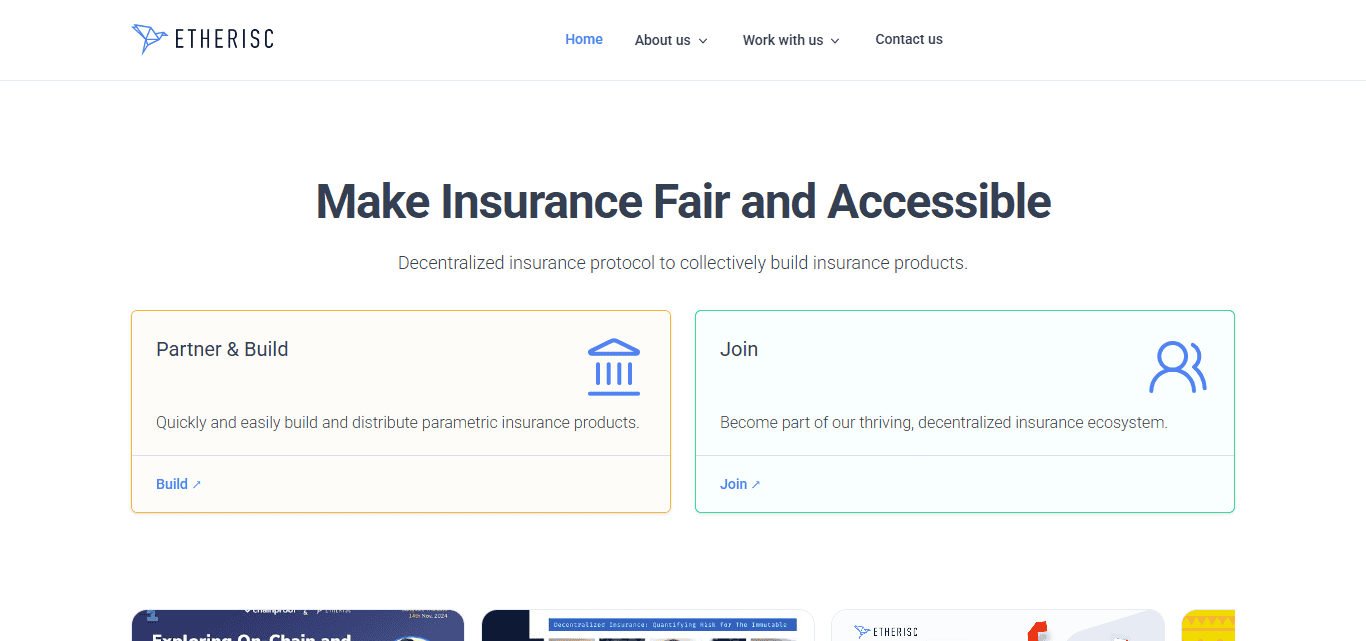
This speed and transparency is its main strength, and it’s less an alternative to Coincover for directly stealing wallets, and more a platform for event-based protection. It suits developers, insurers and communities who want automated, low friction cover. Check which products are live and whether they are in line with your risk for crypto asset protection in particular.
Etherisc Pros & Cons
| Pros | Cons |
|---|---|
| Automatic parametric payouts based on verifiable data | Not a direct wallet-theft alternative to Coincover |
| Fast, transparent, low-friction claims | Fewer products aimed at crypto asset protection |
| Known for flight delay and crop insurance | Parametric triggers may not match your actual loss |
| Framework for building new insurance products | Relies on reliable data sources (oracles) |
| Useful in emerging markets | Products and activity must be checked for current availability |
Why Should You Consider Alternatives to Coincover?
Different coverage needs Coincover is focused on wallet protection and recovery. Some users require cover for stablecoin depeg, custody theft, smart-contract or validator slashing protection, which other providers specialize in.
Higher limits for institutions: Exchanges, funds and miners often want large policy limits and formal wordings. This is what insurers such as Evertas, Relm Insurance and Breach Insurance are built for.
Combined custody and insurance: Some companies prefer to have just one vendor for security and insurance, making BitGo or Cobo more appealing.
DeFi-native protection: People and DAOs may want on-chain, community-governed cover like Nexus Mutual, OpenCover, InsurAce or Unslashed Finance.
Pricing and flexibility: Premiums, fees and underwriting terms vary widely, so shopping around can get you better terms or lower costs.
Claims experience: Depending on how users want losses to be treated, they may prefer the traditional adjuster-based claims, member voting, or automatic parametric payouts like Etherisc offers.
Risk Diversification: If you only have one vendor, then you have one point of failure. Protection in multiple layers reduces exposure.
Regional and regulatory fit: Some providers have a stronger presence in certain markets, e.g. Cobo in Asia or Relm in Bermuda, which is important for compliance.
Conclusion
Summary The best Coincover Alternatives for Asset Insurance depend on what you hold and the level of risk you face. Institutions may prefer Evertas, Relm or Breach, while BitGo and Cobo offer custody and insurance in a package.
DeFi users can try Nexus Mutual, OpenCover, InsurAce, Unslashed Finance or Etherisc. Check the current status, limits and exclusions before you buy.
FAQ
Which alternative is best for institutions?
Evertas, Relm Insurance and Breach Insurance offer regulated, underwriter-backed policies suited to exchanges, funds and large crypto businesses.
Can custody insurance replace separate cover?
BitGo and Cobo bundle insurance with custody, but it covers specific events only, so verify limits and exclusions carefully.
Are DeFi insurance claims guaranteed to be paid?
No. Nexus Mutual payouts are discretionary and member-voted, so they are not guaranteed like traditional contractual insurance rights.
Which option suits individual DeFi users?
Nexus Mutual, OpenCover and InsurAce provide on-chain protection for smart-contract failures, exchange hacks and stablecoin depegs.