
In this article, I will talk about the Best E-commerce Automation Tools that assist online businesses in streamlining their processes, minimizing repetitive actions, and enhancing productivity.
These tools automate critical functions such as order processing, marketing, customer service, inventory management, and shipping.
The right automation tools help e-commerce store owners save time, reduce mistakes, improve customer experience, and grow their businesses in the highly competitive digital marketplace.
Key Points & Best E-commerce Automation Tools
| Tool | Key Point |
|---|---|
| ShipEak | Streamlines shipping operations with automated order fulfillment and tracking. |
| NetSuite | Comprehensive ERP solution integrating inventory, finance, and customer management. |
| Klaviyo | Advanced email and SMS automation for personalized marketing campaigns. |
| Zapier | Connects multiple apps to automate workflows without coding. |
| Brightpearl | Retail operations platform offering inventory, accounting, and order management automation. |
| Omnisend | Omnichannel marketing automation across email, SMS, and push notifications. |
| Recharge | Subscription management tool for recurring billing and customer retention. |
| Hootsuite | Social media automation for scheduling posts and tracking engagement. |
| ShipBob | Third-party logistics automation with warehousing and fast delivery services. |
| Tidio | AI-powered live chat automation to improve customer support and engagement. |
10 Best E-commerce Automation Tools
1. ShipEak
As an e-commerce automation tool, ShipEak helps with order fulfillment and managing shipping intricacies.
ShipEak integrates with several e-commerce platforms and helps merchants automate the creation of shipping labels, updates to tracking, and management of inventory.
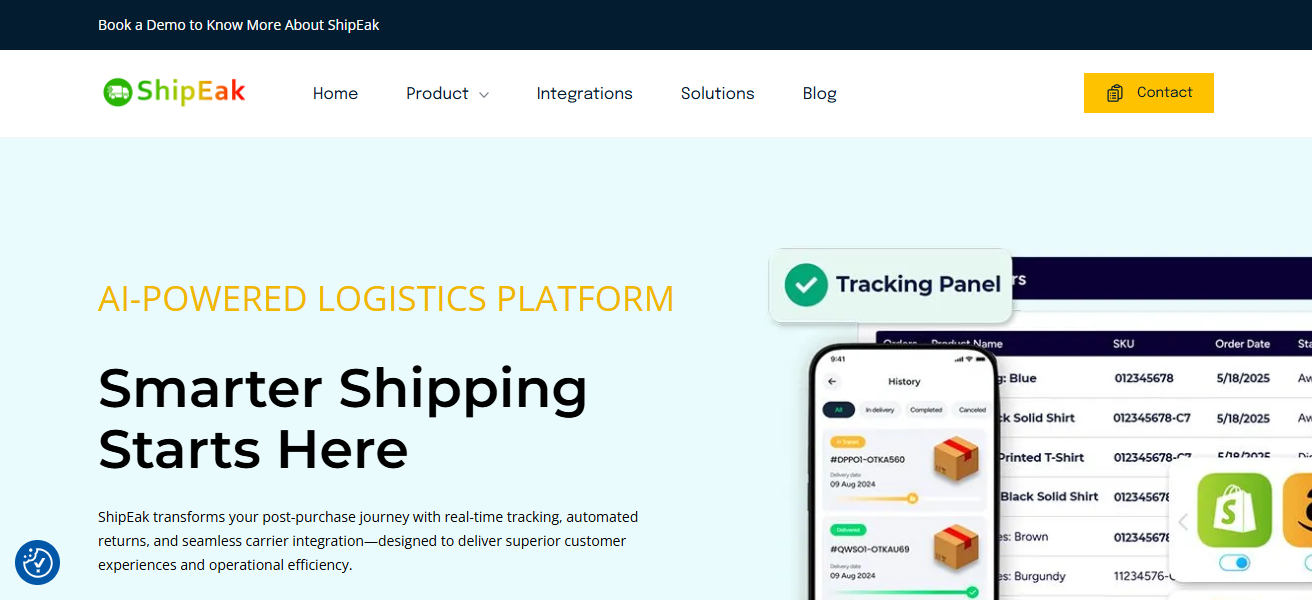
By optimizing logistics, ShipEak minimizes manual mistakes and improves delivery times. Additionally, ShipEak provides analytics to monitor and evaluate business shipping performance and costs.
This is ideal for online shops of any size, as it streamlines order management and leads to more time-efficient processes and happier customers.
ShipEak – Features
- Automated Shipping Management: Creates shipping labels and tracking information without any manual intervention, and decreases the chance of any errors.
- Order Workflow Automation: Automates fulfillment tasks for orders in the system and stores.
- Inventory Updates: Prevents overselling by ensuring that inventory is synced and updated across different channels.
- Shipping Analytics: Analyzes and consolidates data on delivery time, carrier performance, and shipping cost.
| Pros | Cons |
|---|---|
| Automates shipping labels, tracking, and order fulfillment | Limited advanced marketing or CRM features |
| Reduces manual errors in logistics operations | May require integration setup for complex stores |
| Provides shipping cost and performance analytics | Less suitable for non-physical product businesses |
| Saves time by streamlining order processing | Customization options may be limited |
2. NetSuite
NetSuite is an all-in-one ERP system that runs on the cloud and helps e-commerce businesses automate key processes like inventory and order management and financial automation.
Businesses can view sales analytics, customer insights, and other key performance metrics through NetSuite’s real-time dashboards.
NetSuite helps reduce manual work and mistakes by integrating with online stores and marketplaces.
NetSuite also automates procurement, billing, and CRM. For e-commerce companies, NetSuite streamlines workflows, improves operational efficiency, and simplifies decision-making.
NetSuite – Features
- Cloud ERP System: Combines and connects financials, inventory, and e-commerce functions.
- Real-Time Dashboards: Displays insight on sales and overall performance of the business instantaneously.
- Order & Inventory Automation: Automation of order routing and fulfillment process, as well as stock assignment.
- CRM Integration: In tandem with e-commerce, manages and integrates customer information, leads, and support.
| Pros | Cons |
|---|---|
| Complete ERP solution for e-commerce operations | High cost for small or new businesses |
| Real-time dashboards and business insights | Requires training to use efficiently |
| Automates accounting, inventory, and order management | Implementation can be time-consuming |
| Scales easily with growing businesses | Overkill for simple e-commerce needs |
3. Klaviyo
Klaviyo constructs automated marketing solutions for e-commerce platforms. It specializes in managing emails and text messages.
It gathers user information from online stores and shopping carts to organize customers into defined groups for specific promotions.
Its automated marketing features include reminders for abandoned carts, messages after purchases are made, and strategies to re-engage customers.
It offers detailed information about customer interaction, generated sales, and return on investment.
It integrates user data and marketing automation to improve customer engagement and increase sales, all while minimizing the effort required from the online retailers.
Klaviyo – Features
- Email & SMS Campaigns: Automates customer interactions by using triggers to make responsive campaigns.
- Customer Segmentation: Divides customers into various categories based on actions, purchases, and responses.
- Abandoned Cart Automations: Recaptures sales by sending reminders for items that customers did not check out.
- Performance Metrics: Reports the performance of campaigns with respect to revenue, opens, clicks, and ROI.
| Pros | Cons |
|---|---|
| Powerful email and SMS automation for e-commerce | Pricing increases with large contact lists |
| Advanced customer segmentation and personalization | Limited use outside marketing automation |
| Effective abandoned cart and retention workflows | Requires strategy to maximize ROI |
| Detailed campaign analytics and reporting | Initial setup may feel complex |
4. Zapier
Zapier is an innovative automation solution that allows users to connect various applications and e-commerce platforms without the need to write code.
Users can create unique automations which Zapier describes as “Zaps”. These “Zaps” can complete monotonous tasks such as transferring orders into spreadsheets, sending messages, and updating records in a CRM.
With hundreds of integrations, Zapier enhances workflow automation across email platforms and marketing, sales, and inventory software.
By minimizing the number of manual tasks, Zapier allows users to focus on more critical activities. E-commerce businesses can enhance their operational speed, improve app automation, and scale the flexibility of their workflows.
Zapier – Features
- App Integrations: Links various applications using no-code with numerous applications.
- Automated Workflows: Sets up “Zaps” to carry out tasks in various apps.
- Task Scheduling: Acts according to triggers (like new orders or emails).
- Error Handling & Logs: Provides help for analysis with logs and history.
| Pros | Cons |
|---|---|
| Connects hundreds of apps without coding | Complex workflows may require paid plans |
| Saves time by automating repetitive tasks | Not built specifically for e-commerce |
| Highly flexible and customizable automations | Errors can occur if integrations change |
| Improves cross-platform workflow efficiency | Limited control over advanced logic |
5. Brightpearl
Brightpearl is a comprehensive retail and e-commerce automation solution that streamlines the integration of order management, accounting, and inventory.
It automates order routing, shipping, stock updates, and even the generation of financial reports. Brightpearl also offers seamless integrations with various sales channels, carriers, and marketplaces.
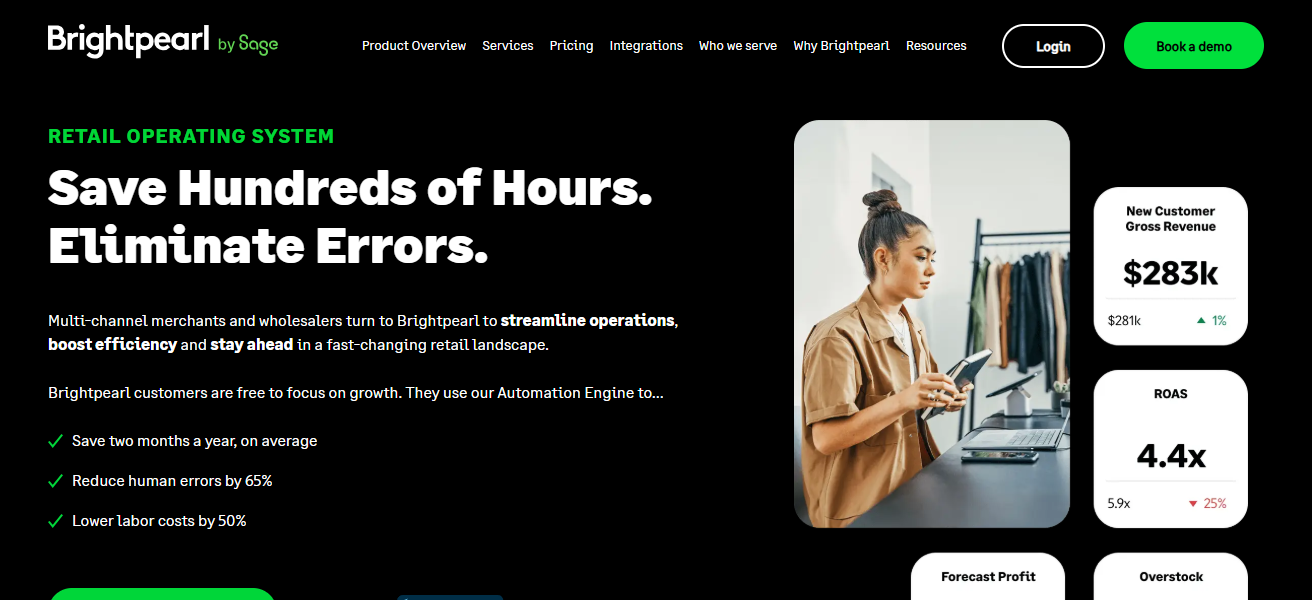
Its dashboards display real-time data to track revenue, sales, and inventory. With fewer manual processes, e-commerce businesses can use Brightpearl to scale efficiently, streamlining inventory management and enhancing the customer experience.
Brightpearl – Features
- Centralized Order Management: Handles orders from various sources in one platform.
- Inventory Control: Stock updates and distribution is automated.
- Accounting Automation: Manages financial records without manual input.
- Multi-Channel Selling: Data is synced between various sellers and stores.
| Pros | Cons |
|---|---|
| Centralized inventory, orders, and accounting | Higher pricing for smaller retailers |
| Excellent for multi-channel selling | Interface may feel overwhelming initially |
| Real-time stock and financial visibility | Limited customization in some areas |
| Reduces manual retail operations | Requires onboarding for full use |
6. Omnisend
Omnisend is an e-commerce marketing automation tool focused on email marketing, SMS, and push notifications. Users can automate customer workflows for abandoned carts, recommend products, and for follow-ups after purchases.
Engagement and conversion rate optimization are achieved through the use of built templates, strategic customer segmentation, and behavior-based marketing triggers.

Performance of email and SMS marketing campaigns can be tracked on Omnisend and analyzed for return on investment.
Omnisend connects to major e-commerce platforms, allowing marketers to manage multiple channels with a single marketing tool, automate repetitive tasks, and improve customer retention through strategic marketing communication.
Omnisend – Features
- Email, SMS & Push Automation: Delivers messages to users through different channels.
- Pre-Built Workflows: Templates for use with cart abandonment and other tasks.
- Customer Segmentation: Messaging is personalized and based on actions.
- Analytics Dashboard: Monitors campaign success and tracking revenue.
| Pros | Cons |
|---|---|
| Strong omnichannel automation (email, SMS, push) | SMS features may add extra cost |
| Easy-to-use templates and workflows | Less advanced CRM capabilities |
| Improves engagement and conversion rates | Limited design customization |
| Behavior-based campaign automation | Not ideal for non-ecommerce businesses |
7. Recharge
Recharge is a subscription management and recurring billing platform designed for e-commerce merchants. Recharge automates and manages subscription processes including recurring payments, customer communications, and retrying failed payments.
Recharge also integrates with leading e-commerce platforms and offers a variety of payment processors. Recharge enables its clients to efficiently scale their subscription business, reduce churn, and improve retention.
Recharge’s automated analytics offer insights into subscribers, revenue, and products. By simplifying recurring billing, Recharge also removes unnecessary admin work to give merchants more time to focus on growth.
Recharge – Features
- Subscription Billing: Automates payment cycles and re-billing.
- Dunning & Payment Recovery: Handles lost payments for lower churn.
- Customer Portal: Subscribers can control their plans and other specifics.
- Revenue Reporting: Offers analytics on recurring revenue and trends in subscribers.
| Pros | Cons |
|---|---|
| Excellent subscription and recurring billing automation | Primarily focused on subscription businesses |
| Reduces churn with automated payment retries | Limited flexibility for one-time sales |
| Detailed subscriber and revenue analytics | Setup can be technical |
| Improves customer retention | Pricing may be high for startups |
8. Hootsuite
Hootsuite is an excellent platform for social media management and automation for e-commerce businesses looking to grow their digital footprint.
Besides allowing users to schedule and post to multiple social media channels at the same time, Hootsuite also saves time and keeps branding consistent.

Also, Hootsuite tracks and analyzes mentions on social channels, and keeps users apprised of their social engagement. Automated reporting drives audience behavior understanding and optimization of campaigns.
Hootsuite social management combined with e-commerce marketing strategies increases brand visibility, improves customer engagement, and propels meaningful traffic and sales through data-driven insights.
Hootsuite – Features
- Social Scheduling: Automated posting of content across social media platforms.
- Engagement Monitoring: Comprehensive tracking of mentions, messages, and comments from a single dashboard.
- Performance Analytics: Reports on audience engagement, reach, and growth.
- Team Collaboration: Supports multiple users managing social accounts.
| Pros | Cons |
|---|---|
| Automates social media scheduling and posting | Advanced features require paid plans |
| Supports multiple social platforms | Limited direct sales automation |
| Provides performance analytics and reporting | Interface can feel complex |
| Saves time managing social presence | Not e-commerce specific |
9. ShipBob
ShipBob automates logistics and order fulfillment for e-commerce. It covers the entire order cycle: storage, order picking, and order shipping. Connecting with various online retailers, ShipBob automates inventory management, order tracking, and shipping emails.
Its network of fulfillment centers provides quicker and cheaper shipping. The platform also provides analytics on fulfillment, inventory, and shipping performance.
Using ShipBob, e-commerce companies streamline their logistics, improve shipping accuracy, and shift their focus to promotion and business expansion, leaving the hassle of shipping processes to ShipBob.
ShipBob – Features
- Fulfillment Network: Faster deliveries through distributed warehouses.
- Order Syncing: Automatic order updates from connected stores and marketplaces.
- Inventory Tracking: Availability of real-time stock updates.
- Shipping Notifications: Updates to customers, from fulfillment to delivery, are provided.
| Pros | Cons |
|---|---|
| End-to-end fulfillment and warehousing solution | Less control over fulfillment processes |
| Faster delivery through distributed warehouses | Storage and fulfillment costs can add up |
| Automated inventory and order tracking | Best suited for high-volume sellers |
| Reduces logistics management workload | Limited customization options |
10. Tidio
Tidio is an e-commerce solution that incorporates artificial intelligence in automating customer support and live chat. It intelligently combines email automation, live chat, and chatbots, so that customer inquiries can be answered in real-time.
FAQs, tracking orders, and product recommendations are personal to the customer. It is also improves engagement and response times. It integrates with all critical e-commerce platforms and CRMs to provide support in all possible channels.
Automated chat workflows improve customer experiences and reduce the volume of support that is needed. Using Tidio, online businesses can improve customer satisfaction, increase conversions, and provide support at all hours with no manual work.
Tidio – Features
- AI Chatbots: Resolves frequently asked questions without human intervention.
- Live Chat Interface: Team members can interact with customers and visitors live.
- Automated Responses: Provides customers with immediate responses on FAQs, order statuses, shipping updates, etc.
- CRM Integration: Chats and customer information are linked with other systems.
| Pros | Cons |
|---|---|
| AI-powered chatbots for 24/7 customer support | Advanced automation requires paid plans |
| Improves response time and customer engagement | Chatbot customization can be limited |
| Easy integration with e-commerce platforms | Less effective for complex support issues |
| Helps increase conversions through instant replies | Analytics features are basic |
How To Choose Best E-commerce Automation Tools
Identify Needs: Specify automation. Shipping, marketing, and customer service are all possible options.
Check Integrations: Make sure the tool integrates with your store and other software.
Evaluate Scalability: It is best to choose tools that will allow you to grow your e-commerce.
Consider Budget: Determine the right tool based on needs and costs, and avoid overspending.
User Friendliness: Choose automation tools that are simple to use and learn.
Customer Support: Choose an automation tool with a dedicated customer support staff and FAQs.
Analytics & Reports: Choose automation tools that analyze your business and provide actionable suggestions.
Customization Options: Workflow automation tools that adapt to your business will provide the most benefit.
Security & Compliance: Verify the tool’s compliance with customer data protection laws and standards.
Trial Periods: Take advantage of free trial tools to determine whether you will use it.
Conclusion
To sum up, with the Best E-commerce Automation Tools, businesses can streamline processes, lessen the amount of work done manually, and boost overall productivity.
These tools assist with marketing, customer service, inventory, and shipping and automate essential processes while improving the customer experience.
By selecting the best automation tools, e-commerce companies can enhance their growth, reduce mistakes, and boost revenue while remaining relevant in a fast-paced online market.
FAQ
Software that automates tasks like marketing, fulfillment, customer support, and inventory management.
They save time, reduce errors, and improve business efficiency and customer experience.
Tools like ShipEak and ShipBob streamline shipping, tracking, and fulfillment processes.
Yes, tools like Klaviyo and Omnisend automate targeted email/SMS campaigns and boost sales.