In this article, I will cover the top enterprise billing infrastructure platforms that assist companies in managing subscriptions, automating invoicing, and efficiently scaling revenue operations.
- Key Points & 10 Best Enterprise Billing Infrastructure Platforms
- 10 Best Enterprise Billing Infrastructure Platforms
- 1. Zuora
- 2. Stripe Billing
- 3. Chargebee
- 4. Aria Systems (Aria Billing Cloud)
- 5. BillingPlatform
- 6. Recurly
- 7. Paddle
- 8. Orb
- 9. Maxio
- 10. Lago
- How To Choose Best Enterprise Billing Infrastructure Platforms
- Cocnlsuion
- FAQ
These platforms provide businesses the ability to manage complicated billing, increase precision, and drive expansion in today’s fast-paced digital and subscription-driven economy.
From adaptable pricing structures to global compliance and real-time analytics, businesses will improve their billing processes.
Key Points & 10 Best Enterprise Billing Infrastructure Platforms
- Zuora – Zuora provides comprehensive subscription billing, revenue recognition, and analytics for complex enterprise monetization models globally.
- Stripe Billing – Stripe Billing offers flexible APIs, usage-based pricing, invoicing, and seamless integration for scaling SaaS businesses.
- Chargebee – Chargebee simplifies subscription management with automated billing, compliance, revenue recognition, and integrations for fast-growing companies.
- Aria Systems – Aria Systems delivers cloud billing supporting complex pricing, usage rating, and enterprise subscription management needs.
- BillingPlatform – BillingPlatform provides configurable billing, rating, invoicing, and revenue management solutions for enterprises evolving monetization strategies.
- Recurly – Recurly enables subscription billing, churn management, dunning, and analytics to optimize revenue growth for businesses.
- Paddle – Paddle as merchant of record, handling payments, taxes, compliance, and billing for SaaS companies globally.
- Orb – Orb focuses on usage-based billing, real-time metering, and developer-friendly APIs for data-driven pricing infrastructure systems.
- Maxio – Maxio combines billing, payments, analytics, and metrics to help B2B companies manage and grow revenue.
- Lago – Lago is open-source platform offering usage-based pricing, metering, and flexibility for engineering teams building solutions.
10 Best Enterprise Billing Infrastructure Platforms
1. Zuora
Zuora is a powerful platform for billing subscriptions on an enterprise scale and for complex global monetization models.
It includes hybrid pricing (subscription, usage, one-time) and multi-entity billing as well as full revenue recognition compliance like ASC 606.

Zuora assists large enterprises with hundreds of millions in recurring revenue and deep ERP and CRM billing integrations.
Billing compliances and global tax control also strengthen implementation as the average project length is 3-6 months and the average cost is $100,000 annually. It is optimal for enterprises with complex pricing structures and global reach.
| Pros | Cons |
|---|---|
| Handles complex subscription, hybrid, and usage-based billing models efficiently | High implementation time (often 3–6+ months) |
| Strong revenue recognition (ASC 606, IFRS 15 compliance) | Expensive (often $75K–$150K+ annually) |
| Global tax, multi-currency, and enterprise-grade scalability | Steep learning curve and complex UI |
| Advanced analytics and lifecycle management tools | Overkill for small or mid-sized businesses |
| Trusted by large global enterprises | Limited flexibility without heavy customization |
2. Stripe Billing
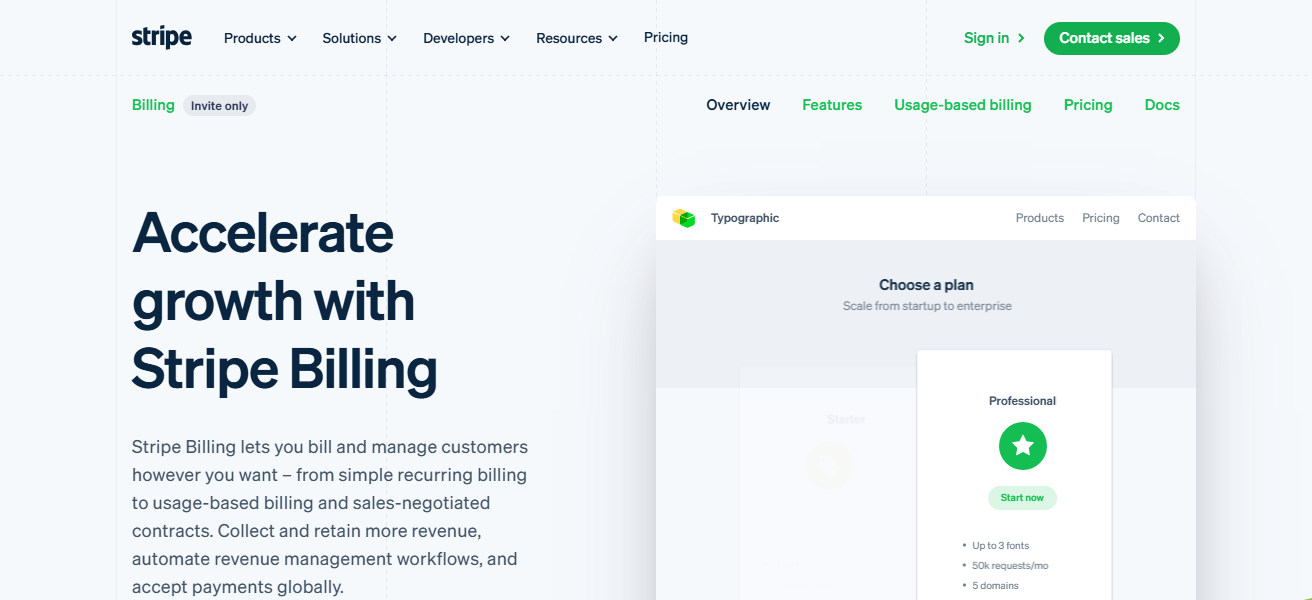
Stripe Billing is a platform that allows developers to build solutions on their platform using APIs for subscriptions, invoices, and usage-based pricing.
This platform is used by many startups and scaling SaaS companies. This is useful for developers due to its ease of integration and easy connection to Stripe Payments.
Stripe allows developers to create customized solutions by building specific billing workflow and automating proration, and handling payments to/from other countries.
What Stripe does not have is native advanced revenue recognition, and many times revenue recognition requires bolt-ons to meet enterprise compliance.
Also, their transaction-based pricing model is revenue neutral to start with, but on high volume usage, revenue becomes very costly
| Pros | Cons |
|---|---|
| Seamless integration with Stripe payments ecosystem | Can become costly at scale due to transaction fees |
| Excellent for startups and scaling SaaS companies | Weak support for highly complex enterprise billing |
| Flexible pricing models including usage-based billing | Requires add-ons for advanced reporting |
| Strong global payment support | DIY approach increases engineering effort |
3. Chargebee
Chargebee specializes in the management of subscriptions in SaaS and digital businesses. It’s strengths lie in automation for billing, invoicing and revenue operations as well as offering solid features to manage actionable pricing, dunning, and revenue recognition compliance.
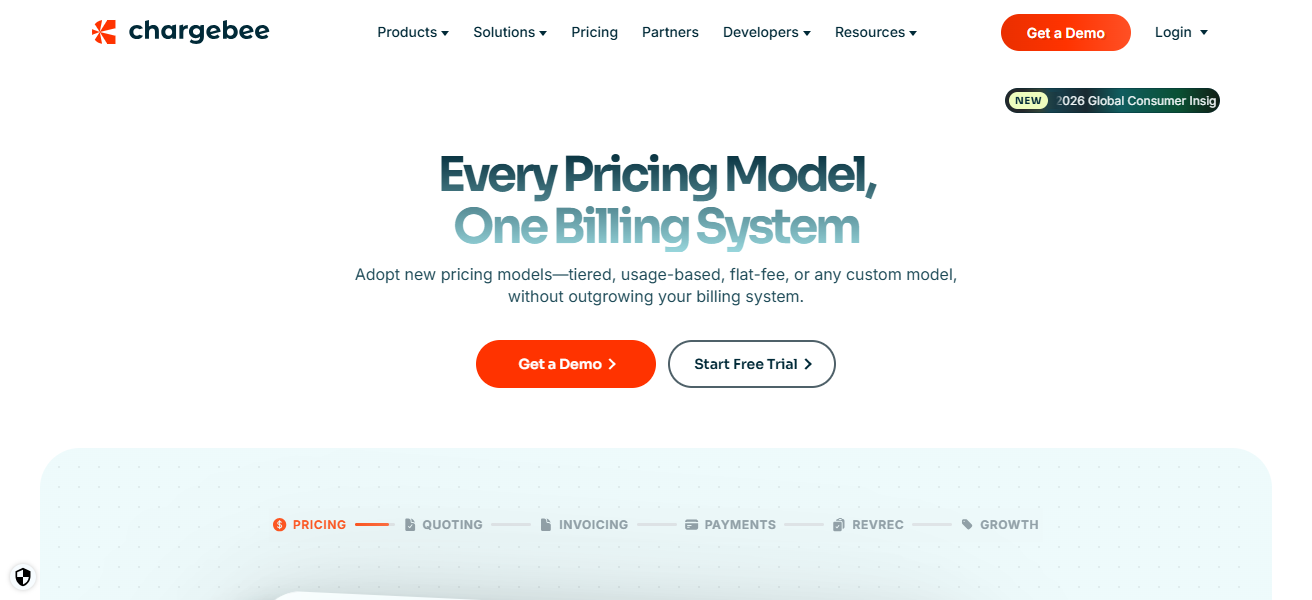
The platform has easy integrations with the majority of payment gateways including Stripe, and features global tax compliance and multi-currency billing.
In terms of flexibility and ease of use, automation for billing workflows up to 95%, Chargebee is the most preferred for mid-market businesses in 2025. It’s ideal for companies with recurring revenue models that are growing in complexity.
| Pros | Cons |
|---|---|
| Easy implementation and strong subscription management | Limited scalability for highly complex enterprise use cases |
| Built-in revenue recognition and tax compliance | Requires technical effort for advanced customization |
| Supports multi-currency and global billing | Can feel rigid with complex usage-based pricing (user feedback) |
| Self-service portals improve retention and reduce churn | Additional fees can scale with revenue growth (user concern) |
| Flexible pricing tiers including free entry level | Lacks advanced workflow automation for large enterprises |
4. Aria Systems (Aria Billing Cloud)
Aria Systems has developed a cloud-native billing platform specifically designed for enterprises with advanced monetization challenges.
The platform’s distinct features include usage-based billing, subscription lifecycle management, and real-time high-volume transaction rating.
Aria Billing Cloud assists billing scenarios that are extremely dynamic for telecom, media, and IoT industries.
The platform manages multi-currency, partner ecosystems, and global compliance. Given its configurability and scalability, the platform is designed for enterprises with millions of customers.
However, this billing platform demands more implementation work and technical effort than other more straightforward SaaS billing systems.
| Pros | Cons |
|---|---|
| Designed for high-volume enterprise billing and telecom-scale use | Not suitable for small or simple billing needs |
| Advanced usage-based billing and real-time rating | Requires significant technical expertise to implement |
| Strong integrations (Salesforce, ServiceNow) | Limited as a full-suite ERP replacement |
| High scalability and performance reliability | Complex setup and longer onboarding cycles |
| Recognized leader by Gartner, IDC, Omdia | Higher cost compared to mid-market tools |
5. BillingPlatform
BillingPlatform is built for enterprises with sophisticated and changing monetization strategies. The platform enables agile billing process customization, real-time transactional rating and invoicing, and dynamic revenue management.
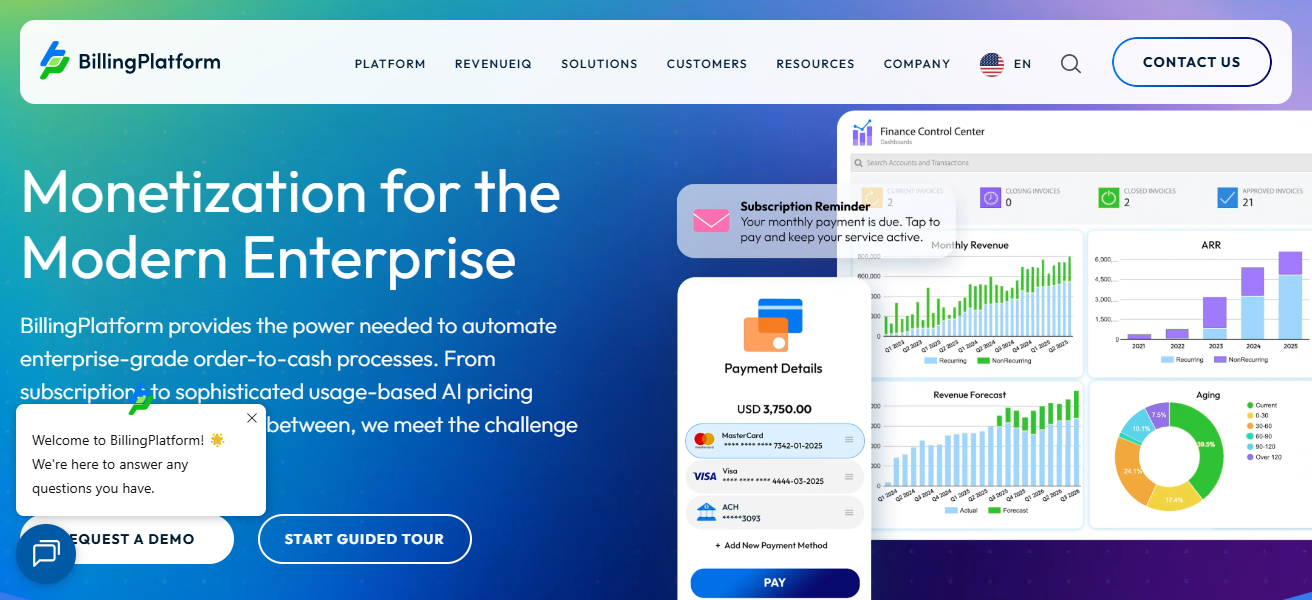
Unlike most enterprise platforms, BillingPlatform supports rapid hybrid billing model deployment. BillingPlatform’s customers consolidate their subscription, usage, and transactional billing into one platform.
BillingPlatform is noted for its flexibility and scalability, often compared to Zuora for large enterprises but offering faster implementations and more modern designs.
| Pros | Cons |
|---|---|
| Highly configurable billing workflows and pricing models | Heavy customization can increase maintenance costs |
| Supports hybrid billing (subscription + usage + transactional) | Longer implementation time for complex setups |
| Modern UI and flexible architecture | Requires skilled teams for optimization |
| Scales well for enterprise monetization strategies | Custom code may limit future upgrades |
| Competes directly with Zuora for enterprise use | Higher professional service costs |
6. Recurly
Recurly is a subscription billing service with strong strength in revenue recovery and churn reduction. It offers automated dunning that can recover up to 70% of missed payments, improving retention rates.
It also offers subscription lifecycle management, global payments, and revenue recognition compliance. Businesses that retain customers and implement quickly will benefit.

While it manages standard and moderately complex situations, it may lack the sophistication required for advanced customization
Especially for large enterprise contracts and complex pricing structures. This is why it is more common among mid-market SaaS businesses.
| Pros | Cons |
|---|---|
| Strong dunning and revenue recovery (up to ~70%) | Occasional payment gateway issues reported |
| Easy to implement compared to enterprise tools | Less flexible for highly complex pricing models |
| Good subscription lifecycle management | Limited enterprise-grade customization |
| Supports global payments and compliance | Integration issues at high scale reported by users |
| Suitable for mid-market SaaS companies | Not ideal for telecom-scale or advanced billing |
7. Paddle
As a Merchant of Record (MoR), Paddle takes care of payments, taxes, compliance, and billing for SaaS companies, allowing them to avoid handling global tax jurisdiction and liability issues.
Paddle snaps up most of the work which enables companies to open up most of the world for commerce for digital products.

Once integrated, Paddle begins to charge companies a tax per sale on a percentage basis, which put up on upon horizontal growth becomes a substantial amount.
Paddle is best for companies that thought of rapid cross-border commerce and compliance, without the work of complex billing systems to provide the necessary systems for cross-border commerce.
| Pros | Cons |
|---|---|
| Merchant of Record (handles taxes, compliance, payments) | Revenue share model (percentage fees) can be expensive |
| Simplifies global SaaS expansion (200+ regions) | Less control over payment infrastructure |
| No need to manage tax or legal entities | Limited customization compared to API-first tools |
| Fast setup and minimal engineering effort | Vendor dependency (lock-in risk) |
| Ideal for SaaS and digital products | Not suited for complex enterprise billing logic |
8. Orb
Orb is a new billing infrastructure built for modern usage-based and event-driven pricing models. It facilitates real-time event data monitoring and billing logic, as well as pricing simulation and event data raw billing.
Orb is a developer-first solution with APIs for extensive pricing structure creation without biilling system constraints. It is being adopted by data-driven SaaS companies with consumption-based pricing models.
Compared to billing legacy models, Orb prioritizes precision, transparency, scalability, and system focused on pricing dynamically with extensive usage threshold billing requiring rapid priced data control.
| Pros | Cons |
|---|---|
| Real-time usage-based billing and metering | Infrastructure-heavy setup (developer effort required) |
| Highly flexible pricing logic via APIs | Still evolving compared to legacy platforms |
| Built for modern data-driven SaaS models | Limited non-usage billing features |
| Strong transparency in billing data | Requires engineering expertise |
| Ideal for high-scale usage-based SaaS | Smaller ecosystem vs established tools |
9. Maxio
Maxio integrates subscription billing, revenue recognition, and SaaS metrics into an all-in-one financial operations platform.
Established from the merger of Chargify and SaaSOptics, it caters to B2B SaaS clients who need both billing and financial insights.
Maxio allows customers to see KPIs such as ARR, MRR, and churn in addition to offering ASC 606 and IFRS 15 compliance.
It is particularly beneficial to analytically inclined, billing-focused finance teams. Although it is very powerful, it can be difficult to set up, and is designed for mid-market and enterprise companies, not early-stage startups.
| Pros | Cons |
|---|---|
| Combines billing, analytics, and revenue recognition in one platform | Can feel complex and “heavy” for some teams (Reddit) |
| Strong SaaS metrics (ARR, MRR, churn tracking) | Less agile for rapid pricing experimentation |
| Good for B2B SaaS finance teams | Setup complexity higher than simpler tools |
| Supports compliance (ASC 606, IFRS 15) | Not ideal for early-stage startups |
| Reduces need for multiple tools | UI and workflows can feel rigid |
10. Lago
Lago is a new open-source billing platform that prioritizes flexibility and developer control. It supports usage-based and hybrid pricing models with full transparency, allowing teams to self-host and modify billing logic.
Lago is especially popular among companies looking to avoid expensive enterprise vendors, particularly for avoiding vendor lock-in. It integrates with payment providers, such as Stripe, but manages billing logic separately.
From 2025-2026, Lago will be widely adopted by engineering-driven teams for having scalable, customizable billing infrastructure without the constraints of a traditional SaaS billing system.
| Pros | Cons |
|---|---|
| Open-source and self-hosted (no vendor lock-in) | Requires engineering resources to manage |
| Highly flexible for usage-based and hybrid billing | Smaller ecosystem and fewer enterprise features |
| Cost-effective alternative to enterprise tools | Limited built-in support and services |
| Developer-friendly and customizable | Less mature compared to Zuora or Stripe |
| Growing popularity for modern SaaS teams | May lack advanced reporting and compliance tools |
How To Choose Best Enterprise Billing Infrastructure Platforms
Assess Scalability Select a platform that supports high volumes of transactions and potential future expansion without degradation of performance.
Assess Pricing Flexibility Ensure that the platform can accommodate subscription, usage, hybrid, and bespoke pricing models to support changing monetization strategy.
Assess Integration Make certain that the platform integrates with your CRM, ERP, payment processing, and analytics without any problems.
Ensure Global Reach Make certain to verify support for multi-currency, taxation, and compliance for localized international business operations.
Prioritize Automation Invoicing, revenue recognition, and collection automation reduces error potential and increases overall efficiency.
Cocnlsuion
In conclusion, the best enterprise billing infrastructure platforms empower businesses to manage complex pricing, automate billing processes, and ensure global compliance.
Solutions like Zuora, Stripe Billing, and Chargebee offer flexibility and scalability, helping organizations streamline revenue operations, reduce errors, and support sustainable growth in an increasingly digital, subscription-driven business landscape.
FAQ
They are software solutions that automate billing, invoicing, subscriptions, and revenue management for large-scale businesses.
Chargebee and Paddle are ideal for SaaS startups due to ease of integration and strong tax compliance.
SAP BRIM and Oracle NetSuite are best for complex, multinational enterprises needing deep ERP integration.
Paddle and Stripe Billing excel at handling multiple currencies, tax jurisdictions, and compliance globally.