
This article will identify the Best Forex Liquidity Aggregation Platforms for brokers and financial companies. Selecting a liquidity provider is important because it impacts a broker’s ability to offer tight spreads, fast execution, and reliable multi-asset trading.
We will analyze leading platforms that provide comprehensive liquidity, sophisticated solutions, and hassle-free integration to enhance operational efficiency for brokers and traders.
Key Points & Best Forex Liquidity Aggregation Platforms
| Platform | Key Point |
|---|---|
| B2Broker | Multi-asset liquidity with tight spreads |
| LMAX Global | Transparent exchange-style execution |
| Finalto | Strong institutional-grade liquidity |
| Advanced Markets | Direct market access with Tier-1 banks |
| Swissquote | Regulated Swiss banking liquidity |
| FXCM Pro | Retail and institutional liquidity solutions |
| Saxo Bank | Multi-asset liquidity with global reach |
| CitiFX | Tier-1 bank liquidity and execution |
| Gold-i | Liquidity management plugins and aggregation |
| X Open Hub | Liquidity for FX, indices, and crypto |
10 Best Forex Liquidity Aggregation Platforms
1. B2Broker
B2Broker is one of the top providers of multi-asset liquidity, including Forex, metals, indices, CFDs and crypto, ultra-deep, and multi-Prime-of-Prime Forex liquidity.
It consolidates its pricing based on the aggregation of Tier 1 banks, non-bank market makers, and other significant locations available to brokers and financial institutions through a FIX API or trading bridge.
With ultra-low latency execution and data center connections around the globe, B2Broker is optimized for competitive spread cost execution.
In addition, it offers turnkey solutions on brokerage tech, reporting, and back-office systems to streamline brokers’ speed to market and operational scaling while keeping best-execution in line.
B2Broker Features
- Multi-Asset Liquidity – Provides access to FX, metals, indices, CFDs, and crypto, which helps brokers offer a range of trading instruments.
- Prime-of-Prime Liquidity – Provides a single consolidated feed with better spreads, combining liquidity from Tier-1 banks, non-bank market makers, and primary venues.
- Low-Latency Execution – Enhanced infrastructure for quick trade execution via FIX API and trading bridges.
- Brokerage Technology Suite – Designed for effective and rapid scaling of brokerage operations, offering comprehensive back-office, reporting, and turnkey tools.
| Pros | Cons |
|---|---|
| Offers ultra-deep multi-asset liquidity including Forex, metals, CFDs, and crypto. | Primarily suited for brokers and institutional clients, not retail traders. |
| Aggregates pricing from Tier-1 banks and non-bank market makers. | Some advanced features may require technical expertise to integrate. |
| Provides low-latency execution via FIX API and trading bridges. | Initial setup may be complex for smaller firms. |
| Turnkey brokerage technology with reporting and back-office systems. | Costs can be higher compared to standard liquidity providers. |
| Global data center connectivity ensures fast and reliable execution. | Focused on professional-grade execution; may be overkill for small-scale brokers. |
2. LMAX Global
Since 2018, LMAX Global has been running institutional liquidity venues with a CLOB (central limit order book) model/) which offers transparent order matching along with tight spread for FX and metals.
While most liquidity providers include market-making, LMAX has exchange-style execution which means there is no last-look pricing.
This way brokers and professional traders are guaranteed a certain level of fill quality and pricing transparency.
LMAX has global reach with infrastructure across all major financial hubs which allows for ultra low-latency execution and direct access to institutional liquidity.
With their global reach, industry awards, and regulated infrastructure, LMAX is a popular and trusted partner for brokers looking for quality execution and liquidity.
LMAX Global Features
- Central Limit Order Book (CLOB) – Clear “last look” exchange-style execution, so there is no lack of pricing and the fills are predictable.
- Institutional Liquidity – FX and metals liquidity from bottomless pools of professional market makers.
- Global Infrastructure” – Execution in financial hubs for speedy low latency trading.
- Regulated & Award Winning – Fully regulated with firm execution tech, validated by the trust of institutional brokers.
| Pros | Cons |
|---|---|
| Exchange-style central limit order book (CLOB) with no “last look.” | Limited to FX and metals, fewer other asset classes. |
| Transparent pricing and predictable order execution. | Can be expensive for smaller brokers or low-volume traders. |
| Low-latency global infrastructure and direct market connections. | Requires understanding of institutional trading workflows. |
| Regulated framework with award-winning technology. | Limited customization for retail-oriented services. |
| Reliable liquidity for professional brokers and hedge funds. | Focused primarily on institutional clients. |
3. Finalto
Finalto offers innovative trading and execution solutions. Finalto has been awarded for its trading and execution solutions. Finalto has also been awarded for its technology stack.
Finalto integrates with Tier-1 banks, multi-asset non-bank market makers, ECNs, and liquidity. Finalto has also received pricing and liquidity awards.
Flexibility and technology integration on client’s margins are also awarded to Finalto. Finalto has also received awards for its risk management services. Finalto is also recognized for optimizing operational efficiency with the use of multi-assets.
Finalto Features
- Multi-Asset Execution – Offers liquidity in FX, CFDs, equities, and other instruments for a wider range of client offerings.
- Tier-1 Connectivity – Tiered pricing and less disparate spreads are offered through the liquidity aggregation of banks, ECNs, and non-bank market makers.
- Advanced Technology Stack – Available FIX API, MT4/MT5 integration, and single-margin account structures.
- Risk Management Tools – Quality of execution, spread management, and trading game efficiency optimizers.
| Pros | Cons |
|---|---|
| Multi-asset liquidity including FX, CFDs, equities, and more. | Integration may be challenging for smaller brokers. |
| Aggregates Tier-1 bank and ECN liquidity. | High minimum account requirements for institutional clients. |
| Supports FIX API, MT4/MT5, and single-margin accounts. | May be less flexible for boutique or niche trading strategies. |
| Advanced risk management and execution optimization tools. | Costs can be relatively high for startups. |
| Customizable liquidity feeds to optimize spreads and depth. | Primarily geared for professional or corporate clients. |
4. Advanced Markets
Advanced Markets is a prime-of-prime broker and provider of institutional-grade liquidity and depth for banks, hedge funds and brokerage firms in FX, metals, energies and CFDs.
Its liquidity comes from Tier-1 banks, ECNs and other non-bank liquidity sources, giving brokers reliable stream liquidity and hot prices via FIX API or other trading bridges.
Advanced Markets places a premium on scalable liquidity and solid execution, which makes it ideal for clients with high trading volumes or low latency trading strategies.
Advanced Markets also covers a rich variety of assets and clients via major data centers and execution hubs so that brokers can optimize on spread and throughput order routing for their clients.
Advanced Markets Features
- Institutional-Grade Liquidity – Deep FX, metals, energies, and CFD liquidity fit for banks, brokers, and hedge funds.
- Tier-1 Bank & ECN Access – Consistent pricing streams from multiple top-tier, high-quality liquidity providers.
- Scalable Execution – Infrastructure for high-frequency and other latency-sensitive trading tactics.
- Multi-Asset Support – Variety of instruments with excellent data center proximity for trade routing.
| Pros | Cons |
|---|---|
| Institutional-grade liquidity across FX, metals, energies, and CFDs. | Less widely known compared to top-tier global providers. |
| Deep liquidity with Tier-1 bank and ECN connections. | Focused mainly on high-volume trading; small brokers may find it costly. |
| Low-latency execution via FIX API and trading bridges. | Limited retail-facing services. |
| Scalable infrastructure for high-frequency trading. | Complexity of setup may require technical expertise. |
| Supports multi-asset trading and broad connectivity. | Some features may be overkill for smaller brokers. |
5. Swissquote
Swissquote provides institutional and corporate foreign exchange services in Switzerland. With the reliability and transparency of a regulated financial institution, Swissquote offers liquidity provision services.
Swissquote provides liquidity for major, minor, and exotic currency pairs and other financial instruments. Customers can directly connect to Swissquote’s pricing feeds via FIX API.
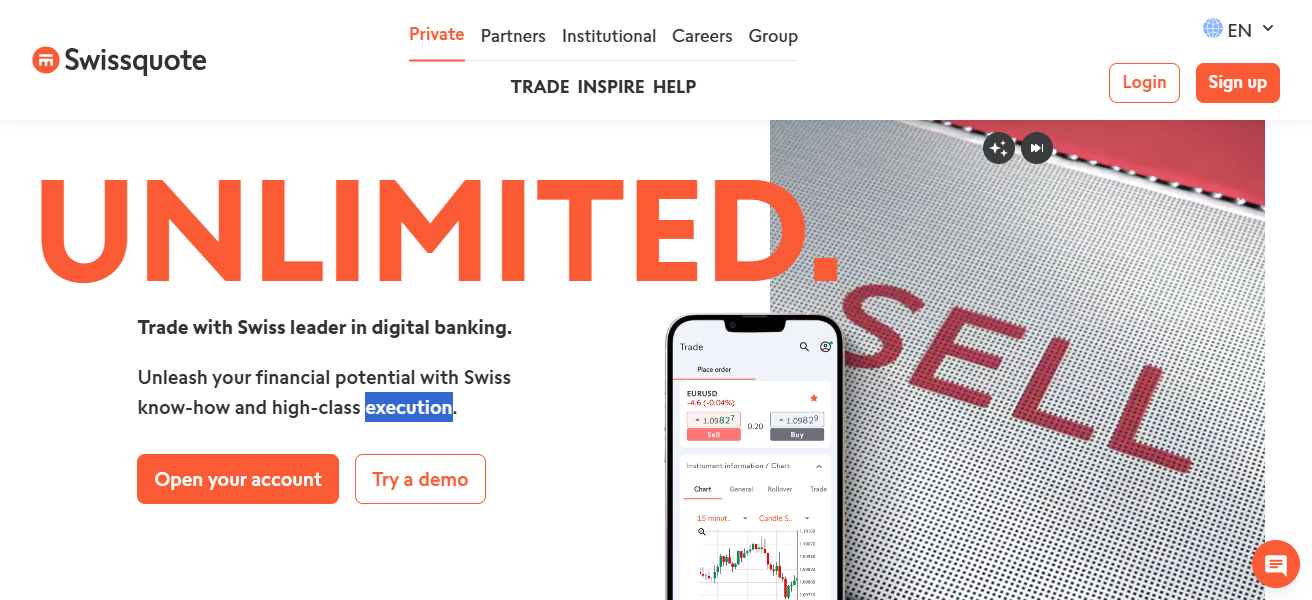
Swissquote’s institutional services are built on credibility, simplicity, and unlimited access to foreign exchange (FX) global markets.
This is due to Swissquote’s outstanding banking reputation and strong compliance with international banking regulations, making them a loyal business partner for companies that need dependable liquidity and risk control.
Swissquote Features
- Bank-Licensed Provider – Regulated and secure, offering trust and reliance to their institutional clients.
- Multi-Currency Liquidity – All majors, minors, and exotic pairs.
- FIX API Access – Direct connection for brokers and institutional partners.
- Stability & Risk Management – Seamless execution within high regulatory standards.
| Pros | Cons |
|---|---|
| Bank-licensed, highly regulated and secure. | Fewer advanced liquidity customization options compared to fintech providers. |
| Access to major, minor, and exotic currency pairs. | Focused more on institutional and corporate clients. |
| FIX API connectivity for brokers and partners. | May not offer the tightest spreads for low-volume traders. |
| Reliable, stable execution backed by a banking group. | Limited crypto and alternative asset coverage. |
| Strong regulatory compliance for risk-conscious institutions. | Less flexible than some fintech-based liquidity providers. |
6. FXCM Pro
FXCM Pro provides wholesale FX liquidity, prime brokerage services, and execution solutions to brokers, hedge funds, and banks from emerging market institutions.
As the institutional branch of FXCM, it utilizes its longstanding partnerships with Tier-1 liquidity providers to configure and optimize pricing and liquidity across all CFDs and major currency pairs.
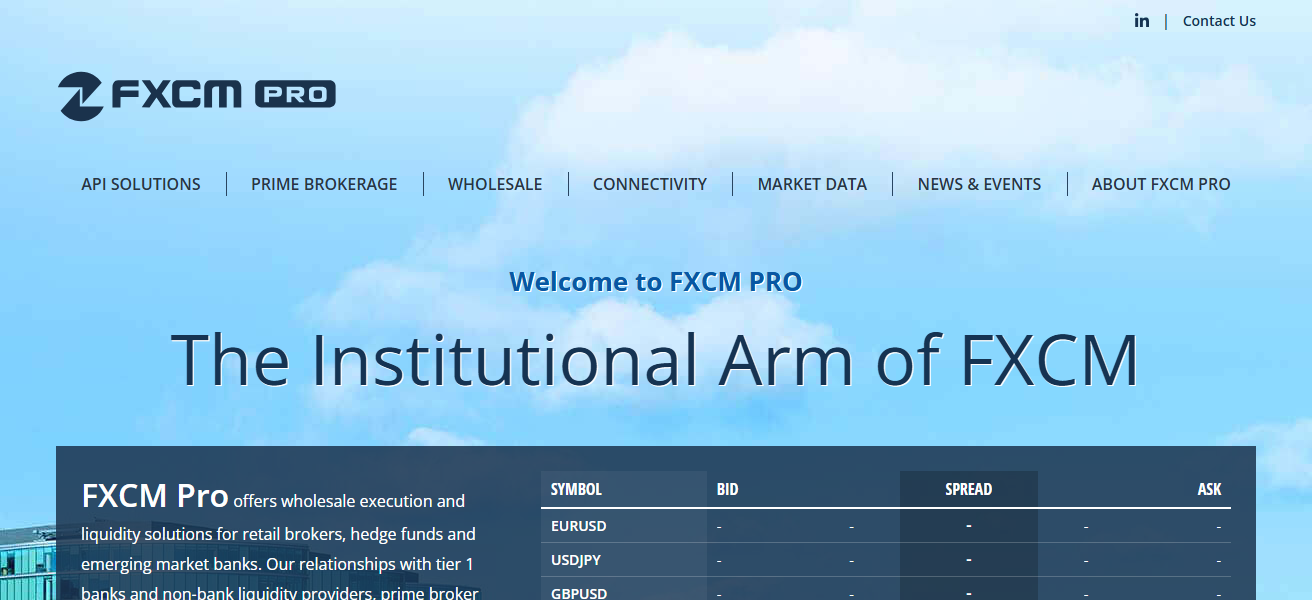
Clients receive the benefits of cross-collateralization on FX and CFD exposures, efficient netting, and via API and FIX connectivity, pool liquidity.
Pro’s institutional focus on sophisticated global execution infrastructure provides a uniquely scalable, enduring support to professional-grade liquidity and trading.
FXCM Pro Features
- Wholesale FX Liquidity – Aggregation of FX and CFD pricing from Tier-1 providers with competitive spread.
- Cross-Collateralization – FX and CFD exposure netting and margin optimization.
- FIX API Integration – Rapid and scalable connectivity for institutional clients.
- Global Execution Infrastructure – Providing professional grade liquidity with fast execution remains reliable.
| Pros | Cons |
|---|---|
| Aggregates FX and CFD liquidity from Tier-1 providers. | Primarily institutional; small brokers may face barriers. |
| Supports cross-collateralization and netting. | May have limited asset diversification compared to multi-asset aggregators. |
| FIX API connectivity with deep liquidity pools. | Setup and integration can be complex. |
| Scalable for high-volume trading. | Not a bank, so may lack some regulatory protections. |
| Institutional-grade execution quality. | May not provide extensive technology platforms beyond FX and CFDs. |
7. Saxo Bank
Saxo Bank is an example of a Danish investment bank which merges traditional banking with advanced trading and liquidity services for institutional clients.
Saxo provides banking services to institutional clients through its multi-asset execution platforms which provide access to foreign exchange and an array of financial instruments.
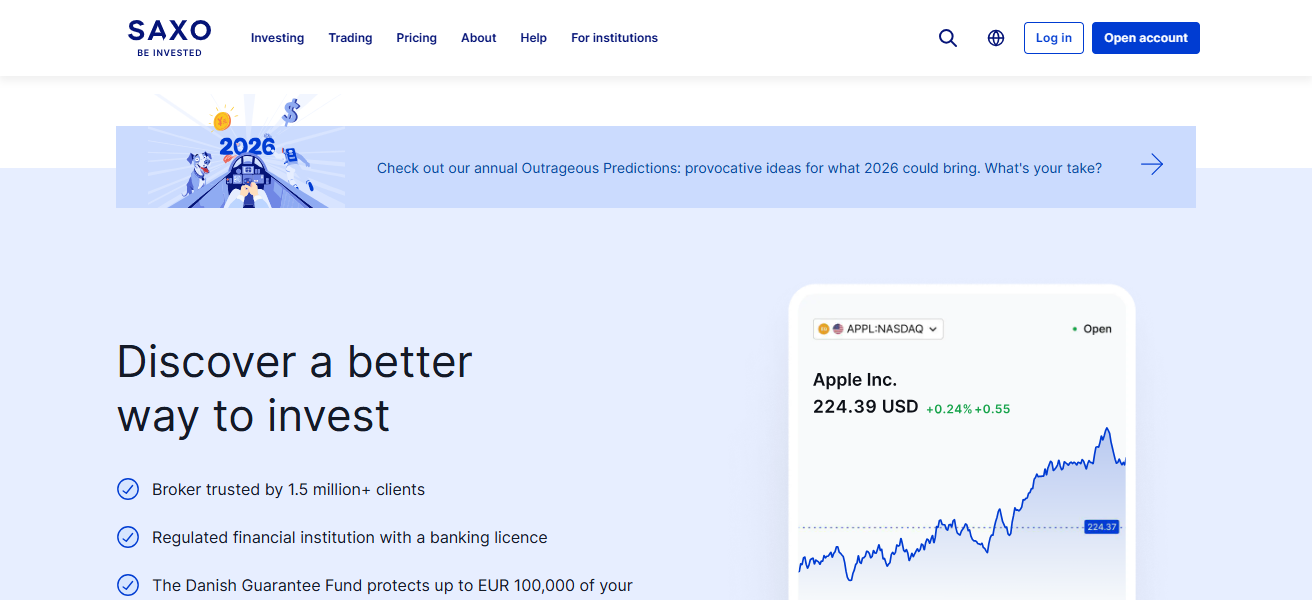
Saxo Bank sources its liquidity from global banking partners and internal risk management systems.
Saxo also provides a technology-driven ecosystem to brokers and multi-institution clients. Saxo is also a partner to many firms for liquidity since its regulatory standing is very strong.
Saxo Bank Features
- Multi-Asset Trading – Provides institutional clients with access to FX, equities, derivatives, and other instruments.
- Aggregated Pricing – Merges liquidity from banking partners and their own internal systems.
- Customizable Trading Environment – Brokers can customize their platforms to meet execution, risk, and reporting requirements.
- Regulated Banking Backing – Strong regulatory oversight ensures operational safety and compliance.
| Pros | Cons |
|---|---|
| Multi-asset liquidity including FX, equities, and derivatives. | Higher minimums and costs compared to smaller providers. |
| Regulated European bank with strong compliance. | Infrastructure may be complex for small brokers to integrate. |
| Technology-driven ecosystem with aggregated pricing. | Mainly serves institutional and high-net-worth clients. |
| Customizable trading environments for brokers. | Limited crypto and niche asset support. |
| Integrated risk management and banking services. | Overkill for smaller trading operations. |
8. CitiFX
CitiFX Pro was the online foreign exchange trading platform of Citibank, which provided API-based foreign exchange pricing and execution services to institutions.
The service was closed down in 2015 and moved to other service providers, but in the history of foreign exchange trading, supporting the institutional client’s first foreign exchange execution and liquidity services of a large international bank is noteworthy.
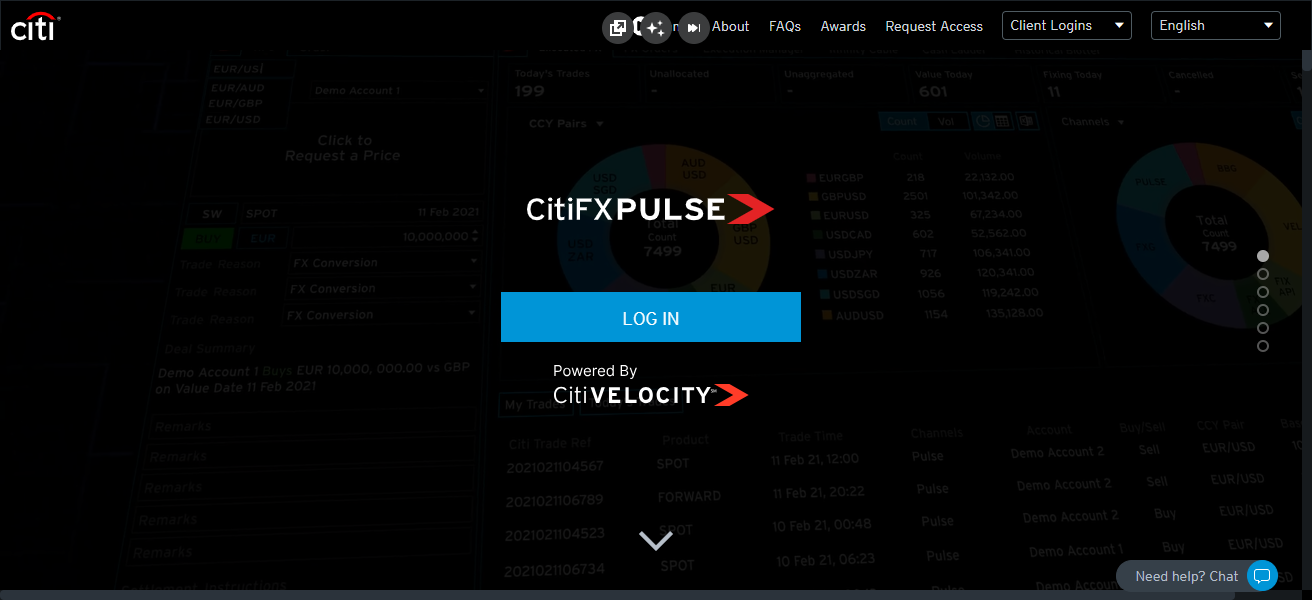
At its height, CitiFX Pro offered professional clients automated trading integration, comprehensive inter-bank pricing, and research sponsorship.
These services shaped the liquidity provisioning models of today that integrate automated execution, FIX API trading, and other institutional trading platforms.
CitiFX Pro Features
- API-Based FX Access – Facilitated direct institutional client trading with interbank pricing.
- Automated Execution – Offered seamless trade execution via FIX and other automated processes.
- Deep Liquidity Pools – Top tier bank pricing for major currency pairs.
- Professional Research & Support – Trading made easier with historical data and market analysis.
| Pros | Cons |
|---|---|
| Early institutional FX execution pioneer. | Platform discontinued in 2015. |
| Automated API connectivity and deep interbank pricing. | No longer available, historical reference only. |
| Strong research and execution quality. | Not usable for current liquidity aggregation. |
| Influenced modern FX liquidity architectures. | Only relevant for historical comparison. |
| High reliability and institutional-grade operations. | Legacy system, no active support. |
9. Gold-i
Gold-i builds technology for Fintech specifically in the fields of liquidity aggregation and distribution in multiple assets. Gold-i focuses on distribution and not on direct liquidity provisioning.
The flagship product of Gold-i is MatrixNET. This connects brokers to over 80 liquidity venues and brokers can aggregate and route pricing from different providers in FX and crypto.
Gold-i offers advanced smart routing, pricing optimization, and connections to MetaTrader for brokers so they can improve execution quality, market depth, and spreads.
Gold-i is not a source of liquidity, however, Gold-i provides technology for brokers to effectively manage and distribute liquidity that is aggregated from numerous sources and across multiple asset classes.
Gold-i Features
- Liquidity Aggregation Technology – Connects brokers to over 80 integrated brokers for FX and crypto markets.
- Smart Routing & Optimization – Achieves better depth of markets with tighter spreads.
- Platform Integration – Operates with MetaTrader and many other leading trading platforms.
- Distribution & Management Tools – Assists brokers in the effective distribution and management of liquidity across various venues.
| Pros | Cons |
|---|---|
| Technology-focused liquidity aggregation for 80+ venues. | Does not provide liquidity directly. |
| Smart routing and pricing optimization algorithms. | Brokers still need liquidity sources. |
| Connects to MetaTrader and other popular platforms. | May require technical expertise to implement. |
| Supports multi-asset liquidity aggregation. | Licensing costs may be significant for smaller firms. |
| Enhances spreads and execution quality by routing efficiently. | Complexity can be high for brokers without IT teams. |
10. X Open Hub
X Open Hub specializes in multi-asset and institutional partnership services, offering regulated deep liquidity across thousands of instruments, including forex, indices, commodities, equities, and cryptocurrencies.
As part of the XTB Group, it leverages superior technology and colocated data centers to provide low-latency execution and aggregated pricing through FIX APIs, MT4/MT5 bridges, and proprietary APIs.
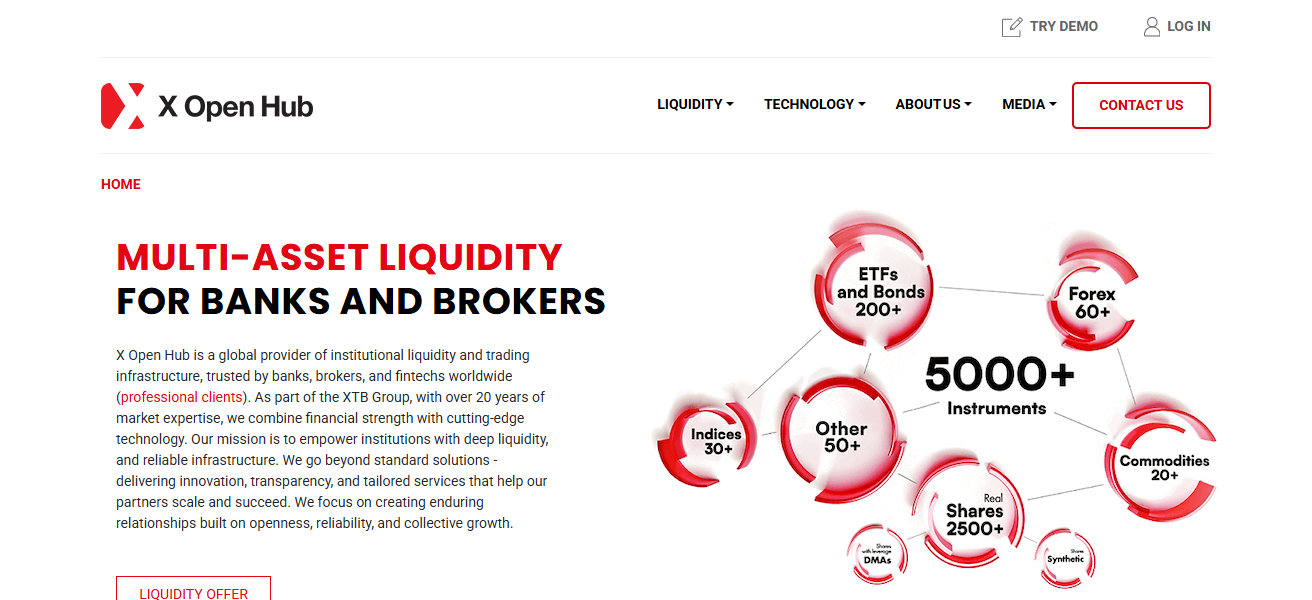
Due to extensive global liquidity connections and regulatory coverage, X Open Hub allows brokers and financial institutions to efficiently scale and diversify their product offerings.
X Open Hub is also an excellent fit for tech-savvy liquidity aggregators, given its transparent pricing and extensive coverage across instruments.
X Open Hub Features
- Multi-Asset Liquidity – Streaming FX, indices, commodities, equities, and crypto from multiple global providers.
- Low-Latency Execution – Infrastructure optimised for rapid trade execution, including colocation.
- Flexible API Connectivity – FIX, MT4/MT5 bridges and custom API support.
- Regulated & Transparent – Institutional-grade risk control with scalable and clear pricing.
| Pros | Cons |
|---|---|
| Multi-asset liquidity covering FX, indices, commodities, equities, and crypto. | May be less known compared to top-tier banks. |
| Low-latency execution via FIX, MT4/MT5, and proprietary APIs. | Some features may be unnecessary for smaller brokers. |
| Regulated and backed by XTB Group. | Integration can be complex for new brokers. |
| Broad connectivity to global liquidity sources. | Costs can be higher for low-volume clients. |
| Transparent pricing and scalable infrastructure. | Focused on tech-forward brokers; less suited for traditional retail. |
How To Choose Best Forex Liquidity Aggregation Platforms
Regulation – Make sure that the providers you choose are safe, licensed, and regulated.
Liquidity Depth – Look through the Tier 1 bank connections to find little spread and high liquidity.
Execution Speed – Low latency means fast and reliable execution. Look for that.
Multi-Asset Support – Your platform should have FX, CFDs, crypto, and more.
Technology Integration – Simple FIX API, MT4/MT5, and bridging should be in place.
Cost & Fees – Fees should be low and clear so that overall cost includes less trading expenses.
Risk Management – Look for margining, exposure control, and hedging tools.
Scalability – Look for growth support, high-frequency trading, and multiple account options.
Customer Support – Look for operational and setup support. They should be available 24/7.
Reputation – Look for a liquidity provider who most institutional brokers trust.
Conclusion
To sum up, Brokers and institutions looking for tight spreads, fast execution, and dependable access to multiple assets need to choose the Best Forex Liquidity Aggregation Platforms.
By taking into account regulation, depth of liquidity, tech integration, and quality of execution, traders can enhance performance and scale better.
A good platform provides competitive pricing, smooth trading, and better risk control which are crucial for success in the FX markets.
FAQ
It combines multiple liquidity sources to provide tight spreads and deep market access.
Brokers, banks, hedge funds, and institutional traders seeking efficient execution.
Deeper liquidity ensures faster execution and less slippage on trades.
Typically FX, CFDs, metals, indices, and sometimes crypto.