
This article will focus on the platforms that offer the best APIs for algorithmic trading. These platforms facilitate the automation of trading strategies, real-time market data retrieval, and trade execution.
With the best APIs, traders can create scalable systems and efficiently and reliably add data, optimize, and execute strategies for various asset classes.
Key Poinst & Platforms With The Best API for Algorithmic Trading
Alpaca Commission-free broker offering developer-friendly API, ideal for building automated trading strategies efficiently.
Interactive Brokers Global leader with robust API access, supporting diverse asset classes and international algorithmic traders.
Tradier Cloud-based brokerage providing flexible API, empowering developers and self-directed investors with automation tools.
TD Ameritrade Comprehensive API access enabling algorithmic trading, real-time data, and integration with advanced trading applications.
E*TRADE Offers API for equities and options trading, supporting algorithmic execution and portfolio management automation.
OANDA Forex-focused broker with reliable API, providing low-latency execution and extensive currency market data access.
IG Group Global broker offering API for forex and CFDs, enabling algorithmic strategies with strong reliability.
Saxo Bank Institutional-grade API access, supporting algorithmic trading across multiple asset classes with advanced functionality.
Zerodha Kite Connect Popular Indian broker API, enabling algorithmic trading with equities, derivatives, and real-time market data.
1Fyers API Indian brokerage offering developer-friendly API, supporting automation, backtesting, and seamless integration with trading systems.
10 Platforms With The Best API for Algorithmic Trading
1. Alpaca
Alpaca is a trading platform for developers and, most importantly, commission free. Its API is simple, fast, and can utilize Python for easy and quick algorithmic trading.
Developers can manage trading and market data in real-time. Users can use the paper trading feature to practice trading without the risk of losing real money.
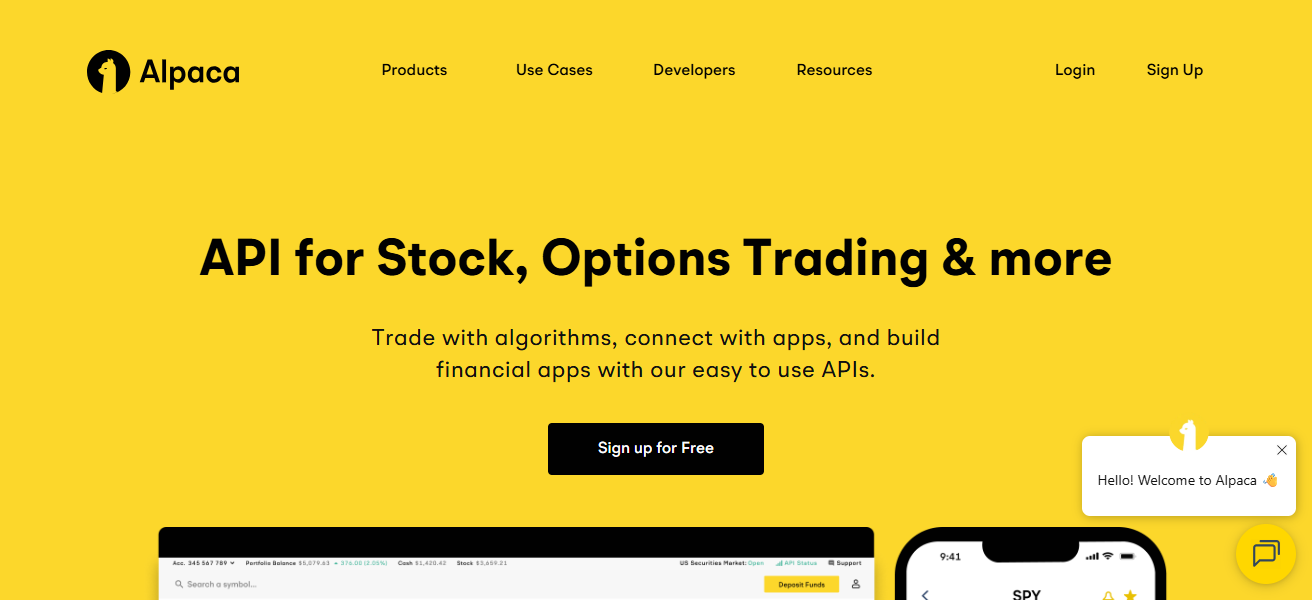
Additionally, their cloud-native infrastructure allows for ease of scaling and reliability. Low latency execution is possible through their REST API and their WebSocket API.
With great community support and documentation, it is no wonder why retail traders and startup trading system developers enjoy using it.
Alpaca Features
- Market data and integration with your own trading algorithm via API.
- Real-time market data and portfolio management via API.
- Low latency execution with REST and WebSocket API.
- Test your trading algorithms with paper trading.
| Pros | Cons |
|---|---|
| Commission-free trading ideal for cost-conscious developers. | Limited asset coverage compared to global brokers. |
| Lightweight API with Python integration. | Primarily focused on U.S. markets only. |
| Paper trading environment for safe testing. | Less suitable for institutional-grade strategies. |
| Strong community support and documentation. | Limited advanced order types. |
2. Interactive Brokers
Interactive Brokers provides one of the best APIs for algorithmic trading. Its Trader Workstation (TWS) API is available for Java, C++, and Python, among other languages.
It offers the ability to trade across global markets, including equities, options, futures, forex, and bonds. It supports both retail and institutional traders with advanced order types and risk management tools.
Interactive Brokers’ API provides clients with real-time and historical market data, as well as account management.
Professional algorithmic traders globally prefer Interactive Brokers for its reliability, low commissions, and extensive asset coverage.
Interactive Brokers Features
- Easy integration with various programming languages using API.
- Trade stocks, foreign exchange, futures, and bonds worldwide.
- Great order types and risk management.
- Great order types and risk management.
| Pros | Cons |
|---|---|
| Access to global markets across multiple asset classes. | Complex API setup for beginners. |
| Supports multiple programming languages. | Higher learning curve compared to simpler platforms. |
| Advanced order types and risk management tools. | Customer support can be less responsive. |
| Reliable infrastructure with low commissions. | Minimum account requirements may deter small traders. |
3. Tradier
Tradier is a cloud-based brokerage. It offers a flexible API for algo-trading and access to the equities and options markets.
It includes order management, account management, and data streaming services. Tradier API integrates easily with third-party trading platforms and custom software.
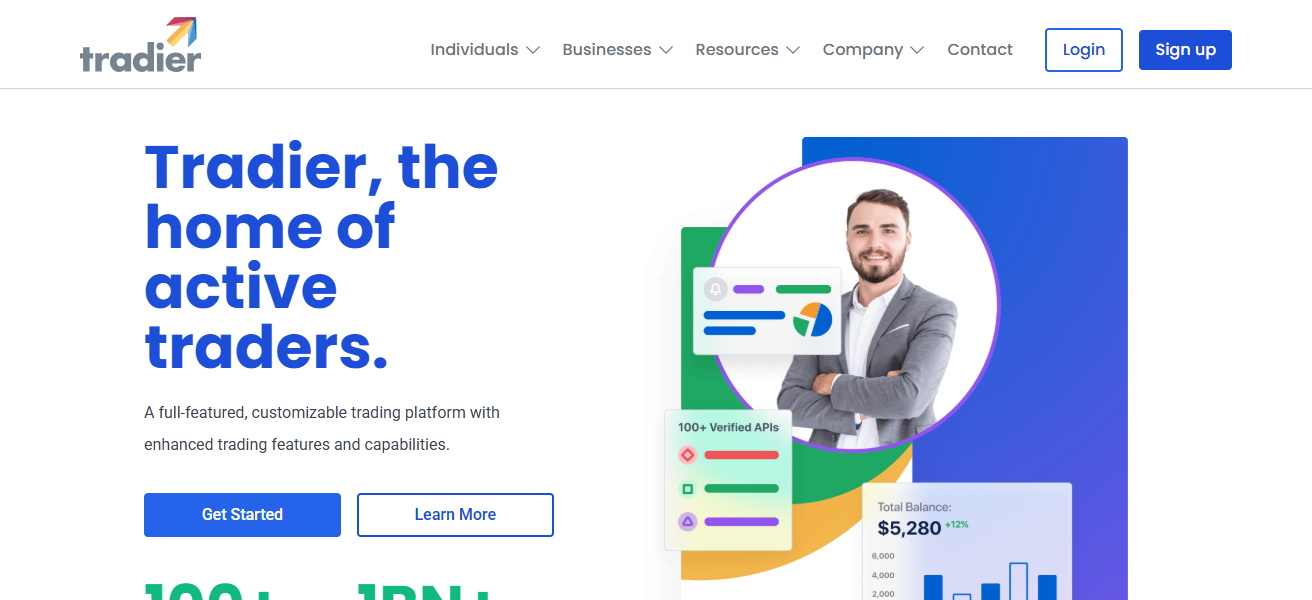
Developers are a RESTful framework for rapid automation strategy implementation. The API also offers fractional trading and competitive pricing.
Due to strong developer resources and partnerships, Tradier is able to provide traders with the tools to create flexible, automated, scalable trading systems.
Tradier Features
- Cloud-based brokerage with flexible API aimed at developers.
- Real-time data and options trading.
- Integrate easily with other services, and your own applications.
- Competitive pricing and fractional trading offered.
| Pros | Cons |
|---|---|
| Cloud-based brokerage with flexible RESTful API. | Limited to equities and options trading. |
| Easy integration with third-party platforms. | Smaller global presence compared to major brokers. |
| Supports fractional trading and competitive pricing. | Advanced features less extensive than institutional platforms. |
| Strong developer resources and partnerships. | Focused mainly on U.S. markets. |
4. TD Ameritrade
TD Ameritrade’s API has gained a reputation for accessibility and a wide range of useful features. Developers can obtain real-time quotes and historical and fundamental data.
The API covers equities, options, ETFs, and mutual funds which supports a wide range of algorithmic strategies. Traders can automate the placement of orders, management of portfolios, and the analysis of risks.
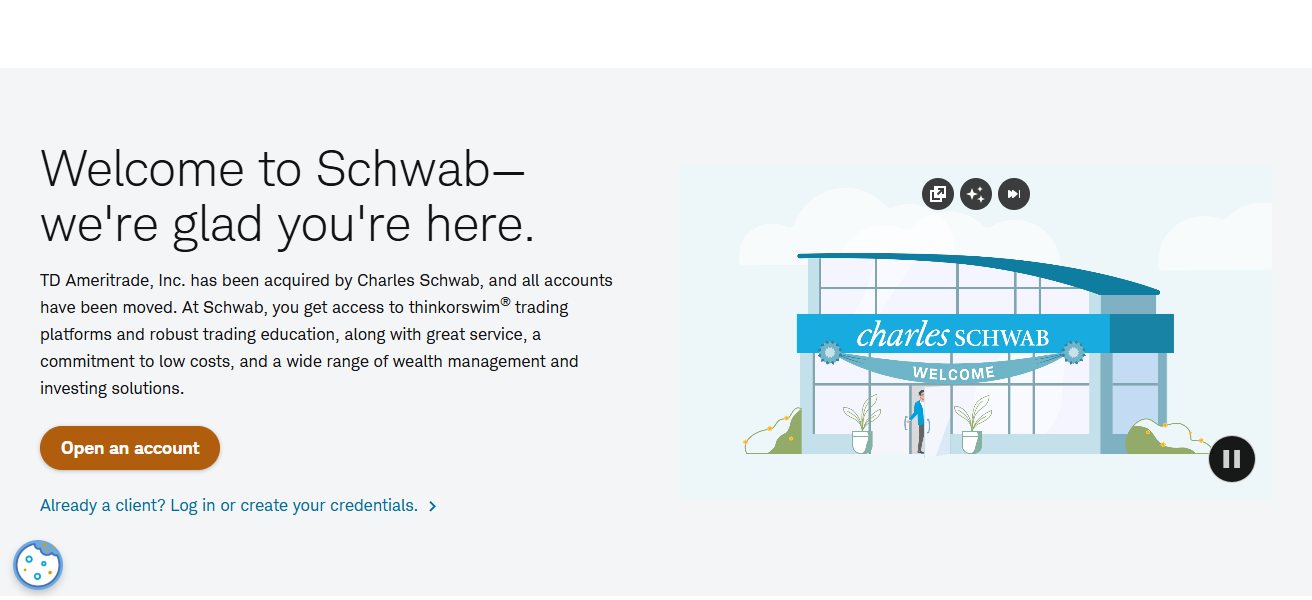
OAuth integration also provides a secure means for automated trading. Developers’ community and documentation support further ease the process for beginners, but the Advanced tools still available.
The API Availability and reputation, along with the integration with thinkorswim, really makes it a great option for anyone interested in automated trading.
TD Ameritrade Features
- Provides quotes and historical API data.
- Trade options, stocks, and ETFs, and mutual funds.
- Integrate with secure OAuth authentication.
- Great community and documentation support.
| Pros | Cons |
|---|---|
| Real-time quotes and historical data access. | Limited international market coverage. |
| Supports equities, ETFs, mutual funds, and options. | API retirement risk after merger with Charles Schwab. |
| Secure OAuth authentication for integration. | More suited for retail traders than institutions. |
| Strong documentation and community support. | Execution speed slower than specialized platforms. |
5. E*TRADE
Developers can trade via ETRADE’s API for equities and options. They can automate their trading strategies and manage their portfolios.
API users can get access to market data, account data, and order data. Since the API is REST and ETRADE also boasts high levels of reliability, developers can easily integrate their own applications.

ETRADE’s commendable reliability also means their API is solid choice for developers who trade options and equities and need reliability.
ETRADE also provides educational services and customer support. Compared to Interactive Brokers, ETRADES API is less global, but ETRADE remains a decent choice for algorithmic traders in the USA.
E*TRADE Features
- Equities and options trading via REST API.
- Access to order execution, account info, and market data.
- Built with safety and reliability in mind.
- Plenty of support available along with educational material.
| Pros | Cons |
|---|---|
| RESTful API for equities and options trading. | Limited global reach compared to Interactive Brokers. |
| Provides market data, account info, and order execution. | Fewer advanced algorithmic features. |
| Emphasizes security and reliability. | Higher fees than discount brokers. |
| Strong customer support and educational resources. | Less developer-focused community. |
6. OANDA
A top forex broker, OANDA, integrates a proven API for algebraic trading. It features order execution, historical pricing, and real-time market access.
Flexible, for low latency custom Forex trading strategies, OANDA’s advanced API offers both REST and streaming, and from OANDA’s proprietary trading platform, continuous feed and order management.
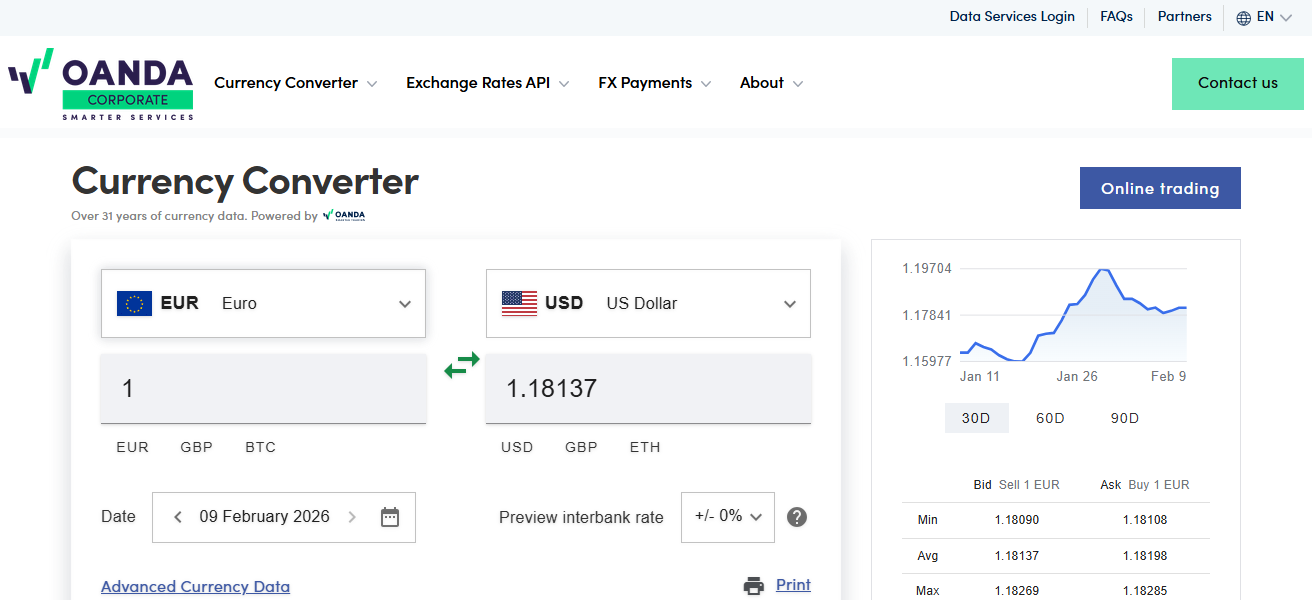
A comprehensive practice and demo trading environment is offered for backtesting and paper trading.
With geographically diverse Competitive trading spreads and proven reliability, OANDA’s advanced API is a top consumer for Forex-algorithmic trading and Forex institutions.
OANDA Features
- Real-time currency market data and forex-centric APIs.
- Streaming and REST APIs supported for optimal efficiency.
- Low latency execution is essential for forex strategies.
- Simulated trading environments for practice.
| Pros | Cons |
|---|---|
| Forex-focused API with real-time currency data. | Limited to forex and CFDs. |
| Low-latency execution crucial for forex strategies. | Not ideal for equities or broader asset classes. |
| REST and streaming APIs for efficiency. | Spreads may be higher during volatile markets. |
| Practice environment for backtesting and paper trading. | Institutional features less comprehensive. |
7. IG Group
IG Group is a global brokerage company that gives access to API for trading currency, index, commodity, and CFD markets.
They also provide API for trading which allows access to live markets, account management, and order execution.

With their REST and streaming features, developers can create automated trading systems. They are also keen on reliability and regulation which is ideal for professional traders.
There are multiple complex order types and risk management features available on the platform. With a large international presence and solid reliability, IG Group API is a valuable option to international traders who want algorithmic trading.
IG Group Features
- Global brokerage API for trading forex, indices, commodities, and CFDs.
- Market data and trading account management in real-time.
- APIs support automation via REST and streaming.
- Comprehensive compliance and trust for the pros.
| Pros | Cons |
|---|---|
| Global broker API covering forex, indices, commodities, and CFDs. | Limited access to equities compared to full-service brokers. |
| Provides real-time market data and account management. | Higher fees for some instruments. |
| REST and streaming capabilities for automation. | More complex compliance requirements. |
| Strong reliability and regulatory compliance. | Less beginner-friendly API documentation. |
8. Saxo Bank
Saxo Bank offers API access to institutional-grade algorithmic trading and multiple asset classes. Their OpenAPI offers equities, forex, futures, options, and bonds.
Developers get access to current and past data along with order management. Saxo Bank’s API is scalable for retail and institutional clients.
The platform aims for security, compliance, and which makes it a better option for advanced traders.
Aided by comprehensive documentation and other support, Saxo Bank encourages the development of high-level trading systems. The global presence of Saxo Bank is more attractive for algorithmic trading experts.
Saxo Bank Features
- OpenAPI of institutional quality across several asset classes.
- Strategy data for the present and the past.
- Enhanced order management and flexible system.
- For committed traders, the compliance and security are top-notch.
| Pros | Cons |
|---|---|
| Institutional-grade OpenAPI supporting multiple asset classes. | Higher minimum deposit requirements. |
| Real-time and historical data access. | More complex setup for retail traders. |
| Advanced order management with scalable infrastructure. | Fees may be higher than discount brokers. |
| Strong security and compliance standards. | Less accessible for small-scale developers. |
9. Zerodha Kite Connect
Zerodha Kite Connect is well-known among Indian traders. It provides access to Indian exchanges for equities, derivatives, and commodities.
Covered by the API is order execution, portfolio management, and real-time market data. Because of its RESTful design, easy integration with Python and other languages is a cinch.
Zerodha provides the opportunity to trade at a low cost for high volume traders, fully supported by their large infrastructure.
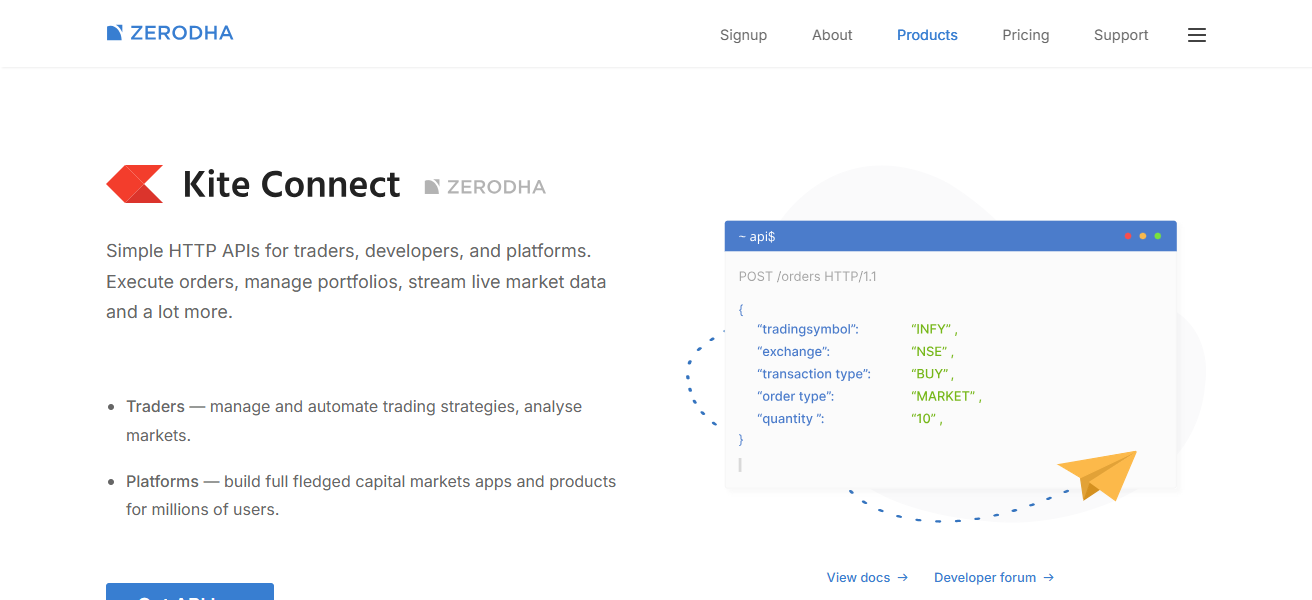
Also, Kite Connect facilitates backtesting and paper trading, thus offering the ability to develop trading strategies without risking real money.
Due to high community support and a large user base, Zerodha API is the most preferred in India for algorithmic trading.
Zerodha Kite Connect Features
- Widely recognized Indian API for trading in equities, derivatives, and commodities.
- Order execution and market data are real-time.
- Python integration via RESTful architecture.
- Lower brokerage charges and a well-established community.
| Pros | Cons |
|---|---|
| Popular Indian API for equities, derivatives, and commodities. | Limited to Indian exchanges only. |
| Real-time market data and order placement supported. | Fewer advanced institutional features. |
| Affordable brokerage fees with strong infrastructure. | Execution speed may lag during high volatility. |
| Strong community support and developer resources. | Limited global expansion opportunities. |
10. 1Fyers API
Fyers API is an Indian brokerage that caters to developers who want to build API-based trading systems.
Fyers API offers equities, derivatives, and commodity trading along with real-time market data and order execution.
Its API includes the ability to automate and backtest trading systems as well as offers the ability to integrate with third-party trading applications.
Fyers is focused on affordability and simplicity, making the product appealing to retail traders. The RESTful architecture allows for the easy implementation of trading strategies and the extensive documentation is great for developers.
Furthermore, Fyers offers the ability to do paper trading to test trading strategies. Fyers API is becoming an increasingly popular trading API in India because of the good automation trading offerings.
Fyers API Features
- Indian equities and derivatives.
- Real-time trading data and market automation and backtesting.
- REST architecture for efficient integration.
- Practice trading environment for backtesting and simulation.
| Pros | Cons |
|---|---|
| Developer-friendly API for Indian equities and derivatives. | Restricted to Indian markets only. |
| Real-time market data with automation and backtesting. | Smaller user base compared to Zerodha. |
| RESTful architecture ensures smooth deployment. | Limited advanced order types. |
| Paper trading environment for safe testing. | Less global recognition and reach. |
Conclusion
To summarize, the best algorithmic trading platforms APIs provide traders with automated trading, access to real-time market data, and quick order execution.
Worldwide frontrunners such as Interactive Brokers and Saxo Bank as well as regionally popular platforms such as Zerodha and Fyers, each have offerings with varying configurations.
When deciding which API is most appropriate for your trading style, consider the breadth of available trading instruments, and the consistency/reliability of the API for retail vs. institutional trading clientele.
FAQ
An API allows traders to connect software with broker systems for automated trading and data access.
They enable automation, real-time data integration, and seamless execution of trading strategies without manual intervention.
Alpaca provides commission-free trading with developer-friendly APIs, making it popular among retail algorithmic traders
Interactive Brokers offers one of the most comprehensive APIs covering equities, forex, futures, and bonds worldwide.