
I’m going to discuss the Best Sanction-Screening Tools for Crypto Companies that allow exchanges, wallets, and Fintechs to remain compliant with WATCH regulations around the globe.
These tools utilize blockchain analysis, transactional monitoring, and watchlist scoring to identify and prevent contraband. These tools ensure strong complete and sanctions compliance for crypto activities on the globe.
Key Points & Best Sanction-Screening Tools for Crypto Companies
| Tool | Key Point |
|---|---|
| FOCAL | Fast setup and scalability – reduces compliance setup time by up to 80% |
| ComplyAdvantage | AI-driven risk detection – global sanctions, PEPs, and adverse media coverage |
| Dow Jones Risk and Compliance | Trusted global watchlist data – widely used by banks and financial institutions |
| Sanction Scanner | Real-time screening – checks OFAC, UN, EU, and 3000+ watchlists |
| Salv | Collaborative compliance platform – tailored for fintechs and crypto firms |
| Feedzai | Machine learning fraud detection – integrates sanctions screening with transaction monitoring |
| Napier | Advanced analytics – configurable rules and AI for AML/sanctions |
| SumSub | Identity verification + sanctions – supports crypto onboarding and KYC |
| Unit21 | No-code compliance workflows – flexible monitoring and sanctions checks |
| Seon | Fraud prevention focus – combines AML screening with digital footprint analysis |
10 Best Sanction-Screening Tools for Crypto Companies
1. FOCAL
FOCAL provides bespoke screening designed for crypto enterprises with bespoke, real-time watchlist screening and blockchain address and transaction matching at the granular transaction level.
It enriches addresses with entity risk scores, ownership linkages, and transaction histories so investigators can better prioritize hits and alleviate the burden of false hits.
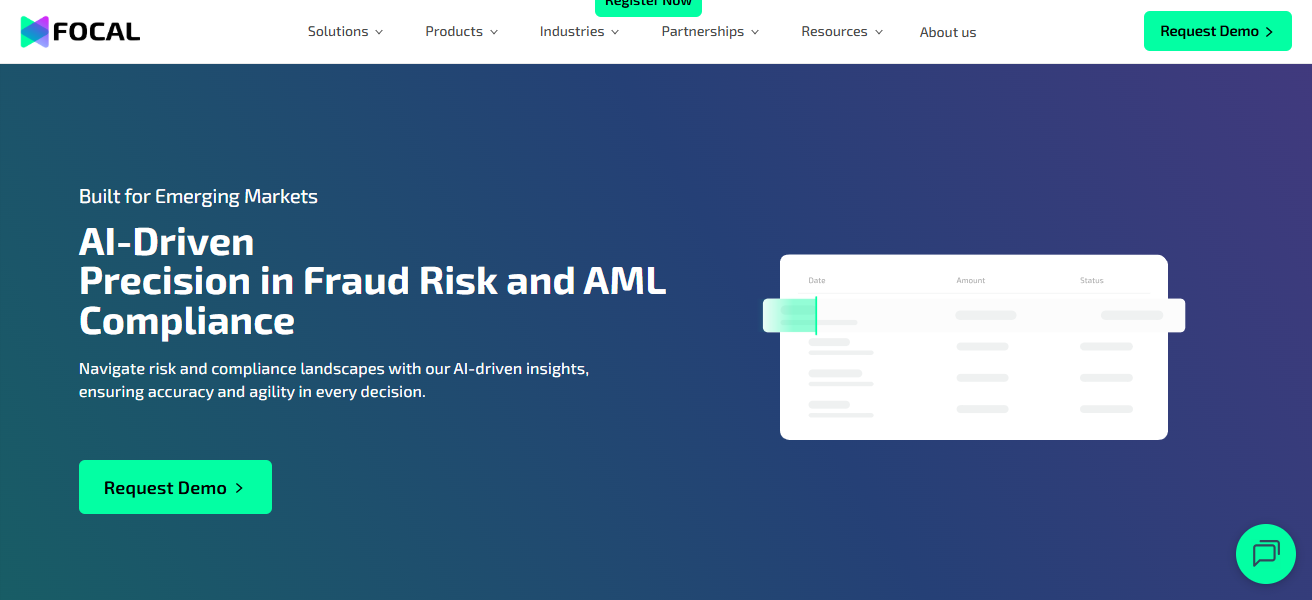
Best Sanction-Screening Tools for Crypto Companies – FOCAL offers this mid-paragraph suggestion. The platform offers integration via API and SIEM connectors, custom lists, and tiered rule systems with compliance audit functionality.
Its analytics are tailored for the identification of crypto obfuscation and jurisdictional avoidance across wallets and counterparties.
| Pros | Cons |
|---|---|
| Advanced blockchain-native sanctions screening with address intelligence | Pricing may be higher for small crypto startups |
| Real-time watchlist updates + API integration | Requires technical onboarding for seamless setup |
| Strong at tracing obfuscated flows and on-chain hops | Limited non-crypto use cases compared to traditional AML tools |
| Custom lists + detailed audit trails for compliance | Requires internal analysts to interpret complex flows |
2. ComplyAdvantage
ComplyAdvantage offers Data Driven Risk Screening Solutions for crypto firms that aggregate globally sanctions, PEP, and negatives media into one searchable intelligence layer.
Best Sanction Screening Tools for Crypto Companies talks about the importance of ComplyAdvantage for exchanges and custodians.
These products utilize machine learning to mitigate aliasing, transliteration, and negative news emergent risks. They provide alerts on AML frameworks, entity resolution, tailored risk rules, and optimization of case management.
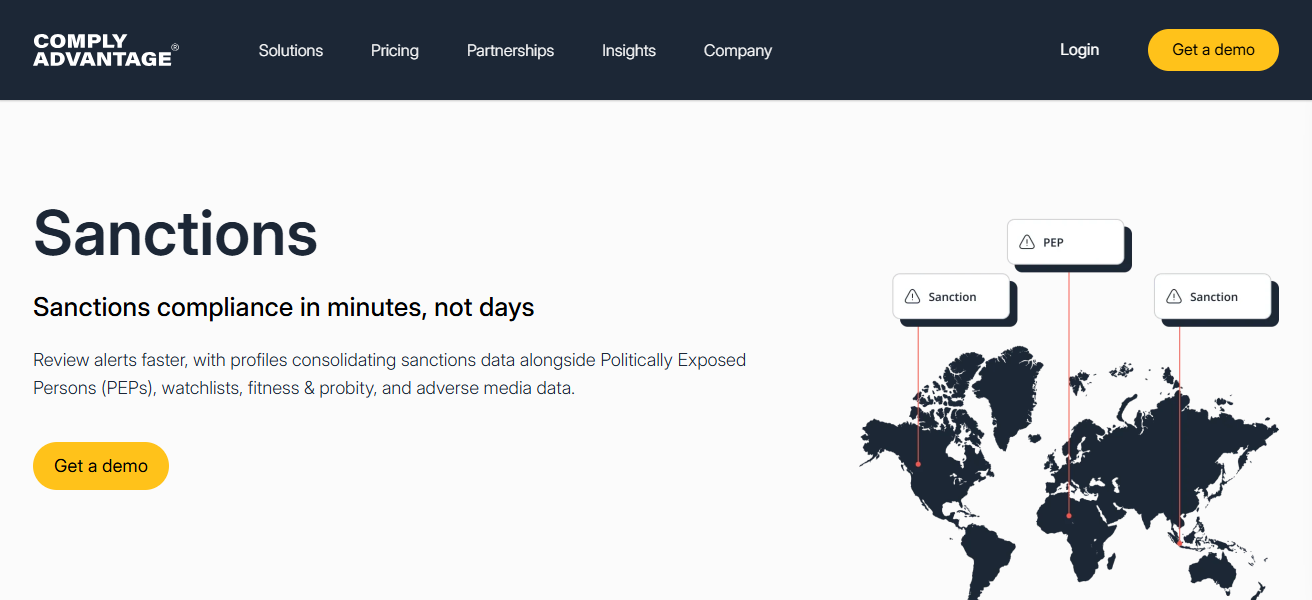
ComplyAdvantage also enhances the ability to robustly support the onboarding of clients, transaction monitoring, and the completion of regulatory reports for fast-moving crypto environments, owing to real-time streaming and meticulously detailed data, as well as APIs that facilitate development.
| Pros | Cons |
|---|---|
| Huge global sanctions, PEP, and adverse media database | False positives can occur in high-volume environments |
| ML-powered entity resolution helps reduce noise | Limited deep blockchain tracing features |
| Excellent API and developer-friendly integration | Enterprise plans may be expensive |
| Fast onboarding and supports high-velocity crypto operations | Some datasets require premium add-ons |
3. Dow Jones Risk and Compliance
Dow Jones Risk and Compliance is Regulatory Technology leaders with their integrated watchlists and published media intelligence from editors as well as global regulator lists and addresses complex sanction screening requirements.
Also, Best Sanction-Screening Tools for Crypto Companies – Dow Jones Risk and Compliance is mentioned to assess its contribution.

The solution targets firms with high assurance requirements for adverse media checks alongside sanctions matching as it supports batching and real-time screening.
Adjustable confidence levels with evidence trail for audits adds to its credibility especially for institutional clients in crypto with KYC/CDD requirements and cross-border counterparty risk.
| Pros | Cons |
|---|---|
| Industry-leading curated data and editorially verified sources | One of the most expensive on the list |
| Strong adverse media and high-assurance intelligence | Not crypto-native; lacks blockchain tracing |
| Supports batch + real-time screening | Setup may be complex for smaller exchanges |
| Trusted by top institutional regulators and banks | Less flexible for modern DeFi workflows |
4. Sanction Scanner
Sanction Scanner is heavily involved in blockchain and crypto-native screening, specifically syncing blockchain wallet addresses with sanctions lists and identifying tainted flows across chains.
Best Sanction-Screening Tools for Crypto Companies – Sanction Scanner is quoted here to emphasize its focus on crypto.
The platform provides automated address monitoring, transaction tracing, and alerts for on-chain activity and off-chain customer related events.
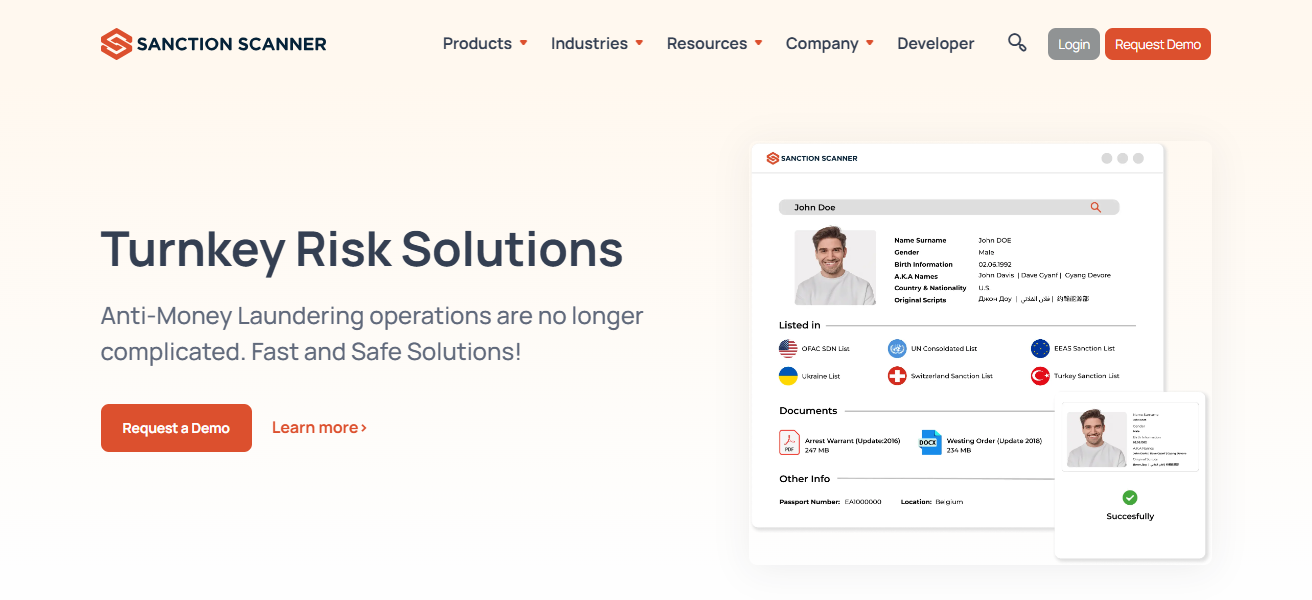
Support for multi-chain and on-chain/off-chain integration is often done in custodians and traded exchanges so product forensics is improved.
These areas, especially for crypto, typically mandating strategies to conceal their blockchain activity can introduce significant risks with off-the-shelf sanctioning tools.
| Pros | Cons |
|---|---|
| Built specifically for crypto sanctions and wallet screening | Limited enterprise-scale reputation compared to older firms |
| Multi-chain tracing + visual forensic tools | Some advanced analytics require higher-tier plans |
| Real-time alerts for wallet monitoring | UI may feel basic for large compliance teams |
| Strong mixing, chain-hop detection | Coverage for new chains may lag slightly |
5. Salv
Salv incorporates transaction supervision together with sanctions and PEP screening transposed into one platform tailored for crypto and fintech companies utilizing behavioral analytics to spot abnormal activities.
Best Sanction-Screening Tools for Crypto Companies-Salv is referred to within the same paragraph to emphasize its relevance to crypto compliance.
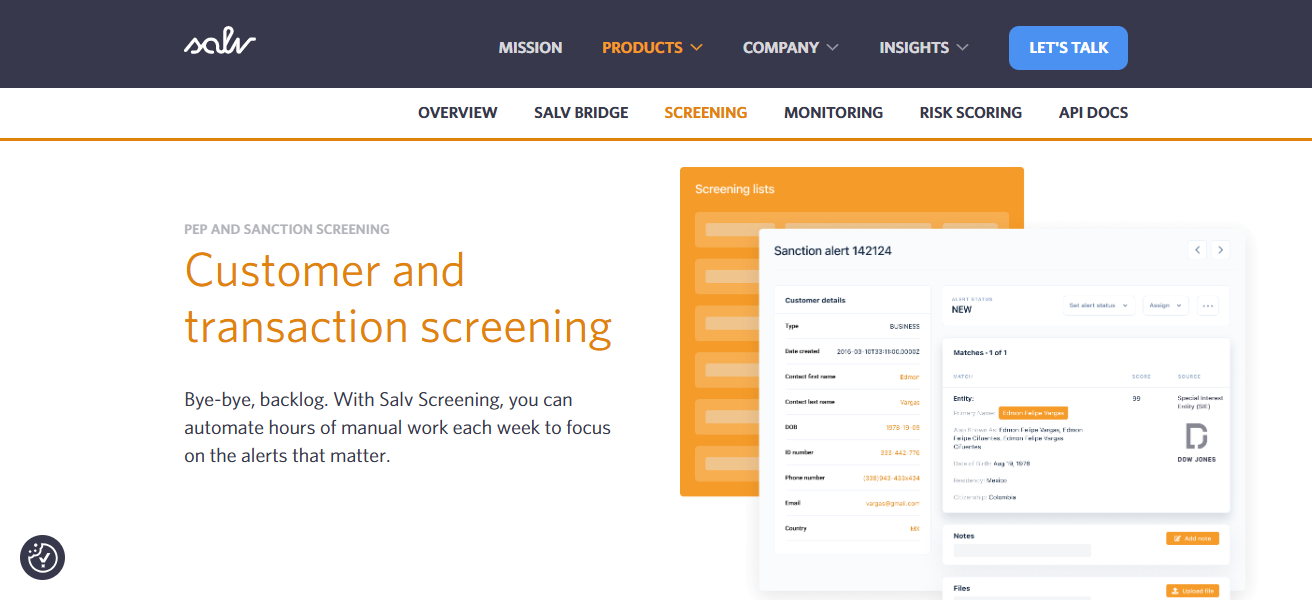
The platform provides rules engines, case management, and on-chain to off-chain correlation so that teams can analyze alerts with enriched context for investigation like wallet clustering and provenance scoring.
Salv assists in rapid triaging and regulatory reporting and its tuning feature mitigates training alert fatigue for enlarging exchanges and DeFi service providers.
| Pros | Cons |
|---|---|
| Combines AML, sanctions, and behavioral analysis | Not as well known globally as other AML giants |
| Great for crypto exchanges + fintechs | Advanced features require configuration time |
| Strong UI, triage flow, and alerting tools | Limited native blockchain analytics vs on-chain specialists |
| Easy rule-tuning reduces alert fatigue | May need additional tools for full on-chain intelligence |
6. Feedzai
Feedzai provides an enterprise-grade fraud and AML platform that can be configured to encompass sanctions screening, transaction scoring, and real-time crypto service decisioning.
Best Sanction-Screening Tools for Crypto Companies-Feedzai has been referred to within the same paragraph to highlight its relevance.
Deploying machine learning, the platform analyzes transactional and behavioral telemetry to highlight potential discord and, to streamline compliance, automates workflows to either hold an account, escalate an issue, or provide remediation.
Feedzai can integrate with third party sanctions and watchlists and is designed for high transaction volume environments, for which it is well suited to large exchanges and institutional custody.
| Pros | Cons |
|---|---|
| Enterprise-level fraud + AML system suitable for huge exchanges | Expensive and best suited for large institutions |
| ML-powered decisioning and real-time scoring | Requires dedicated engineering resources |
| Highly scalable for millions of transactions | Not crypto-native; needs external blockchain data |
| Strong orchestration + automation tools | Longer implementation cycle |
7. Napier
Napier offers blockchain monitoring and sanctions screening from an institutional perspective, integrating on-chain analytics, regulatory list matching, and risk scoring.
Best Sanction-Screening Tools for Crypto Companies Napier is mentioned mid-paragraph to support the point of Napier’s place among crypto tools.
Napier provides explainability of matches, and uses chain-aware heuristics, to assist compliance managers to explain flagged flows and demonstrate to auditors how flows have been controlled.
It is useful in AML case, sanctions compliance, and transaction freeze at level. It has API, dashboarding, and alerting.
It is particularly strong in across-bridges and wrapped assets forensic tracing, which is important for companies providing multi-chain custody and multi-chain settlement services.
| Pros | Cons |
|---|---|
| Strong institutional AML + sanctions compliance suite | Can feel heavy for small or mid-size crypto firms |
| On-chain analytics + regulatory screening combined | Pricing not transparent for smaller teams |
| Great explainability + documentation for auditors | Interface may require training |
| Forensic tracing across bridges, wrapped assets, and multi-chain | Not as fast-moving as dedicated crypto analytics companies |
8. SumSub
SumSub is an identity verification and screening provider who combines KYC, KYB, and sanctions, PEP, and adverse media screening designed for digital asset platforms.
Best Sanction-Screening Tools for Crypto Companies – SumSub is mentioned here to recognize his combined KYC + screening.
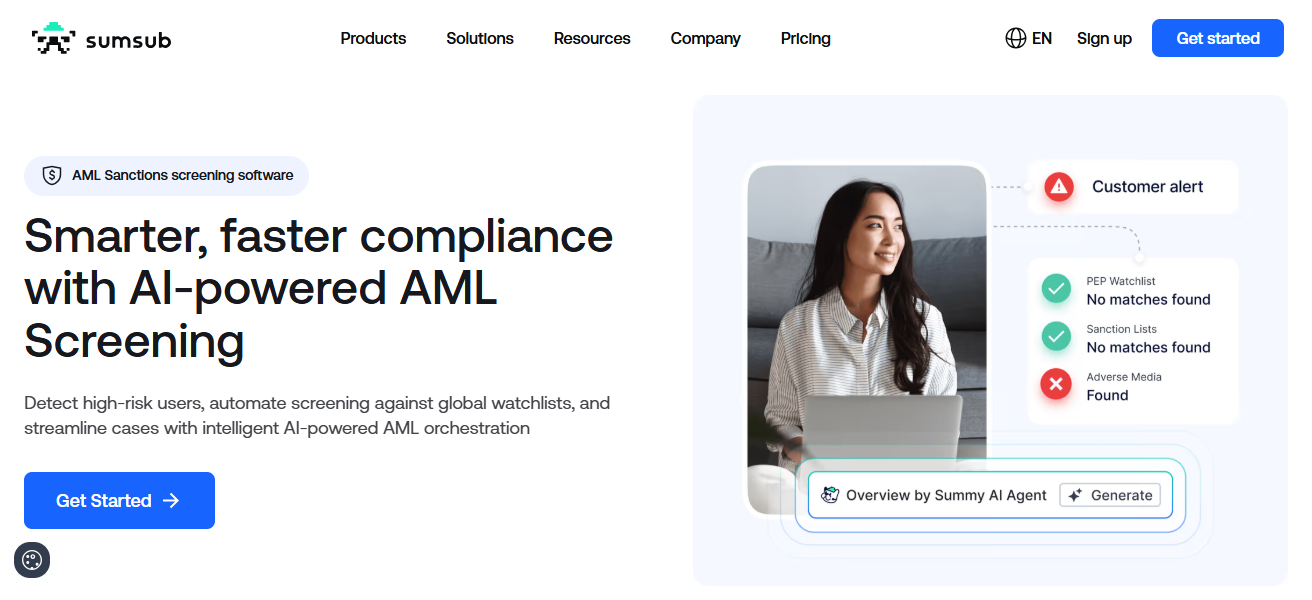
It simplifies the onboarding process of clients by verifying their identity and crosschecking global watchlists simultaneously, which accelerates the onboarding process without compromising compliance.
Identity risk can be automated by exchanges and wallets, using SumSub’s flexible SDKs, document verification, liveness checks, and risk scoring. It allows sanctions hits to be manually reviewed, and provides documented onboarding.
| Pros | Cons |
|---|---|
| All-in-one KYC/KYB + sanctions screening | Not a specialized blockchain forensic tool |
| Streamlined onboarding with liveness + doc verification | Some customers report occasional false negatives |
| Easy SDK/API for fast integration | Advanced compliance features available only in higher tiers |
| Strong global coverage for identity checks | Sometimes slower for complex document types |
9. Unit21
Unit21 has built a modular compliance platform that provides screen rule-based compliance, custom watchlists, and case management tailored for the fintech and crypto industries for specialized AML compliance solutions.
Best Sanction-Screening Tools for Crypto Companies – Unit21 is mentioned mid-paragraph to indicate its suitability.
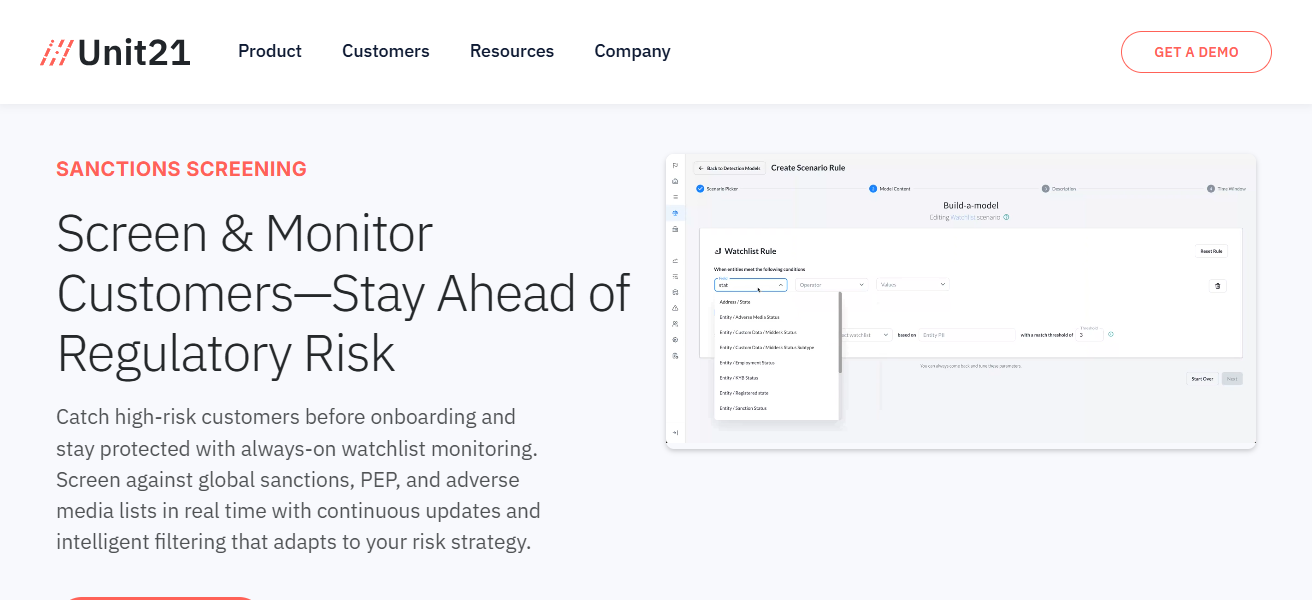
With a low-code rules engine, varied schema, and developer-friendly APIs, teams can pair sanctions hits with behavioral rules to decrease false positive rates and focus on higher impact events.
Unit21 also provides enrichment through external providers, audit trail logging, and collaborative case management; especially valuable for teams with customizable compliance needs who are integrating Unit21 with an Exchange or KYC solutions.
| Pros | Cons |
|---|---|
| Highly customizable, low-code AML + sanctions rules engine | Requires skilled team to fine-tune rules |
| Great for building custom crypto compliance workflows | Not a native blockchain analytics solution |
| Flexible API + schema for modern exchanges | Complex setup for beginners |
| Supports enrichment from external data providers | Pricing scales with usage |
10. Seon
Seon s specialized in fraud and digital identity signal with a focus on prevention, augmenting sanctions and PEP with device, IP, and behavioral layers to better understand the suspicious accounts and transactions.
Best Sanction-Screening Tools for Crypto Companies – Seon is mentioned mid-paragraph to show its relevance.
Seon helps compliance teams understand the difference between false positives and genuine risk by cross-referencing sanctions hits with device fingerprints, velocity checks, and phone/email analytics.
It provides APIs, out of the box integrations, and risk scoring that can be used in combination with other sanctions modules to provide layered defenses for crypto platforms looking to lower fraud while also upholding compliance screening.
| Pros | Cons |
|---|---|
| Strong fraud detection with device, IP, and behavioral analytics | Not primarily a sanctions-focused platform |
| Helps distinguish false positives using identity signals | Limited on-chain analysis features |
| Easy integrations + powerful API | May require pairing with a dedicated sanctions tool |
| Good for early-stage crypto platforms fighting fraud | Advanced features require technical setup |
Conclsuion
To conclude, the most appropriate sanction-screening software for crypto businesses merges blockchain analytics, automated risk assessments, and live watchlist information to safeguard businesses against regulatory and monetary dangers.
Tools such as FOCAL, ComplyAdvantage, Dow Jones, Sanction Scanner, Salv, Feedzai, Napier, SumSub, Unit21, and Seon enable exchanges, e-wallets, and fintech firms to achieve compliance, lower false positives, and enhance their overall management of AML and sanctions-related risks.
FAQ
Tools that check users, wallets, and transactions against global sanctions, PEPs, and adverse media.
To prevent illegal activity, ensure compliance, and avoid regulatory penalties.
FOCAL, ComplyAdvantage, Dow Jones, Sanction Scanner, Salv, Feedzai, Napier, SumSub, Unit21, Seon.
They analyze blockchain addresses, transaction patterns, identities, and watchlists in real time.
Yes, advanced tools trace chain hops and obfuscated flows.