In this article, I will provide the best spend analytics platforms to help financial executives understand operational costs within the organization.
These platforms offer visibility to the various functions within the organization on a real-time basis, generate reports on spend/frugal initiatives, and provide compliance, supplier risk, and spend visibility.
From these analytics, the CFO can make decisions on cost optimization and enhance overall financial performance at the enterprise level.
Key Points & Best Spend Analytics Platforms For CFOs
| Platform | Key Point |
|---|---|
| SpendHQ | Purpose-built spend intelligence: Delivers actionable insights for procurement and finance teams. |
| Coupa | AI-driven spend optimization: Helps CFOs maximize savings and supplier value. |
| JAGGAER | Comprehensive procurement suite: Strong in supplier management and risk mitigation. |
| SAP Ariba | Global enterprise integration: Seamlessly connects spend data with ERP systems. |
| Suplari | Predictive analytics: Uses AI to forecast spend trends and identify risks. |
| Zycus | Automation-first approach: Streamlines spend classification and compliance. |
| GEP SMART | Cloud-native platform: Unified spend analysis, sourcing, and supplier collaboration. |
| Ivalua | Highly configurable solution: Flexible spend visibility for complex organizations. |
| Proactis | Mid-market focus: Cost-effective spend control for growing businesses. |
| Sievo | Advanced analytics dashboards: Strong visualization and benchmarking capabilities. |
10 Best Spend Analytics Platforms For CFOs
1. SpendHQ
SpendHQ is a customized spend analytics and intelligence solution created specifically for CFOs and procurement leaders to visualize organizational spend in a consolidated fashion.
It automates the cleansing, categorization, and enrichment of data to transfigure raw expense data into actionable intelligence that steers strategic sourcing and supplier decisions.
The solution merges spend intelligence with performance management, allowing teams to centrally manage the oversight of savings initiatives, compliance, and supplier risk.
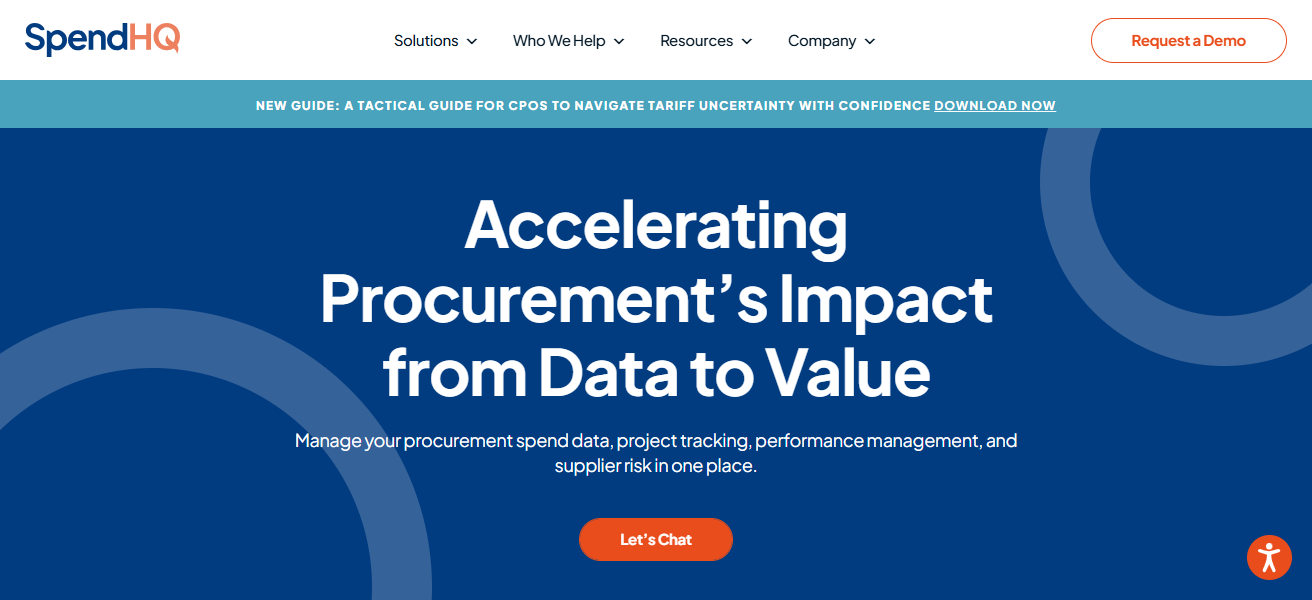
SpendHQ integrates with a multitude of ERP and procurement solutions to curtail the use of spreadsheets and fast-track the visibility into the spend drivers, savings, and procurement influence across the organization.
Features SpendHQ
Automated Spend Classification – With intelligent data cleansing and categorizing, spend data is transformed into a structured spend, enabling CFOs to understand what and who the organization is buying from.
Unified Spend Dashboard – Central visualization of spend collected across ERP systems, enabling finance leaders to recognize patterns, trends, anomalies, and outliers without the assistance of manual spreadsheets.
Savings Opportunity Identification – Recognizes areas of where spend can be minimized, especially in gaps in contract compliance or supplier consolidation, targeted for potential procurement strategies.
Integration with ERPs – Effortlessly plugs into every major ERP and financial system. Spend data is then integrated into a centralized analytics engine for better and more accurate insights.
| Pros | Cons |
|---|---|
| Strong focus on spend visibility and classification. | Limited broader source‑to‑pay suite compared to full platforms. |
| Easy to implement and integrates with major ERPs. | May require cleanup effort for highly fragmented data. |
| Clear dashboards tailored for finance and procurement leaders. | Smaller ecosystem of third‑party add‑ons vs larger vendors. |
| Good support and onboarding. | Advanced predictive analytics features may be less developed. |
2. Coupa
Coupa finance analytics are embedded in Coupa real-time intelligence S2P systems that help CFOs track spending in real-time; spending is visible and tracked continuously.
Coupa captures spend data in real-time and helps finance teams analyze and manage spending performance; the data enables finance to benchmark against industry and helps finance teams to manage compliance in automated procurement.
Coupa analytics user dashboards and reports enable users to analyze spend by supplier and contracts. CFOs get real-time spend data and financial realigning integrated with Coupa procurement spend management.
Features Coupa
Real-Time Spend Capture – Does record spending activity in real-time, empowering CFOs to be able to see real-time data as opposed to a retrospective view.
Embedded Analytics in S2P Workflow – Analytics are built into the source-to-pay suite from Coupa, allowing for easier fusion of spend data with procurement and compliance actions.
Benchmarking and Predictive Insights – Employing an industry standard with AI to predictive spend performance and trends. Should accurate data be provided, it can forecast and track spend movement trends as well.
Policy Enforcement & Risk Monitoring – Performs automatic detection of policy breach enforcement and supplier risk alerting, thereby assisting with financial controls enforcement.
| Pros | Cons |
|---|---|
| Real‑time spend capture as purchases occur. | Can be expensive for smaller organizations. |
| Embedded analytics within a full S2P suite enhances alignment. | Complexity may require trained administrators. |
| Benchmarking against industry peers. | Custom reporting may need consulting support. |
| Strong compliance and policy enforcement. | Implementation timelines can be longer. |
3. JAGGAER
Spend analytics from JAGGAER are integrated within the unified JAGGAER One procurement suite. This provides CFOs with a single view of spend data across multiple systems.
The platform combines and enriches disparate data sources so spend visibility, analytics, and reporting can be performed on a granular level across specific spend patterns, supplier performance, and compliance risk.
Financial teams can expose imbalances, document savings on spend, and classify performance across categories and business units with ease of use from AI-assisted classification, configurable dashboards and reporting.
Risk mitigation and scenario planning from JAGGAER make it a viable option for large players to leverage procurement data for primary strategic cost control and governance.
Features JAGGAER
Multi-Source Spend Consolidation – Helps eliminate data silos by integrating spending data from multiple systems and providing a unified view for comprehensive analysis.
AI-Assisted Classification – Ensures accurate and less labor-intensive classification of spending data through machine learning.
Customizable Dashboards & Reports – Empowers CFOs with flexibility in personalizing analytics dashboards in line with their strategic financial objectives and individual department requirements.
| Pros | Cons |
|---|---|
| Unified spend view from multiple systems. | UI can be complex for new users. |
| Good AI‑assisted classification. | Deployment and configuration can be resource‑intensive. |
| Strong supplier risk and compliance insights. | Not as intuitive as some newer analytics‑first tools. |
| Scales well for large enterprises. | Smaller companies may find it over‑featured. |
4. SAP Ariba
SAP Ariba’s spend analytics functionality (now being developed into SAP’s Spend Control Tower solution) provides CFOs with a consolidated overview of enterprise expenses by integrating payment and supplier data from various systems.
With the help of machine learning classification and user-friendly dashboards, hidden costs, supplier risk, and cost optimization opportunities are revealed.
Its close integration with SAP ERP environments provides finance teams with a trusted data foundation for budgeting, forecasting, and compliance.
SAP’s analytics provide visibility into sustainability and diversity spend, allowing CFOs to coordinate their financial objectives with the organization’s wider goals.
Features SAP Ariba
Deep SAP Ecosystem Integration – Integrates effortlessly with other SAP ERP systems, providing CFOs with spending data that is synchronized to specific financial planning and budgeting modules.
Machine Learning Spend Classification – Streamlines data analysis by using automated normalization of spend data through intelligent categorization.
Comprehensive Compliance Tracking – Facilitates financial governance by monitoring compliance with contracts, purchasing policies, and audit histories.
Strategic Sourcing Insights – Helps discover savings through spend analytics by providing supplier and regional spend comparative analysis.
| Pros | Cons |
|---|---|
| Deep integration with SAP ERP and financial planning. | Best ROI often realized only with wider SAP suite adoption. |
| Strong machine learning classification capabilities. | Can be expensive overall. |
| Visibility into sustainability and diversity spend. | Setup and change management require expertise. |
| Comprehensive compliance & audit trails. | Analytics tooling sometimes rigid. |
5. Suplari
Suplari provides machine learning and provides autonomous modules to clean and analyze spend data in real time, a unique feature among spend analytics platforms.
Rather than spend history reporting and manual data entry, Suplari agents issue pinpointed savings compliance and supplier risk issues.
This results in automated, accurate, and real-time reporting and intelligence that allows CFOs to make proactive financial decisions and improve cashflow.
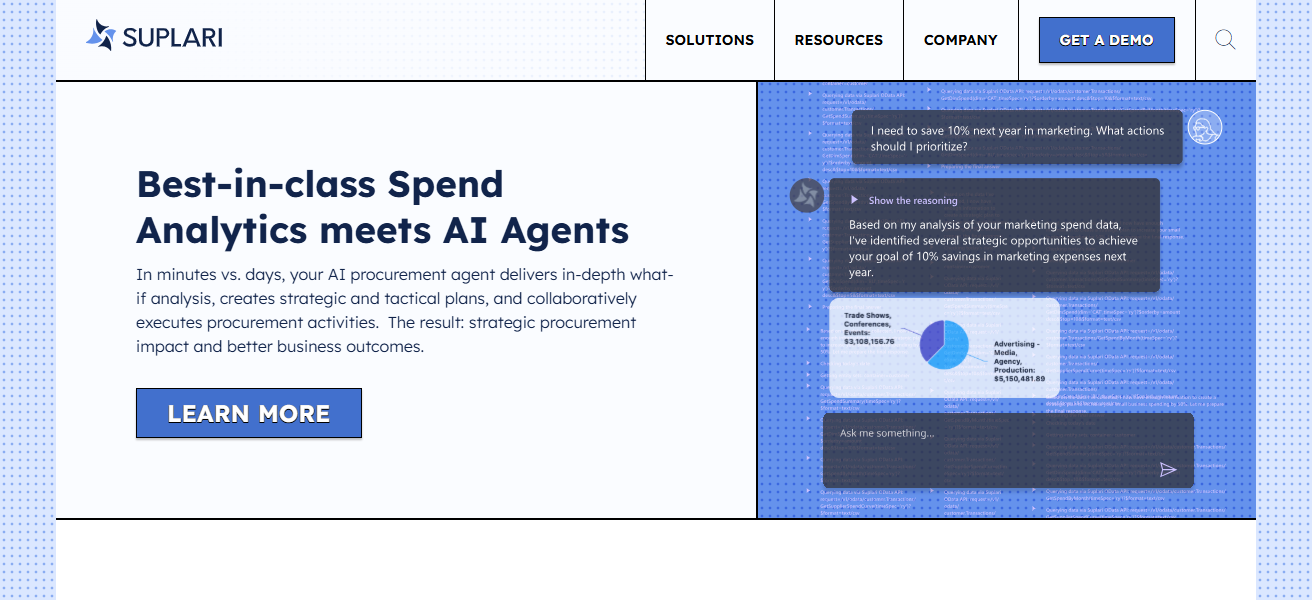
Suplari architecture is centered on automation and continuous analytics which allow financial executives to forecast and optimize category strategy.
This reduces cycle time down to days, for otherwise valuable insights that would take weeks to pull.
Features Suplari
Spend Intelligence – Suplari offers insights into opportunities, risks, and compliance through autonomous machine learning.
Prescriptive Analytics – Suplari goes beyond simply reporting historical spend by forecasting future scenarios and recommending based on current trends.
Continuous Data Monitoring – Always current financial and procurement data refreshes provide valuable insights for CFOs.
Risk & Compliance – Supplier risks, contract gaps, and other anomalies requiring executive action are automatically surfaced.
| Pros | Cons |
|---|---|
| AI‑first analytics with prescriptive insights. | May require clean data sources for best results. |
| Autonomous agents surface savings & risks proactively. | Not a full source‑to‑pay suite on its own. |
| Great for short time‑to‑value. | Integrations need configuration for real‑time feeds. |
| Excellent for forecasting & scenario planning. | Less focused on procurement execution workflows. |
6. Zycus
Zycus iAnalyze is one of the components of the Zycus source-to-pay suite. iAnalyze assists CFOs in deciphering complex spend data. Zycus uses classification to gain a more granular visibility across each of the dimensions (suppliers, categories, geographies) in the spends data.
More importantly, Zycus mitigates maverick spending and assists in discovering hidden savings. Finance teams leverage Zycus for automating compliance monitoring and pricing anomaly detection.
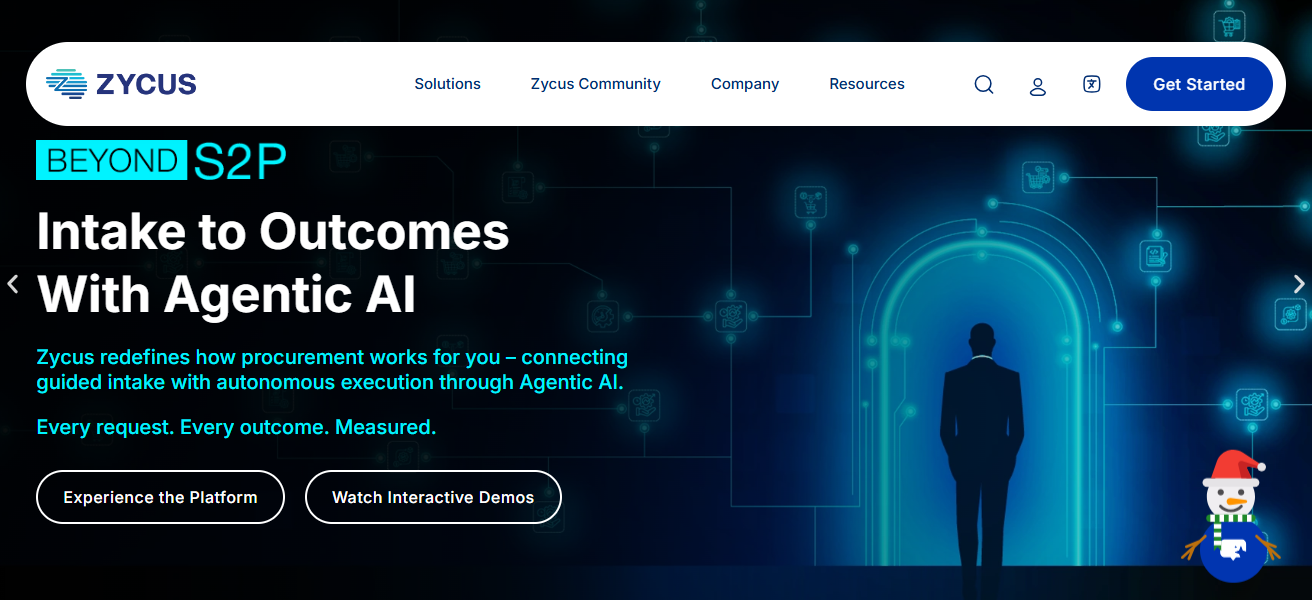
Zycus provides firms a data foundation to enact robust game plans for negotiations. Coupled with the dashboards and reports, spend for analytics can be transformed, resulting in more purposeful plans around cost control, supplier rationalization, and procurement optimization.
Features Zycus
AI-Powered Data Enrichment – Zycus uses algorithms to organize and clean spend data, accelerating time to analytic readiness.
Saving & Opportunity Tracking – Through contract compliance and supplier rationalization, Zycus identifies opportunities to reduce spend.
Integration Within Source-To-Pay Suite – Closely collaborates with other Zycus modules to integrate procurement performance with spend insights.
Custom Reporting – Finance teams can customize analytic views for strategy, planning, and reporting to the CFO.
| Pros | Cons |
|---|---|
| Strong AI‑driven classification with savings insight. | Analytics depend on quality of source data. |
| Good integration within its S2P suite. | User interface can feel dated. |
| Helps enforce compliance and detect anomalies. | Customization may require technical help. |
| Useful for strategic sourcing planning. | Smaller market presence vs giants like SAP/Coupa. |
7. GEP SMART
There are components of GEP SMART that are incorporated into a cloud-native source-to-pay system designed to accommodate entire procurement and finance operations.
For CFOs, that means integrated visibility into spend data and supplier performance, contract compliance, and outcomes of strategic sourcing.
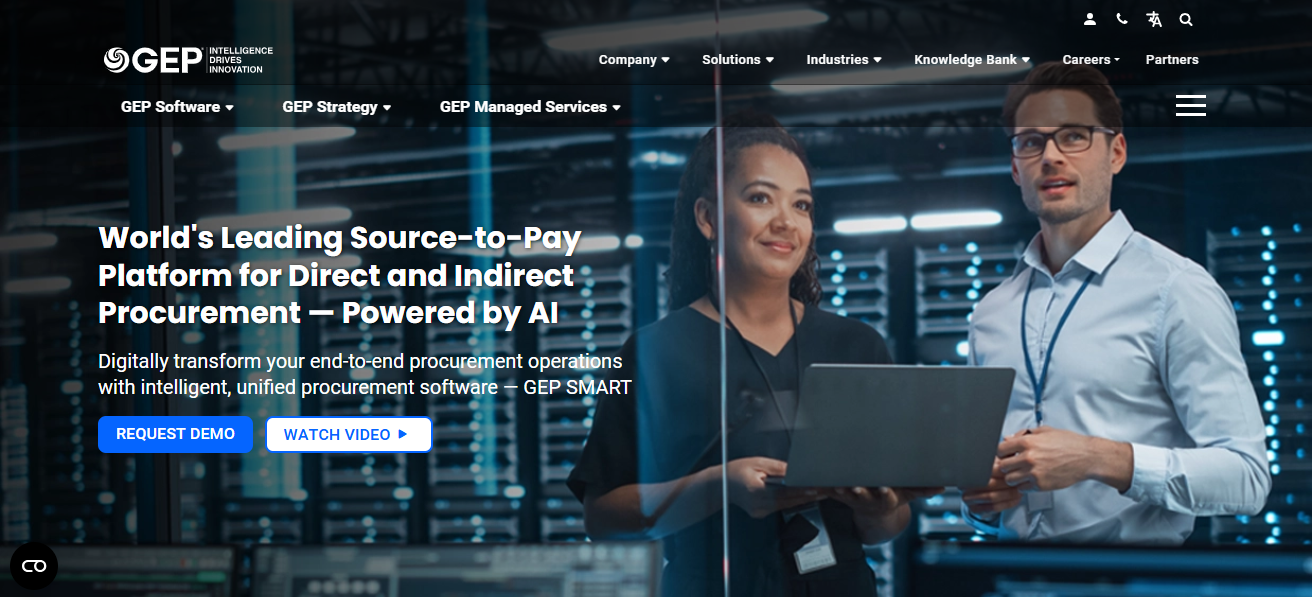
Analytics applications cleanse and categorize spend data across disparate systems and apply machine learning and advanced algorithms to illuminate savings
Predict spend; and notify stakeholders to meet or exceed thresholds. Its architecture makes data governance easier and equips finance teams with sophisticated tools for continuous cost management and operational efficiency.
Features GEP SMART
Unified Platform – Provides spend analytics, procurement execution, and supplier management within one cloud solution.
Predictive Spend Forecasting – Data and AI are leveraged to predict future spend trends, enhancing budgeting and planning forecast accuracy.
Alerts & Threshold Monitoring – Financial leaders have the option to set alerts for spend thresholds, supplier risks, or compliance issues.
Advanced Supplier & Category Insights – Heuristic analytics can understand each supplier and category in depth to form the basis of strategic sourcing.
| Pros | Cons |
|---|---|
| Unified architecture spanning analytics and execution. | Platform breadth can make onboarding steeper. |
| Strong forecasting and alerting capabilities. | Some users report reporting complexity. |
| AI and advanced algorithms for insights. | Custom dashboards require effort to tailor. |
| Cloud‑native and scalable. | May be overkill for simpler spend environments. |
8. Ivalua
Analytical capabilities to evaluate spending and assess procurement effectiveness from a stance CFOs can customize and manipulate as they see fit within some predefined parameters and in a single, homogeneous environment is a healthcare module within Ivalua’s single-codebase source-to-pay platform.
The module snapshot, normalizes, and classifies spend data on a customizable, on-demand basis and allows the finance team to empirically customize analytics.
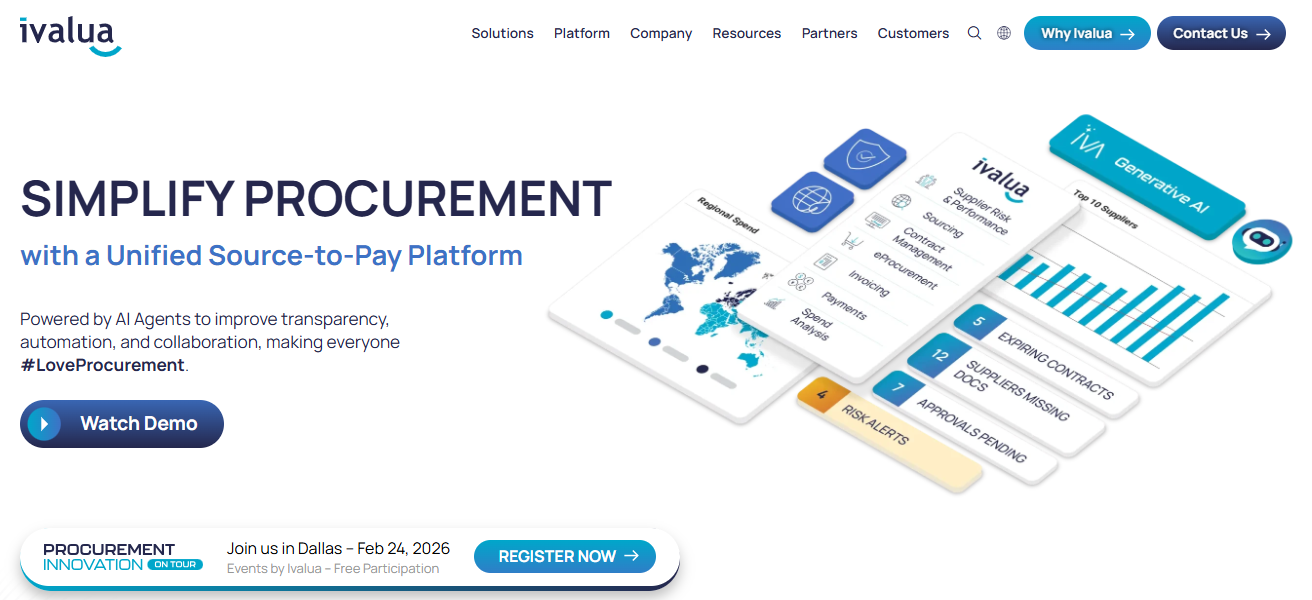
The module’s spend analytics configurability allows the finance team to empirically identify, and therefore, customize a report to address the provision of individual category costs, trends in suppliers, gaps in compliance, and so on.
The finance team of some clients requires a higher degree of customization than others and would, therefore, need to manually configure analytics within their dashboards.
This is, however, Ivalua’s unified data and flexible mechanism facilitates finance strategies that require complex analytics, new model scenarios, compliance gaps, and so on.
Features Ivalua
Configurable Analytics Framework – Finance teams are empowered to create their own logic and metrics for spend analysis, as opposed to one-size-fits-all templates.
Single Data Model – Guarantees trust in the analysis as the data is unified and consistent across the financial and procurement areas.
Category & Supplier Spend Views – Spending can be viewed in detail to target specific areas for improvement.
Flexible Reporting Engine – Custom reports and dashboards can be created using the platform by the CFO for internal and leadership purposes.
| Pros | Cons |
|---|---|
| Highly configurable analytics environment. | Requires configuration effort for advanced analytics. |
| Single data model for consistency. | Analytics depend on dashboard setups by users. |
| Good supplier & category spend visibility. | Not as plug‑and‑play as analytics‑first tools. |
| Flexible for varied business logic. | Learning curve with customization tools. |
9. Proactis
As a function of its other procure-to-pay solutions in its spend management suite, Proactis provides spend analysis and reporting functionalities for CFOs to be able to obtain a 360-degree overview of all company outflows and expenditures.
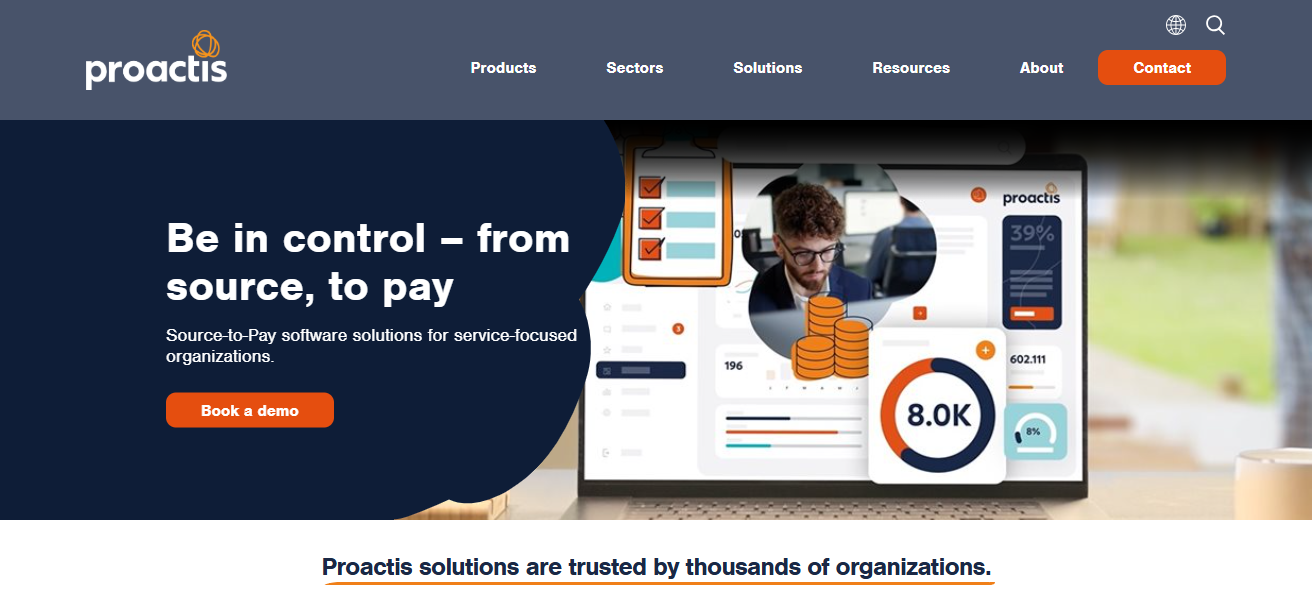
Proactis integrates spend data from a company’s purchasing and other financial systems into spend data dashboards, helping finance teams to answer the money disbursement questions, which suppliers’ spend is most of the company’s and where structural savings can be obtained.
Proactis’ reporting tools enable organizations to better understand and act on their spend so as to enhance smarter buying decisions, compliance, and financial transparency.
Features Proactis
Comprehensive Spend Visibility – Data integration results in excessive control from purchasing and financial systems for consolidated analytics dashboards.
Spend Reporting & Alerts – Finance teams are equipped with customizable reports and alerts to raise awareness of important changes.
Supplier Spend Insights – Dominant spend and supplier dominance are visible and can help in negotiations and consolidation.
User‑Friendly Analytics Tools – These analytics tools are built for the finance and procurement teams to use with little technical support.
| Pros | Cons |
|---|---|
| 360° visibility into purchase & spend data. | Analytics may not be as advanced as AI‑driven platforms. |
| Supports smarter compliance & buying decisions. | Smaller partner ecosystem vs large competitors. |
| Good dashboards for CFO reporting needs. | Integration depth depends on data sources. |
| Transparent supplier spend breakdowns. | Data refresh cycle not always real‑time. |
10. Sievo
Sievo has spend analytics and procurement intelligence that help CFOs turn intricate, multi-source data into actionable insights.
Sievo’s platform provides an AI-assisted classification, savings tracking, and supplier intelligence which gives finance departments an overall picture of spending behaviour and performance analytics.
Sievo emphasizes visualization of data, sustainability analytics reporting, including CO2 emissions, and automated reporting to help businesses synergies financial objectives and ESG.
Sievo provides CFOs the tools to custom dashboards and benchmarking that promote ongoing advancements to supplier relationship management and to extract analytical procurement lifecycle value.
Features Sievo
Advanced Visualization & Dashboards – Provides rich visual analysis that makes it easier to identify patterns and trends.
AI-Assisted Classifications & Benchmarking –Automatically assigns category to spend and allows CFO benchmarking performance to others or internally.
Sustainability & ESG Spend Analytics – Provides insights like the tracking of CO2 footprint and sustainable spend aligned to corporate objectives.
Automated Reporting & Alerts – Combines mass reporting and real-time notifications of emerging risks or opportunities to decrease manual workload.
| Pros | Cons |
|---|---|
| Strong visualization and automated reporting. | Higher pricing for full analytics suite. |
| Excellent supplier intelligence & benchmarking. | Requires clean, consolidated data for best accuracy. |
| Sustainability & CO2 footprint insights. | Not a full procurement execution platform. |
| Highly customizable dashboards. | Setup can be resource‑intensive for complex spend. |
How We Choose Best Spend Analytics Platforms for CFOs
- Data Integration: The ability to seamlessly connect to ERPs, procurement, and finance systems.
- Spend Visibility: All categories of spending in simplified dashboards.
- AI & Automation: Predictions, anomaly detection, and smart classification.
- Supplier Risk Management: Monitoring of supplier performance, compliance, and risk exposure.
- Scalability: Adaptable to the size and complexity of the organization.
- User Experience: An intuitive interface for finance and procurement teams.
- Customization: Tailored reports and analyses that align with the CFO’s focus areas.
- Cost Efficiency: Optimal trade-off between the platform’s cost and potential savings ROI.
- Security & Compliance: Adherence to applicable financial regulations and strong data security.
- Benchmarking & Insights: Analytics to assess performance in comparison to the industry.
Cocnlsuion
To summarize, the most beneficial platforms for the CFOs offer real-time visibility, actionable insights, and control over organizational spending.
These platforms enable financial leaders to strategically optimize costs, ensure compliance, mitigate supplier risk, and make data-driven decisions with the combination of AI-driven analytics and dashboards with integrated ERP. Smart spend analytics will offer sustainable financial efficiency to the organization.
FAQ
It’s a tool that consolidates, classifies, and analyzes company spend data to provide insights for cost optimization and financial decision-making.
To gain visibility into expenses, identify savings, manage risks, and make strategic financial decisions.
SAP Ariba, Coupa, JAGGAER, and GEP SMART are ideal for complex, large-scale spend environments.
Some, like SpendHQ and Proactis, offer simpler deployment and are suitable for smaller organizations.
Yes, most integrate with popular ERP systems like SAP, Oracle, and NetSuite for accurate data consolidation.