The Best Token Governance Delegation Platforms that enable cryptocurrency owners to assign voting rights and take part in decentralized decision-making will be covered in this post. To assist you in comparing top platforms and selecting the ideal governance solution
for your blockchain project or decentralized community, we will examine their salient features, blockchain support, supported coins, DAO integrations, and optimal use cases.
What Are Token Governance Delegation Platforms?
By giving trusted representatives the ability to vote, token governance delegation platforms enable cryptocurrency owners to take part in decentralized decision-making. Through these platforms, people can have an impact on community initiatives, DAO operations, and blockchain protocols without having to vote on every decision.
They offer tools for voting participation, tracking delegates, managing proposals, and transparency in governance. These platforms enhance community engagement, facilitate well-informed decision-making, and assist decentralized organizations in more effectively managing governance by streamlining delegation procedures.
How We Choose the Best Token Governance Delegation Platforms
- Governance Features: Assess tools for managing governance, voting procedures, delegation choices, and proposal preparation.
- Blockchain Compatibility: Verify ecosystem integrations, cross-chain capabilities, and supported blockchain networks.
- Supported DAOs and Tokens: Check for compatibility with governance tokens and supported decentralized organizations.
- Security and Transparency: Evaluate voting transparency, governance execution mechanisms, and smart contract security.
- User Experience: Take into account voting simplicity, delegation procedures, dashboard accessibility, and navigation.
- Integration Capabilities: Examine interoperability with third-party apps, wallets, DAO frameworks, and smart contracts.
- Community Participation: Assess voter participation, delegate tracking, governance activity, and community support for decision-making.
Key Points & Best Token Governance Delegation Platforms
| Platform | Explanation |
|---|---|
| Tally | Provides on-chain voting, proposal creation, and token-based governance delegation tools. |
| Snapshot | Enables gasless voting and flexible governance participation for decentralized communities. |
| Aragon | Offers customizable DAO governance, token voting, and decentralized decision-making solutions. |
| OpenZeppelin | Provides secure governance contracts supporting token delegation and transparent voting mechanisms. |
| Colony | Combines decentralized governance, reputation systems, and contributor-based decision-making tools. |
| DAOhaus | Helps communities create, manage, and govern DAOs through flexible frameworks. |
| Ink Finance | Supports decentralized financial governance, asset management, and community coordination mechanisms. |
| Boardroom | Simplifies DAO governance tracking, proposal management, and token-holder participation processes. |
| MultiGov | Enables cross-chain governance coordination and unified decentralized voting across networks. |
| Torus | Provides blockchain identity and wallet infrastructure supporting accessible governance participation. |
10 Best Token Governance Delegation Platforms In 2026
1. Tally
Tally is a well-known governance technology that facilitates token delegation, voting, and proposal management for decentralized autonomous groups. Token holders can examine governance ideas, assign voting authority, keep an eye on representatives, and take part in protocol decisions through this interface. Communities can monitor voting behavior and comprehend delegate participation with the aid of its governance tools.

Blockchain Support: Depending on the DAO integration, Tally mostly supports EVM-compatible governance ecosystems, such as Ethereum and supported networks like Arbitrum and Optimism. Supported DAOs and Tokens Compound, Uniswap, and other suitable organizations are among the governance-ready tokens and DAOs that it works with. Communities looking for coordinated delegate involvement and transparent on-chain governance will find Tally very helpful.
OpenZeppelin Tally
- Offers governance management, voting, and proposal creation on-chain.
Token delegation to reliable community leaders is supported.
Provides tracking of governance activities and delegate profiles. - Integrates with DAO ecosystems and smart contracts that are compatible with governors.
Best Use Cases
- Overseeing community votes and decentralized protocol governance.
- Giving seasoned members of the government the ability to vote.
- Keep an eye on ideas and assign participation to various DAOs.
- Organizing open decision-making for blockchain companies.
2. Snapshot
DAOs, DeFi protocols, and NFT communities can organize community decisions without forcing voters to pay transaction fees thanks to Snapshot, a popular governance voting tool. It supports several voting techniques, such as single-choice, approval, and quadratic voting, as well as customized voting strategies, proposal generation, and vote validation.
While supported delegation schemes aid in representing delegated balances, token holders can take part by using their eligible voting power. Blockchain Support: Ethereum and other EVM-compatible networks are among the many blockchain ecosystems that Snapshot supports thanks to its voting techniques and interfaces.
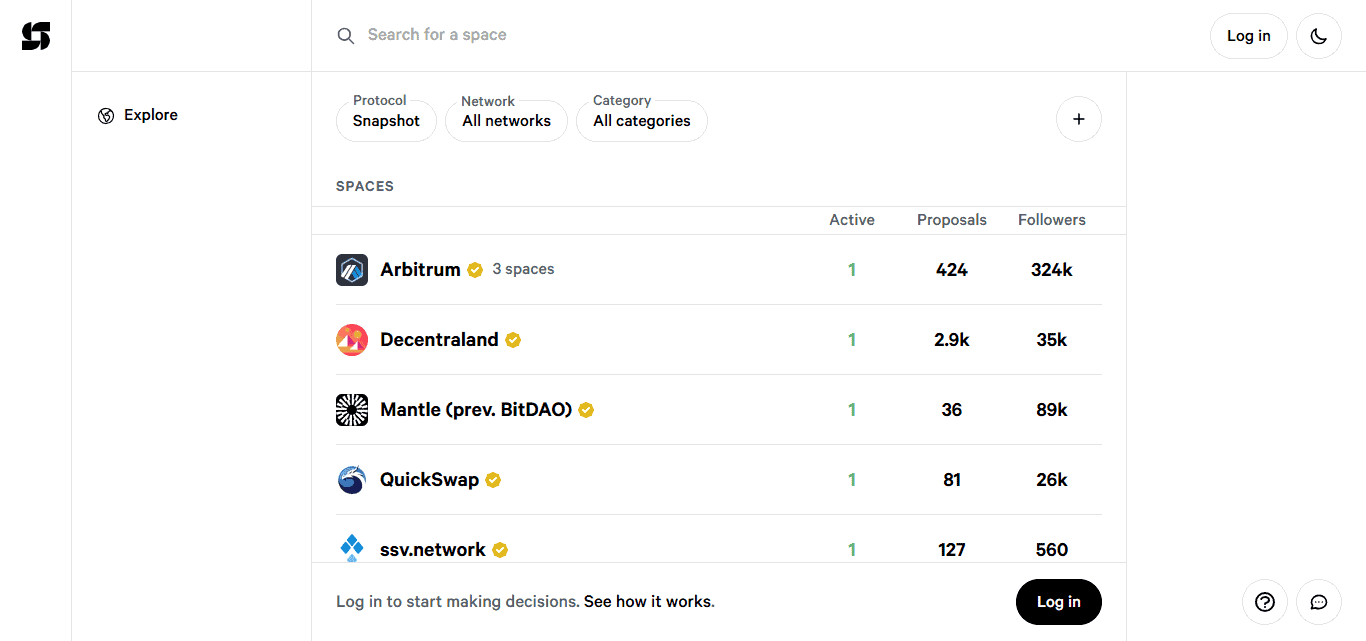
Additionally, Snapshot X offers modular on-chain governance infrastructure. Supported DAOs and Tokens: Custom voting-power techniques, NFTs, and ERC-20 governance tokens are all supported. DeFi protocols, NFT communities, and decentralized organizations looking for flexible governance can all benefit from it.
Features Snapshot
- Gasless voting is made possible for decentralized groups.
- It allows for customized proposal parameters and a variety of voting procedures
- Provides voting and delegation integrations based on tokens.
- Offers clear voting results and proposal management.
Best Use Cases:
- Polling the community without charging transaction fees.
- Overseeing DeFi protocol governance choices.
- NFT communities and decentralized groups are supported.
- Collecting stakeholder input using flexible voting processes.
3. Aragon
Aragon is a DAO governance platform that facilitates the development, administration, and customization of decentralized decision-making systems for companies. Its Aragon OSx architecture offers treasury administration, token-based voting, permission management, and modular governance plugins.

Organizations have the ability to set proposal rules, grant voting rights, and give representatives token-based voting authority. DAOs can upgrade or replace governance components as their needs evolve because to its modular nature. Blockchain Support: Depending on the network, Aragon OSx’s deployments and integrations are tailored to EVM-compatible blockchain setups.
Supported DAOs and Tokens: ERC20 is supported by its Token Voting plugin.wrapped regular ERC-20 tokens and governance tokens that are compatible with voting. Aragon is appropriate for DAOs that require flexible voting systems, secure permissions, and customisable governance.
Features Aragon
- Offers DAO management and governance tools that are modular.
Token-based voting is supported by customisable governance plugins. - Provides mechanisms for proposal execution and permissions that can be customized.Aids companies in overseeing decentralized decision-making procedures.
Best Use Cases:
- Developing and overseeing specialized decentralized groups.
- Putting in place voting and governance systems based on tokens.
- Overseeing organizational duties and DAO permissions.
- Creating adaptable governance frameworks for blockchain
4. OpenZeppelin
Blockchain projects may create safe, adaptable token governance systems with the aid of OpenZeppelin’s smart contract development tools. Proposals, voting, quorum setup, execution rules, and vote delegation are all supported by its Governor structure. Instead of creating every component from start, developers can mix several governance modules to create systems that meet specific DAO requirements.
Token holders can assign votes directly or through signed messages thanks to its ERC20Votes extension, which also keeps track of past voting power. Blockchain Support: EVM-compatible settings, such as Ethereum and related networks, are the main focus of OpenZeppelin Contracts.
Additional blockchain technologies are supported by its larger development environment using different tools. Supported DAOs and Tokens: ERC-20 governance tokens that use compatible voting interfaces and ERC20Votes are supported. Developers creating bespoke DAO governance contracts will find it especially
Features OpenZeppelin
- Provides secure and reusable smart contract governance frameworks.
- Supports voting delegation through ERC20Votes functionality.
- Offers Governor contracts for proposals and voting.
- Enables customizable quorum, voting periods, and execution rules.
Best Use Cases:
- Developing customized on-chain governance systems.
- Building secure token delegation mechanisms for DAOs.
- Creating proposal and voting infrastructure for protocols.
- Implementing transparent governance using smart contracts.
5. Colony
Colony is a decentralized platform for organizing teams, allocating tasks, overseeing finances, and rewarding contributions. Colony use reputation to gage members’ influence based on their contributions and finished work, in contrast to conventional token-weighted governance systems. Participants can manage organizational permissions, draft motions, settle conflicts, and reach decisions as a group thanks to its governance systems.

Members’ control over organizational operations and finances is also influenced by their reputation. Blockchain Support: Colony leverages Ethereum-based smart contract infrastructure to run its Colony Network. Supported Tokens and DAOs While individual colonies can employ reputation and supported token arrangements for governance
CLNY is the native token linked to the Metacolony. Certain governance operations require both native coins and reputation. Contributor-driven businesses looking for work-based accountability and decision-making can benefit from Colony.
Features Colony
- Measures member contributions using reputation-based governance.
Task management and contributor reward systems are offered.Supports the resolution of disputes and organizational motions. - Provides decentralized team management and resource distribution.
Best Use Cases:
- Overseeing decentralized organizations driven by contributors.Members are rewarded based on their contributions and finished tasks.
- Organizing project duties and decentralized teams.
- Encouraging community decision-making based on reputation.
6. DAOhaus
DAOhaus is a decentralized platform that uses the Moloch governance architecture to assist communities in setting up, running, and managing DAOs. Membership management, proposal filing, voting, governance configuration, and treasury coordination are all supported by its tools. By separating governance from treasury execution, Moloch V3 enables enterprises to link safe-based treasury infrastructure with governance choices.
Depending on how the DAO is set up, members can take part through governance shares or loot shares. Blockchain Support: The Ethereum Mainnet and Gnosis Chain are included in the DAOhaus Moloch V3 documentation as deployable environments, and its execution design facilitates EVM-compatible chains via networked infrastructure.
Supported Tokens/DAOs: ERC-20 membership shares and loot shares are used, and DAO configurations are adjustable. Communities looking for communal treasury management and flexible membership-based governance can consider DAOhaus.
Features DAOhaus
- The Moloch governance architecture facilitates the establishment of DAOs.Membership shares and proposal-based voting are supported.
- Treasury management is provided by a networked safe infrastructure.Customizable membership structures and governance norms are made possible.
Best Use Cases:
- Establishing membership-based, decentralized groups.
- Overseeing shared resources and community treasuries.
- Organizing decisions and suggestions among DAO members.
- Creating community-owned businesses and investment clubs.
7. Ink Finance
Ink Finance is a decentralized finance and DAO management platform designed to help organizations manage governance, financial operations, and community resources. It provides infrastructure for creating and operating decentralized organizations with configurable governance processes and financial management capabilities.

Its ecosystem uses governance mechanisms to support organizational decisions, token-based participation, and resource coordination. The platform also introduces QUILL as its native governance and utility token. Blockchain Support: Ink Finance is built around blockchain-based DAO infrastructure, with specific network compatibility depending on its deployment and integrations.
Supported Tokens / DAOs: QUILL serves as the native governance token of the Ink Finance ecosystem, while other DAOs can use their own governance tokens or platform configurations. It is relevant for organizations combining financial management and decentralized governance.
Features Finance:
- Offers an infrastructure for decentralized organizational and financial administration.
- Its native governance and utility token is QUILL.
- DAO-focused financial coordination and governance procedures are supported.
- Combines financial management capabilities with blockchain-based organizational tools.
Best Use Cases:
- Overseeing the financial operations of decentralized groups.Assisting with community cooperation and DAO governance.
- Investigating token-based involvement in financial systems.
- Organizing organizational activity and decentralized resources.
8. Boardroom
Token holders, delegates, and community members can better comprehend and engage in decentralized decision-making with the aid of Boardroom, a DAO governance and intelligence platform. Proposals, voting data, and organizational activities are all consolidated on its governance dashboard.
Additionally, the platform offers governance data via its API, which enables businesses and developers to incorporate DAO data into their apps. Proposals may be investigated, governance activities can be tracked, and decision-making within supported communities can be observed.

Blockchain Support: The DAOs and governance protocols incorporated into Boardroom’s platform and API determine the network coverage. Supported Tokens/DAOs: Rather than producing a single universal governance token, it offers governance information for integrated DAO tokens and protocols. Boardroom is helpful for recording proposals, monitoring delegates, and doing governance research.
Features of the Boardroom
- Dashboards for DAO governance data are centralized.
- Monitors changes in governance, voting, and proposals.Through developer-focused API interfaces, it provides governance data.
- Research delegates and protocol choices are made easier for users.
Best Use Cases
- Examining voting turnout and delegate performance.
Monitoring advancements in decentralized protocol governance. - Including governance data in analytical programs.
- Keeping an eye on governance suggestions from various DAOs.
9. MultiGov
Wormhole interoperability technology was used in the development of MultiGov, a cross-chain governance system. Instead of limiting governance involvement to a single chain, it enables decentralized organizations to coordinate ideas and voting across many blockchain networks.
Voting data is transferred to a single hub for aggregation via its architecture, which gathers votes from many blockchain networks. Through linked infrastructure, approved proposals can also initiate cross-chain execution.
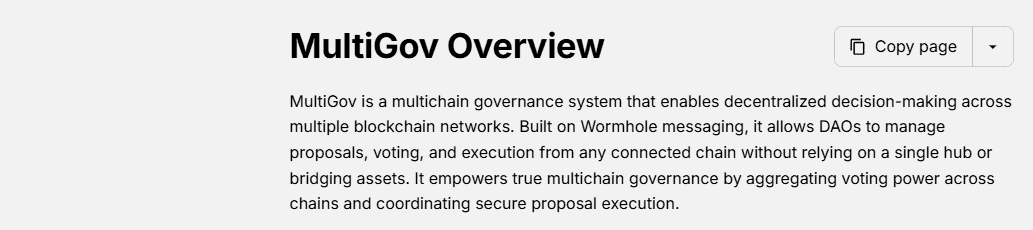
When tokens and users operate across multiple networks, this method aids communities in coordinating governance. Blockchain Support: An EVM hub with EVM and Solana Virtual Machine (SVM) spokes is supported by MultiGov; further network compatibility is contingent upon Wormhole integrations.
Supported Tokens/DAOs: It needs a governor that supports Flexible Voting, timestamp-based clock support, and governance tokens compatible with ERC20Votes. It works especially well with multichain DAOs.
Features:
- Enables cross-chain governance through Wormhole infrastructure.
- Supports governance coordination across EVM and SVM networks.
- Aggregates voting information from connected blockchain networks.
- Supports cross-chain proposal execution through interoperability infrastructure.
Best Use Cases:
- Coordinating governance across multiple blockchain networks.
- Managing voting participation in multichain DAOs.
- Connecting token holders across different blockchain ecosystems.
- Implementing unified governance for cross-chain protocols.
10. Torus
Torus offers a token-based governance approach for a blockchain ecosystem that enables community members to take part in protocol decisions. Voting on suggestions pertaining to network parameters, treasury allocations, emissions, and protocol development is made possible by its DAO governance structure.
Stakeholders can affect the network’s future course because voting power is proportionate to token ownership. When participants fulfilll the necessary stake requirements and take part in governance talks, they can submit recommendations.

Blockchain Support: Torus’s governance is distinct from that of general-purpose multichain delegation software; it functions via its own blockchain network and related protocol infrastructure. Supported DAOs and Tokens: The Torus DAO uses TORUS as its native governance token. This makes it pertinent to protocol-level decision-making and token-based community governance.
Features:
- Uses TORUS as its native governance token.
- Supports token-holder participation in protocol decisions.
- Enables voting on treasury and network-related proposals.
- Provides governance mechanisms for its blockchain ecosystem.
Best Use Cases:
- Supporting community participation in protocol governance.
- Managing token-based voting for network decisions.
- Coordinating treasury-related governance proposals.
- Allowing TORUS holders to influence protocol development.
Conclusion
In conclusion, DAOs and blockchain communities can enhance voting participation, transparency, and decentralized decision-making by selecting the top token governance delegation platforms. Blockchain connectors, delegation mechanisms, and various governance capabilities are provided by platforms such as Tally, Snapshot, Aragon, and OpenZeppelin.
To identify the best option for your organization’s governance needs, evaluate a platform’s security, supported tokens, network compatibility, and usefulness before choosing one.
FAQ
Which Are the Best Token Governance Delegation Platforms?
Popular options include Tally, Snapshot, Aragon, OpenZeppelin, Colony, DAOhaus, Ink Finance, Boardroom, MultiGov, and Torus.
How Does Token Governance Delegation Work?
Token holders assign their voting power to trusted delegates, who vote on proposals according to community interests.
Why Is Token Delegation Important for DAOs?
Token delegation increases governance participation, reduces voting barriers, and allows experienced representatives to influence decentralized decisions.
Which Platform Supports Gasless Governance Voting?
Snapshot is well known for gasless off-chain voting, allowing eligible community members to participate without paying blockchain transaction fees for votes.