In this article, I’ll explore the Top Chia Network Competitors for Green Farming, with an emphasis on blockchain platforms that focus on energy efficiency, decentralized storage, and sustainable digital infrastructure.
We’ll look at their technologies, consensus mechanisms, storage, scalability and potential applications in agriculture and help readers understand how Filecoin, Spacemesh, Signum, Arweave, Storj, Sia, Algorand, Hedera, Cardano and ScPrime compare to Chia.
Key Points
| Chia Network Competitor | Explanation |
|---|---|
| Filecoin (FIL) | Decentralized storage network supporting sustainable data infrastructure and distributed resource utilization. |
| Alephium (ALPH) | Energy-efficient blockchain architecture designed to reduce environmental impact through innovative consensus mechanisms. |
| Signum (SIGNA) | Eco-friendly blockchain using low-energy mining while supporting decentralized applications and digital transactions. |
| Arweave (AR) | Permanent decentralized storage network offering efficient, long-term data preservation for sustainable applications. |
| Storj (STORJ) | Distributed cloud storage platform improving resource efficiency through decentralized data storage infrastructure. |
| Sia (SC) | Decentralized storage marketplace enabling efficient utilization of unused storage capacity worldwide. |
| Algorand (ALGO) | Energy-efficient blockchain supporting sustainable applications, payments, and environmentally conscious decentralized infrastructure. |
| Hedera (HBAR) | Low-energy distributed ledger enabling sustainable applications with fast transactions and efficient network operations. |
| Cardano (ADA) | Energy-efficient proof-of-stake blockchain supporting sustainable decentralized applications and global digital infrastructure. |
| ScPrime (SCP) | Decentralized storage ecosystem focused on secure, efficient, and environmentally conscious data management. |
10 Top Chia Network Competitors for Green Farming
1. Filecoin (FIL)
Filecoin is a decentralized storage network that transforms untapped storage capacity into a global marketplace. It’s consensus uses Proof-of-Replication and Proof-of-Spacetime so storage providers can prove that data is stored correctly over time Its energy profile is tied to the hardware and consensus operations of the storage provider.

Filecoin can hold huge agricultural data sets, sensor records and farm images. Filecoin is more of a decentralized storage market than Chia, which uses Proof of Space and Time. Its drawback is the technical complexity of the participation of the storage providers.
Filecoin (FIL) Features
- Proof-of-Replication and Proof-of-Spacetime for verifiable storage.
- Supports large scale distributed storage infrastructure.
- Enables storage providers to monetize unused disk space.
- Marketplace for decentralized data storage, buy and sell.
| Pros | Cons |
|---|---|
| Large decentralized storage ecosystem | Storage-provider setup can be technically complex |
| Verifiable storage through cryptographic proofs | Energy use depends on provider hardware and operations |
| Supports large-scale data storage | Costs can vary with network conditions |
| Useful for agricultural data infrastructure | Not specifically designed for green farming |
2. Spacemesh (SMH)
Spacemesh is a decentralized blockchain based on storage-based participation and a scalable consensus architecture. It’s mining process is based on Proof of Space-Time, where miners have to dedicate committed hard-drive space and prove ongoing eligibility.
This approach reduces dependence on ongoing computational competition relative to traditional Proof-of-Work mining. Not a major farming-storage platform but its storage-based architecture is able to support decentralized network participation.

Similar to Chia, Spacemesh also uses storage resources for consensus, so it has a similar sustainability angle. The downside is that the direct applications of green farming are still quite niche.
Spacemesh (SMH) Features
- Blockchain for decentralized participation based on storage.
- Uses the Proof-of-Space-Time consensus algorithm.
- Intended to reduce dependence on computational mining.
- Supports scalable distributed blockchain applications.
| Pros | Cons |
|---|---|
| Uses storage-based Proof-of-Space-Time | Requires substantial allocated disk space |
| Designed for decentralized participation | Smaller ecosystem than major blockchains |
| Reduces reliance on computational mining | Hardware requirements can still affect efficiency |
| Provides a sustainability-oriented consensus approach | Limited direct agricultural applications |
3. Signum (SIGNA)
Signum is a blockchain ecosystem with storage-oriented participation and energy-efficient network operation. It uses available disk space, instead of requiring heavy computational mining, through its Proof-of-Capacity mechanism.

It can cut down the electricity consumption in comparison to the traditional Proof-of-Work systems, but also enable participants to provide storage resources. Signum can assist with decentralized transactions, data coordination and machine-to-machine systems for agriculture applications.
Signum is similar to Chia in that it is focused on storage capacity as a network resource but the architecture and ecosystem is different. The flip side is a smaller ecosystem of agricultural applications and less focus on dedicated farming infrastructure.
Signum (SIGNA) Features
- Uses Proof-of-Capacity to take part in the network through storage.
- Makes cryptocurrency mining energy-aware.
- Enables intelligent contracts and decentralized apps.
- Enables users to use available disk storage.
| Pros | Cons |
|---|---|
| Uses Proof-of-Capacity mining | Requires dedicated storage capacity |
| Lower computational requirements than traditional PoW | Smaller network ecosystem |
| Supports smart contracts and applications | Mining profitability can fluctuate |
| Utilizes available disk resources | Limited green-farming-specific infrastructure |
4. Arweave (AR)
Arweave is a decentralized storage network that aims to provide permanent data availability for long durations. It has a blockchain-based architecture combined with storage incentives and its protocol uses Succinct Proofs of Random Access (SPoRA) to prove access to historical data.
Energy needs are driven by storage and consensus operations, not typical cloud infrastructure. Arweave can store farm records, environmental measurements, satellite imagery, and agricultural datasets.

Arweave is more geared toward permanent data storage (relative to Chia) while Chia provides more general blockchain infrastructure. Its disadvantage is the different cost and data-management implications that permanent storage can introduce.
Arweave (AR) Features
- Permanent decentralized data storage.
- For long term data availability and preservation.
- Uses blockchain based economic incentives for the storage providers
- Suitable for applications that require durable and accessible data sets.
| Pros | Cons |
|---|---|
| Designed for permanent decentralized storage | Permanent storage can create higher long-term commitments |
| Strong data-preservation capabilities | Primarily focused on storage rather than farming |
| Suitable for large historical datasets | Protocol economics can be complex |
| Useful for preserving agricultural records | Storage requirements can grow over time |
5. Storj (STORJ)
Storj is a decentralized cloud object storage that utilizes the unused storage capacity of independent nodes. Scalable, resilient storage. Files are encrypted, sliced and geo-distributed. Storj is committed to sustainability by leveraging underutilized hardware and decreasing the dependency on traditional centralized data centers.

It can store IoT readings, crop images, drone data, farm records etc for green farming. Unlike Chia, which is primarily about blockchain consensus, Storj is mostly about decentralized cloud storage. The only problem with STORJ is that it’s really more of a storage service than a farming blockchain.
Storj (STORJ) Features
- Shares data among several places in encrypted form.
- Uses spare storage capacity of independent operators
- Offers scalable storage for applications and large data sets.
- Decentralized cloud storage with distributed storage nodes.
| Pros | Cons |
|---|---|
| Decentralized cloud-storage architecture | Requires reliable node infrastructure |
| Data is encrypted and distributed | Primarily a storage platform |
| Uses distributed unused storage capacity | Performance can depend on network conditions |
| Suitable for agricultural datasets and backups | Not a direct blockchain-consensus competitor to Chia |
6. Sia (SC)
Sia is a decentralized cloud-storage platform based on a peer-to-peer architecture and a Proof-of-Work blockchain. Its network allows users to purchase decentralized storage from independent providers, creating a marketplace for unused capacity.

Sia uses Proof-of-Work, which consumes more computational energy than storage-oriented or Proof-of-Stake variants in its consensus. Sia can offer decentralized storage for sensor data, farm documents, imagery and operational backups for green farming.
Unlike Chia, Sia combines decentralized storage with the Proof-of-Work model, instead of Chia’s Proof-of-Space-and-Time model. Its main drawback is its higher demand for consensus energy.
Sia (CS) Features
- Decentralized peer-to-peer cloud-storage marketplace.
- Connects users to independent storage providers.
turns into a market resource unused storage capacity. - Supports distributed data storage, with encryption and redundancy.
| Pros | Cons |
|---|---|
| Decentralized storage marketplace | Uses Proof-of-Work consensus |
| Makes unused storage capacity available | PoW requires computational resources |
| Supports distributed and redundant storage | Storage management can require technical knowledge |
| Useful for decentralized data infrastructure | Less focused on agricultural applications |
7. Algorand (ALGO)
Algorand is a scalable blockchain using Pure Proof-of-Stake (PPoS) where cryptographic randomness selects the block proposers and validator committees. The consensus is designed to minimize computational competition and energy consumption.
Unlike Chia, Algorand doesn’t provide decentralized storage but its fast transaction infrastructure could underpin agricultural payments, supply-chain monitoring, carbon records and intelligent contracts.

Unlike Chia which is focused on storage-based consensus, Algorand is focused on energy-efficient blockchain transactions. This is limited as it may require separate storage infrastructure for large agricultural datasets.
Algorand (ALGO) Features
- Employs Pure Proof-of-Stake consensus.
- Built for scalable and efficient blockchain transactions.
• Support for intelligent contracts and dApps. - Suitable for sustainability, payments, and supply-chain apps.
| Pros | Cons |
|---|---|
| Uses energy-efficient Pure Proof-of-Stake | Does not provide native decentralized storage like Chia |
| Supports smart contracts | Requires external storage for large datasets |
| Designed for scalable transactions | Smaller ecosystem than some established platforms |
| Suitable for sustainability applications | Not primarily a storage-focused network |
8. Hedera (HBAR)
Hedera employs the hashgraph distributed consensus algorithm with Proof-of-Stake governance, gossip-based communication, and virtual voting. Its network is built for low energy consumption and high transaction throughput, with current sustainability metrics published by Hedera.

Hedera’s services can be used to support supply-chain records, sustainability reporting, carbon tracking and timestamped agricultural data for green farming.
Unlike Chia, Hedera is more of a transaction and consensus network than a storage-centric blockchain. Its limitation is that large scale agricultural data storage generally needs external systems.
Hedera (HBAR) Features
- Runs on hashgraph distributed ledger technology.
- Network Security based on Proof of Stake.
- Enables fast transactions and high throughput.
- Supports enterprise sustainability and tracking applications.
| Pros | Cons |
|---|---|
| Uses energy-efficient hashgraph technology | Different architecture from Chia |
| Supports high transaction throughput | Not designed primarily for decentralized storage |
| Suitable for enterprise applications | Large datasets require additional storage systems |
| Useful for sustainability tracking | Governance structure differs from fully permissionless models |
9. Cardano (ADA)
Cardano is a Proof-of-Stake blockchain built on top of the Ouroboros consensus protocol, which relies on stake pools and a randomized leader election. Cardano’s design requires less energy than Proof-of-Work systems.
Its scalable blockchain infrastructure supports smart contracting, agricultural traceability, sustainability records, payments and decentralized applications. Chia incorporates storage capacity into its consensus design

While Cardano focuses on stake-based blockchain security and application development. The only downside is that Cardano does not natively offer Chia-style decentralized storage capacity, so agricultural data may need extra infrastructure.
Cardano (ADA) Features
- It supports intelligent contracts and decentralized apps.
- Built for scalable blockchain development.
Good for sustainability, traceability, and agriculture applications - Implements the Proof-of-Stake consensus protocol, Ouroboros.
| Pros | Cons |
|---|---|
| Uses energy-efficient Proof-of-Stake | Does not natively focus on decentralized storage |
| Supports smart contracts and dApps | Agricultural storage requires additional infrastructure |
| Designed for scalable blockchain applications | Development can be technically complex |
| Suitable for sustainability and traceability | Transaction functionality differs from Chia’s storage model |
10. ScPrime (SCP)
ScPrime is a Sia-based ecosystem of decentralized cloud storage. It uses distributed storage in conjunction with client-side encryption and blockchain-based coordination. Its architecture makes use of Proof-of-Work consensus, according to its technical documentation.
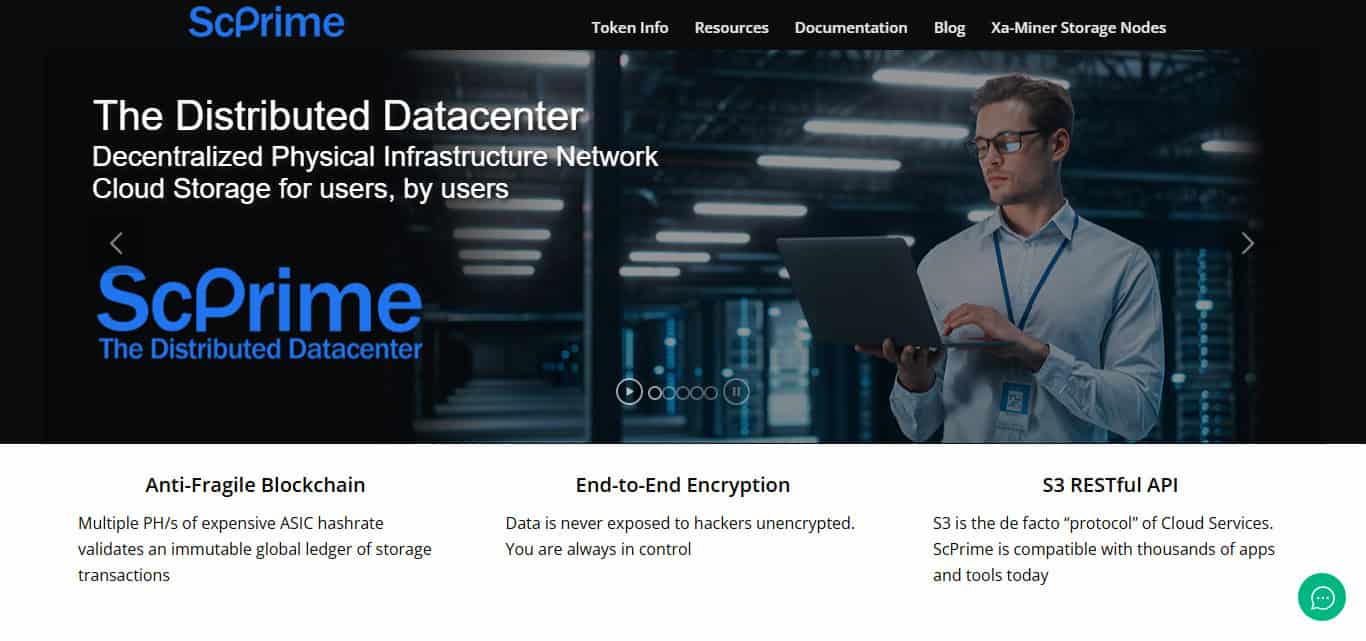
Storage providers offer capacity . Users are able to store data on a distributed network . ScPrime is useful for backups, agricultural datasets, sensor data, and operational data for green farming.
Chia is a hybrid of blockchain functionality and storage-based consensus, whereas ScPrime is more directly targeted at decentralized cloud storage than Chia. The only drawback is that Proof-of-Work consumes more energy than Chia’s storage-based consensus model.
ScPrime (SCP) Features
- Decentralized cloud storage ecosystem on distributed infrastructure.
- Offers encrypted and redundant storage for data.
- lets users tap into decentralized storage resources.
- Provides safe storage of business and application data.
| Pros | Cons |
|---|---|
| Focuses on decentralized cloud storage | Uses Proof-of-Work consensus |
| Provides encrypted distributed storage | PoW increases computational energy requirements |
| Supports redundant data storage | Smaller ecosystem and adoption |
| Useful for business and agricultural datasets | Requires reliable storage infrastructure |
Conclusion
In conclusion Chia Network’s competitors are using different methods for creating sustainable blockchain and decentralized infrastructure for green farming. Filecoin, Arweave, Storj and Sia are all focused on decentralized storage, while Algorand, Hedera and Cardano are targeting energy-efficient blockchain networks.
Spacemesh and Signum follow storage-oriented models, while ScPrime is focused on decentralized storage. Comparing energy use, scalability, storage capabilities, security, and agricultural applications aids in selecting the appropriate technology for specific farming needs.
FAQ
What are the top Chia Network competitors for green farming?
Filecoin, Spacemesh, Signum, Arweave, Storj, Sia, and Algorand are alternatives.
Why is Chia considered suitable for green farming?
Chia uses storage-based consensus, reducing reliance on intensive computational mining.
Which competitor focuses primarily on decentralized storage?
Filecoin provides decentralized storage infrastructure for large-scale agricultural datasets.
Which alternatives use energy-efficient blockchain consensus mechanisms?
Algorand, Hedera, and Cardano use energy-efficient Proof-of-Stake approaches.