In this article, I examine some of the best options for compute and GPU token marketplaces used in Web3. I will look at some platforms that have a focus on providing decentralized computing and GPU resources.
I will explore how these marketplaces connect providers with users and incorporate AI and Web3 workloads, use native blockchain tokens, and provide more creative options to traditional centralized cloud services for developers and businesses.
Key Points & Top Compute and GPU Token Marketplaces for Web3
- Akash Network: Decentralized cloud marketplace connects GPU providers with developers needing scalable computing resources globally.
- io.net: Aggregates distributed GPUs, enabling AI workloads through decentralized infrastructure and token incentives.
- Render Network: Decentralized GPU marketplace lets users rent rendering power using blockchain-based payments.
- Golem Network: Peer-to-peer computing marketplace allows users to exchange unused computational resources for tokens.
- Nosana: Decentralized GPU cloud provides affordable AI computing through globally distributed community infrastructure.
- Aethir: Enterprise-focused decentralized GPU network delivers scalable compute resources for AI and gaming.
- Clore.ai: GPU marketplace connects providers and renters, supporting AI, rendering, and cryptocurrency workloads.
- Bittensor: Decentralized machine-intelligence network rewards specialized computational contributions through its blockchain economy.
- Flux: Decentralized cloud infrastructure marketplace provides distributed computing resources for Web3 applications and developers.
- Vast.ai: GPU rental marketplace offers competitive computing access, increasingly useful alongside decentralized Web3 infrastructure.
- Theta EdgeCloud: Distributed computing platform combines edge resources for AI workloads, media, and Web3 applications.
- CUDOS: Decentralized computing network enables users to access distributed resources through blockchain-powered infrastructure markets.
12 Top Compute and GPU Token Marketplaces for Web3
1. Akash Network
Akash Network permits developers to build with resources available on its decentralized Cloud commoditization marketplace. Participants (vendors) provide available CPUs, GPUs, and memory and storage resources.
Akash uses market-driven pricing, where developers post requests detailing the desired resources. An iteration of the request is then posted to the marketplace for vendors to build pricing around (bid on). Akash supports Cloud deployments for workloads such as AI inference, machine learning and is compatible with containers.
AAKT is the utility token that provides economics and participation to providers. Akash Network is specialized for developers looking to build with flexible infrastructure and minimize reliance to centralized Cloud providers.
Akash Network Features
- Decentralized Cloud: A marketplace that matches infrastructure providers with developers in need of cloud flexiibility.
- GPU Computing: Provides compute instances with data processing units for AI and other demanding workloads.
- Containerized Deployments: Used for the deployment of Web3 applications within a container.
- AKT Token: Used for network economics, participation of providers, and incentivization of the ecosystem.
| Pros | Cons |
|---|---|
| Decentralized infrastructure reduces reliance on traditional cloud providers. | Decentralized infrastructure can introduce varying provider reliability. |
| Offers GPU resources for AI and machine-learning workloads. | GPU availability may fluctuate depending on provider participation. |
| Containerized deployments simplify application deployment and management. | Beginners may need technical knowledge to configure deployments. |
| AKT token supports the network’s decentralized economic model. | AKT price volatility can affect overall ecosystem economics. |
2. io.net
io.net is a purpose built GPU based AI and machine learning workload centered network that aggregates GPUs from distributed data centers, crypto mining and other infrastructure into distributed GPU clusters.
Developers can leverage the clusters to perform model training, inference, reinforcement learning and hyperparameter tuning. The network uses IO tokens to implement its economic policies. Like many networks, io.net implements supplier staking to create an economic incentive to maintain network security.
io.net intends to provide developers with sufficiently large computational capacity to perform large scale AI and ML computations without relying on centralized cloud service providers.
io.net Features
- Distributed GPUs: Infrastructure for the computation of workloads integrated with multiple GPU sources.
- AI Workloads: Training, inference, reinforcement learning, and optimization within the distributed framework.
- GPU Clustering: Provides a scalable computational framework built on distributed hardware.
- IO Token: For its decentralized system and networks, and the associated incentives, io.net uses IO token.
| Pros | Cons |
|---|---|
| Aggregates distributed GPUs to create scalable computing capacity. | Distributed hardware can create consistency and reliability challenges. |
| Specifically designed around AI and machine-learning workloads. | Primarily focused on specialized computational use cases. |
| GPU clustering can support demanding AI applications. | Performance may vary between different underlying hardware providers. |
| IO token creates economic incentives for ecosystem participants. | Token volatility can influence participation and operational costs. |
3. Render Network
Render Network provides a decentralized GPU platform that originally focused on rendering, but is expanding to support AI related workloads.
Legislated by the demand for extreme GPU workloads, Render Network provides high-end GPU resources to creators that need them and connects resource contributors to the network. With a decentralized architecture, interested parties can compute intensive workloads that could tax local resources.
RENDER is the current Solana-based token of the blockchain. Certain computational work burns RENDER tokens to acquire Render Credits, while GPU nodes are rewarded with token emissions. The model aligns blockchain incentives with real-world graphics, rendering, and AI-compute needs.
Render Network Features
- GPU Marketplace: Matches demand with supply for compute infrastructure.
- Rendering Support: Pactivation fo distributed computing for graphics and visual computing workloads
- AI Computing: Adding capabilities and functionality to perform AI and ML operations.
- RENDER Token: Token used in blockchain-based computation and payment systems.
| Pros | Cons |
|---|---|
| Provides decentralized access to substantial GPU rendering capacity. | Originally focused heavily on rendering rather than general computing. |
| Well suited for demanding graphics and visual-production workloads. | Availability depends on participating GPU node capacity. |
| Expanding capabilities create opportunities for AI-related workloads. | AI capabilities may not match specialized AI cloud platforms. |
| RENDER provides blockchain-based economic coordination. | Token-based transactions introduce cryptocurrency market volatility. |
4. Golem Network
Golem Network is a peer-to-peer decentralized computing network that lets users access or offer computing resources, avoiding centralized cloud offerings. This network is made up of computing providers and computing requestors.
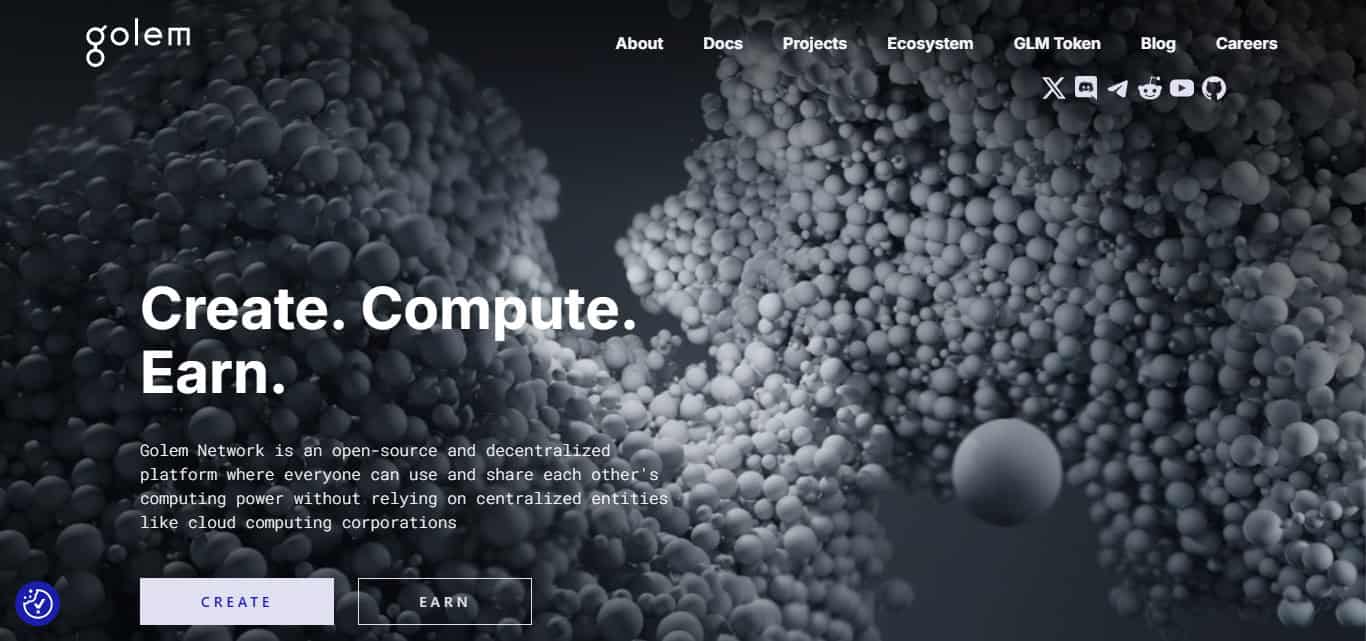
GLM is the token of this network and facilitates all economic interactions between computing providers and computing requestors. Golem supports multiple computational tasks. For most users, the most relevant service is rendering.
However, Golem supports data processing, distributed computational tasks, and the development of decentralized applications. Its aim is to create a computational marketplace with a token economy.
Golem Network Features
- Peer-to-Peer Computing: Connects participants to a decentralized network for sharing computing resources.
- Resource Providers: Monetizes computing resources that would otherwise go unused.
- Multiple Workloads: Supports rendering, data processing, distributed applications and other computational tasks.
- GLM Payments: GLM token is used for all payments and economic activities on the network.
| Pros | Cons |
|---|---|
| Peer-to-peer architecture enables decentralized computing resource sharing. | Resource performance can vary significantly among providers. |
| Helps users monetize otherwise unused computing capacity. | Some workloads require additional configuration and technical expertise. |
| Supports rendering, processing, and distributed computational workloads. | It may not provide specialized enterprise GPU infrastructure. |
| GLM enables decentralized payments between network participants. | Cryptocurrency price fluctuations can affect payment economics. |
5. Nosana
Nosana aims to provide on-demand GPU compute infrastructure for AI workloads and other high performance computing. Nosana offers a marketplace that connects requestors of GPU capacity with resource providers.
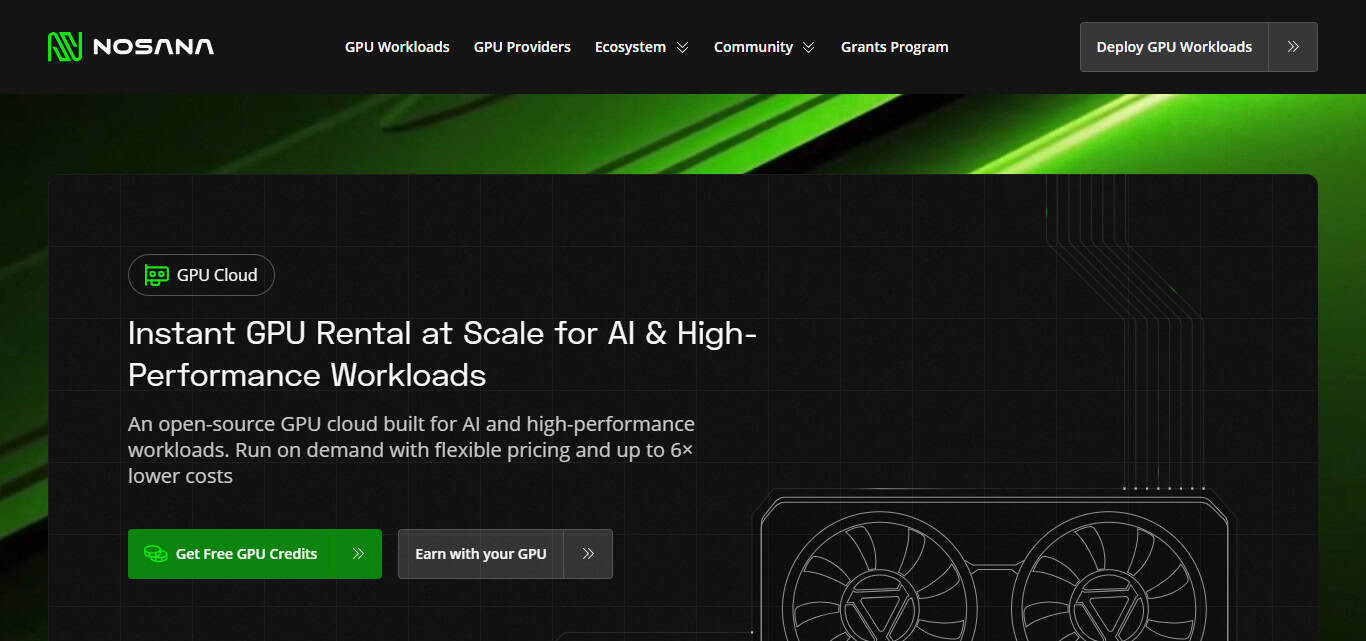
Developers can use this infrastructure for AI training and inference, rendering, simulation, and other computing workloads. It offers flexible access where user demand defines the scope of workloads.
Nosana supports staking and rewards for its projects, jobs, and GPU hosting on the Solana blockchain. This creates a Web3 economy for distributed GPU computing.
Nosana Features
- Decentralized GPUs: Creates a marketplace for providers of GPU and high performance computing (HPC) resources.
- AI Infrastructure: Supports workloads such as inference, training, fine-tuning and simulation.
- Flexible Scaling: Enables developers to dynamically scale computing resources based on the changing needs of the workload.
- Solana Integration: Employs Solana-based services for staking, task, hosting, and rewards networks.
| Pros | Cons |
|---|---|
| Focuses specifically on accessible decentralized GPU computing. | GPU availability depends on participating infrastructure providers. |
| Supports AI inference, training, and model-related workloads. | Advanced workloads may require careful infrastructure configuration. |
| Flexible access can reduce the need for dedicated hardware. | Decentralized infrastructure may have variable performance characteristics. |
| Solana integration enables fast blockchain-based ecosystem operations. | Dependence on blockchain infrastructure introduces additional considerations. |
6. Aethir
Aethir focuses on the enterprise AI, high performance computing, and gaming segments. Aethir supports AI computing, high performance computing, gaming, and other computing workloads.
Its ecosystem connects Cloud Hosts contributing GPU infrastructure to Cloud Customers requiring flexible computational capacity. The platform uses enterprise-grade GPUs and supports NVIDIA A100 and H100 systems.

Aethir’s ATH token is integrated into the payment and reward structures for participating infrastructure. Aethir’s infrastructure is UI/UX focused and is therefore highly relevant to AI companies and Web3 initiatives.
Aethir Features
- Enterprise GPU Cloud: Offers a distributed GPU computing service for heavy enterprise computing workloads.
- AI Support: Emphasizes GPU acceleration for heavy artificial intelligence workloads.
- Gaming Infrastructure: Catering to cloud gaming and other low-latency gaming services.
- ATH Token: Integrates ATH into the economy of the network, payments, participation, and infrastructure subsidies.
| Pros | Cons |
|---|---|
| Designed for enterprise-grade distributed GPU computing requirements. | Enterprise deployments can require more complex planning and integration. |
| Supports AI workloads requiring substantial GPU resources. | High-performance GPU resources can remain relatively expensive. |
| Targets gaming applications requiring low-latency infrastructure. | Network performance depends partly on geographic infrastructure availability. |
| ATH supports network participation and economic incentives. | ATH cryptocurrency volatility creates additional financial considerations. |
7. Clore.ai
Clore.ai’s GPU marketplace allows users to search and rent servers based on various factors including hardware model, VRAM, CUDA compatibility, price, and workload. Clore.ai supports several different use cases including AI training and inference, rendering, and other computationally intensive tasks.
Resource providers list their computing resources, and users can select the resource that best satisfies their requirements. The support for flexible marketplace-based GPU computing capacity makes Clore.ai a practical choice. CLORE is integrated into the ecosystem of the marketplace and fee-related services.
Clore.ai Features
- GPU Marketplace: Connects requestors and suppliers of GPU computing resources.
- Hardware Choice: GPU model, VRAM, pricing, location, and compatibility are some of the many petservices offered.
- Multiple Applications: AI training and inference, rendering, and cryptocurrency computing work are some supported applications.
- CLORE Ecosystem: CLORE is the foundation of economics for marketplace participation and subsidies.
| Pros | Cons |
|---|---|
| Provides a marketplace for comparing and renting GPU machines. | Individual provider quality and reliability can vary. |
| Users can evaluate hardware, VRAM, pricing, and compatibility. | Comparing numerous configurations may require technical knowledge. |
| Supports AI, rendering, and other GPU-intensive workloads. | Not every available GPU will suit demanding AI applications. |
| CLORE supports marketplace-related ecosystem incentives. | Token economics introduce additional cryptocurrency-related risks. |
8. Bittensor
Bittensor offers a decentralized marketplace for AI tasks and is not simply a case of renting out GPU capacity. Each specialized subnet is dedicated to a particular digital good or AI task. Miners provide computational or intelligence-related services, and validators assess the work done.
The Bittensor economy is built around TAO, the primary token. Block rewards are utilized to create an economic system for the development of decentralized AI.
As a result, Bittensor is critical for users within Web3 who want to build AI infrastructure, implement rewards, or transact in machine-intelligence markets.
Bittensor Features
- Decentralized AI: Creates a distributed computing ecosystem for machine intelligence.
- Specialized Subnets: Separate computational markets and differentiate AI services.
- Validators and Miners: Consensus and service evaluation platforms.
- TAO Economy: Employs subnets and TAO for subsidies.
| Pros | Cons |
|---|---|
| Creates decentralized markets around machine-intelligence services. | Bittensor is not primarily a conventional GPU rental marketplace. |
| Specialized subnets support different AI-related applications. | Understanding subnet architecture can be difficult for newcomers. |
| Miners and validators create performance-based network incentives. | Network participation can require substantial technical expertise. |
| TAO provides an economic mechanism for decentralized AI contributions. | TAO and subnet economics can be complex and volatile. |
9. Flux
Flux is a cloud computing infrastructure network constructed from user-operated computational nodes that span the globe. Developers have more flexibility in application deployment as they are no longer dependent on a single centralized infrastructure provider.
FluxCloud provides computing resources, application deployment, storage services, and marketplace services for decentralized applications.

Flux is broader than a dedicated GPU marketplace, as it provides distributed infrastructure for deploying applications, APIs, databases, and blockchain and other services.
Flux Features
- Decentralized Cloud: Builds a cloud computing platform using independently operated computational nodes.
- Web3 Hosting: Supports application deployment, databases, APIs, blockchains, and services.
- Container Support: Offers deployment of containerized applications.
- FluxNode Rewards: Provides subsidies for computational resources on the Flux network.
| Pros | Cons |
|---|---|
| Provides decentralized infrastructure for Web3 application hosting. | It is broader than a dedicated GPU marketplace. |
| Distributed nodes reduce dependence on centralized infrastructure providers. | Node performance and availability may vary across locations. |
| Supports applications, APIs, databases, and blockchain services. | GPU-specific workloads may have better-suited specialized alternatives. |
| FluxNode rewards encourage infrastructure providers to participate. | Operating infrastructure nodes requires technical and hardware resources. |
10. Vast.ai
Vast.ai is a GPU cloud marketplace that connects users to GPU suppliers that range from individual operators to professional data centers. Vast.ai’s marketplace lets customers compare suppliers based on GPU model, price, other hardware components, and location.

Users can deploy instances of computing resources almost instantaneously through the marketplace, thus providing computing services for training and running extensive workloads.
Compared to most blockchain-native networks listed herein, Vast.ai is a traditional marketplace, but its distributed provider model makes it relevant to the broader decentralized compute landscape.
Vast.ai Features
- GPU Marketplace: Allows you to browse various providers to find the configuration of GPU instances that works best for you.
- Hardware Comparison: Checks GPUs by their performance, memory, location, and pricing.
- AI Workloads: Supports GPU-related workloads for training and inference, and for workloads requiring large compute resources.
- Developer Tools: Tools to control compute instances via APIs, SDKs, and CLI.
11. Theta EdgeCloud
Theta EdgeCloud integrates cloud and edge computing resources to provide GPU infrastructure for AI and computationally intensive applications.
Its marketplace lets users search for offered GPU resources that can be community or hosted, and launch workloads based on price, reliability, and hardware specifications.

The infrastructure allows for the development of AI models, the running of GPU applications, training, and more. Theta’s larger ecosystem revolves around edge resources
That makes it viable to include Theta in Web3 infrastructure discussions. Instead of just providing a token-based GPU marketplace, EdgeCloud offers accessible compute along with Theta’s decentralized tech.
Theta EdgeCloud
- Distributed Computing: Combines cloud and edge computing resources.
- GPU Access: Access to GPUs for AI and compute intensive tasks.
- AI Workloads: Model development, training and inference, and other tasks that are GPU intensive.
- Edge Infrastructure: Utilizes Theta’s distributed compute network to increase capability globally.
| Pros | Cons |
|---|---|
| Offers extensive choices of GPU hardware configurations. | Vast.ai is not fundamentally a blockchain-native marketplace. |
| Users can compare pricing, specifications, and available machines. | Provider quality can differ between individual marketplace listings. |
| Supports AI training, inference, and experimentation workloads. | Users must understand GPU specifications for optimal selection. |
| APIs and developer tools support automated infrastructure management. | Advanced automation may require programming and cloud-computing knowledge. |
12. CUDOS
AI and GPU cloud services are the direction CUDOS is headed with its current ASI:Cloud product. This gives developers the needed GPU and AI model inference infrastructure.
Users can rent GPUs on an hourly basis and interact with model APIs through wallet-based services, all of which make it ideal for development on Web3.

The service has pre-built environments, serverless inference, and a global GPU marketplace, while its broader ecosystem connects CUDOS infrastructure with Artificial Superintelligence Alliance technologies.
The goal is to offer developers an easy way to utilize the building blocks of AI within one unified framework, including compute, models, services, and APIs.
CUDOS
- GPU Cloud: AI cloud ecosystem allowing developers to access GPU infrastructures.
- AI Inference: Access computing services for inference of AI models.
- Flexible Computing: GPUs can be rented based on the demand/workload of the user.
- Web3 Integration: Unifies decentralized infrastructure, AI, blockchain, and wallet.
| Pros | Cons |
|---|---|
| Combines cloud infrastructure with distributed edge computing. | Distributed infrastructure can introduce performance variability. |
| Provides GPU resources for AI and demanding applications. | GPU availability depends on participating infrastructure capacity. |
| Supports AI development, training, and inference workloads. | Advanced enterprise workloads may require additional configuration. |
| Distributed architecture can expand computing resources geographically. | Geographic distribution can affect latency for certain applications. |
Conclusion
In conclusion, the advent of Compute and GPU token markets is changing how Web3 projects can interact with decentralized infrastructure. Computing markets for AI, gaming, rendering, and blockchain are available on platforms like Akash, io.net, Render, Golem, Nosana, and Aethir
Marketplaces built on composable and interconnected infrastructure can include different layers such as token-based incentives and computing resources to make projects more accessible and scalable, while also offering resources that challenge the centralized cloud computing paradigm.
FAQ
How do decentralized GPU marketplaces work?
They connect GPU providers with users requiring computing power for various workloads.
Which Web3 GPU marketplace is best for AI?
The best choice depends on pricing, GPU availability, performance, and workload requirements.
What tokens are used in GPU marketplaces?
Platforms use native tokens such as AKT, RENDER, IO, GLM, and ATH.
Can developers use these marketplaces for AI training?
Yes, many platforms provide GPU resources suitable for training and inference workloads.