
The following paper will assess the Top Real Estate Crowdfunding Platforms for Fractional Property Investing.
I will dissect the features of these companies in terms of minimum investments, fees, benefits, and disadvantages. This article will help the new and experienced investor approach property ownership without having to buy the property.
Key Points
| Platform | explanation |
|---|---|
| Fundrise | Beginner-friendly platform with real estate investments starting at ten dollars. |
| Arrived | Jeff Bezos-backed platform offering rental and vacation properties to investors. |
| RealtyMogul | Offers REITs for non-accredited investors, plus private accredited opportunities. |
| EquityMultiple | Accredited investors access transparent commercial real estate projects through platform. |
| Groundfloor | Offers short-term real estate loans starting at just ten dollars. |
| CrowdStreet | Accredited investors access institutional-quality commercial real estate deals starting higher. |
| Lofty.ai | Uses blockchain tokenization to offer fractional ownership of rental properties. |
| Yieldstreet | Alternative investment platform offering commercial real estate, private credit, and notes. |
| SmartCrowd | The first regulatory approved buy-to-let system for fractional investment in Dubai residential properties, starting from about AED 500 (around €150). |
| Prypco Blocks | A local PropTech ecosystem offering fractional ownership in Dubai residential real estate starting from AED 500 |
10 Top Real Estate Crowdfunding Platforms for Fractional Property Investing
1. Fundrise
Fundrise was started in 2012 and has grown quickly to become one of the largest online real estate investment companies in the U.S.
Their plan was to make real estate investing similar to how real estate institutions do it, available to all. They hoped to do this while eliminating the large capital hurdles that are usually associated with real estate.
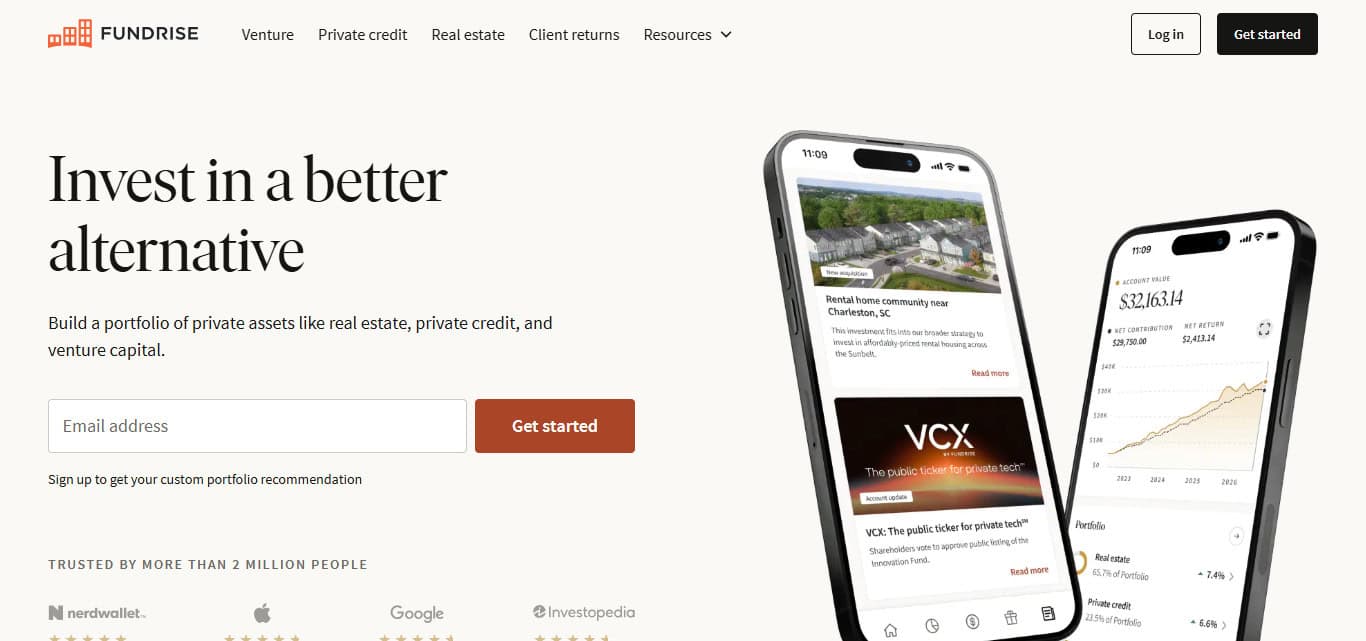
Through their online platform Fundrise offers participants real estate and private market investments with diversification.
For taxable accounts the minimum is $10 while for retirement accounts it’s $1,000. The fees vary for each investment product and plan, so take the time to read the offering prospectus for each before you invest.
Key Features Fundrise
- Low minimum: Beginner investors can fund their accounts with as little as $10.
- Investors can invest in a managed fund through Fundrise. Differing from other traditional investment options that require the purchase of an entire property, Fundrise opens a new avenue of investment.
- Investing in private real estate is simplified through Fundrise.
- Through Fundrise, investors can select investment plans based on their goals and the associated levels of risk and return.
| Pros | Cons |
|---|---|
| Very low $10 starting investment | Private investments can have limited liquidity |
| Suitable for beginners | Returns are not guaranteed |
| Diversified real-estate exposure | Fees vary by investment plan |
| Easy online investing | Investors do not directly control properties |
2. Arrived
Arrived was started in 2019 with the goal of making purchasing real estate investment properties more accessible to people who are not investment professionals.
Their started opening capital raises for their properties in March 2021, whereby investors could buy a property and portion of an individual real estate property and avoid the whole real estate property owning and operating responsibility.
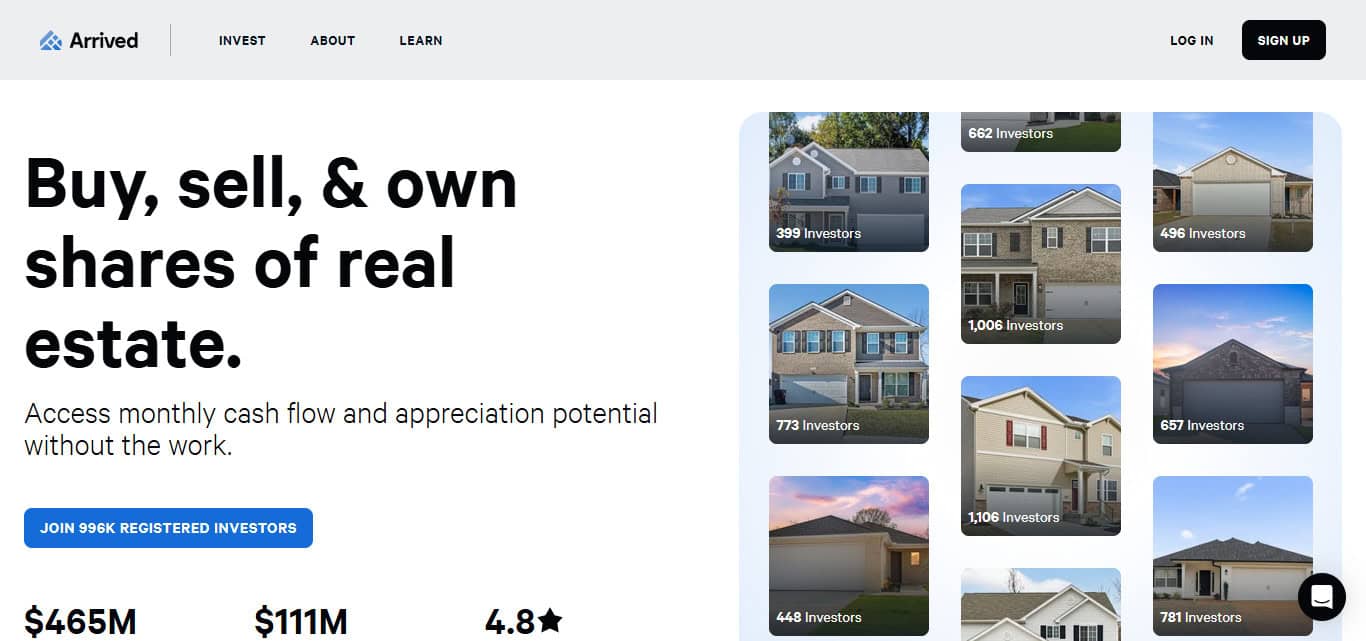
Arrived has since added real estate diversification and vacation rental properties to their service offerings. Their current minimum investment is $100.
Arrived charges an asset management fee that ranges from 0.10% to 0.30% of the investment, depending on the product. For single family residential properties, their AUM fee is 0.15% of the investment.
Key Features Arrived
- Fractional Ownership: Investors do not need to purchase an entire property to have exposure to rental homes.
- Focus on Residential: There are rental and vacation rental opportunities offered by the platform.
- Asset Management Fees: Currently, fees for AUM range from approximately 0.10% to 0.30% each quarter, depending on the offering.
| Pros | Cons |
|---|---|
| Accessible $100 minimum | Property-specific risks remain |
| Fractional rental-property exposure | Management fees reduce returns |
| Professional property management | Liquidity may be limited |
| Simple online experience | Investors don’t manage properties themselves |
3. RealtyMogul
RealtyMogul was started in 2013 and has become a synonym for real estate investment in the U.S. They offer their clients a lot of flexibility with their different investment options including non-traded REITS for non-accredited investors, and private real estate investment opportunities for accredited investors.
There is a $5,000 minimum to invest in a REIT through RealtyMogul, with additional investments starting at $1,000. There is a $0 cost to join the platform. Individual investments, however, may incur direct or indirect expenses that are disclosed in the offering documents.

Pursuant to prior offerings on the platform, the company’s focus was on providing investors with access to professionally structured commercial real estate investments (including income-producing multifamily properties), without requiring the investors to purchase the property.
Key Features RealtyMogul
- REIT Investment Minimum: RealtyMogul REIT investments have a $5,000 minimum, as opposed to many private deals which require $25,000 or $35,000.
- Commercial Property Investments: RealtyMogul funds office, retail, industrial, apartments, self-storage and all different forms of commercial property, as well as mixed-use property.
- Separate Offering Eligibility: Dependent on the offering, non-accredited investors are able to apply, and most private placements require accredited investors.
| Pros | Cons |
|---|---|
| Established real-estate platform | Higher minimums for individual deals |
| Multiple property categories | REITs are not highly liquid |
| Options for non-accredited investors | Investment-specific fees apply |
| Commercial real-estate exposure | Private deals generally require accreditation |
4. EquityMultiple
EquityMultiple is a United States real-estate private equity investment firm. The firm focuses on real assets and capital, particularly on commercial real estate. From a beginner investor standpoint, this firm is more advanced.
The minimum investment can be as low as $5,000, though they claim most offers have minimums of $10,000 to $30,000. Fees can vary depending on the investment structure.

In common equity investments, an annual reporting and monitoring fee of 0.5% to 1.5% is common. For most debt and preferred capital investments, servicing costs are set at 1%. Alpine Notes are described as being “fee free” to the investor. Additional capital costs may apply.
Key Features EquityMultiple
- Commercial Real Estate: EquityMultiple specializes in investing in private commercial real estate as well as structured investments in private equity.
- $5,000: Some opportunities start at $5,000, but often the minimum is $10,000, $15,000, or $30,000.
- Accredited Investors: Accredited-investor requirements and an appropriate U.S. tax identification number are among the requirements for most investors.
- Multiple Structures: Investments differ in several respects, such as risks, duration, the structure of the deal, and what might be earned.
| Pros | Cons |
|---|---|
| Access to commercial projects | Primarily for accredited investors |
| Detailed investment information | Higher investment minimums |
| Multiple investment structures | Private investments can be illiquid |
| Professional underwriting | Fees vary by offering |
5. Groundfloor
Groundfloor was started in 2013 and was the first lending company focused on both accredited and non-accredited investors, with a real estate backed lending focus.
Groundfloor, in comparison to other companies, historically did offer real estate backed lending, as opposed to selling shares of rental property. Current investment options for investors can be as low as $10 on individual loans, while Notes require investment in the range of $100 to $1,000.
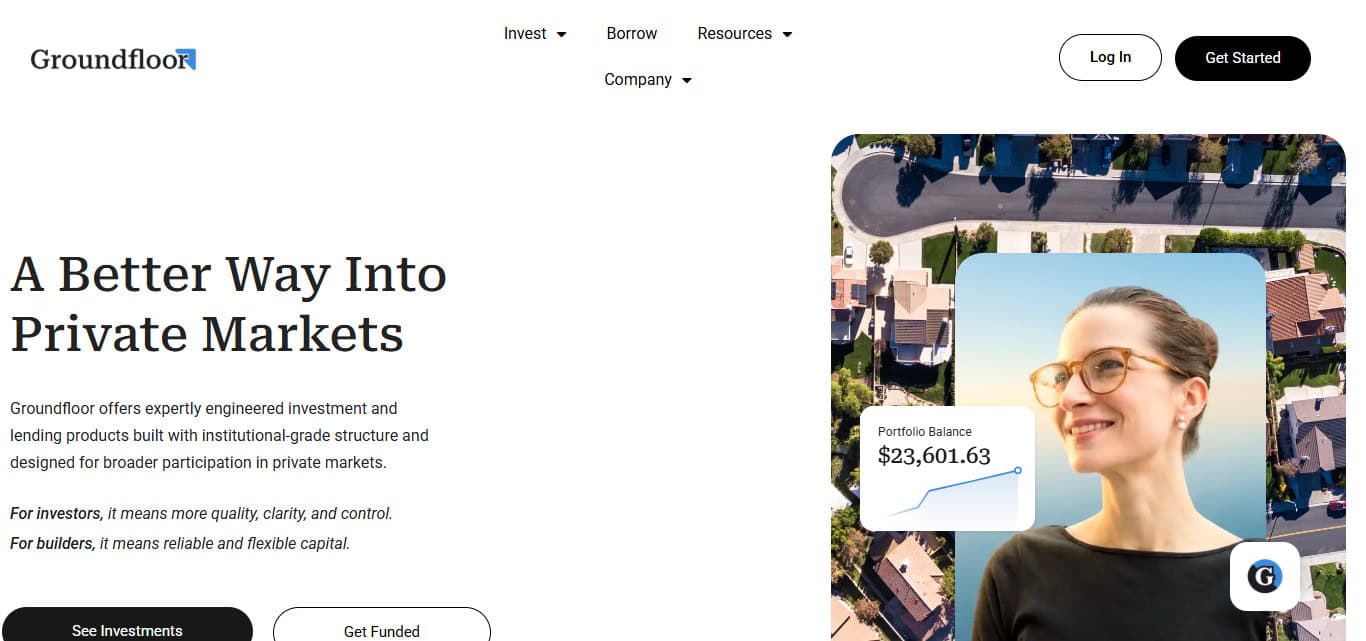
According to Groundfloor, Notes and Loans incur no investor fees. Emerging alternative and accredited products can contain fees.
Groundfloor does more than the traditional marketplace by originating, structuring, and managing investment opportunities. They underwrite and fund or originate investments themselves.
Key Features Groundfloor
- $10 Minimum: Investors can start with loans as low as $10.
- Real-Estate Debt: Groundfloor focuses more so on real-estate backed loans vs. traditional ownership of a fraction of a completed real-estate property.
- No Investor Fees: With Groundfloor, Notes and Loans supposedly charge no fees, although other products may have applicable fees.
- Flexible Offerings: Investors have the choice to invest in individual loans, or other products that they are eligible to invest in.
| Pros | Cons |
|---|---|
| Extremely low starting amount | Primarily debt rather than property ownership |
| No fees on Loans and Notes | Borrower default risk |
| Available to everyday investors | Returns aren’t guaranteed |
| Shorter-term opportunities available | Property-market conditions can affect repayment |
6. CrowdStreet
CrowdStreet was an online marketplace offering commercial real estate and institutional private-markets investments begun around 2014-2015. This investment marketplace targeted accredited investors starting at around $25,000 per investment rather than beginner clients.
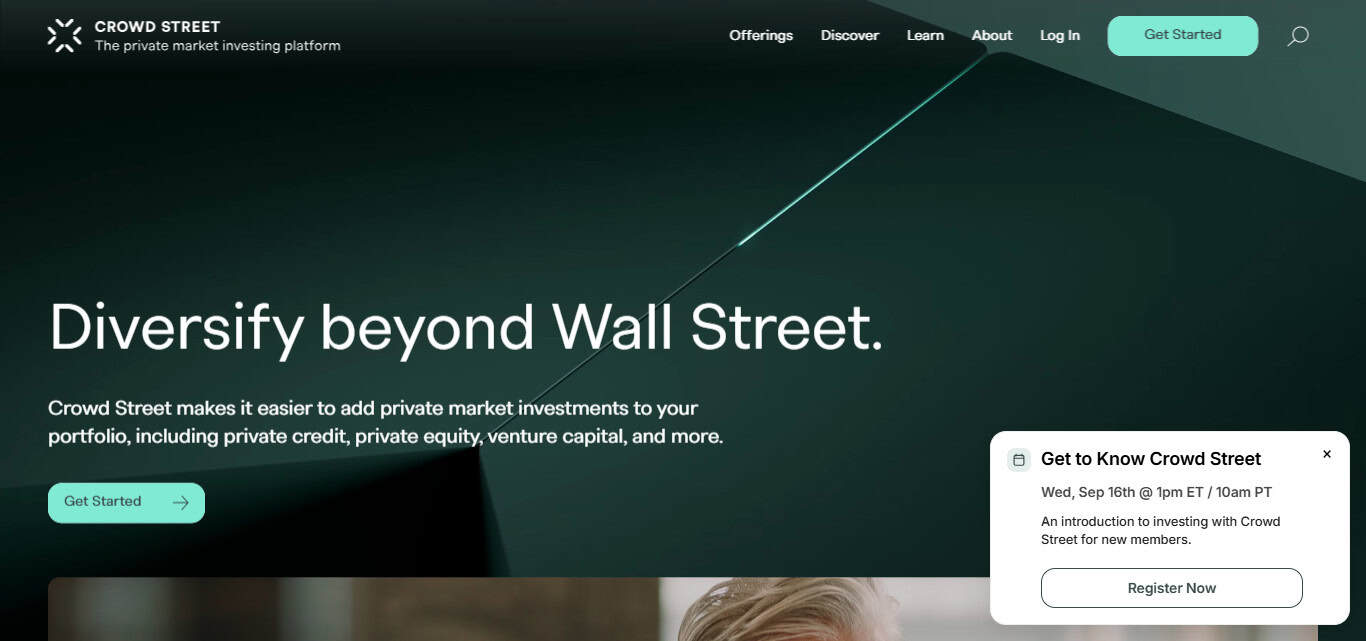
CrowdStreet’s platform differs from consumer-based investment marketplaces in that they do not charge an investment-platform fee.
Rather, asset sponsors may agree to pay fees for due diligence, placement, technology, or services. CrowdStreet has facilitated investment opportunities across several property sectors including multifamily, industrial, retail, self-storage, and hospitality.
Key Features CrowdStreet
- Commercial real estate: CrowdStreet operates in the market for private commercial real-estate investments.
- $25,000 minimum: Available offerings generally begin at $25,000. There are exceptions where offerings involve an investment of a higher amount.
- Accredited investors: Investors have to validate their accredited-investor status in order to access the offerings.
- Institutional-style opportunities: The Marketplace allows users to access opportunities to invest in projects sponsored by operators of commercial real-estate.
| Pros | Cons |
|---|---|
| Commercial real-estate opportunities | High minimum investment |
| Strong project selection | Accredited investors only |
| Online investment process | Private placements are illiquid |
| Large range of property strategies | Significant investment risk |
7. Lofty.ai
Lofty.ai, now referred to as just Lofty, was invested in by Y Combinator and was founded in 2018. In 2021, Lofty.ai launched its marketplace to offer fractional interests in U.S. rental properties to its investors.
Lofty.ai pioneered the use of blockchain to provide fractional ownership of properties, allowing its clients to purchase interests in properties as opposed to purchasing a property. Lofty.ai’s model has the goal of significantly decreasing the traditional barriers to ownership of real property.
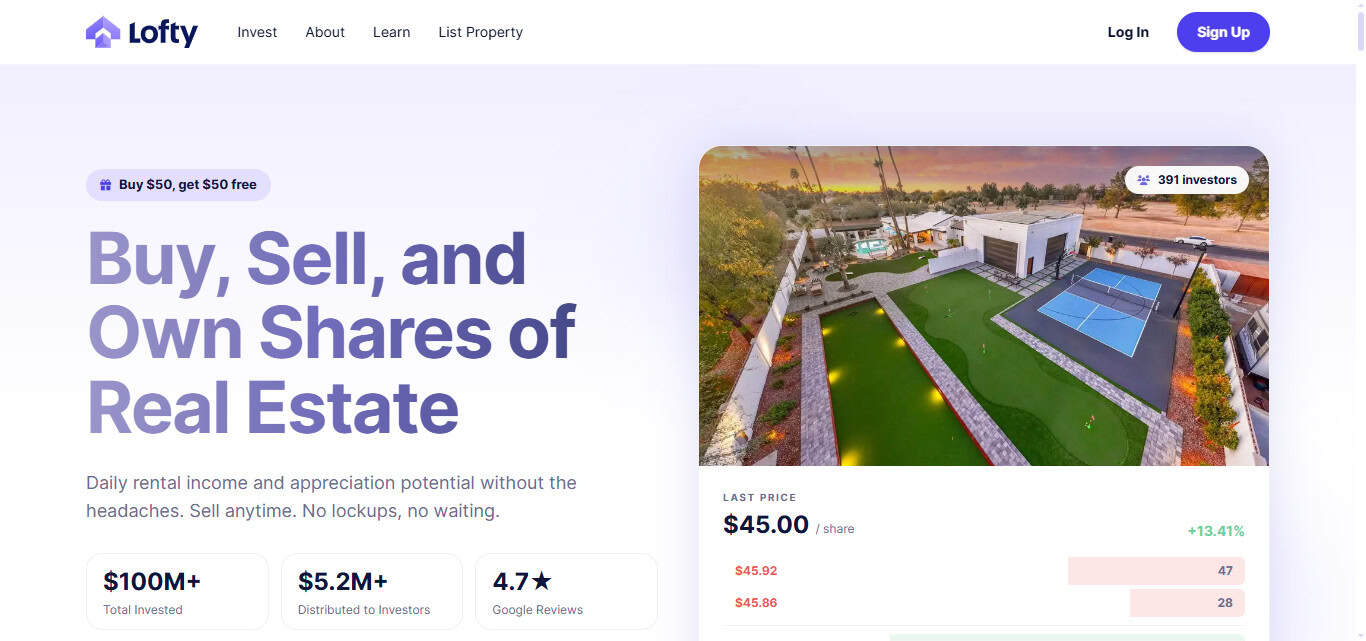
The company has historically had low minimum investments; however, this will vary by property and offering. Lofty.ai claims to have made thousands of rental ownership income distributions to investors.
Key Features Lofty.ai
- Fractional Property Ownership: Lofty helps investors to buy fractional interests of rental properties.
- used blockchain/tokenization: to represent fractional interests in ownership.
- Property exposure: Investors can have exposure to property investments without owning a property.
- Rental income: Investors may be able to receive the rental income of the property.
| Pros | Cons |
|---|---|
| Fractional property ownership | Blockchain adds technological complexity |
| Lower barrier than buying entire properties | Real-estate values can decline |
| Rental-income potential | Liquidity isn’t guaranteed |
| Technology-driven investment model | Property-specific risks remain |
8. Yieldstreet
Beginning in 2015, Yieldstreet started out in private real estate crowdfunding and has since expanded into a broader marketplace for private investments beyond real estate including private credit, structured notes, private equity, and other alternative investments.

Yieldstreet structures minimum investments and fees on an individual basis for each offering and based on the eligibility of each investor. Some offerings may require a significant capital allocation, while others may require a relatively lower capital allocation.
Fees for each investment may comprise management, servicing, origination, and/or other related fees. Yieldstreet’s background as a real estate private equity firm and its position as an alternative-investment firm outside the traditional real estate private equity space is relevant here.
Key Features Yieldstreet
- Alternative Investments: Yieldstreet offers private market investments that go beyond stocks and bonds.
- Real Estate Exposure: Through its platform, Yieldstreet offers commercial real estate as one of the available investment categories.
- Private Credit: Yieldstreet offers investment opportunities in private credit.
| Pros | Cons |
|---|---|
| Broad alternative-investment selection | Not exclusively a real-estate platform |
| Commercial real-estate opportunities | Investment minimums vary |
| Private-credit exposure | Fees vary by offering |
| Portfolio diversification potential | Alternative investments can be complex |
9. SmartCrowd
SmartCrowd is a Dubai company offering fractional ownership of U.A.E. residential properties via the Dubai International Financial Centre (DIFC) authorization and regulation by the Dubai Financial Services Authority (DFSA).
The minimum investment of AED 500 makes fractional ownership with SmartCrowd one of the more cost-accessible opportunities in Dubai. SmartCrowd’s fee structure consists of a 1.5% one-time fee, a 0.5% annual fee, and a 2.5% exit or sale fee relative
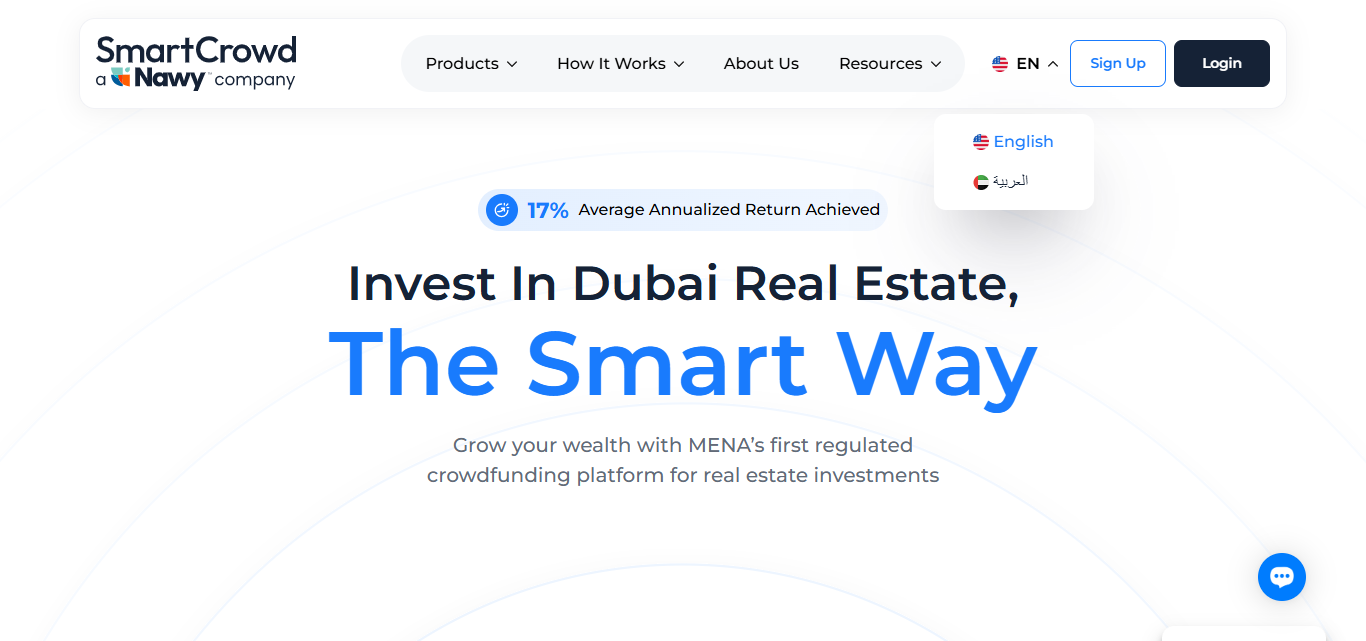
To the sale price of the property. These fees offset the costs associated with sourcing the property, conducting due diligence, administration, regulation, and the exit process.
Key Features SmartCrowd
- Dubai fractional property: SmartCrowd enables investors to obtain fractional exposure to Dubai residential properties.
- AED 500 minimum: The platform’s entry requirement is approximately AED 500, making Dubai property investing accessible with relatively little capital.
- Regulated structure: SmartCrowd operates within the DIFC/DFSA regulatory framework.
- Transparent fee structure: Current fees include a 1.5% entry fee, 0.5% annual administration fee and 2.5% exit fee.
| Pros | Cons |
|---|---|
| Very low AED 500 entry point | Multiple fees affect net returns |
| Dubai residential exposure | Dubai property values can fluctuate |
| Regulated investment structure | Exit liquidity is not unlimited |
| Suitable for smaller investors | Returns aren’t guaranteed |
10. PRYPCO Blocks
Formed by Amira Sajwani in 2022, PRYPCO Blocks is one of the offerings of Dubai PropTech company PRYPCO. PRYPCO Blocks is built on a fractional real-estate platform that allows investors the opportunity to buy “Blocks” of interest in Dubai rental properties.
PRYPCO Blocks’ public materials indicate that investment can begin at AED 500. PRYPCO Blocks is regulated by the DFSA and is registered in the DIFC.
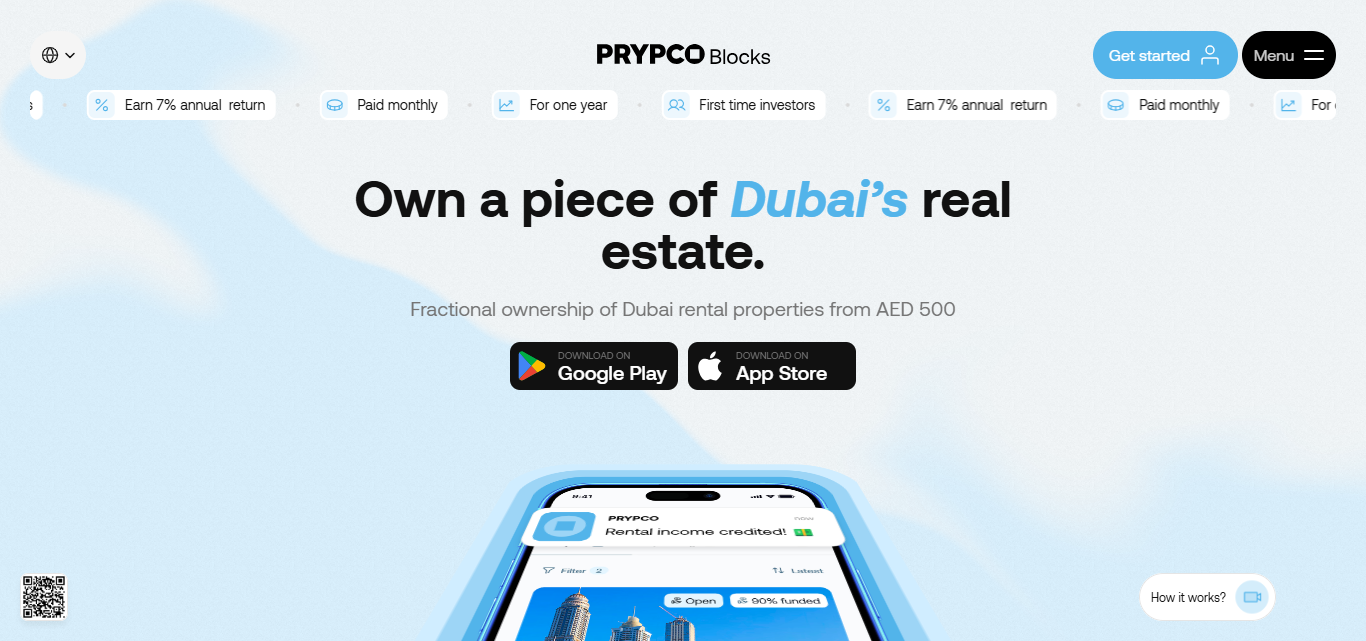
PRYPCO Blocks’ current fee structure is comprised of a 1% acquisition fee, 0.2% KYC/AML upon acquisition, 0.1% annually for KYC/AML, 0.5% administration fee effective from Year 2, and a 2.5% exit fee, where a 7% incentive fee may be applicable.
Key Features PRYPCO Blocks
- Fractional ownership: A “Block” constitutes a part ownership pro-rata of the real estate in a Dubai rental property.
- Property information: Documentation pertaining to selected rental properties, financial projections, and expected rental yields and timelines.
- International accessibility: Selected UAE residents and eligible non-resident investors subject to verification and criteria.
| Pros | Cons |
|---|---|
| AED 500 starting investment | Several transaction fees apply |
| Fractional Dubai property ownership | Returns are not guaranteed |
| Detailed property information | Exit conditions can restrict liquidity |
| International investors can participate | Property-market risk remains |
How We Select the Best Real Estate Crowdfunding Services for Fractional Property Investing
- Minimum Investment: When choosing platforms, we focused on those with lower entry points for different investors.
- Fees: When comparing fees, we looked at the platform, management, and other transaction-related investment fees.
- Fractional Property Ownership: We looked at how simple it was for investors to acquire partial property ownership.
- Property Offerings: We researched the variety, quality, and location of properties offered for investment.
- Investor Class: We looked at the availability to both accredited and non-accredited investors.
- Company History: We researched the company launch date, experience, and backgrounds of the personnel.
- Investment Transparency: We looked at how transparent the companies were regarding the investments, financials, and articulation of the risks.
Conclusion
The choice of the best real estate crowdfunding platform for fractional property investment depends on budget size, target investment amount, preferred risk exposure and the desired property market. The budget constraints for initial investments are less onerous with Fundrise and Arrived.
More stringent player, like CrowdStreet and EquityMultiple, target accredited investors. Dubai specific real estate crowdfunding platforms are SmartCrowd and PRYPCO Blocks. Before making an investment decision, compare fees, liquidity, quality of property, regulations and risks.
FAQ
What is fractional property investing?
Fractional property investing lets investors purchase a portion of a property instead of owning the entire property.
How much money do I need to start?
Minimum investments vary widely. Some platforms start around $10, while others require thousands of dollars.
Are real estate crowdfunding platforms safe?
They can provide regulated investment opportunities, but all real-estate investments involve risks, including potential loss of capital.
Can non-accredited investors participate?
Yes. Platforms such as Fundrise and some RealtyMogul offerings provide opportunities for non-accredited investors.