

In this article, I analyze the Best Decentralized Price Oracles for Smart Contracts, key tools for providing secure and accurate data streams to blockchain apps.
These price oracles allow smart contracts to query price data in a decentralized fashion, thus increasing trust and reducing price manipulation.
I will examine the leading oracle networks that provide safe, transparent, and efficient execution in today’s DeFi market.
Key Poinst & Best Decentralized Price Oracles for Safe Execution of Custom Smart Contracts
| Oracle | Explanation |
|---|---|
| Chainlink | Provides decentralized secure price feeds widely used DeFi ecosystems globally |
| Band Protocol | Cross-chain decentralized oracle aggregating real-time data for smart contracts reliably |
| API3 | First-party oracle networks delivering direct data feeds from APIs securely |
| Pyth Network | Pyth Network provides high-frequency financial market data for DeFi protocols |
| UMA | Optimistic oracle system enabling dispute resolution for synthetic assets pricing |
| Tellor | Permissionless oracle using miners to submit and validate price data |
| DIA | DIA aggregates transparent financial data from multiple verified sources on-chain |
| Nest Protocol | Decentralized price oracle using on-chain quotation and incentive mechanisms efficiently |
| Razor Network | Staking-based oracle network ensuring secure and tamper-resistant price feeds accuracy |
| Supra Oracles | High-performance decentralized oracle network delivering fast reliable cross-chain data streams |
10 Best Decentralized Price Oracles for Safe Execution of Custom Smart Contracts
1. Chainlink
Chainlink is the most popular decentralized oracle network and formalizes the secure execution of custom contracts within most DeFi ecosystems.
Chainlink offers secure price feeds by collecting data through multiple independent nodes. Recent innovations to Chainlink

Such as Chainlink Functions and CCIP (Cross-Chain Interoperability Protocol) expand their ability to collect real-world data and cross-chain messaging.
Chainlink is foundational to developing lending, derivatives, and automated trading systems that require dependable and irreproachable price feeds.
Chainlink Features
- Multiple independent node operators provide the basis for secure price data
- Distributed price feeds are reliable and resistant to tampering
- Chainlink CCIP provides the ability for cross-chain communication
- Chainlink Functions enable a bridge to real world data
2. Band Protocol
Built on a delegated proof-of-stake model, Band Protocol is a cross-chain oracle that rapidly and flexibly solves the price feed puzzle by connecting real-world APIs with smart contracts across multiple blockchains.
The Band v3 upgrade offers increased price update flexibility and decreased latency. Band Protocol is used by developers in gaming, DeFi, and prediction markets that require real-time price updates to automate execution and mitigate risk.
Band Protocol Features
- Fast and scalable data processing is achieved with a delegated proof-of-stake model
- Direct connection of real world APIs to smart contracts of any blockchain
- Low-latency, flexible data updates for DeFi
- Supports prediction markets, gaming, and cross-chain data
3. API3
By introducing a first-party oracle structure in which APIs serve as their own nodes, API3 reduces the number of intermediaries, making data less opaque.
This structure also provides an opportunity for smart contracts to execute with greater confidence and less risk of price manipulation.
API3’s Airnode is a new ease-of-use technology that allows APIs to integrate with no third-party involvement.
API3’s latest concentration areas of decentralized insurance, DeFi derivatives, and premium data make it appropriate for use cases in which real-world data is required and must be beyond verifiable means and irretrievably signed.
API3 Features
- Removes third parties for data delivery with a first-party oracle model
- Direct API connection to the blockchain with Airnode
- Data feeds are authenticated with a cryptographic signature
- DeFi and enterprise application risks are mitigated with reduced manipulation
4. Pyth Network
Pyth Network aggregates high-frequency financial data directly from top trading firms, exchanges, and market makers.
Pyth Network also offers institutional-grade data for advanced trading and on-chain risk modeling systems.
The pull oracle model used by Pyth Network allows users to decrease gas fees by fetching prices only when needed.
Pyth Network Features
- Institutional market data offers high-frequency price coverage
- Pull-based model offers pricing with less impact on gas costs
- Low latency pricing for trades and derivatives
- Multi-chain expansion offers pricing for more blockchains
5. UMA
UMA uses Optimistic Oracle Systems which allow disputes to be settled through economic incentives instead of costly continuous data feeds.
This makes the oracle system well-suited for the creation of synthetic assets, prediction markets, and insurance protocols.

The Optimistic design of UMA helps lower cost of smart contracts while maintaining security guarantees via a strong dispute resolution mechanism.
Recent improvements of UMA also greatly enhance the scalability of the oracle system and its interoperability across various blockchain environments.
UMA Features
- Optimistic oracle system offers low-cost dispute resolution
- Low cost with no on-chain updates of data
- Supports prediction markets, insurance protocols, and synthetic assets
- Flexible smart contract implementation with enhanced cross-chain
6. Tellor
Tellor is a permissionless oracle system in which miners can submit and validate price data on-chain. Tellor also uses a staking system to incentivize the honest reporting of price data to the oracle.
Tellor is suitable for decentralized lending protocols, synthetic asset protocols, and other DeFi applications that require reliable and community-driven oracle solutions. Tellor’s latest innovation, TellorFlex, allows developers to create customizable data feeds.
Tellor Features
- Price data is submitted by miners in a permissionless system
- Data reporting is honest and incentivized through staking
- Strong censorship resistance is achieved through decentralized validation
- TellorFlex allows for customizable data feeds
7. DIA
DIA (Decentralized Information Asset) offers a way for the community to gather financial data from trading platforms and DeFi in a transparent and open-source manner.
DIA prefers the community to source and verify data compared to closed oracle systems. DIA is developer-friendly as it offers flexible data pipelines for both on and off chains.
DIA has recently improved its DeFi and NFT analytic data feeds and offers multi-chain support, growing its reputation as an oracle in the transparent execution of smart contracts.
DIA Features
- DIA offers free open-source and transparent financial data aggregation
- Data is aggregated directly from exchanges and DeFi platforms
- DIA supports on-chain and off-chain data pipelines
- Data can be verified by the community, increasing trust
8. Nest Protocol
Nest Protocol has on-chain quotations which let the participants of the market source prices on the blockchain themselves.
This provides a solution to the problem of using centralized price aggregators. Similarly to DIA, Nest has a price incentive structure to obtain on-chain price quotations.

The emphasis on liquidity-based price discovery makes Nest Protocol particularly applicable to DeFi trade engines. Furthermore, due to its structure, Nest is resilient to price manipulation.
Nest Protocol Features
- Creates on-chain price quotes for participating market users
- Completely eliminates reliance on centralized data sources
- Incentives improve price discovery
- Suitable for liquidity-centric decentralized trading protocols
9. Razor Network
Razor Network employs a staking mechanism for a decentralized oracle and places emphasis on the security of cryptography and data.
In order to offer accurate price feeds, validators must stake tokens and submit honest feeds or else forfeit their stake.

It aims to serve numerous blockchain ecosystems and provide rapid delivery of data that cannot be altered.
Razor’s design and approach increase the level of trust required to offer accessible data for the automation of smart contracts in DeFi.
Razor Network Features
- Staking-based and secure price data oracle
- Validators are punished for incorrect pricing
- Fast and secure, low latency data feeds
- Ideal for DeFi lending, insurance, and derivatives
10. Supra Oracles
Supra Oracles uses cross-chain technology to provide fast and secure price feeds and data. By employing consensus-based checks for accuracy, they provide security across chains.
For the advancement of DeFi, GameFi, trading, and other applications, Supra focuses on speed and scalability. Their most recent innovations have focused on data security and latency.
Because of this, developers can rely on accurate and secure data feeds to build complex smart contracts and to develop new features and applications.
Supra Oracles Features
- Fast cross-chain oracle for real-time data
- Validates consensus for correct pricing
- Focused on scalability and multiple chains
- GameFi, DeFi, and trading use are within the targets
Alternative Decentralized Price Oracles for Smart Contract Security
1. Chronicle Protocol
Chronicle Protocol is an innovative decentralized oracle system with an emphasis on transparent data sourcing that can be verified.
Utilizing cryptography, Chronicle is able to provide direct price feeds that are not reliant on large intercessors. Their design provides improved data integrity for lending, derivatives and risk management in DeFi.
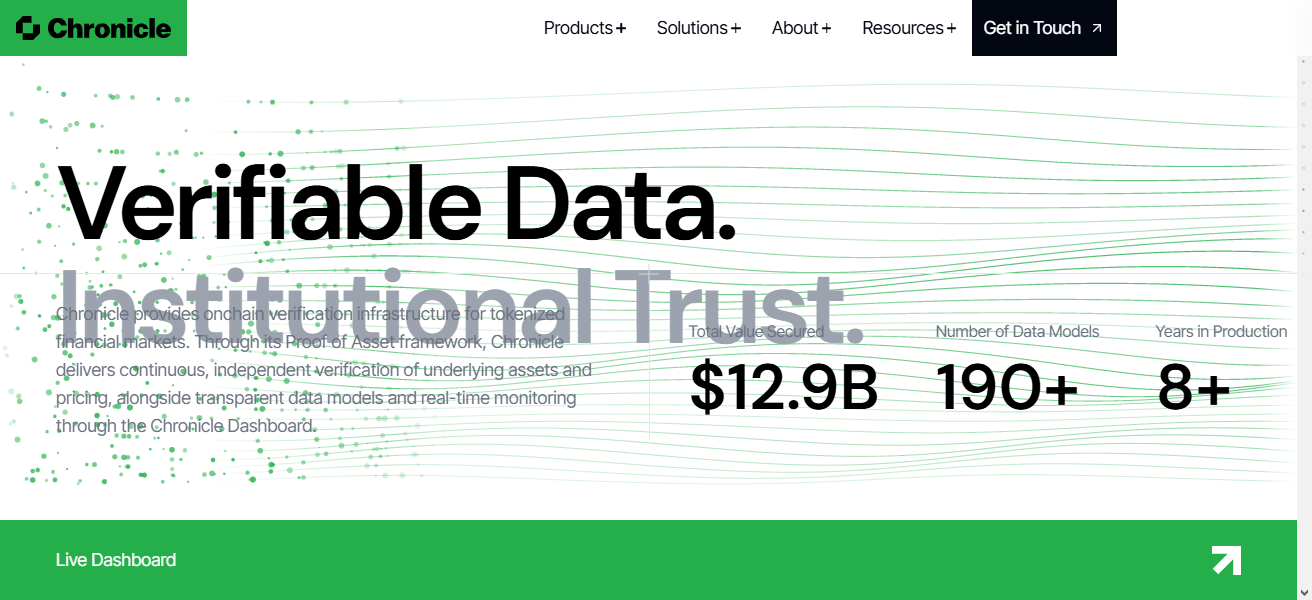
Chronicle aims to provide the smart contract community with the ability to validate prices in both the past and in the present with a high degree of confidence and with very little exposure to manipulation and/or harmful interference.
2. Switchboard
Switchboard is a highly flexible, customizable, and developer-centric oracle network. Switchboard provides the ability to create custom data feeds in order to satisfy the requirements of specific smart contracts across multiple blockchains.
Focused on low latency data, Switchboard also emphasizes the ability to create permissionless oracles.
Its modular design supports DeFi, gaming, and prediction markets, providing a highly decentralized and flexible system that offers real-time data.
3. Witnet
Utilizing a consensus based witness system, Witnet provides a way for oracles to verify and deliver off-chain data.
In order to provide accurate data, Witnet requires that multiple nodes validate data independently.

Witnet provides a fully decentralized system of oracles that can provide highly secure random numbers, price feeds, and APIs in order to aggregate data.
4. DOS Network
The DOS Network is a Layer-2 oracle that scales to provide data services for secure and efficient decentralized applications.
DOS Network integrates off-chain computation with on-chain verification to increase speed and decrease gas costs. DOS Network provides real-time price feeds, randomness generation, and on-demand API data.

Using its hybrid architecture, DOS Network achieves high throughput with reliability, ideal for DeFi platforms, and for on-demand, fast, cost-effective, and tamper-proof external data execution for smart contracts.
Criteria for Selecting The Best Decentralized Price Oracles for Smart Contracts
- Security: Prioritize oracle networks that are resistant to manipulation and censorship.
- Data Integrity: Select oracles that ensure multiple sources and verified price feeds.
- Decentralization: Focus on oracles that employ distributed nodes or validators.
- Cross-Chain Support: Oracles should support multiple blockchain networks and protocols.
- Speed: Data delivery should be as close to real-time as possible.
- Developer Support: Offer APIs and SDKs and let developers build custom data feeds.
- Trust: High historical up-time with minimal or no intentional downtimes or manipulations.
- Honesty Incentives: Thorough staking and rewards and/or penalties for honest reporting.
- Defi Support: Popular oracles supporting most DeFi applications.
- Future Proofing: Support high data and transaction volumes with minimal performance impacts.
Conclusion
In conclusion, decentralized price oracles are essential to the proper functioning of smart contracts within DeFi.
They help reduce the risk of manipulation by drawing data from independent nodes, and they increase the transparency of the data on the blockchain.
Developers use these trustworthy oracle networks when designing financial applications in the DeFi ecosystem and require real-time data, cross-chain functionality, and price data
that is completely decentralized. Decentralized oracle price networks are a critical smart contract price data infrastructure for the modern DeFi ecosystem.
FAQ
What are decentralized price oracles?
They are blockchain systems that securely provide real-world price data to smart contracts.
Why are price oracles important in DeFi?
They ensure accurate pricing for lending, trading, and automated financial execution.
Which is the most popular decentralized oracle?
Chainlink is widely used due to its strong security and reliability.
How do oracles protect smart contracts?
They reduce manipulation by aggregating data from multiple independent sources.
What makes an oracle decentralized?
It uses distributed nodes instead of a single centralized data provider.