
In this article, we will explore managing payment decline recovery at scale, highlighting the best tools available for reducing failed transactions and recovering lost revenue.
As subscription models spread worldwide, managing payment failures with intelligent automation, AI-based retries and tailored dunning strategies in place has become crucial
for minimizing churn as well as optimizing cash flow and securing a smooth customer payment experience across various countries and payment types.
Key Poinst & Best Tools for Managing Payment Decline Recovery at Scale
Stripe Billing Automates retries, sends smart dunning emails, and integrates seamlessly with subscription platforms for recovery efficiency.
Chargebee Offers customizable retry logic, communication workflows, and analytics to minimize churn from failed transactions.
Recurly Uses machine learning to optimize retries, recover revenue, and reduce false declines across global markets.
Zuora Collect Provides advanced dunning management, flexible retry schedules, and reporting tools to maximize subscription payment recovery.
Vindicia Retain Leverages network intelligence to recover failed payments without customer involvement, improving authorization success rates.
ProfitWell Retain Focuses on behavioral data, personalized recovery messaging, and churn reduction strategies for subscription businesses worldwide.
Spreedly Improves transaction routing, reduces false declines, and enhances acceptance rates across multiple payment gateways globally.
Gravy Recover Human-powered recovery service combining personalized outreach with automation to win back failed subscription payments.
FlexPay AI-driven platform that combats false declines, optimizes retries, and boosts overall payment acceptance rates.
GoCardless Success+ Automates retries for failed direct debit payments, ensuring higher recovery rates with minimal customer friction.
10 Best Tools for Managing Payment Decline Recovery at Scale
1. Stripe Billing
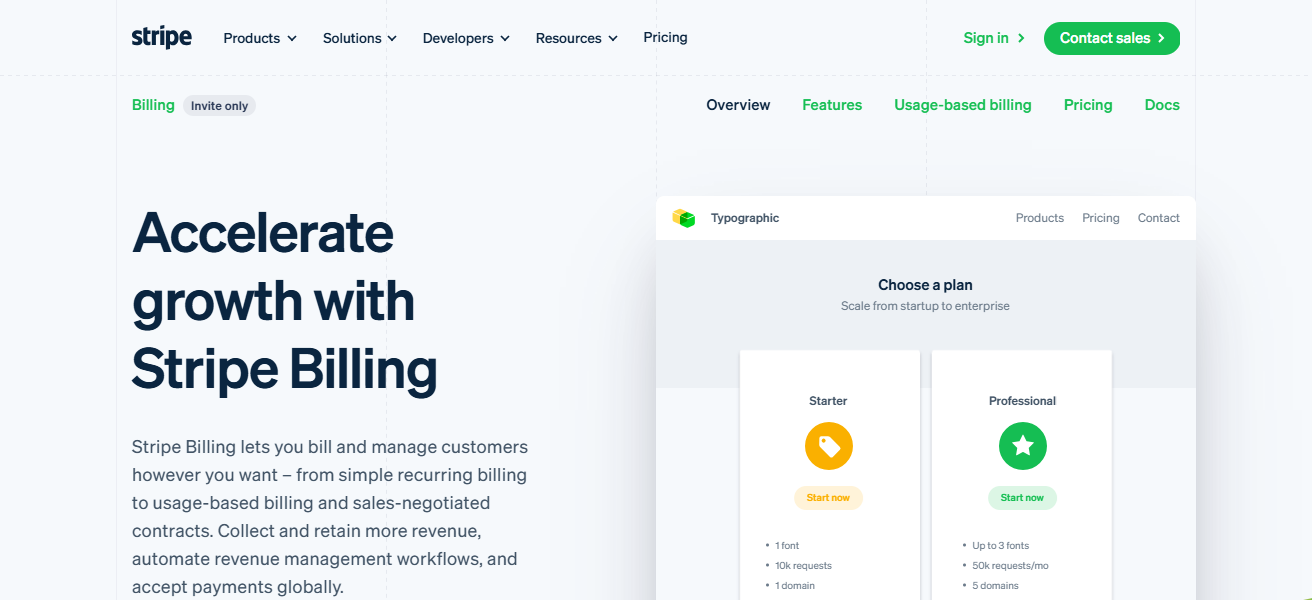
Stripe Billing is a developer-centric subscription platform commonly used for delivering scalable payment retries.
It has a built-in smart dunning management to retry failed payments automatically according to customizable schedules and sending reminders via e-mail to customers.
Automation of Retry Logic: Businesses can automate retry logic based on card behavior and regional payment patterns, improving recovery rates with no manual intervention.
It also connects with Stripe Radar to detect fraud and supports global payment methods for localized retry.
Limitations of Native Optimization — Reliable automated recovery optimization with native tools leads to high-performing results and useful insights
But advanced decline management and churn reduction often require 3rd party tools for deeper AI-powered analysis.
| Pros | Cons |
|---|---|
| Highly scalable infrastructure supporting global payments and currencies | Advanced AI recovery often requires third-party integrations |
| Built-in smart dunning with customizable retry logic | Can be developer-heavy for non-technical users |
| Strong fraud detection with Stripe Radar integration | Limited native churn prediction features |
| Excellent API flexibility for custom workflows | Pricing can increase with scale and add-ons |
| Supports localized payment methods and retries | Reporting may require additional tools for deep insights |
2. Chargebee
Chargebee, a powerful subscription billing solution with AI-powered Smart Dunning to intelligently retry failed payments and orchestrate personalized communication workflows.
It enables automated card updates, multi-gateway routing, and localized payment management to limit involuntary churn.

Leveraging advanced retry algorithms and segmentation-based outreach, businesses can recover 18% more failed revenue.
Chargebee also offers advanced analytics on churn, also allowing for insightful optimization. Its myriad of integrations with CRMs and accounting tools makes it perfect for the international growth of SaaS companies.
| Pros | Cons |
|---|---|
| AI-powered Smart Dunning improves recovery rates | Higher pricing tiers for advanced features |
| Automated card updater and multi-gateway support | Setup complexity for small businesses |
| Detailed churn analytics and reporting | UI can feel complex for beginners |
| Strong integrations with CRM and accounting tools | Customization may require technical support |
| Supports global tax and compliance requirements | Performance depends on integration quality |
3. Recurly
Recurly is one of the most popular subscription management platforms and has a very strong emphasis on decline recovery / churn reduction.
With smart retries, account updater tools, and personalized customer communication, its AI-powered dunning system will recover 20–40% of failed payments.

Recurly also applies payment orchestration to direct transactions through various gateways for increased approval rates of 95%.
Use of advanced analytics to both predict and optimize recovery from churn. With enterprise-scale go-to-market needs, services like Recurly are better for the big brands we see, like streaming platforms—ideal for companies focused on retention and revenue recovery than basic billing functionality.
| Pros | Cons |
|---|---|
| High recovery rates (20–40%) with AI-driven dunning | Premium pricing compared to competitors |
| Payment orchestration boosts authorization rates | Limited flexibility in lower-tier plans |
| Advanced churn prediction analytics | Integration setup can be time-consuming |
| Account updater reduces failed transactions | Not ideal for very small businesses |
| Trusted by large-scale subscription platforms | Custom workflows may need developer input |
4. Zuora Collect
It is an advanced level, enterprise-grade solution that enables payment recovery (Zuora Collect) as an integrated part of the Zuora monetization suite targeted to large scale subscription businesses.
It provides highly customizable dunning workflows, automated retry and AI-based payment orchestration across various gateways.
Zuora is designed to handle complex billing scenarios such as multi-year contracts, usage-based pricing and international tax compliance.

Its recovery tools connect with modern revenue recognition and finance systems to achieve end-to-end automation.
Descriptive segmentation enables enterprises to have extensive knowledge about the impact of the crisis on different customer cohorts
| Pros | Cons |
|---|---|
| Enterprise-grade dunning and payment workflows | Complex implementation and onboarding |
| Supports complex billing models (usage-based, contracts) | Expensive for small to mid-sized businesses |
| Strong financial and revenue recognition integration | Requires dedicated team for management |
| Advanced segmentation for targeted recovery | Slower deployment compared to simpler tools |
| Global compliance and tax handling | UI can feel outdated and less intuitive |
5. Vindicia Retain
Vindicia Retain: With a focus on media, SaaS and digital services subscription businesses, Vindicia offers a solution that helps maximize the recovery of payment.
This feature takes advantage of a machine learning model that has been trained on billions of transactions to optimize the timing and messaging strategies for retries.
Underscore handles both soft and hard declines, implementing account updater services as well as issuer-specific retry logic to drive better authorization rates.
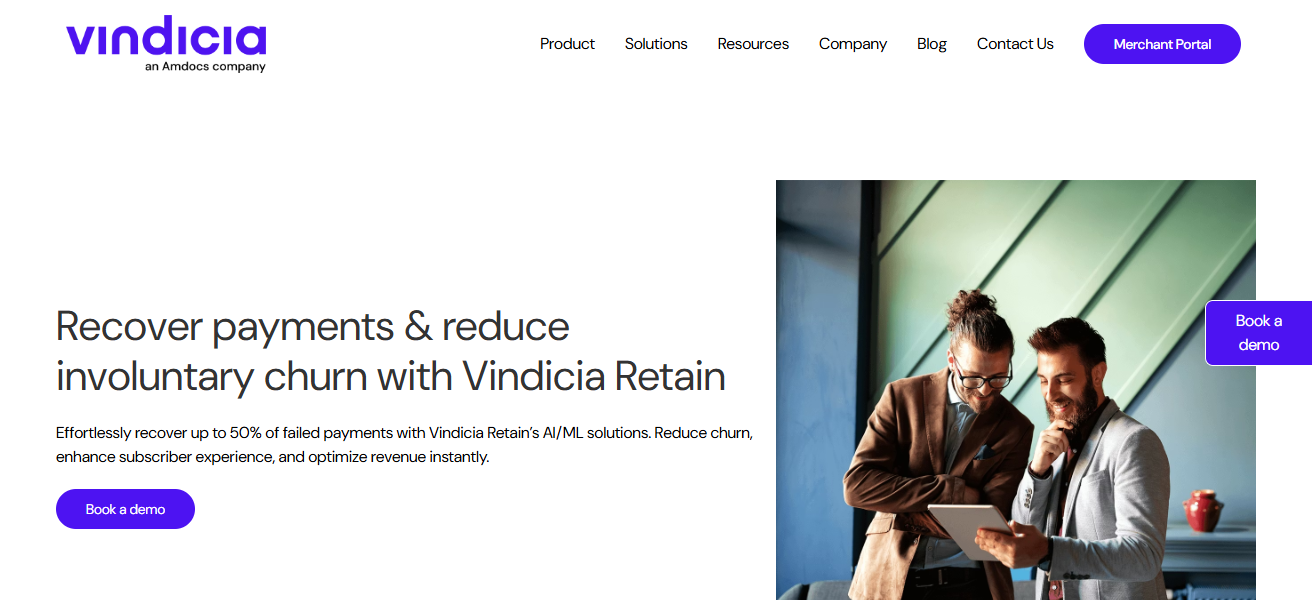
It is particularly known for generating high recovery lift with low customer friction and often drastically improving revenue retention.
Vindicia also includes reporting dashboards to help businesses iterate and optimize decline management strategies at scale.
| Pros | Cons |
|---|---|
| Machine learning trained on billions of transactions | Limited brand awareness compared to competitors |
| High recovery lift for both soft and hard declines | Pricing not transparent publicly |
| Optimized retry timing based on issuer behavior | Requires integration with billing systems |
| Minimal customer friction during recovery | Reporting customization can be limited |
| Strong performance in media and SaaS industries | Not ideal for early-stage startups |
6. ProfitWell Retain
ProfitWell Retain (now part of Paddle) is a performance-oriented recovery tool that only charges based on success, enabling you to recover the most revenue at zero risk.
It optimizes the timing of retries, email outreach, and card updater programs using sophisticated machine learning.

The tool is one of the most ROI-driven in-market as businesses typically achieve a 20–40% recovery for failed payments.
It is particularly suitable for SaaS companies focused on subscription growth and retention optimization, according to Retain, because its customer-friendly communication helps prevent churn while adding brand experience.
| Pros | Cons |
|---|---|
| No upfront cost, pay only on recovered revenue | Revenue share model may reduce margins |
| High recovery rates (20–40%) using AI | Limited control over recovery strategies |
| Easy setup with minimal technical effort | Less customization compared to enterprise tools |
| Customer-friendly communication workflows | Dependent on Paddle ecosystem (post-acquisition) |
| Strong ROI-focused approach | Not suitable for highly complex billing needs |
7. Spreedly
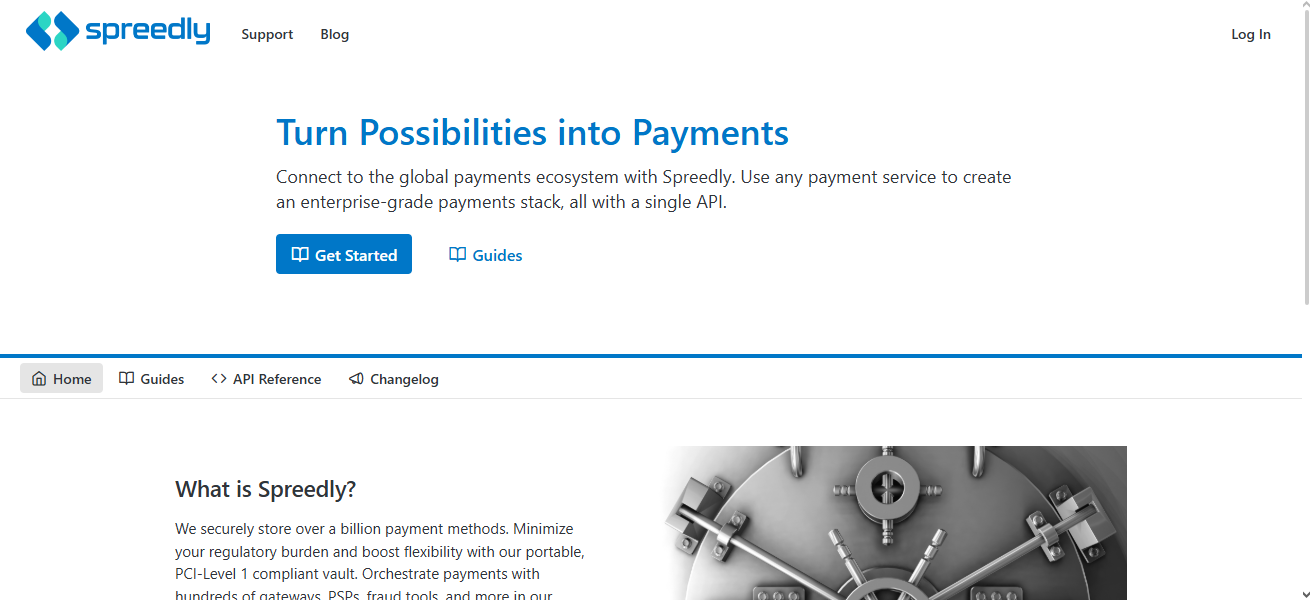
Payment orchestration platform Spreedly boosts decline recovery with multi-gateway routing, and tokenization across providers.
Spreedly offers businesses a way to dynamically route transactions based on their success at different gateways, rather than only relying on one payment processor.
It also enables network tokenization and card lifecycle management, decreasing failures caused by expired or updated cards.
Spreedly, while some facets of the business are not direct dunning features, is one of the industries most important players in preventing declines up front at scale
A powerful tool and gives full value for global enterprises managing payment infrastructures as borders dissolve.
| Pros | Cons |
|---|---|
| Multi-gateway routing improves authorization rates | Not a direct dunning or recovery tool |
| Tokenization enhances payment security | Requires integration with other billing systems |
| Reduces declines due to card lifecycle issues | Technical setup can be complex |
| Supports global payment orchestration | Limited built-in analytics for recovery |
| Vendor-agnostic payment infrastructure | Higher cost for smaller businesses |
8. Gravy Recover
Gravy Recover uses human-assisted payment decline recovery: Automated workflows Enhanced with real customer outreach through email, SMS and phone calls.
This hybrid approach will recover payments that would slip through if separated to 100% automation, especially in cases of hard declines or customer confusion.

Gravy focuses on customer engagement and retention, which claims much higher recovery rates than classical dunning tools.
It also gives insights into what causes the failure of payments and allows businesses to improve upon their billing processes. That makes it a perfect fit for subscription businesses with high customer lifetime value.
| Pros | Cons |
|---|---|
| Human-assisted recovery increases success rates | More expensive than fully automated tools |
| Multi-channel outreach (email, SMS, phone) | Scaling human support can be challenging |
| Effective for hard declines and high-value customers | Slower recovery compared to automated retries |
| Provides insights into payment failures | Not ideal for low-margin businesses |
| Improves customer retention and experience | Requires coordination with internal teams |
9. FlexPay
FlexPay is based on AI-driven decline recovery technology that optimizes automated payment retries depending on the behavior of issuers, customer history and transaction context.
There machine learning models process billions of data points to identify the perfect time and way to retry failed payments, which can significantly improve success rates.

FlexPay works particularly well for soft declines like insufficient funds, where time is in play. It can seamlessly integrate with pre-existing billing processes and continuously learns and adapts. Most have seen huge recoveries in revenue and reduced churn when they roll out FlexPay at scale
| Pros | Cons |
|---|---|
| AI-driven retry optimization based on issuer behavior | Limited brand recognition in some markets |
| High success rate for soft declines | Requires integration with existing billing systems |
| Continuously improves using machine learning | Pricing details not always transparent |
| Easy to integrate with subscription platforms | Less control over manual recovery workflows |
| Proven increase in recovered revenue | Focused mainly on card payments |
10. GoCardless Success
GoCardless Success+ is a tool that automates the recovery of bank debit payments using intelligent retries, informed by machine learning.
Unlike card-based systems, it uses payer behavior data to calculate the best time for a retry, optimizing success rates for failed bank accounts.

Particularly, merchants have the option to automatically recover a good portion of failed transactions, all with no customer interaction.
Especially successful in common direct debit regions, like Europe and the UK Success+ acts as an integrated add-on for merchants using GoCardless, enabling a frictionless, automated way to recover failure payments and clean up cash flow uncertainty.
| Pros | Cons |
|---|---|
| Optimized for bank debit recovery with smart retries | Limited to bank debit (not card payments) |
| Machine learning improves retry timing | Best suited for specific regions (EU/UK) |
| Fully automated recovery with minimal effort | Less flexible for complex billing setups |
| Seamless integration with GoCardless ecosystem | Limited customization options |
| Improves cash flow predictability | Not ideal for global card-based businesses |
Conclsuion
Last but not least, the Best Tools for Payment Decline Recovery at Scale are necessary if businesses want to minimize failed payments, churn and maximize revenue recovery.
That accounting line still can lead to other solutions in financial performance, but it does show growth through platforms that are kind of like stripe billing,
Chargebee and recurly with more automation —AI-enabled retries and intelligent workflows ensuring recovery at scale while generating customer experience seamlessness.
FAQ
Payment decline recovery is the process of recovering failed transactions by retrying payments, updating card details, and using automated or manual workflows to reduce revenue loss.
It helps reduce involuntary churn, recover lost revenue, improve cash flow, and maintain strong customer relationships.
Chargebee, Recurly, ProfitWell Retain, and FlexPay use AI to optimize retry timing and increase success rates.
Spreedly, Chargebee, and Recurly enable routing payments through multiple gateways to improve approval rates.