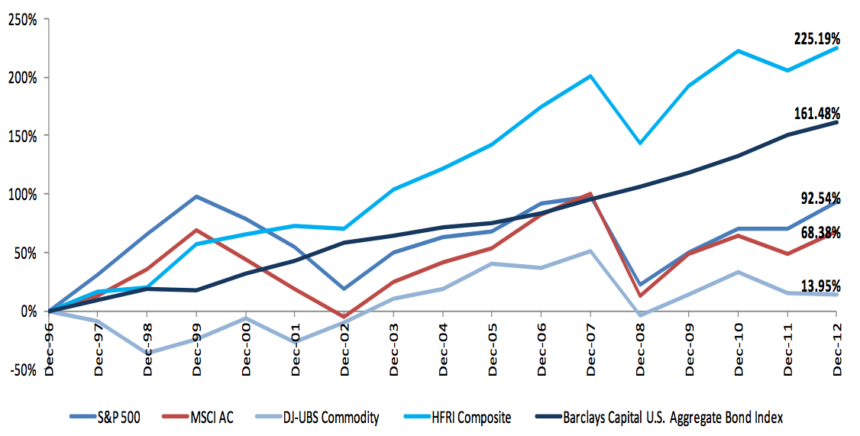
In this article, I will explore the best tools used by hedge funds for predicting the market, with particular emphasis on hedge fund market prediction tools, such as the Bloomberg Terminal and Quandl (Nasdaq Data Link).
- Key Points & Best Tools Hedge Funds Use for Market Prediction
- 10 Best Tools Hedge Funds Use for Market Prediction
- 1. Quandl (Nasdaq Data Link)
- 2. Bloomberg Terminal
- 3. Refinitiv Eikon
- 4. QuantConnect
- 5. AlphaSense
- 6. Kensho
- 7. Two Sigma Data Platform
- 8. BlackRock Aladdin
- 9. Sentieo
- 10. Dataminr
- Key Analytical Techniques Used by Hedge Funds:
- How To Choose Best Tools Hedge Funds Use For Market Prediction
- Determine Your Strategy First
- Assess Quality and Coverage of Data
- Assess the Analytical Features
- Assess Compatibility and Availability of Enabling API Tools
- Assess Support for Real-Time and Fast Processing
- Assess the Interface and Automation Features
- Assess trade offs between cost and value of tools
- Features for Backtesting and Simulation
- Security and Reliability
- Support and Community
- Conclsuion
- FAQ
These tools integrate data analytics, AI, and real-time perspectives, enabling prediction, risk assessment, and data-based decision-making regarding trading, even in the most demanding global financial markets.
Key Points & Best Tools Hedge Funds Use for Market Prediction
Quandl (Nasdaq Data Link) – Provides alternative datasets, economic indicators, and financial data APIs for quantitative analysis models.
Bloomberg Terminal – Provides real-time financial data, analytics, news, and trading tools for informed investment decisions globally.
Refinitiv Eikon – Delivers comprehensive market data, risk analytics, and insights to support institutional trading strategies worldwide.
QuantConnect – Cloud-based algorithmic trading platform enabling backtesting, data analysis, and strategy deployment across multiple asset classes.
AlphaSense – AI-powered search engine extracting insights from financial documents, earnings calls, and market intelligence sources quickly.
Kensho – Uses machine learning to analyze market events, trends, and correlations for predictive financial decision-making support.
Two Sigma Data Platform – Advanced data-driven system leveraging big data, AI, and statistical models for trading predictions.
BlackRock Aladdin – Integrated risk management and portfolio analytics platform widely used by institutional investors globally.
Sentieo – Financial research platform combining document search, data extraction, and modeling tools for investment professionals.
Dataminr – Real-time AI platform detecting market-moving events from news, social media, and alternative data sources instantly.
10 Best Tools Hedge Funds Use for Market Prediction
1. Quandl (Nasdaq Data Link)
Nasdaq Data Link (formerly known as Quandl) has a uniquely large collection of various alternative datasets. Hedge funds access odd datasets and economic indicators, and satellite and credit card data.
This offers a way to find novel trends in the market before the trends become popular. The data provided is API-based, meaning the data can be integrated into models.
Most traditional data provides offer large datasets. Quandl is different, as the focus is on smaller datasets to offer funds a unique advantage.
Quandl is also important because raw alternative data is useless in its raw form and leads to actionable insights that affect trading and portfolio construction decisions.
Quandl ( Nasdaq Data Link) Features
- They provide alternative data sets including satellite data, credit card transactions, and some economic data.
- First API platform, allowing uninterrupted integration of quantitative trading models.
- Curated data sets in finance and economics both premium and free.
- Backtesting and predictive analysis is supported as the historical data is accessible.
- Focus on niche data sets for different data points.
| Pros | Cons |
|---|---|
| Access to alternative datasets like satellite and transaction data | Some datasets are expensive and restricted |
| Easy API integration for quantitative models | Requires technical skills for full utilization |
| Unique data for competitive advantage | Data quality varies across providers |
| Strong support for predictive analytics | Limited built-in visualization tools |
2. Bloomberg Terminal
Bloomberg Terminal is the gold standard for real-time financial intelligence. Hedge funds rely on its powerful analytics, live data feeds, and global news integration to make split-second decisions.
What makes it unique is its ability to combine macroeconomic indicators, company financials, and breaking news into a single interface.
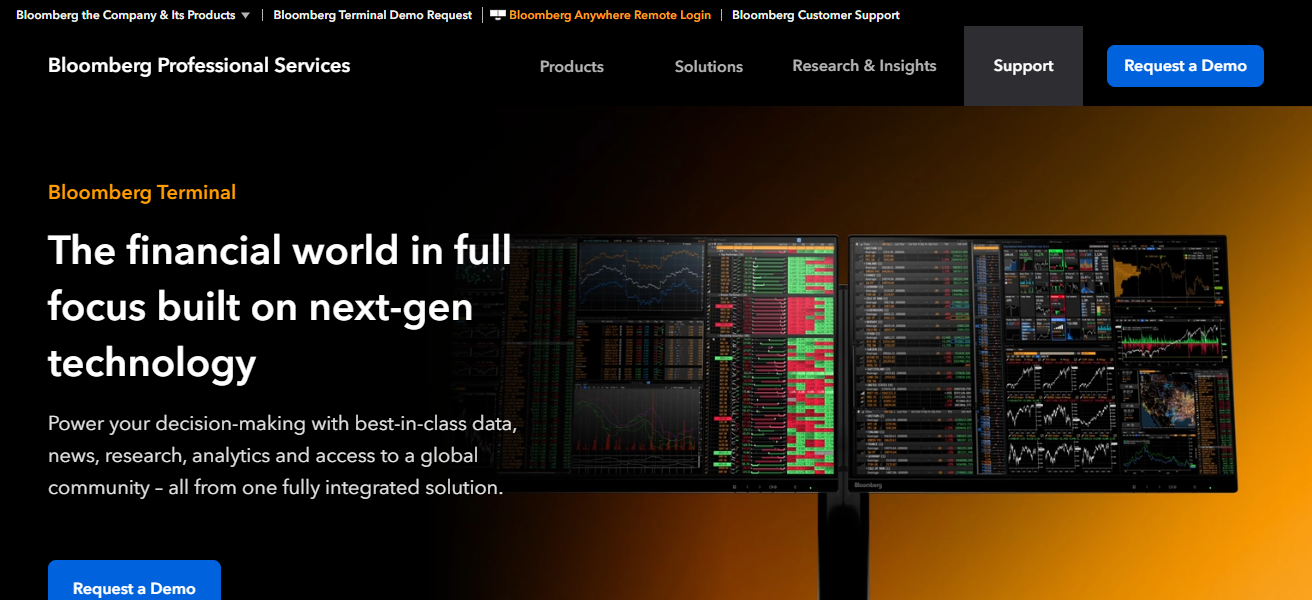
Traders can monitor market sentiment, execute trades, and run complex models without leaving the platform.
Its proprietary functions and vast historical database enable predictive analysis at scale. Despite its high cost, its depth, speed, and reliability make it indispensable for firms seeking precision in volatile markets.
Bloomberg Terminal Features
- One platform for the integration of news, finance analysis, and market data.
- Tools for portfolio management, trading and advanced charting.
- Offers global economic stats and company financials.
- Proprietary functions for financial analysis.
- Communication system designed for trading and finance.
| Pros | Cons |
|---|---|
| Real-time global financial data and news | Extremely high subscription cost |
| Powerful analytics and trading tools | Steep learning curve for beginners |
| All-in-one platform for research and execution | Interface can feel complex |
| Highly reliable and widely trusted | Limited customization compared to open systems |
3. Refinitiv Eikon
Eikon by Refinitiv provides market analysis and prediction tools. Hedge funds use it for its deep data spans equities, fixed income, commodities, and foreign exchange markets.
It’s advanced charting, risk analytics, and Excel integration for personalized models are its biggest selling points.
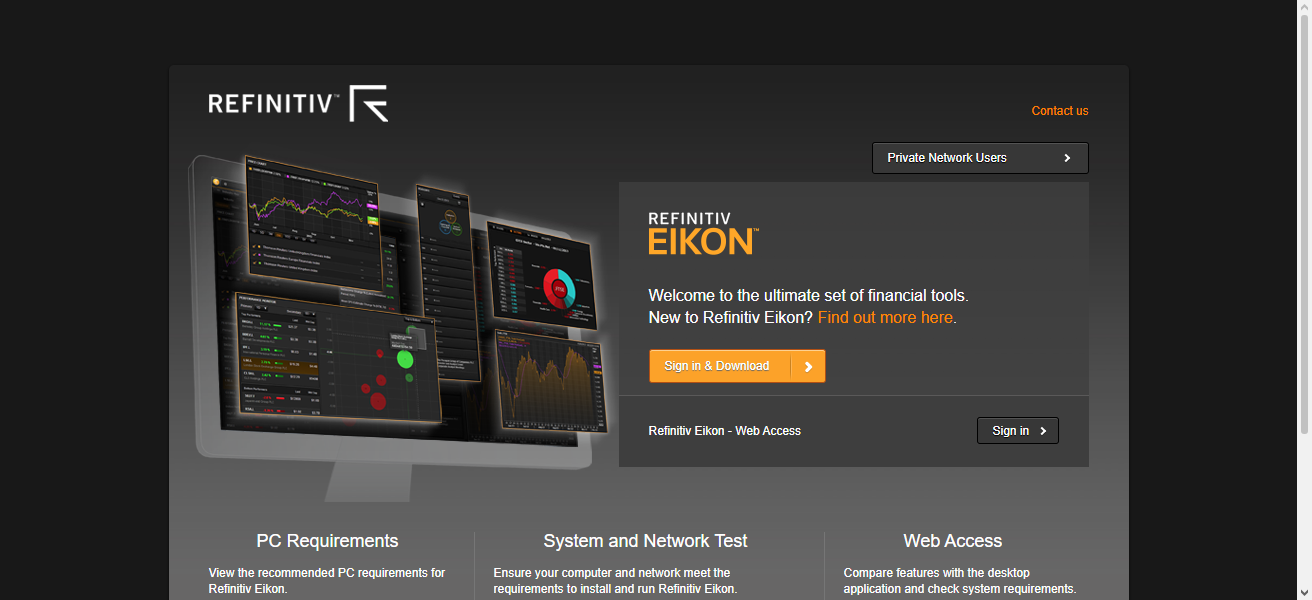
Eikon offers up-to-the-minute sentiment analysis shaped by news and social media, allowing funds to gauge potential market shifts.
It leads its competitors in flexibility and customization. Portfolio managers are equipped with advanced predictive strategies by Eikon’s ability to simplify datasets and correlate data streams.
Refinitiv Eikon Features
- Coverage of multiple assets, including equities, F, commodities, and bonds.
- Advanced charting with configured dashboards.
- Excel for Financial Modeling and Financial Analysis helps.
- Analysis of news and social media sentiment.
- Global market coverage with real time data.
| Pros | Cons |
|---|---|
| Comprehensive multi-asset data coverage | Expensive for smaller firms |
| Strong Excel integration for modeling | Slightly slower than competitors in some cases |
| Advanced charting and analytics tools | Interface less intuitive than rivals |
| Sentiment analysis from news and social data | Requires setup for customization |
4. QuantConnect
QuantConnect’s cloud environment offers hedge funds a way to create algorithms and develop trading strategies.
Because it offers multiple programming languages, quants can draft, assess, and implement trading algorithms quickly. With an extensive library of past market conditions, hedge funds can perform thorough backtesting.
The ability to work in teams means hedge funds can collaborate to improve and polish their models. In comparison to standard systems
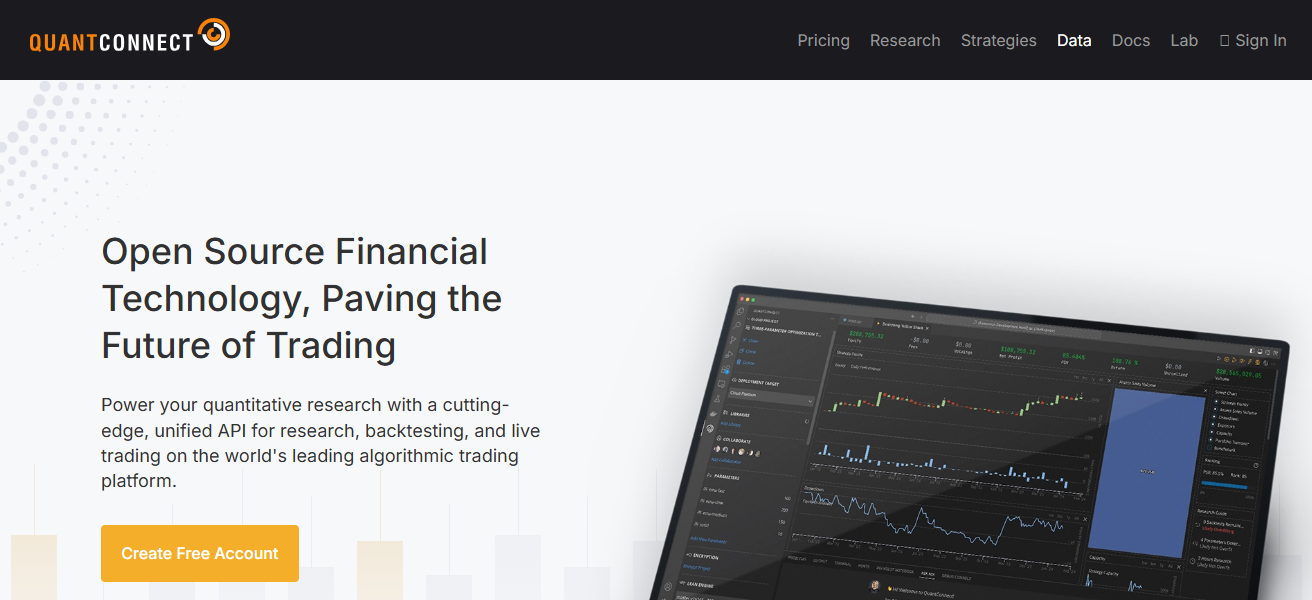
QuantConnect continues to save hedge funds money on infrastructure by providing more backtest trading systems.
By providing data, hedge funds can slow down and focus on advancing their systems. Because of this, it is less stressful to implement systems for funds that require and employ frequent and systematic trading.
QuantConnect Features
- Offers a trading and strategy development environment for cloud based algorithmic support.
- Python and C# are two of the supported programming languages.
- Offers historical data for backtesting.* Live trading implementation over various asset classes
- Team and developer collaborative interface
| Pros | Cons |
|---|---|
| Excellent for algorithmic trading and backtesting | Requires coding knowledge |
| Cloud-based, scalable infrastructure | Limited support for discretionary trading |
| Supports multiple programming languages | Data access can be limited without subscriptions |
| Strong community and collaboration tools | Learning curve for beginners |
5. AlphaSense
AlphaSense employs AI technology to aid in the transformation of financial research. Hedge funds are able to sort through extensive amounts of documents, including earning calls, SEC documents, and expert transcripts.
Using Natural Language Processing, AlphaSense captures important insights and trends, and reveals sentiment patterns that would otherwise go undetected.
This process saves time and increases the accuracy of research. Users can locate and access relevant content instantaneously due to the platform’s smart search capabilities.
AlphaSense improves the predictive ability of hedge funds by transforming unstructured text into clear, actionable intelligence.
AlphaSense gives funds access to valuable information, allowing detection of unrecognized market signals, which leads to market behavior shifts.
AlphaSense Features
- Search engine for financial documents and transcripts leveraging AI
- Natural Language Processing for identifying insights and their sentiment
- Smart filtering for quick access to relevant information
- Included are transcripts from earnings calls, filings, and consultant calls
- Speeds up research while improving the quality of decisions
| Pros | Cons |
|---|---|
| AI-powered document search and insights | Expensive subscription pricing |
| Saves significant research time | Limited coverage outside financial documents |
| Advanced NLP for sentiment and trends | Not ideal for real-time trading decisions |
| Easy-to-use interface | Depends on data availability |
6. Kensho
Kensho builds applications for machine learning that analyze relationships between events and impact financial markets.
Hedge funds utilize machine learning to study past cases like geopolitical events or changes in economic policy and forecast future events. Its power is in contextual intelligence and the cross-market relationships in cause and effect.
Whereas traditional models are static, Kensho’s model is constantly evolving in response to data shifts. This is important for the funds to forecast and analyze different levels of risks in their models.
Kensho’s ability to integrate a strong financial model and AI facilitates the investment community to move beyond traditional forecasting.
In today’s highly volatile and unpredictably changing markets, an ability to provide contextual intelligence and look beyond the present focused range is invaluable.
Kensho Features
- Market Event driven analysis through machine learning
- Market event based scenario projections using historical data
- Establishes relationships of the cause and effect of events
- Process data and insights through machine learning in real time
- Geopolitical and economic focuses are a key priority
| Pros | Cons |
|---|---|
| Strong event-driven market analysis | Limited accessibility for small investors |
| Uses machine learning for predictions | Requires understanding of AI models |
| Excellent for scenario simulation | Less transparency in model outputs |
| Adapts dynamically to new data | Integration complexity |
7. Two Sigma Data Platform
The Two Sigma Data Platform illustrates an advanced level of data-centric investing sophistication. Two Sigma, a quantitative firm, developed the Platform to evaluate vast quantities of both structured and unstructured data.
It is the same underlying architecture that hedge funds utilize to detect the patterns that go unnoticed by human analysts.
The Platform combines Machine Learning, Distributed Computing, and high-level Statistics to form predictive signals.

The Platform’s ability to autonomously learn and adapt, as a result of the data stream, is what distinguishes this platform.
Further, this automated data discovery and analysis allows for quick decisions from fund managers. In a competitive market, the transformation of unprocessed data into predictive analytics provides funds an obvious advantage.
Two Sigma Data Platform
- Handles massive amounts of structured and unstructured data
- Involves AI, machine learning and statistical modelling
- System improves its accuracy of result through a learning model
- High speed analysis is achieved through distributed computing
- Quantitative trading is done based on the predictive signals from the system
| Pros | Cons |
|---|---|
| Handles massive structured and unstructured datasets | Not publicly available as a standard product |
| Advanced AI and machine learning capabilities | Requires heavy infrastructure investment |
| Continuous learning and adaptation | High complexity in implementation |
| Generates strong predictive signals | Needs expert quantitative teams |
8. BlackRock Aladdin
Aladdin is BlackRock’s investment portfolio and risk management system. It is used by hedge funds for exposure tracking, market scenario simulations, and asset allocation optimizations.
It is particularly good for integrating market data and risk analytics to give portfolio managers a complete view on how their portfolio is performing.
Aladdin provides managers the ability to stress-test investments for economic conditions, which improves the investment’s ability to withstand economic shocks.

Aladdin also provides the ability to combine trading, risk management, and compliance which improves the ecosystem of the investment portfolio.
Aladdin also helps manage investments by providing insights into risk and potential return of the investment.
BlackRock Aladdin Features
- System is a risk analytics and portfolio management tool
- System captures, and processes real time data in relation to the market
- Scenario and stress test analysis is available
- Includes trading, compliance, and risk management tools
- Widely used globally among institutional investors
| Pros | Cons |
|---|---|
| Integrated risk and portfolio management | High cost and enterprise-level access |
| Real-time analytics and stress testing | Complex implementation process |
| Combines trading, compliance, and analytics | Requires training to use effectively |
| Trusted by large institutions globally | Limited flexibility for smaller funds |
9. Sentieo
Sentieo consolidates tools for document search, financial data, and modeling into one platform for investors. Hedge funds utilize Sentieo to optimize research processes and find actionable insights more quickly.
Its AI features reduce manual effort by pinpointing key data from filings and other reports. Sentieo also incorporates modeling in spreadsheets, allowing users to move from research to analysis seamlessly.

Its ease of use combined with robust features make Sentieo stand out. With data centralization and productivity improvement, analytics can prioritize strategy work instead of data synthesis. This work is crucial for precise market forecasting.
Sentieo Features
- Integrates financial document search, data, and financial modelling
- AI is used to identify key data from financial documents
- Value and spreadsheet functionality integrated
- Workflow optimization through user-friendly design
- For researchers and analysts, a unified research tool
| Pros | Cons |
|---|---|
| Combines research, data, and modeling tools | Smaller dataset compared to larger platforms |
| AI-driven document analysis | Limited real-time market data |
| User-friendly interface | Fewer advanced analytics features |
| Improves research efficiency | Not ideal for high-frequency trading |
10. Dataminr
Dataminr’s emphasis on AI-driven event recognition is tailored to real-time applications. For hedge funds, it’s critical in spotting developing stories and potential threats before they are published in mainstream outlets.
Dataminr’s AI technology offers predictive analyses based on real-time social media and newsfeed postings, as well as other publicly available information.
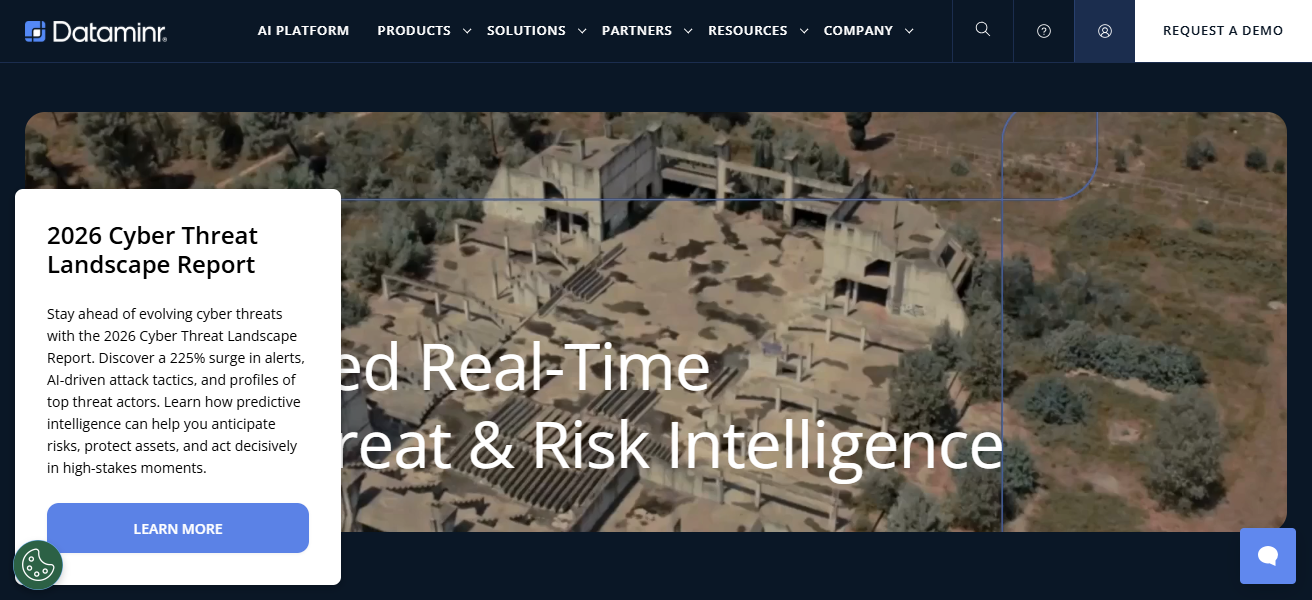
Five to ten minutes ahead of newsbreaks, Dataminr is often able to give, what traders consider to be, extremely valuable alerts (because of their time-sensitive nature) and allows them to act on these opportunities.
In today’s competitive marketplace, predictive analytics and overall trading performance are highly dependent on streamlining information overload into operational alerts.
Dataminr Features
- Big Data and AI Event detection as they happen
- Scanning media, news, and public data
- Market mobilizing incidents starting notices
- Instant signal provide for opportunistic trading
- Actionable insights from unorganized data
| Pros | Cons |
|---|---|
| Real-time alerts from news and social media | Can generate false positives |
| Early detection of market-moving events | Expensive for full feature access |
| Fast and actionable insights | Limited historical data analysis |
| Useful for short-term trading strategies | Requires filtering of noise |
Key Analytical Techniques Used by Hedge Funds:
NLP-Powered Fundamental Analysis: Using natural language processing to analyze publications and news stories in real time.
Sentiment Analysis: Analyzing market feelings through social networks and news sources.
Modeling: Forecasting market movements by identifying non-linear patterns.
High-Frequency Data Analytics: Analyzing time series data at millisecond intervals.
How To Choose Best Tools Hedge Funds Use For Market Prediction
Determine Your Strategy First
- Select tools based on your preferred approach to trading (quantitative vs. fundamental vs. high-frequency)
- Example: Research tools for fundamental investors, AI tools for quant funds
Assess Quality and Coverage of Data
- Assess coverage on equities, commodities, and FX, and alternative data to ensure accuracy, and diversity of datasets in real-time.
Assess the Analytical Features
- Select tools that offer AI, machine learning, and predictive modeling
- Advanced analytics assist in identifying patterns, and forecasting market changes
Assess Compatibility and Availability of Enabling API Tools
- Tools should integrate with the existing tools and processes
- Automation and the ability to develop custom models require API access
Assess Support for Real-Time and Fast Processing
- Intraday and high-frequency trading strategies require real-time updates and minimal delays
Assess the Interface and Automation Features
- The interface should allow for high productivity and low learning time
- Tools should offer simple navigation and provide advanced analytics, and simple interfaces
Assess trade offs between cost and value of tools
- Consider the pricing, features, and potential ROI metrics.
- Powerful and expensive tools such as the Bloomberg Terminal may not fit the needs of small firms.
Features for Backtesting and Simulation
- Confirm that the tool provides the capability of testing strategies against past data.
- This is useful to validate models before real-capital deployment.
Security and Reliability
- Look for systems that are secure and have a good uptime.
- This is essential to keep sensitive strategies and financial data secure.
Support and Community
- Active user communities and customer support are good to have.
- QuantConnect, for example, has good support for collaboration and learning.
Conclsuion
To conclude, the most effective hedge funds market prediction tools, like Bloomberg Terminal and QuantConnect, integrate data, AI, and analytics for better decision making.
While these tools improve prediction through trend spotting, risk management, and accurate forecasting, the most important components are strategy, expertise, and adaptability to the ever-changing nature of the markets.
FAQ
Hedge funds use platforms like Bloomberg Terminal, AI tools, and data analytics systems for forecasting markets.
It offers real-time data, news, analytics, and trading tools in one powerful platform.
It provides alternative datasets like economic indicators and transaction data for predictive analysis.
Yes, AI tools like Kensho help analyze data and predict market trends.