This article will focus on the tools that execute trades faster than human traders. With algorithmic trading and Ai trading becoming more accessible, tools have been developed that allow traders to place orders, analyze the market, and respond to price less than a human trader.
- Key Points & Tools That Execute Trades Faster Than Human Traders
- 10 Tools That Execute Trades Faster Than Human Traders
- 1. Trade Ideas (Holly AI)
- 2. TrendSpider
- 3. Capitalise.ai
- 4. AlgoTest
- 5. Zerodha Streak
- 6. QuantConnect
- 7. Tradetron
- 8. Zignaly
- 9. NinjaTrader
- 10. Interactive Brokers API (TWS)
- What are the challenges of latency when using cloud‑based algo trading systems?
- What role does machine learning play in real‑time trade execution speed?
- Hpw We Choose Tools That Execute Trades Faster Than Human Traders
- Cocnlsuion
- FAQ
These tools also minimize emotional trading decisions, automate the execution of trading strategies, and provide insights in real time across multiple verticals like stock, crypto, and forex trading.
Key Points & Tools That Execute Trades Faster Than Human Traders
Trade Ideas (Holly AI) – AI-powered platform scans markets, generates trade signals, automates strategies faster than human traders.
TrendSpider – Uses AI and automation to identify trends, technical patterns, and trade opportunities efficiently.
Capitalise.ai – Lets users create automated trading strategies using plain English, executing them without manual intervention.
AlgoTest – Backtests and simulates algorithmic strategies quickly, helping traders optimize automated approaches before live execution.
Zerodha Streak – Automates trading on Zerodha by creating, testing, and deploying strategies without coding knowledge.
QuantConnect – Cloud-based algorithmic trading platform offering backtesting, strategy deployment, and fast execution across multiple markets.
Tradetron – Allows building, deploying, and automating algorithmic strategies for multiple brokers with minimal coding effort.
Zignaly – Crypto trading bot platform that automates trades and copy-trading strategies efficiently on supported exchanges.
NinjaTrader – Advanced trading platform providing automated strategy execution, backtesting, and market analysis tools for speed.
Interactive Brokers API (TWS) – Enables programmatic order execution and algorithmic trading, bypassing human latency in financial markets.
10 Tools That Execute Trades Faster Than Human Traders
1. Trade Ideas (Holly AI)
Trade Ideas is an advanced AI trading platform designed for professional stock traders. Its main AI, Holly, performs daily simulations on thousands of equities and identifies probable trading opportunities and pre-market entry, exit, and stop-loss instructions, as well as profit-targets.

Holly statistically ranks trades, which removes the need for manual screening and provides tradable signals which are able to be auto-executed through broker API connections. Trade Ideas continues to add new AI variations and automation to its platform.
Trad ideas (Holly AI) Features
- AI supported signal engine predicts millions of situations before the market opens.
- Automatically creates actionable entries, and exits, and risk parameters
- Trade automation via connected broker API.
- Different trading styles are supported through custom filter and strategy templates.
| Pros | Cons |
|---|---|
| AI engine simulates millions of trades daily to find high-probability setups. | Premium pricing may be prohibitive for beginners. |
| Fully automated signals with broker integration for execution. | Only supports U.S. equities primarily, limiting global exposure. |
| Eliminates manual screening and reduces emotional trading. | Steeper learning curve for customizing AI strategies. |
| Offers risk management with stop-loss and profit targets. | Advanced features require subscription upgrades. |
2. TrendSpider
TrendSpider offers automated technical analysis and charting. It’s able to find trend lines, chart patterns, support and resistance zones, and indicators, saving a tremendous amount of time analysis.
Users can build, backtest, and implement rule-based strategies created through intelligent alerts and automated scans.

The machine-assisted tools provided by TrendSpider are designed to remove emotions from trading and improve the users’ speed of making trading decisions.
TrendSpider Features
- Support, resistance, and patterns across multiple timeframes are automatically detected.
- You can execute alerts based on your parameters through Smart Alerts
- The charts come with integrated backtesting and optimization.
- There are pre-determined strategies and automated symbol scanning.
| Pros | Cons |
|---|---|
| Automated multi-timeframe trendline and pattern detection saves hours. | Some advanced features require higher-tier subscriptions. |
| Rule-based alerts and backtesting accelerate trading decisions. | Limited broker integration compared to institutional-grade platforms. |
| Reduces emotional bias with AI-assisted analysis. | Focused mostly on technical analysis, less on fundamental data. |
| Supports dynamic charting and customizable automation workflows. | Complex interface may intimidate new traders. |
3. Capitalise.ai
Capitalise.ai offers a one-of-a-kind text automation platform that enables traders to specify algorithmic guidelines in simple terms (e.g., “if RSI < 30 then buy”).
The platform closes the gap between strategy and execution, transforming text-based strategy logic into automation and execution rules, complete with backtesting and real-time strategy monitoring.
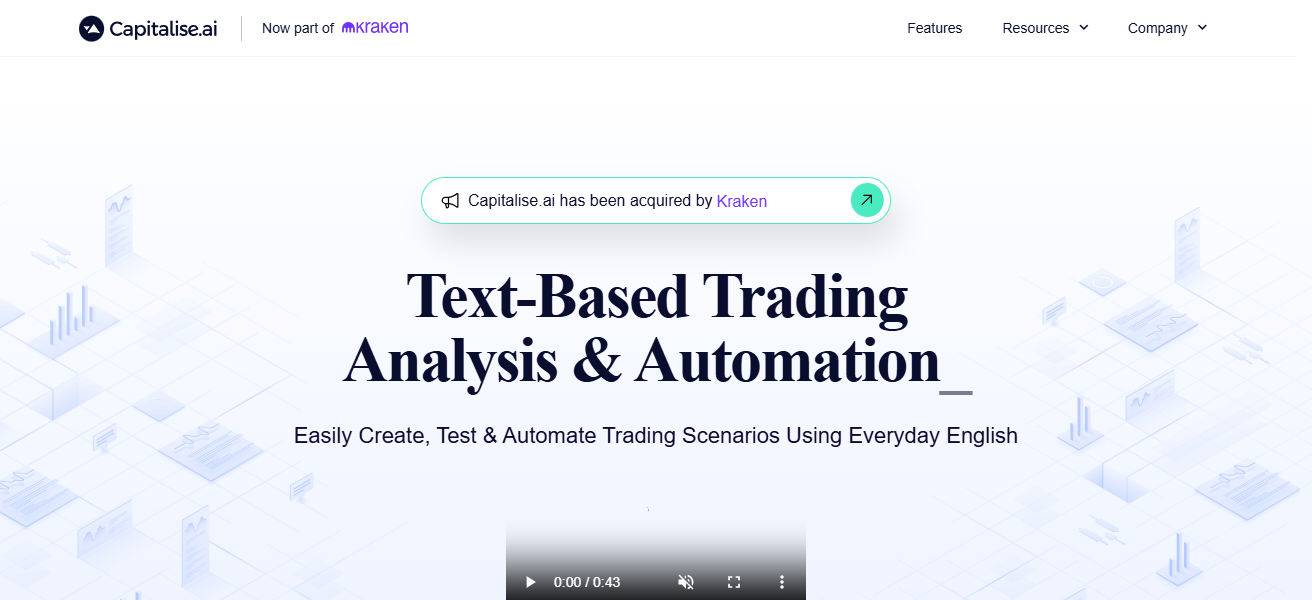
Capitalise integrates with brokerage firms, offering a complete system to automate without the need to code, reducing emotional decisions and manual market live interventions.
Capitalise.ai Features
- Build rules in plain English to convert ideas into actionable strategies.
- Backtesting against historical data before actual deployment.
- Real-time alerts and monitoring
- Backtesting paired with Brokerage integration for automated/semi-automated execution.
| Pros | Cons |
|---|---|
| Plain-English automation allows non-coders to create strategies easily. | Limited to supported brokers for live execution. |
| Built-in backtesting and real-time monitoring improve strategy reliability. | Advanced strategy complexity is restricted by plain-language interface. |
| Reduces emotional decisions with automated execution. | Performance may lag for very high-frequency trades. |
| Integrates seamlessly with alerts and execution pipelines. | Smaller user community than mainstream algo platforms. |
4. AlgoTest
AlgoTest is a favored strategy builder and testing platform, especially in Indian markets, and among options trading communities.
The platform allows users to backtest and optimize trading strategies using historical data. This helps users evaluate rule-based strategies quickly.
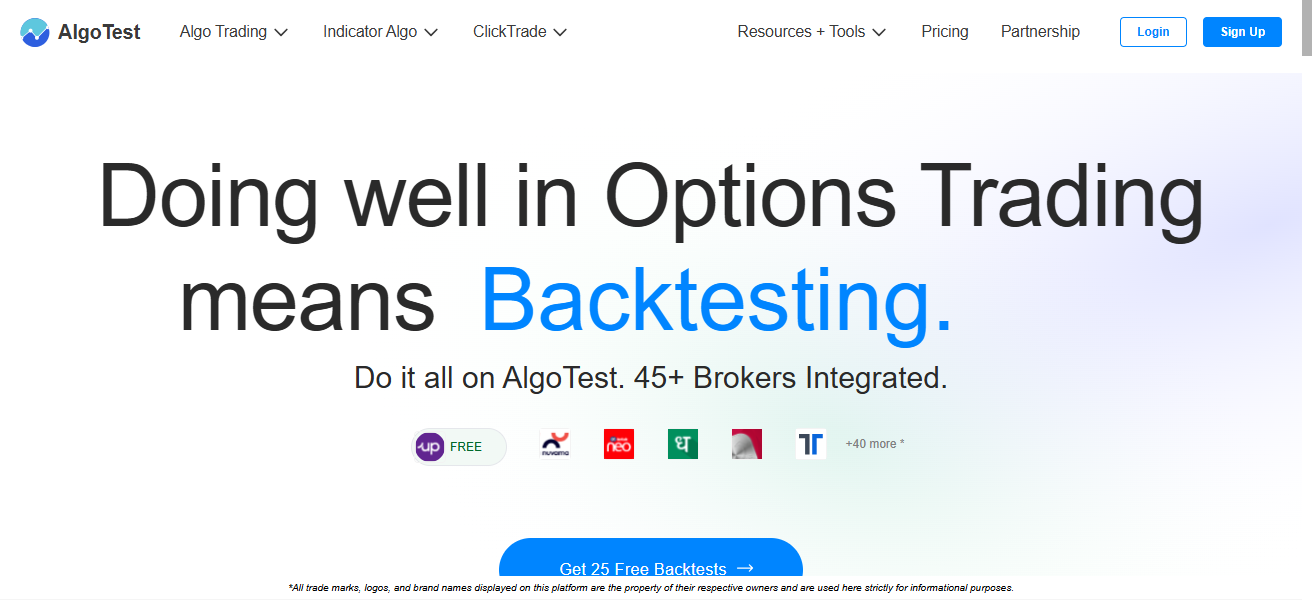
After testing, users can link their strategies to execution pipelines and broker integration connectors to automate trading.
Its quick testing, trustworthy backtesting and brokerage system integration options, sets it apart from competitors, especially for F&O algo traders.
AlgoTest Features
- Create rule-based algorithms for strategy development without complications
- Backtesting is quick, with optional performance metrics.
- Executions streams through broker integration.
- Validation of strategies for options and derivatives is prioritized.
| Pros | Cons |
|---|---|
| Fast backtesting and optimization on historical data. | Mostly focused on Indian markets and options trading. |
| Supports integration with broker execution pipelines. | Limited global market coverage. |
| Ideal for F&O and rule-based strategies. | UI may feel dated compared to newer platforms. |
| Reliable for validating strategies before live deployment. | Less suited for crypto or multi-asset trading. |
5. Zerodha Streak
Zerodha Streak is an algo trading platform that integrates with Zerodha’s brokerage services and is designed to be simple enough for beginners to use.
Users can create rule-based strategies with quick visual builders and backtest those strategies with historical market data.
Once that is complete, users can connect their Zerodha Kite account for semi-automated trade execution.
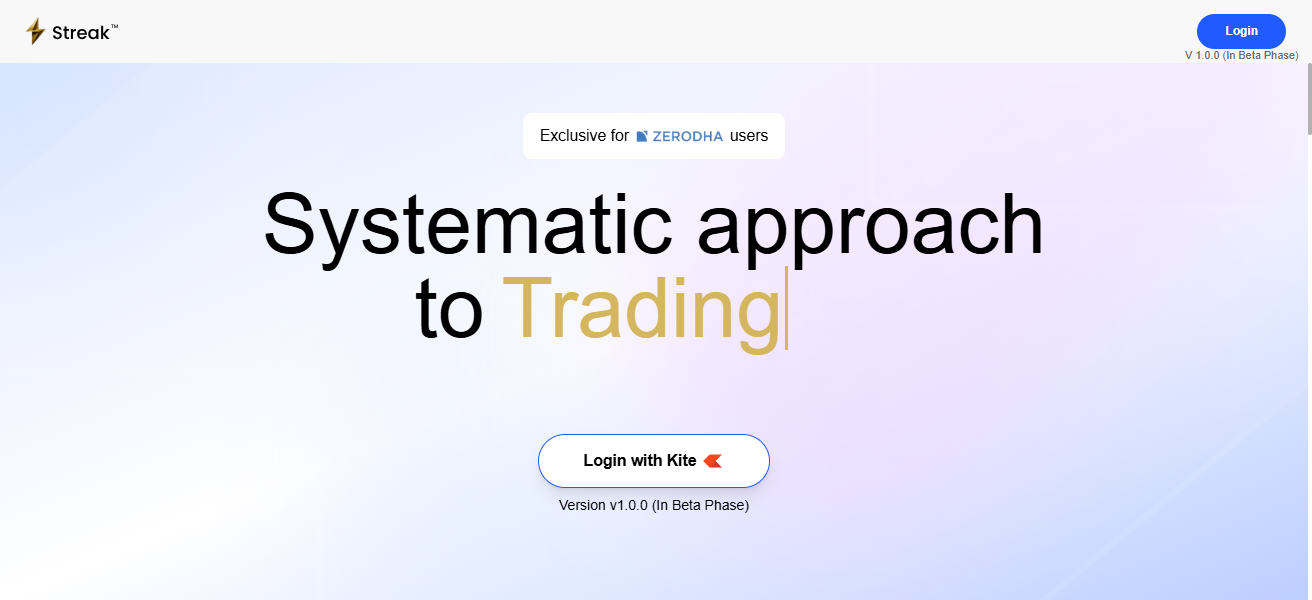
Although many strategies can be created and tested with ease, some strategies may require user confirmation depending on their risk set. Streak offers some of the most simplified automated trading for retail traders.
Zerodha Streak Features
- Create strategies visually and use drag and drop to formulate rules
- Historical market data enables quick backtesting.
- Zerodha users can receive alerts and automated order triggers
- There’s no need for local software; it’s cloud-based.
| Pros | Cons |
|---|---|
| Beginner-friendly visual builder for strategy creation. | Semi-automated execution may require manual confirmations. |
| Integrated with Zerodha Kite for seamless order execution. | Limited to Zerodha brokerage ecosystem. |
| Cloud-based, no coding required, and fast backtesting. | Less flexible for highly customized or advanced strategies. |
| Easy entry point for retail algorithmic traders. | Advanced traders may find features restrictive. |
6. QuantConnect
QuantConnect is a top tier, cloud-based, algorithmic trading platform that utilizes the open source LEAN engine and offers institutional quality service.
It caters to developers, quants, and researchers by providing comprehensive historical tick data, extensive backtesting, and live multi-asset deployments across equities, futures, options, and crypto.
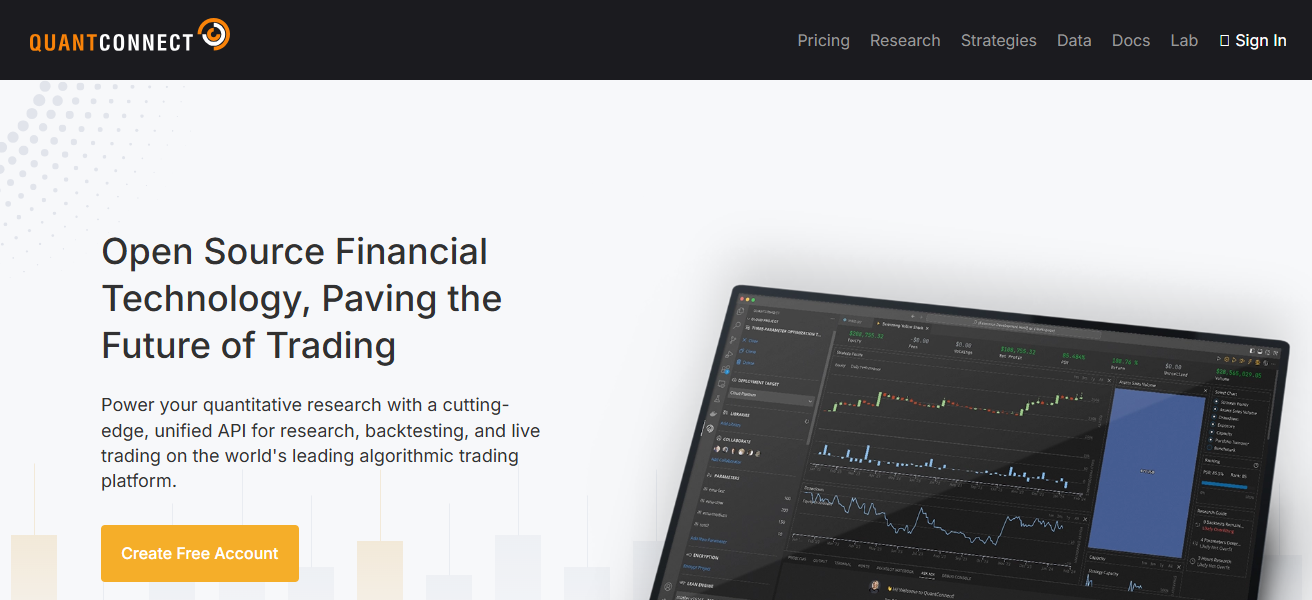
Users can code their strategies in either Python or C#, including the ability to embed machine learning models directly into their trading strategies.
The platform’s infrastructure includes execution and broker connectivity, giving systematic traders a great alternative.
QuantConnect Features
- Build strategies using Python/C#.
- Backtesting can be precise with the use of deep tick-level historical data.
- Support for multiple assets = options, equities, futures, and crypto.
- Live strategy execution is available through broker integration.
| Pros | Cons |
|---|---|
| Institutional-grade platform with multi-asset and global market support. | Requires coding knowledge (Python/C#) for most functionality. |
| Tick-level historical data for accurate backtesting. | Steep learning curve for beginners. |
| Supports machine learning integration and systematic trading. | Cloud-dependency may affect execution latency for some regions. |
| Multi-broker connectivity enables live deployment across markets. | Free tier has limited backtesting resources. |
7. Tradetron
Tradetron allows traders to build cloud-based algorithmic trading strategies using a visual, no-code builder, or custom logic, and deploy them automotically.
The company offers a strategy marketplace, which in addition to offering a unique value proposition, allows customers to discover and subscribe to various pre-built strategies.
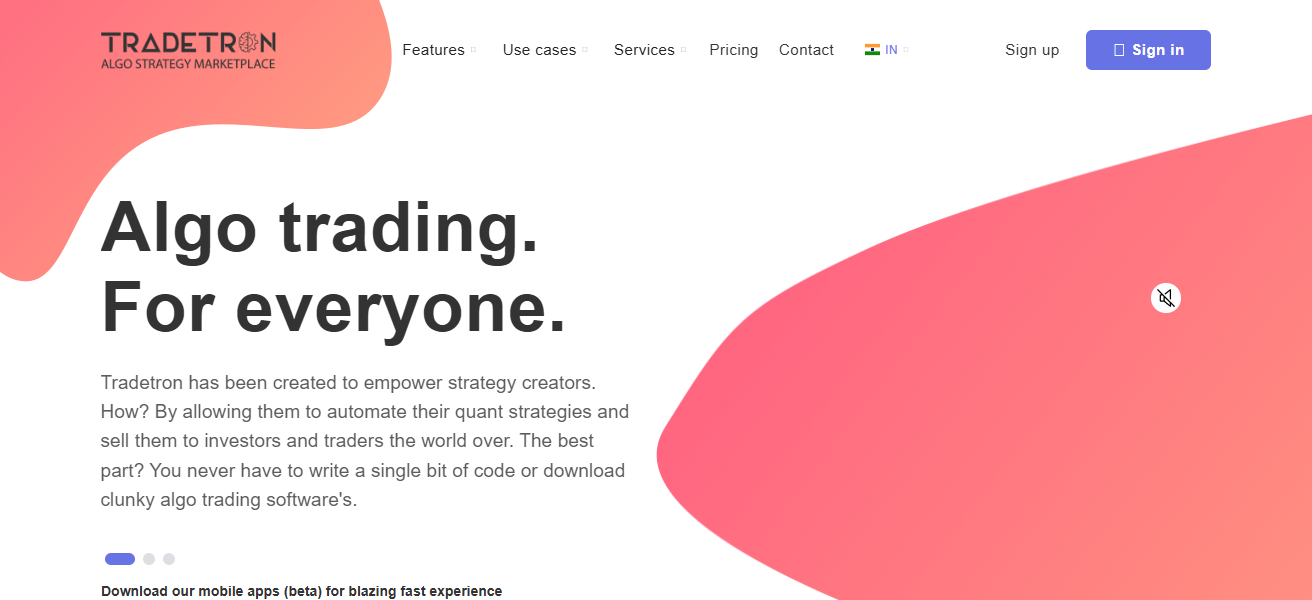
With multi-broker execution and paper trading capabilities, Tradetron allows customers to execute live orders without the need for local infrastructure. The cloud execution engine offers seamless strategy execution for both retail and advanced traders.
Tradetron Features
- Visual builder for strategies as an easy no-code option.
- Strategy execution is continuous.
- Live orders can be placed with multiple brokers.
- Strategies can be subscribed to or shared on the marketplace.
| Pros | Cons |
|---|---|
| No-code builder and visual interface for strategy creation. | Marketplace strategies involve revenue sharing or subscription. |
| Multi-broker execution and cloud deployment for continuous automation. | Limited advanced coding support for highly customized strategies. |
| Strategy marketplace allows exploration of pre-built approaches. | Paper trading features can be less precise than live markets. |
| Continuous cloud execution reduces infrastructure overhead. | Strategy complexity is sometimes limited by platform constraints. |
8. Zignaly
Zignaly’s platform emphasizes automated trading, copy trading, and trading portfolio automation by integrating user’s strategies in real time and automatically trade on their behalfs.
Additionally, Zignaly offers Z-Indexes, which are diversified smart portfolios with automated rebalancing and adjustments to allocation as per strategy, such that manual adjustments are not needed.
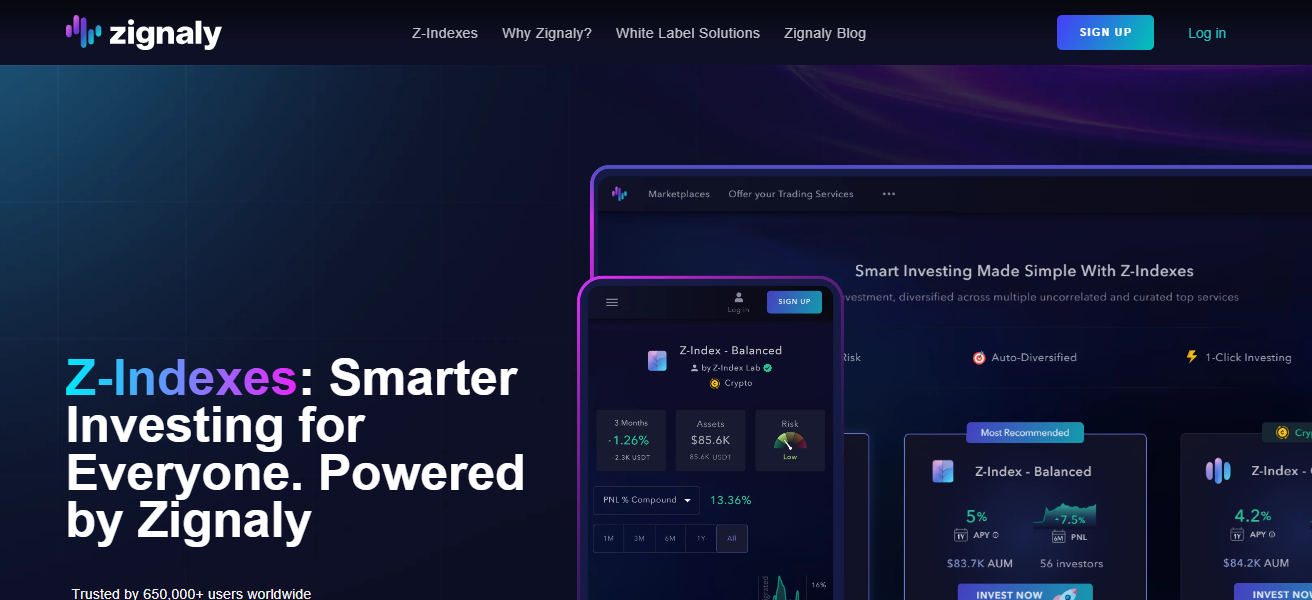
Zignaly is also focused on profit sharing in addition to automated execution, which provides robust options for both passive and active execution of automated trading strategies.
Zignaly Features
- Copy trading offers automated crypto execution.
- Portfolios are managed by rules-based rebalancing.
- Real-time trading of strategy leaders is tracked.
- Risk management, along with automatic profit control, is integrated.
| Pros | Cons |
|---|---|
| Automated crypto trading with copy-trading capabilities. | Limited to crypto markets only. |
| Smart portfolios rebalance automatically to minimize manual effort. | Profit-sharing model may reduce net returns. |
| Supports passive and active automated trading. | Exchange integration may not cover all global platforms. |
| Simplifies complex crypto strategy deployment for users. | Advanced customization requires technical knowledge. |
9. NinjaTrader
NinjaTrader is a multi-faceted trading application designed for futures, forex, and equities, with robust automation strategy support.
Traders can chart, backtest, and algorithmically develop trading strategies via NinjaScript (which is based on C#).
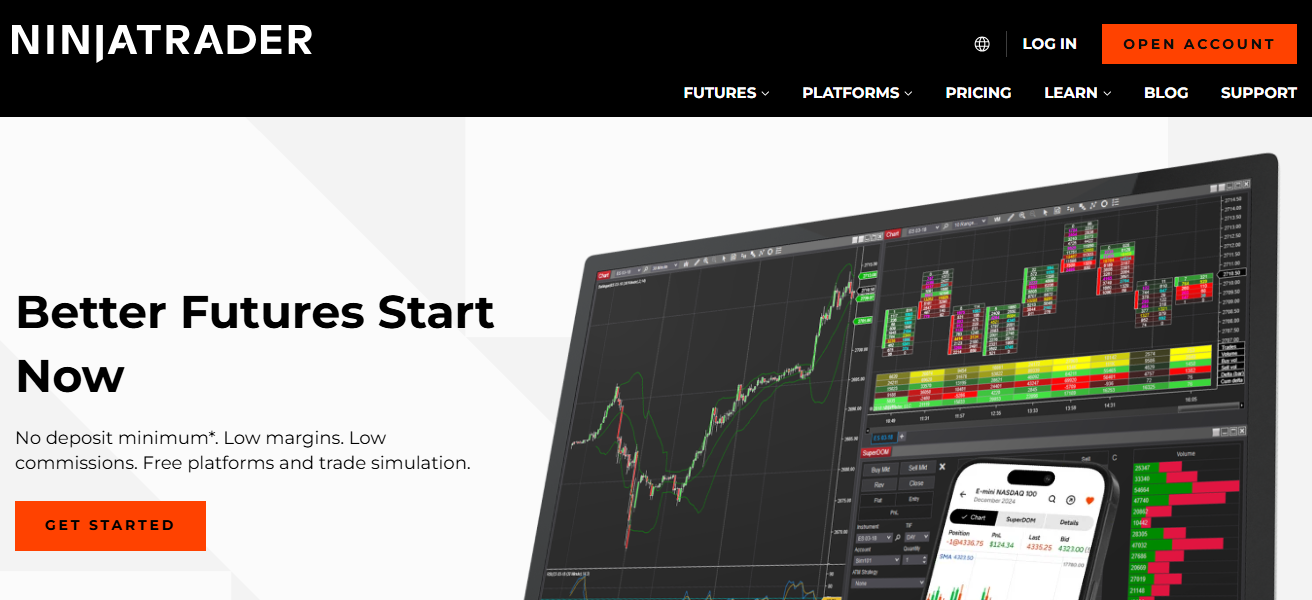
NinjaTrader can connect with brokers (Interactive Brokers included) and allows traders to automate strategies and trade in real time.
Because of its emphasis on customization, performance, and backtesting, NinjaTrader is a MUST HAVE for both discretionary traders and systematic traders who require low-latency execution along with complete control over the mechanics of their strategies.
NinjaTrader Features
- Strategy development via NinjaScript offers sophisticated charting.
- Tools are available for backtesting along with performance analysis.
- Execution latency is minimized for brokers that are integrated.
- Support for strategies and custom indicators is provided.
| Pros | Cons |
|---|---|
| Advanced charting, backtesting, and NinjaScript coding support. | Requires coding knowledge for custom strategies. |
| Supports futures, forex, and equities with broker integration. | Learning curve is steep for beginners. |
| Low-latency execution and performance-focused platform. | Subscription or broker connection needed for live trading. |
| Full control over systematic and discretionary strategies. | Cloud automation features limited compared to dedicated algo platforms. |
10. Interactive Brokers API (TWS)
Interactive Brokers’ Trader Workstation (TWS) API is a powerful interface that enables users to automate order placement, access and manage market data, and manage accounts in many global markets.
It supports several programming languages (Python, Java, C++, C#) and includes both real-time and historical data feeds.
Using FIX, Web API and TWS sockets, developers and quantitative analysts can design high levels of customization when building low latency execution systems to directly integrate with IB’s global routing system, which allows for systematic high frequency trading.
Interactive Brokers API (TWS API) Features
- Order execution and market access are programmable.
- Data provision includes both real-time and historical data.
- Supported languages are Python, Java, C++, and C#.
- For systematic or high-frequency trading, customization is extensive.
| Pros | Cons |
|---|---|
| Highly customizable programmatic execution across global markets. | Requires programming knowledge in Python, Java, C++, or C#. |
| Real-time and historical data feeds for systematic trading. | Complexity can overwhelm retail traders. |
| Low-latency execution for algorithmic and high-frequency strategies. | No visual strategy builder; fully developer-focused. |
| Multi-language support and robust broker connectivity. | Error handling and debugging can be challenging without coding experience. |
What are the challenges of latency when using cloud‑based algo trading systems?
Execution Speed – Unlike in-house systems, cloud-based systems will always introduce order execution delays of multiple milliseconds due to the step of routing the order to the cloud.
Market Fluctuation – Profit loss due to order execution delays and delays to receive market data cause huge losses whenever the market drops.
Cloud Latency – Cloud-based algorithmic trading systems are dependent on wireless internet speed, server location, and network traffic which are unpredictable.
Lag in Feed Data – Delay in receiving up to date market quotes will result in an outdated quote.
Order Queue – When cloud-based platforms have multiple/users, they will increase the order queue and delay execution in order to increase order throughput.
Brokers/Regulatory Restrictions – High frequency trading strategies are impacted by intentionally designed delays and restrictions from the platform.
What role does machine learning play in real‑time trade execution speed?
Machine learning (ML) significantly improves the speed of real-time trade execution by speeding up the processes involved in making decisions and by reducing the amount of time it takes to make decisions. Here are the keys involved:
Predictive Order Timing – Algorithmic trading is performed by ML™ models that identify and predict short-term price fluctuations of the target security so that they can optimize the timing of their trading decisions.
Adaptive Strategy Adjustment – ML can alter the execution strategies in real-time so that the trading profits can be maximized (and trading costs are minimized) by adjusting trading parameters such as order size, order type, and market conditions.
Anomaly Detection – ML can significantly reduce the time required to identify changes in market conditions (e.g., sudden market changes, order book depth changes) and so market participants are able to respond more quickly than humans.
Prioritization of Orders – Order-filling bottlenecks are minimized by ML, which enables real-time ranking and routing of orders that demand urgent attention.
Latency Compensation – ML models are capable of pre-emptively compensating for latency by forecasting the presence of networking/processing delays before they occur.
Hpw We Choose Tools That Execute Trades Faster Than Human Traders
- Execution Speed – The faster the order routing, and the lower the delay, the better it is.
- Market Coverage – Choose the one that covers the markets you trade. (stocks, crypto, forex, options).
- Automation Level – Choose the one that require the least manul intervention.
- Backtesting & Simulation – Choose the one that can give you the best backtesting of your trade strategies and can test the done reliability the strategies.
- Broker Integration – The more you can connect to your broker, the better it real time execution.
- Risk Management Tools – Built in: stop loss, take profit, and alert.
- Scalability – Choose the one that can handle the most volume and can handle the most strategies running at the same time.
- Support & Community – Choose the one that has tutorials, support, and troubleshooting.
Cocnlsuion
In summary, Tools That Execute Trades Faster Than Human Traders have changed the modern trading landscape by providing speed, accuracy, and automation to trade execution.
They reduce the possibility of human error, provide the opportunity for enhancement of trading strategies, and react to the dynamic nature of the market.
With the additoin of Artificial Intelligence, machine learning, and algorithmic trading, traders are able to manage risk, trade defensively and exploit market opportunities faster than ever.
FAQ
It uses AI to simulate millions of trades daily and generate actionable signals automatically.
It automates technical analysis, trendline detection, and multi-timeframe alerts for faster decision-making.
Yes, it converts plain-English rules into automated strategies for execution with supported brokers.
Options and derivatives traders who need fast backtesting and automated execution pipelines.