
In this article, I will discuss the Best AI Platforms for Business Rule Optimization. These platforms help businesses automate complex decisions, improve operational efficiency, and ensure compliance.
By leveraging AI, analytics, and workflow automation, they enable real-time, accurate, and scalable decision-making. Choosing the right platform can significantly enhance productivity, reduce errors, and support long-term business growth and innovation.
What is a Business rule Optimization Platform?
A Business Rule Optimization Platform is a software system designed to automate, manage, and improve decision-making within an organization.
It enables businesses to define, execute, and optimize complex rules that guide operations, ensuring consistency, compliance, and efficiency.
By leveraging AI, analytics, and workflow automation, these platforms help reduce errors, accelerate processes, and adapt to changing policies.
They support real-time decisioning, scenario simulation, and integration with enterprise systems, allowing both technical and business users to collaborate effectively while enhancing overall operational performance.
Key Points & Best AI Platforms for Business Rule Optimization
FICO Blaze Advisor – A robust decision management platform helping businesses automate complex rules with high scalability and accuracy.
IBM Operational Decision Manager (ODM) – Enables real-time decision automation, rule management, and analytics for consistent enterprise-level decision-making.
Nected – Simplifies business rule automation using AI-driven workflows, reducing manual effort and improving operational efficiency.
Red Hat Decision Manager (Drools) – Open-source platform providing rule-based automation and predictive analytics for flexible business decision-making processes.
Progress Corticon – Offers no-code business rule management, ensuring rapid deployment and compliance across enterprise decision automation.
Oracle Intelligent Advisor – Empowers organizations to automate decisions and recommendations with AI-driven, rule-based logic and integrations.
Moxo – Combines AI workflows and decision logic for seamless client engagement and streamlined operational rule enforcement.
Vellum AI – Uses AI to define, optimize, and automate complex business rules for faster decision-making efficiency.
Workato – Integrates AI and automation to connect apps, enforce rules, and optimize business workflows effortlessly.
Microsoft Power Automate – Automates repetitive business tasks and rule-based processes with AI-powered workflows across Microsoft ecosystem.
10 Best AI Platforms for Business Rule Optimization
1. FICO Blaze Advisor
FICO Blaze Advisor is the industry-leading business rule management system (BRMS) for automating and optimizing complex decisions.
It allows organizations to set up, apply and administer business rules independent of the application codes, providing them with flexibility and responsiveness to changing policies.
Blaze Advisor offers a comprehensive suite of analytics and decision modeling tools, enabling businesses to make faster decisions while minimizing errors and enhancing efficiency in areas such as credit scoring, compliance, and risk management.
Its extreme scalability makes it suitable for large organizations with heavy transactional workloads. Its tools for simulation and testing allow business users to collaboratively iterate on strategy with IT teams without halting operations.
| Feature | Description |
|---|---|
| Rule Management | Define, deploy, and manage business rules independently from code. |
| Decision Modeling | Provides analytics and simulations for complex decision-making. |
| Scalability | Handles high transactional workloads for large enterprises. |
| Compliance | Ensures decisions meet regulatory and policy requirements. |
| Collaboration | Allows IT and business teams to co-manage evolving rules. |
| Testing & Simulation | Simulate scenarios to validate rules before deployment. |
| Industry Focus | Strong in finance, credit scoring, and risk management. |
2. IBM Operational Decision Manager (ODM)
IBM Operational Decision Manager (ODM) is a decision automation mechanism that integrates business rule management and event processing with real‑time analytics.
It enables organizations to capture, automate and govern business decisions across critical processes, enhancing consistency and transparency.
ODM has smart authoring tools that allow business users and developers to work on rules together, thus lowering reliance from traditional codes.

The laws and regulations can also be simulated before being updated with advanced simulation and scoring capabilities.
Its integration with IBM Cloud Pak and ecosystem helps enable scalable, secure deployments. ODM excels in complex, dynamic business logic and operationalization of decisions in banking, insurance, supply chain, and customer engagement use cases.
| Feature | Description |
|---|---|
| Real-Time Decisioning | Executes decisions in real-time for operational efficiency. |
| Rule Authoring | Intuitive interface for business users and developers. |
| Event Processing | Integrates with event streams for dynamic decisions. |
| Analytics & Simulation | Test and score rule changes before deployment. |
| Integration | Works with IBM Cloud Pak and enterprise ecosystems. |
| Governance | Centralized control over rules and policies. |
| Industry Focus | Banking, insurance, supply chain, and customer engagement. |
3. Nected
Nected is a Next-Gen data processing platform using AI driven workflow and business rule automation to streamline the way organizations orchestrate their processes and enforce their policies.
In contrast to traditional rule engines, Nected combines low‑code configuration with intelligent decisioning, meaning teams can create bespoke rules and logic without the need for deep tech skills. It works really well at automating repeatable decisions in an auditable, controlled manner.
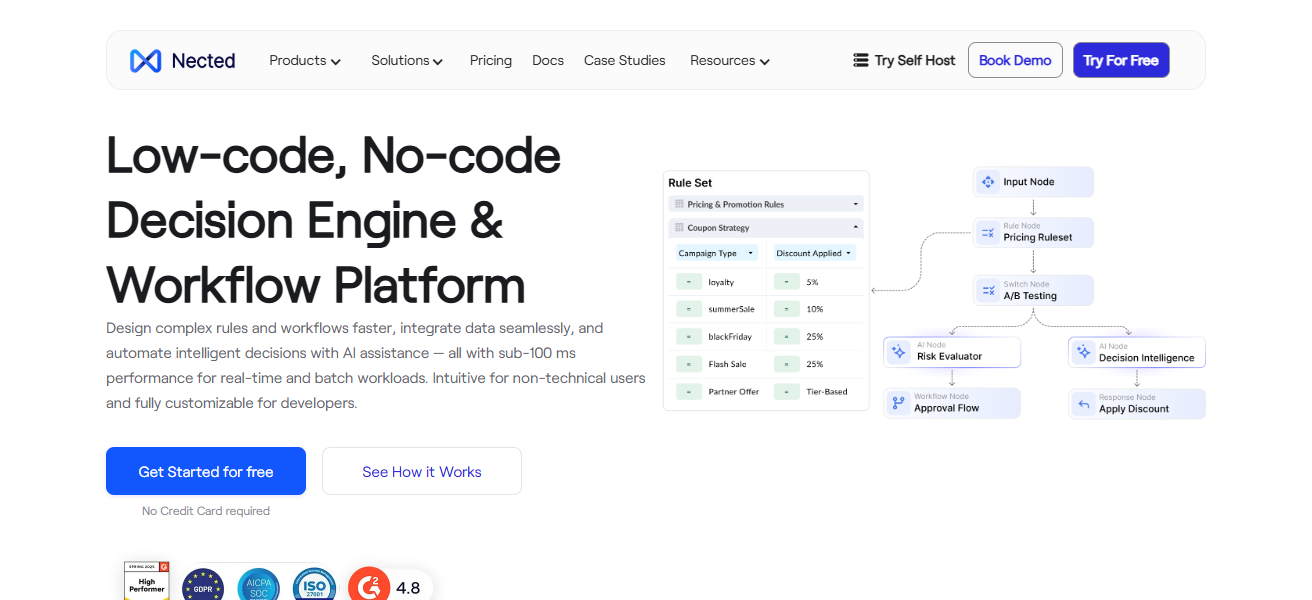
Nected delivers data-backed recommendations that increase productivity and ensure operational clarity, with optimized outcomes by utilizing AI insights while evaluating the rules.
This provides the flexibility to integrate existing systems, APIs and data sources, which makes it well suited for mid‑size to large businesses that require agile rule optimization and increased collaboration between technical and business stakeholders.
| Feature | Description |
|---|---|
| AI-Driven Workflows | Uses AI to optimize business rules and decisions. |
| Low-Code Configuration | Build rules without deep technical knowledge. |
| Automation | Reduces manual decision-making and repetitive tasks. |
| Integration | Connects with APIs and existing enterprise systems. |
| Auditability | Tracks rules for compliance and accountability. |
| Collaboration | Enhances teamwork between IT and business users. |
| Operational Efficiency | Improves productivity and clarity in decision processes. |
4. Red Hat Decision Manager (Drools)
Red Hat Decision Manager, based on the open‑source Drools® engine, is a comprehensive business rule management and complex event processing platform.
It allows organizations to automate and govern rules while embedding predictive analytics and decision models.
By providing authoring facilities that allow users to easily define business logic expressed in rules which can be executed and deployed across applications, Decision Manager helps both technical and business stakeholders.

Its open architecture enables cloud‑native deployment, Kubernetes orchestration, and scalable execution. It shines in situations where flexible rulesets, concurrent processing and real‑time decisioning are required.
It helps enterprises with its community ecosystem, extensibility and combining rules with business processes and even streams of events to drive better outcomes and accelerate innovation.
| Feature | Description |
|---|---|
| Open Source | Built on Drools engine with community support. |
| Complex Event Processing | Handles concurrent events and real-time decisions. |
| Decision Modeling | Integrates predictive analytics for advanced rule logic. |
| Cloud-Native | Supports Kubernetes and scalable deployment. |
| Flexibility | Enables custom rulesets and extensions. |
| Collaboration | Tools for business and technical stakeholders. |
| Industry Focus | Suitable for complex enterprise operations and innovation. |
5. Progress Corticon
Progress Corticon is a BPM that focuses on eliminating complex decision automation without any coding.
As per the description, it uses its no‑code rule modeling environment that enables business analysts and subject‑matter experts to define, test, and deploy rules with clarity and precision.
Corticon’s patented inference capabilities guarantee speedy execution and reliable outcomes, even among thousands of interdependent rules.

The platform’s scalable architecture allows making rules work in cloud/hybrid/on‑premise environments. Integrating easily with enterprise systems and analytics engines, Corticon enables better compliance,’
ower risk, and faster processing in functions such as finance, insurance and customer service. Corticon improves governance and lowers time‑to‑value for rule initiatives with automated testing and traceability.
| Feature | Description |
|---|---|
| No-Code Rule Modeling | Enables business analysts to define rules visually. |
| Fast Execution | Patented inference engine processes thousands of rules quickly. |
| Scalable Architecture | Deploy rules on cloud, hybrid, or on-premise setups. |
| Integration | Works with analytics engines and enterprise systems. |
| Compliance | Reduces risk and strengthens governance. |
| Testing & Traceability | Validate rules and track changes easily. |
| Industry Focus | Finance, insurance, and customer service processes. |
6. Oracle Intelligent Advisor
Oracle Intelligent Advisor is a decision automation and guidance platform that unifies business rules with predictive analytics and conversational logic.
It allows organizations to codify expertise in rule projects that can intelligently guide customers, employees and partners through decisions.
Visual tools enable business users to author sophisticated rules, model scenarios and publish decision services with minimal IT intervention.

Oracle’s deep integration with its larger cloud ecosystem provides robust access to data, analytics and enterprise applications.
With omnichannel support for real‑time advice within web portals, mobile apps, and contact centres.
By merging AI insights with powerful rule execution, it accelerates, improves and delivers better decisions at scale.
| Feature | Description |
|---|---|
| Decision Automation | Automates complex rules and guidance. |
| Predictive Analytics | Integrates insights for smarter decisions. |
| Visual Rule Authoring | Business users can create rules without IT. |
| Omnichannel Deployment | Delivers advice via web, mobile, and contact centers. |
| Integration | Seamless with Oracle Cloud applications. |
| AI Insights | Enhances rule execution and accuracy. |
| Industry Focus | Enterprise-wide decision-making across services. |
7. Moxo
The Moxo client engagement and workflow platform embeds intelligent business rule automation into collaborative workspaces.
Built for enhanced operational interactions, the Moxo platform features intelligent decision logic to initiate actions based on workflow parameters, user inputs and contextual data.
Emphasizing customer lifecycle workflows, it enriches onboarding, case management and service delivery, with rules providing consistency and compliance.
Moxo’s visual tools enable teams to design rule‑based processes without much code, while maintaining transparency and auditability.
Through secure data handling and integrations across enterprise systems, Moxo can automate decisions, eliminate manual overhead, and enhance customer experiences, which makes it particularly suitable for service‑intensive industries.
| Feature | Description |
|---|---|
| Workflow Automation | Triggers actions based on decision logic. |
| Customer Lifecycle Focus | Improves onboarding, case management, and service delivery. |
| Visual Rule Design | Low-code environment for building rule-based processes. |
| Compliance | Ensures auditability and structured decision-making. |
| Secure Integrations | Works with enterprise systems safely. |
| Collaboration | Enhances teamwork in client engagement workflows. |
| Operational Efficiency | Reduces manual overhead and improves experiences. |
8. Vellum AI
Vellum AI is an AI powered business rule optimization platform that makes it easier to define, test and optimize decision logic. Using natural language processing and machine learning, Vellum lets stakeholders articulate rules in plain text and converts them into executable logic.
This makes it easier to write rules and fast-tracks decision automation initiatives. Its built‑in analytics and simulation tools assess rule performance

identify optimizations, encouraging a cycle of continuous improvement. Vellum binds together existing systems, data sources and APIs to allow seamless rule deployment over any enterprise application.
This human-AI interaction spectrum helps deliver a better outcome by combining domain knowledge with AI-generated insights to improve accuracy, mitigate bias and provide greater operational efficiency in complex decision environments.
| Feature | Description |
|---|---|
| AI-Enhanced Rules | Uses NLP and machine learning for rule creation. |
| Conversational Authoring | Express rules in natural language. |
| Analytics & Simulation | Tests performance and suggests optimizations. |
| Integration | Works with APIs and enterprise data sources. |
| Accuracy | Combines human expertise with AI insights. |
| Continuous Improvement | Optimizes decision-making over time. |
| Operational Efficiency | Improves rule execution in complex environments. |
9. Workato
Workato is an enterprise automation and integration platform that embeds intelligent decisioning within workflows and business rules.
It facilitates heterogeneous applications and services to talk with each other, allowing organizations to specify rule‑based triggers and actions across systems without programming.
Workato’s AI and automation features fast track monotonous processes like approvals, escalations and data transformations by enforcing business logic in a consistent manner.

Through its library of connectors and prebuilt recipes, teams can instantly assemble rule‑driven workflows capable of scaling alongside evolving business requirements.
The traceability and monitoring tools underpin improved governance across the platform, and its intuitive interface enables cross‑functional collaboration between IT and business users to maximize both agility and operational effectiveness.
| Feature | Description |
|---|---|
| Automation & Integration | Connects multiple applications and enforces business rules. |
| AI-Driven Decisions | Streamlines approvals, escalations, and data transformations. |
| Prebuilt Recipes | Ready-to-use workflows accelerate implementation. |
| Traceability | Monitoring and governance for rules and automation. |
| Low-Code Interface | Build workflows without heavy coding skills. |
| Collaboration | Supports cross-functional IT and business teamwork. |
| Scalability | Enterprise-ready for complex, multi-system environments. |
10. Microsoft Power Automate
Microsoft Power Automate is a low‑code automation platform that combines AI insights with rule‑based workflows to streamline business processes.
It enables organizations to create automated flows which repeat decision logic in Microsoft 365, Azure, Dynamics and third-party systems.
It allows users to embed predictions, form processing or classification into the execution of rules, thereby making smarter decisions using AI Builder.
By eliminating the need for business users to have deep technical skills, Power Automate’s user‑friendly designer empowers them to implement and maintain rules. Automated monitoring, approvals, and governance capabilities deliver both transparency and compliance.
The platform enables scaling from departmental level automation to enterprise-wide implementations, improving productivity and reducing errors while ensuring rules consistently determine outcomes across organizational processes.
| Feature | Description |
|---|---|
| Low-Code Automation | Build flows with minimal coding. |
| AI Integration | Uses AI Builder for predictions, classification, and forms. |
| Rule-Based Workflows | Automates decision logic across Microsoft and third-party apps. |
| Governance | Monitoring, approvals, and compliance built-in. |
| Enterprise Scale | Supports departmental to organization-wide automation. |
| Productivity | Reduces errors and manual work. |
| Collaboration | Enables business users to maintain rules efficiently. |
How To Choose Best AI Platforms for Business Rule Optimization
Rule complexity – Pick platforms that you would need to work with your decision logic complexity and interdependent rules.
Scalability – Make sure it can handle high transaction volumes and scale with your company requirements.
Usability – Search for low-code/no-code interfaces which enable business users to write and manage rules.
Integration Capabilities – Check if it will work with your enterprise systems, APIs and data sources.
AI & Analytics Support – Platforms that have predictive analytics and AI can optimize decisions to improve outcomes.
Compliance & Governance – Maintain strong audit trails, traceability and industry regulations.
Real-Time Decisioning – For fluid environments, select platforms that assess rules in real-time.
Collaboration Tools – Enables co-working for IT, developers, and business stakeholders.
Cost & Licensing – Evaluate pricing structures relative to your usage scale and ROI potential.
Industry Fit – Some are focused on finance, insurance, customer service or supply chain.
Conclsuion
In conclusion, the best AI platforms for business rule optimization empower organizations to automate complex decisions, improve accuracy, and enhance operational efficiency.
By combining AI, analytics, and low-code tools, platforms like FICO Blaze Advisor, IBM ODM, and Microsoft Power Automate enable scalable, compliant, and real-time decision-making. Choosing the right platform ensures agility, productivity, and long-term business growth.
FAQ
How does IBM Operational Decision Manager (ODM) help businesses?
IBM ODM automates, governs, and optimizes business decisions with real-time event processing, analytics, and rule management, ensuring consistent operational outcomes.
What makes Nected different from other platforms?
Nected combines AI-driven workflows with low-code configuration to automate repetitive decisions, integrate data sources, and enhance collaboration between business and IT teams.
Why choose Red Hat Decision Manager (Drools)?
Red Hat Decision Manager is open-source, flexible, and cloud-native, ideal for complex event processing and predictive analytics for real-time decision automation.
What industries benefit most from Progress Corticon?
Corticon is popular in finance, insurance, and customer service because it simplifies rule modeling, ensures compliance, and accelerates decision automation without coding.