
Over the past few months, I have been writing about Underrated Legal Tech Tools With Huge Growth Potential, which are changing the function of the legal industry behind the scenes, automating contracts with intelligence and smart research systems.
These platforms create efficiencies in law firms while remaining stealthy compared to the mainstream legal software solutions in use today, as they continue to drive down costs, increase accuracy, and make workflows faster.
Key Poinst & Underrated Legal Tech Tools With Huge Growth Potential
- Spellbook – AI drafting assistant for contracts integrated inside the Microsoft Word workflow automation tool
- Everlaw – Cloud-based eDiscovery platform enabling litigation teams to analyze evidence efficiently collaboratively
- Darrow AI – AI legal intelligence platform identifying high-value litigation opportunities from data sources
- Luminance – Luminance AI contract analysis tool, detecting risks and clauses in documents quickly
- Apperio – Apperio legal spend analytics platform providing real-time visibility into billing data
- vLex Vincent – vLex Vincent AI legal research assistant delivering case law insights globally fast
- SpotDraft – SpotDraft contract lifecycle management platform automating drafting approvals and contract workflows efficiently
- Caseflood.ai – Caseflood.ai predicts legal case outcomes using AI-driven data analytics models and insights
- Zoho Sign – Zoho Sign electronic signature software enabling secure digital document approvals easily workflow
- Tezeract – Tezeract AI automation platform streamlining legal workflows and document processing tasks efficiently
Key Poinst & Underrated Legal Tech Tools With Huge Growth Potential
1. Spellbook
Spellbook is quickly becoming the main platform of AI Copilot for transactional lawyers. Instead, it plugs directly into Microsoft Word and allows for drafting, redlining, and benchmarking clauses in real-time against the market.
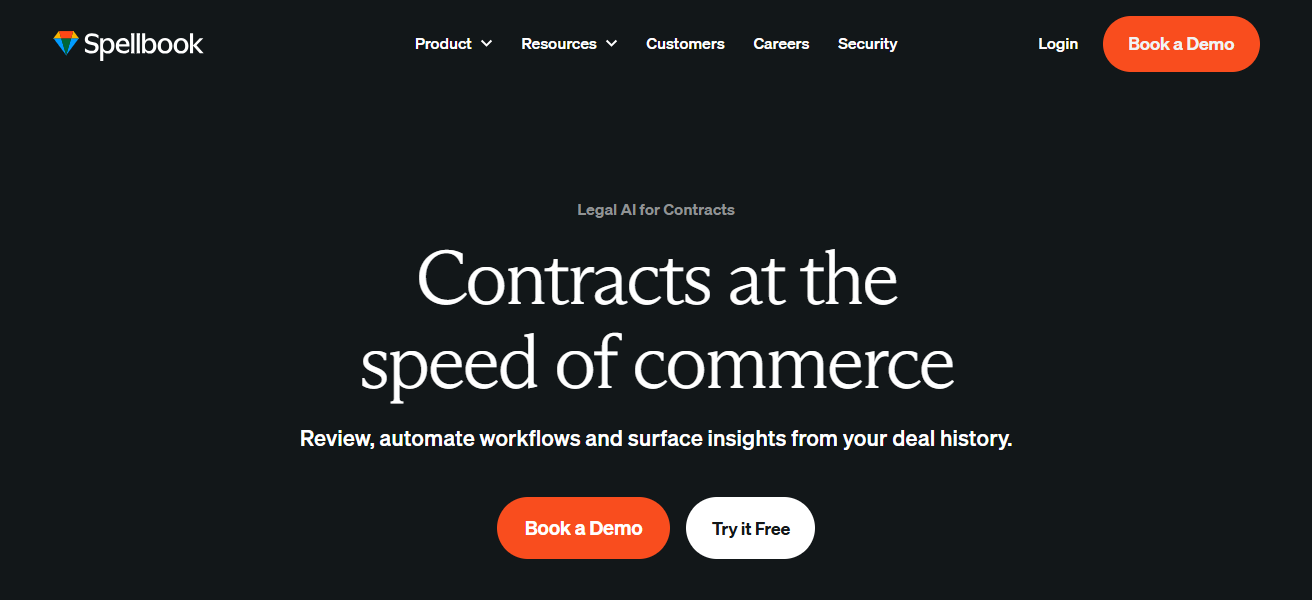
Latest updates are multi-document “Associate” workflows and GPT-based legal reasoning. Its SOC2 compliance status and overall enterprise adoption across 80+ countries make it
If not a critical app yet, something that in-house legal teams should have on their radar while seeking to minimize drafting time as well as improve the accuracy of contracts.
Spellbook – Pros & Cons
| Pros | Cons |
|---|---|
| AI drafting directly inside Microsoft Word | Requires Word ecosystem dependency |
| Reduces contract drafting time significantly | Limited offline functionality |
| GPT-powered clause suggestions improve accuracy | Advanced features may need training |
| Strong enterprise security (SOC2 compliance) | Premium pricing for small firms |
| Multi-document workflow support | Still evolving for complex jurisdictions |
2. Everlaw
Everlaw | $328 M ($24.69 B)A rapid-growth, AI-driven cloud litigation platform for discovery. Its newest features: a natural-language search
That reaches across millions of documents dubbed “Deep Dive,” and one called “Writing Assistant” that helps turn evidence into legal stories.

What it does: Everlaw supports predictive coding and clustering AI over 10M+ document cases. Its biggest selling point is transparency and courtroom-ready workflows
Which make it absolutely irresistible to litigation-heavy firms that have adopted new AI-powered case preparation systems.
Everlaw – Pros & Cons
| Pros | Cons |
|---|---|
| Powerful AI-driven eDiscovery search tools | High learning curve for beginners |
| Handles millions of legal documents smoothly | Expensive for small law firms |
| Strong courtroom-ready presentation tools | Requires stable internet connection |
| Deep Dive natural language search feature | Limited customization in workflows |
| Excellent collaboration features | Focus mainly on litigation, not contracts |
3. Darrow AI
Darrow AI is a predictive analytics company that identifies surface-level legal claims long before they reach the public domain.
Its newest AI models check regulatory filings, news, and public data for class-action opportunities.
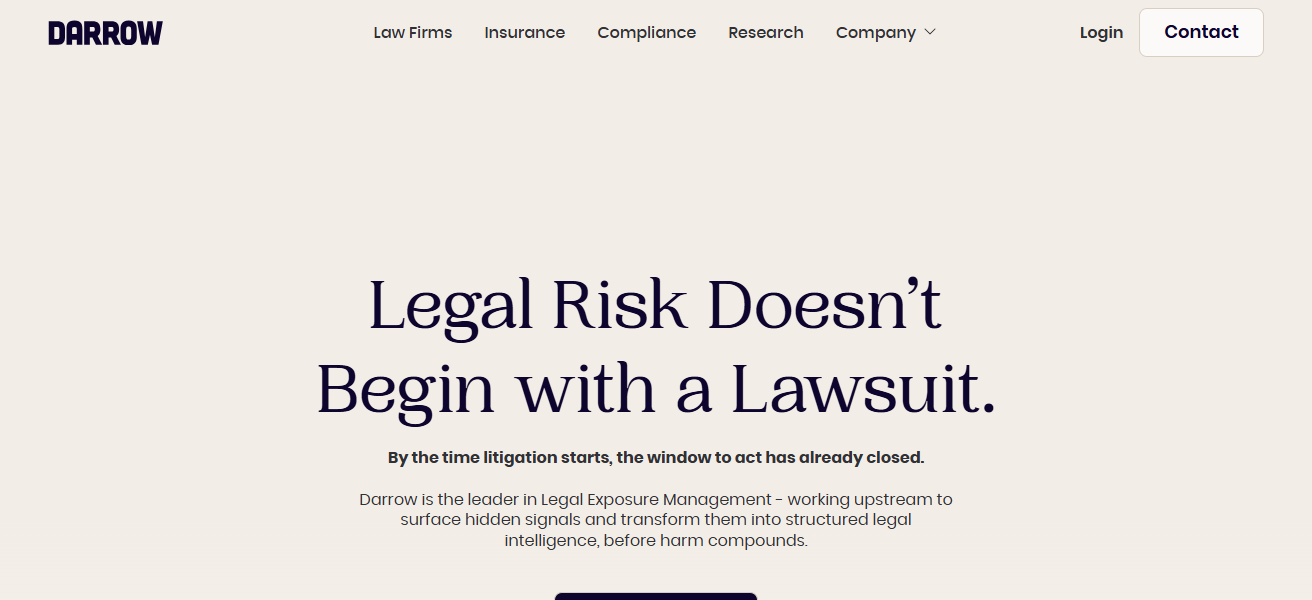
It can be used by law firms to not only identify high-value litigation leads but also maximize monetization of the cases.
It’s well-suited to become a staple in plaintiff-side litigation, since it has the potential to convert raw data into viable legal opportunities that could yield great returns.
Darrow AI – Pros & Cons
| Pros | Cons |
|---|---|
| Identifies high-value legal claims early | Limited use outside plaintiff litigation |
| AI-driven legal opportunity detection | Requires large data input for accuracy |
| Strong ROI potential for law firms | Still niche and emerging technology |
| Automates case discovery process | Risk of false positives in predictions |
| Competitive advantage in litigation strategy | Automates the case discovery process |
4. Luminance
Luminance focuses on AI-based contract review and risk detection. Its newest system utilizes LLM-based “Autopilot” to tag anomalies, clause comparisons, and assist due diligence in acquisitions.

It is extensively used in corporate legal departments to automate compliance checks. With improved accuracy in time owing to the self-learning AI of this platform, it is a remarkable alternative for contract governance and regulatory monitoring at an enterprise scale.
Luminance – Pros & Cons
| Pros | Cons |
|---|---|
| Advanced AI contract risk detection | High implementation cost for enterprises |
| Self-learning AI improves over time | Requires large document datasets |
| Excellent for M&A due diligence | UI can be complex for new users |
| Automates compliance checks efficiently | Best suited for large organizations |
| Strong global enterprise adoption | Limited SMB-focused features |
5. Apperio
Apperio Transparent legal billing enmart helps law firms not to stretch their billings. The latest update features AI invoice analysis and cost tracking at the matter level.
Corporate legal departments leverage it to identify billing inefficiencies and enhance budget planning. In stark contrast to traditional e–billing systems
Which rely on standardised billing guidelines from some of the biggest (and least transparent) law firms

Apperio is uniquely integrated with the underlying billing data at law firms to offer transparency previously unseen in this sector.
It is increasingly being adopted by Legal Operations teams that are supported by the CFO and focused on cost control and accountability.
Apperio – Pros & Cons
| Pros | Cons |
|---|---|
| Real-time legal spend visibility | Depends on law firm data integration |
| Improves budgeting and forecasting | Limited features beyond billing analytics |
| Detects invoice inefficiencies easily | Requires strong adoption by firms |
| Transparent matter-level tracking | Not a full legal management system |
| Strong CFO-level reporting tools | Setup process can be complex |
6. vLex Vincent
By combining legal research with AI reasoning, vLex Vincent is revolutionizing the process of legal research through multi — jurisdiction and multi—language technologies.
Stopping at October 2023 in terms of data, one of its latest features is the capability to conduct 50-state surveys, along with a comparison of cases from across countries and answers validated via citations.
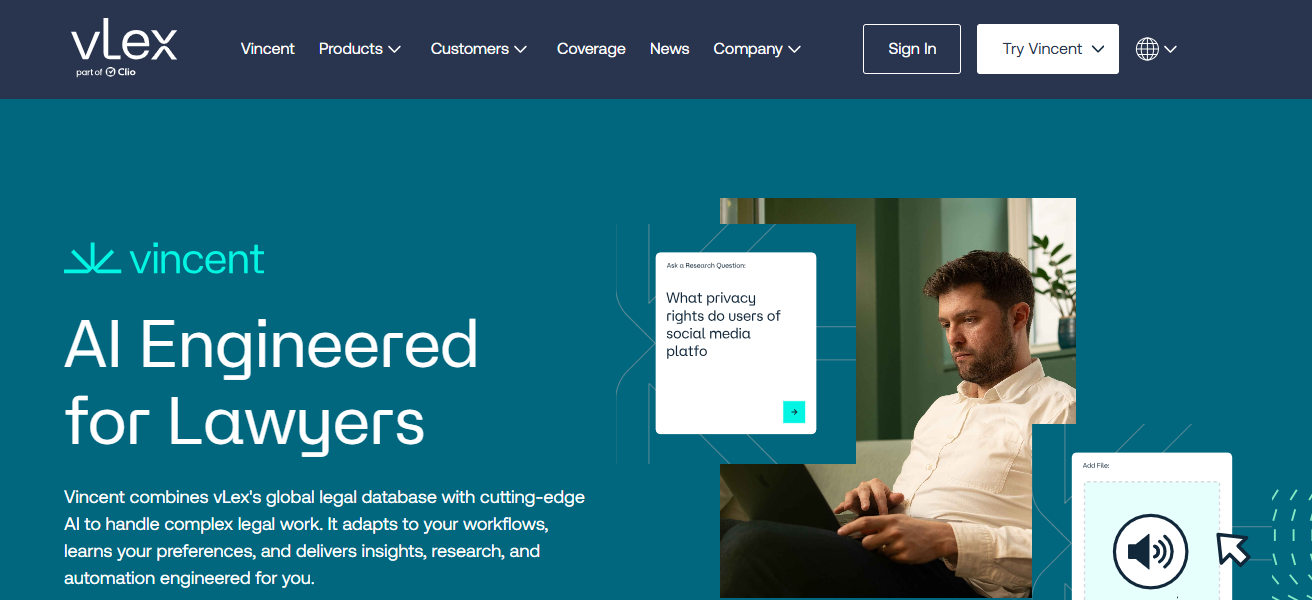
Vincent has been trained on billions of legal documents, so it is extremely well-suited for deep work and analysis in the law area.
It is being used by law firms to speed up more time-consuming research workflows and decrease their reliance on manual case law review.
vLex Vincent – Pros & Cons
| Pros | Cons |
|---|---|
| Multi-jurisdiction legal research AI | Subscription can be costly |
| Citation-backed accurate responses | Requires training for optimal use |
| Handles massive legal databases | Occasional AI interpretation gaps |
| Speeds up case law research | Internet connectivity required |
| Useful for global legal comparison | Not ideal for very niche legal topics |
7. SpotDraft
SpotDraft is an end-to-end contract automation CLM platform scaling quickly. Among its latest AI features are VerifAI (which checks clauses) and a new feature for automating workflows ranging from drafting to approval to e-signature.

It integrates natively with Word, Slack and enterprise tools. Especially with startups and mid-market enterprises rapidly adopting SpotDraft
The company is establishing itself as a solution of choice for teams seeking to streamline contract turnaround time and minimize manual legal chokepoints.
SpotDraft – Pros & Cons
| Pros | Cons |
|---|---|
| End-to-end contract lifecycle automation | Can be complex for small teams |
| AI-based clause verification tools | Limited customization in some workflows |
| Integrates with Slack and Word easily | Pricing may be high for startups |
| Reduces contract turnaround time | Requires onboarding time |
| Strong enterprise adoption growth | Advanced features locked in higher plans |
8. Caseflood.ai
Caseflood. ai is geared to provide insights about litigations and predicted case outcomes. Its AI models predict the chances of success by analyzing previous judgments, how judges behave, and trends in cases.
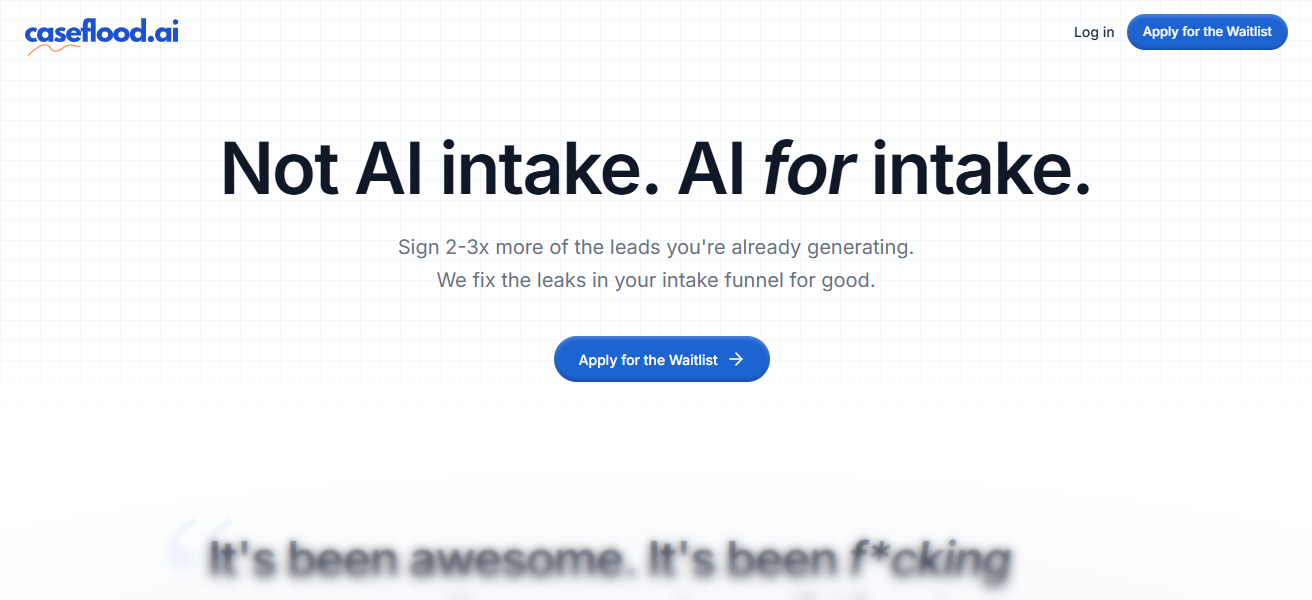
The platform is being used more and more to construct litigation strategies as well as settlement decisions.
Its most significant innovation is using raw legal data to create prediction models, so lawyers can make data-backed decisions before they step foot in front of a judge.
Caseflood.ai – Pros & Cons
| Pros | Cons |
|---|---|
| Predicts case outcomes using AI | Accuracy depends on data quality |
| Helps in litigation strategy planning | Still early-stage technology |
| Analyzes judge and case patterns | Limited global jurisdiction coverage |
| Improves settlement decision-making | Not widely adopted yet |
| Converts legal data into insights | Requires legal expertise to interpret |
9. Zoho Sign
Zoho Sign is extending beyond e-signatures to complete workflow automation. The latest highlights include API integrations, audit trails, and identity verification for highly regulated industries.

The price-friendly aspects and seamless integration with the Zoho ecosystem give it mass adoption from Small and medium enterprises (SME).
Because you might even be able to replace not just your standalone signature tools with, you know, more of a complete document. Lifecycle management as businesses are fully transitioning into the digital age.
Zoho Sign – Pros & Cons
| Pros | Cons |
|---|---|
| Affordable e-signature solution | Limited advanced legal analytics |
| Strong integration with Zoho ecosystem | Not as feature-rich as competitors |
| Secure audit trails and compliance | Basic UI compared to premium tools |
| API support for automation | Less powerful for large enterprises |
| Easy adoption for SMEs | Limited standalone legal workflow tools |
10. Tezeract
Tezeract specializes in AI-based legal process automation, including document parsing, contract classification, and workflow optimization.
The latest of them uses machine learning to help cut down on legal admin functions. It is getting noticed in emerging global markets that require cost-efficient automation of the work done by legal teams.

Tezeract focuses on customisable AI-based workflows that enable small and mid-sized law firms to increase their operational scale without human resource onboarding.
Tezeract – Pros & Cons
| Pros | Cons |
|---|---|
| AI automation for legal workflows | Still emerging in global market |
| Reduces manual administrative tasks | Limited enterprise recognition |
| Customizable automation pipelines | Smaller ecosystem compared to leaders |
| Cost-effective for law firms | Requires setup and tuning |
| Good for emerging market adoption | Fewer integrations available |
Why it’s Underrated Legal Tech Tools With Huge Growth Potential
- Drafting contracts with AI inside MS Word
- Accelerates redlining and clause creation
- Rapid transformation, corporate legal teams all over the world
- Litigation-based Cloud AI eDiscovery tool
- Smart search for high-volume document review
- Widely adopted in complex legal cases
- Using predictive AI to identify lucrative legal claims
- Identifies public data that provides timely inputs for litigation
- Strong potential in plaintiff-side lawsuits
Conclsuion
Lastly, Underrated Legal Tech Tools With Immense Potential for Growth are changing the legal industry by way of AI Automation, Smart Contract Analysis, and Predictive analytics.
They leverage efficiencies and drive costs down across the legal chain to help law firms and businesses make better decisions.
These tools will support and guide faster, better, technology-driven legal workflows with global roots, as adoption increases.
FAQ
What are underrated legal tech tools?
They are emerging AI and automation platforms that improve legal work efficiency but are still not widely adopted in mainstream law firms.
Why are these tools gaining popularity now?
Because law firms are shifting toward AI-driven automation, cost reduction, and faster legal workflows.
Is Spellbook useful for lawyers?
Yes, it helps lawyers draft contracts directly in Word using AI suggestions and clause automation.
How does Everlaw help in legal cases?
It simplifies eDiscovery by analyzing large legal datasets and improving litigation document review speed.