This is the article where, in the 20th-25th areas, I am going a little bit into depth about which SaaS Tools Every Bootstrapped Startup Uses Instead of Enterprise Software in our fast-growing digital economy.
Such tools enable startups to operate more efficiently, optimize their costs and productivity, and scale without burdening themselves with an enterprise system.
Discover how mainstream tools such as Notion, Slack, ClickUp, and others in 2026 have changed the game for lean startups.
Key Points & SaaS Tools Every Bootstrapped Startup Uses Instead of Enterprise Software
| SaaS Tool | Explanation (12 words each) |
|---|---|
| Notion | Flexible spreadsheet-database hybrid for organizing data and workflows easily no-code platform |
| Slack | All-in-one workspace for notes, docs, databases, and a team collaboration management platform solution |
| ClickUp | Productivity tool combining tasks, docs, goals, and workflows in one platform suite |
| Trello | Visual project management tool using boards, lists, and cards system Kanban approach |
| Airtable | Lightweight CRM for managing contacts and building strong relationships, simple user friendly |
| HubSpot CRM | Sales CRM focused on pipeline tracking and deal management efficiency boosts conversion |
| Pipedrive | Sales CRM focused on pipeline tracking and deal management efficiency boost conversion |
| Folk | Email marketing platform for campaign automation and audience engagement growth marketing tool |
| Mailchimp | Design tool for creating graphics presentations and social media content, with easy editing |
| Canva | Email marketing platform for campaign automation and audience engagement, a growth marketing tool |
10 SaaS Tools Every Bootstrapped Startup Uses Instead of Enterprise Software
1. Notion
In 2026, Notion has taken the place of expensive enterprise knowledge tools and become the unicorn operating system for bootstrapped startups.
The platform integrates documentation, project management, databases, and an AI writer in one flexible environment.
Notion is used by startups as product roadmaps, internal wikis, meeting notes, and sometimes light-weight CRMs.
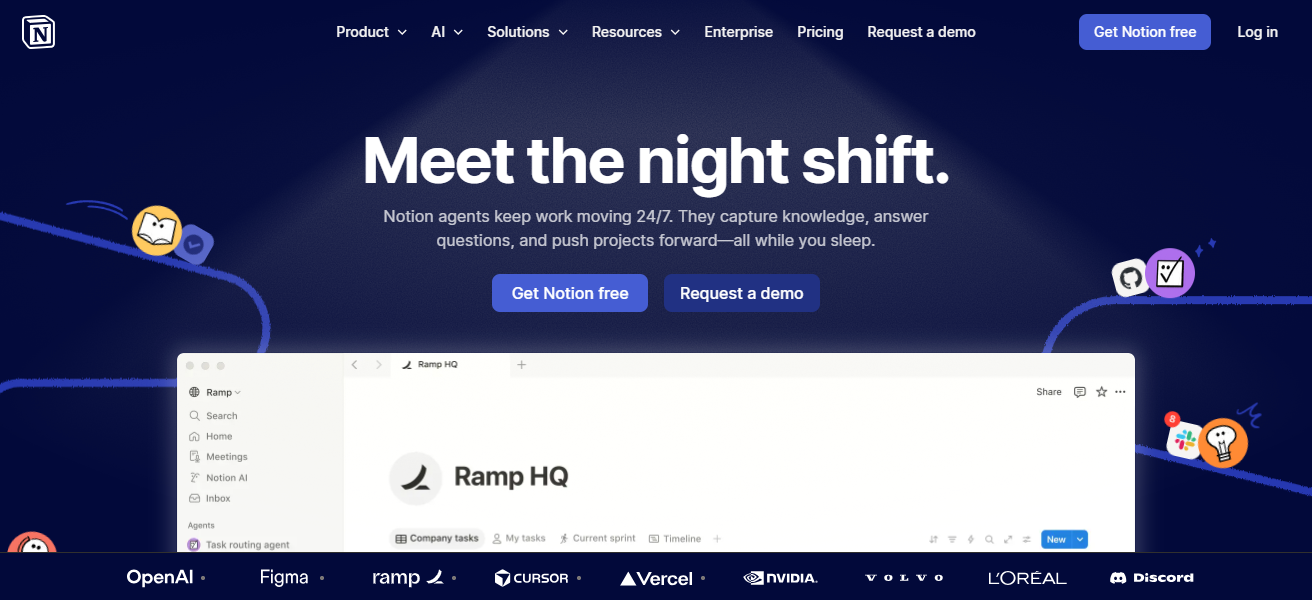
Teams are replacing the 5–7 separate tools they use for things like documentation tracking, meeting notes, and task management within Notion alone — achieving up to 40% margin cost reduction.
Now with integrated AI writing, auto-summary, SOP, and action plans to make it an essential tool for lean fast-scaling teams without the cost of enterprise software.
| Pros | Cons |
|---|---|
| All-in-one workspace reduces multiple SaaS tool dependencies | All-in-one workspace reduces multiple SaaS tool dependencies |
| Strong AI integration for notes, summaries, and workflows | Performance slows with very large databases |
| Highly customizable for startups and scaling teams | Requires setup time to build structured systems |
| Great for documentation and team knowledge sharing | Offline functionality is still limited |
2. Slack
With more than 60% of early-stage teams already using Slack today, it retains its position as the central communication hub for startups — particularly those under 100 employees.
It replaces expensive corporate communication suites with real-time messaging, channels, and 2000+ app integrations.

Slack AI features summarize conversations and minimize meetings by around 25%, in the year 2026. For bootstrapped startups, Slack is a more suitable option as it enhances the speed of execution and remote collaboration.
Slack is one of the central threads of startup ecosystems due to its simplicity, scalability, and ability to pull communications into a single place without enterprise-level complexity or implementation friction, despite Microsoft’s high-profile attempts with Microsoft Teams.
| Pros | Cons |
|---|---|
| Real-time communication improves team speed and coordination | Message overload can reduce productivity |
| Thousands of integrations with startup tools | Free plan has limited message history |
| Channels improve structured collaboration | Can replace deep work with constant notifications |
| AI summaries reduce meeting dependency | Can become costly for large teams |
3. ClickUp
ClickUp has officially become their new enterprise project management tool all-in-one app for productivity (i.e., you know, the “everything app”).
Combines tasks, docs, goals, dashboards & automation into one platform. What are the actual benefits of ClickUp, Startup Save 30–50% SaaS costs against Asana, Jira, Trello In 2026?
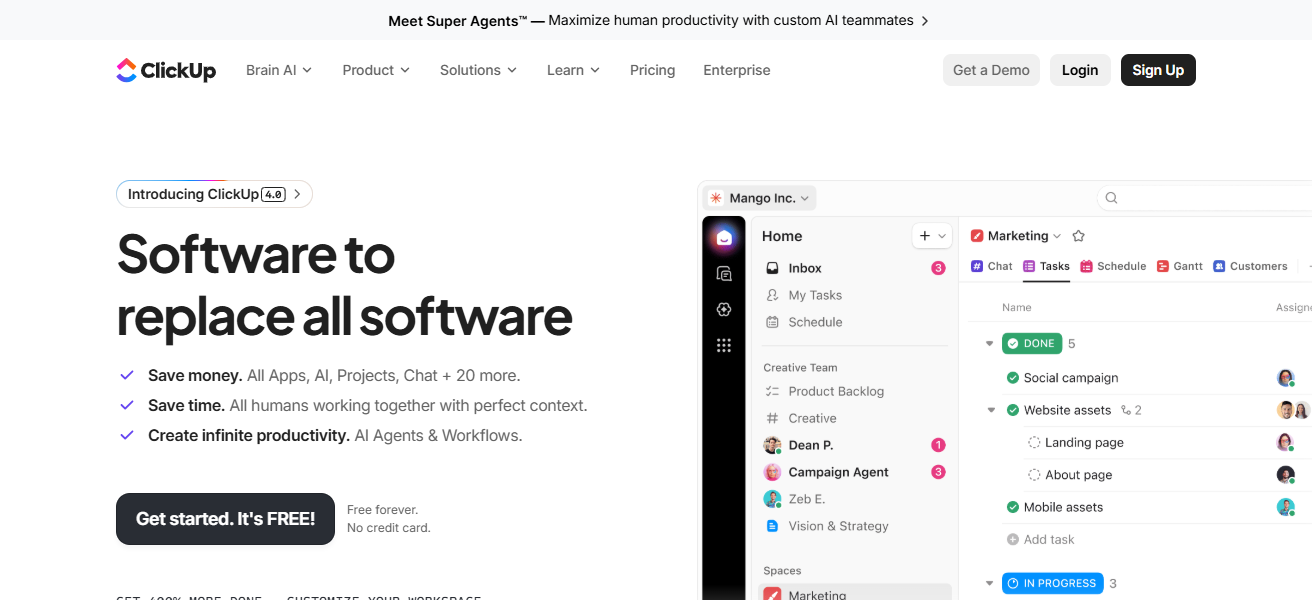
AI-driven task recommendations and workflow automation assist small teams in managing complex product pipelines without resorting to operations staff.
ClickUp is particularly great for SaaS founders as the tool grows with you, helping to fit an agile, sprint-based dev cycle & is on the affordable side of scales in terms of pricing (3-50k).
| Pros | Cons |
|---|---|
| Replaces multiple tools like Jira, Asana, Trello | Interface can feel complex initially |
| Strong automation and AI task management | Occasional performance lag in large projects |
| Highly customizable workflows for startups | Learning curve for non-technical users |
| Cost-effective for scaling teams | Too many features may overwhelm small teams |
4. Trello
Free-tier Trello remains a big success as a lightweight visual project management tool for early-stage startups. It is constructed around kanban boards (organizing workflows with a drag-and-drop simplicity for founders).
Despite its shortcomings, many bootstrapped startups still like Trello for its simple flow and the flexibility of its forever-free tier. It is commonly utilized for content planning, simple product management, and small team collaboration.

It isn’t as feature-rich with enterprise-level features, but its simplicity is its biggest strength; the product helps startups not over-engineer processes. A lot of teams pair Trello with Slack and Notion to build a lean, but powerful startup stack.
| Pros | Cons |
|---|---|
| Extremely simple Kanban-based interface | Limited advanced project management features |
| Fast onboarding with zero learning curve | Not ideal for complex enterprise workflows |
| Free plan works well for startups | Weak reporting and analytics tools |
| Great for visual task tracking | Requires add-ons for advanced functionality |
5. Airtable
With a mix of spreadsheets and databases, Airtable is the new low-code tool for startups to replace high-priced enterprise data tools.
It is deep-linked into the 2026 CRM systems, inventory tracing, content pipelines, and operational dashboards.

It is valuable for bootstrapped startups with custom workflows possible without engineers. We have seen reports of startups eliminating 3–4 individual SaaS tools by consolidating into
Airtable. Automation with generative content fields assists a group in managing the structured content quickly.
Airtable is particularly favoured by product, marketing and operations teams who want systems to be scale for them and avoid heavy enterprise database infrastructure.
| Pros | Cons |
|---|---|
| Combines spreadsheet and database flexibility | Can become expensive as usage scales |
| No-code workflow creation for startups | Limited offline functionality |
| Great for CRM, inventory, and operations | Requires setup knowledge for advanced use |
| Strong automation and AI fields | Performance slows with large datasets |
6. HubSpot CRM
One of these free tools, which has the most adoption among startups at an enterprise-grade level in 2026 HubSpot CRM. It includes contact management, pipeline tracking, email automation, and marketing functionality within one ecosystem.
HubSpot is a favorite option among startups due to its free tier that allows unlimited users and contacts, supporting massive reductions in early-stage costs.

Recent data on SaaS usage indicates that HubSpot (and only HubSpot!) powers 100,000+ startup domains across the globe and is ruling the marketing automation space.
Today, its AI tools forecast deal success and handle follow-ups automatically, delivering an enterprise-class CRM alternative at a fraction of the price.
| Pros | Cons |
|---|---|
| Free plan offers powerful CRM features | Paid tiers become expensive quickly |
| Strong sales, marketing, and automation tools | Interface can feel complex for beginners |
| AI-powered insights and deal predictions | Advanced features locked behind paywalls |
| Scales well from startup to enterprise | Customization can be limited in free version |
7. Pipedrive
If the goal of your startup is to close deals at a high velocity, Pipedrive is for you. It’s also why by 2026, so many bootstrapped SaaS companies use it for its visual pipeline interface and because it’s vastly more affordable than enterprise CRMs like Salesforce.
Pipedrive is loved by startups due to its easy and simple deal management, email integration, and forecasting; no unnecessary complexity. It has gained popularity, particularly amongst B2B founders dealing with outbound.

Sales forecasts based on historical data, another pilot solution, are finding a better alternative to conventional batched CRM systems.
Why startups are switching from heavyweight baton Constant fuse for more active C Startups have started writing Pipedrive, ditching cumbersome crms and boosting profit tempo
30+angel investor selling latency. The latest forecasts across the 2015/16 Pipedrive customer lifecycle report hit what is clearly an impressive $307K in sales pipeline spending per employee.
| Pros | Cons |
|---|---|
| Simple visual sales pipeline management | Limited marketing automation features |
| Easy to use for sales-focused startups | Not ideal for large enterprise ecosystems |
| Improves deal tracking and conversion rates | Fewer integrations compared to competitors |
| Affordable for small teams | Reporting tools are basic |
8. Folk
Folk is a CRM for people who work in relationship-driven startups and for founders and it is the modern, lightweight CRM. It offers simplicity, contact enrichment, and collaboration, which is not typical of an enterprise CRM.
Folk is so easy to use that in 2026, a lot of indie SaaS founders used Folk to manage investors, leads, and partnerships without any complex setup. Automation features allow the tracking of conversations and reminders.
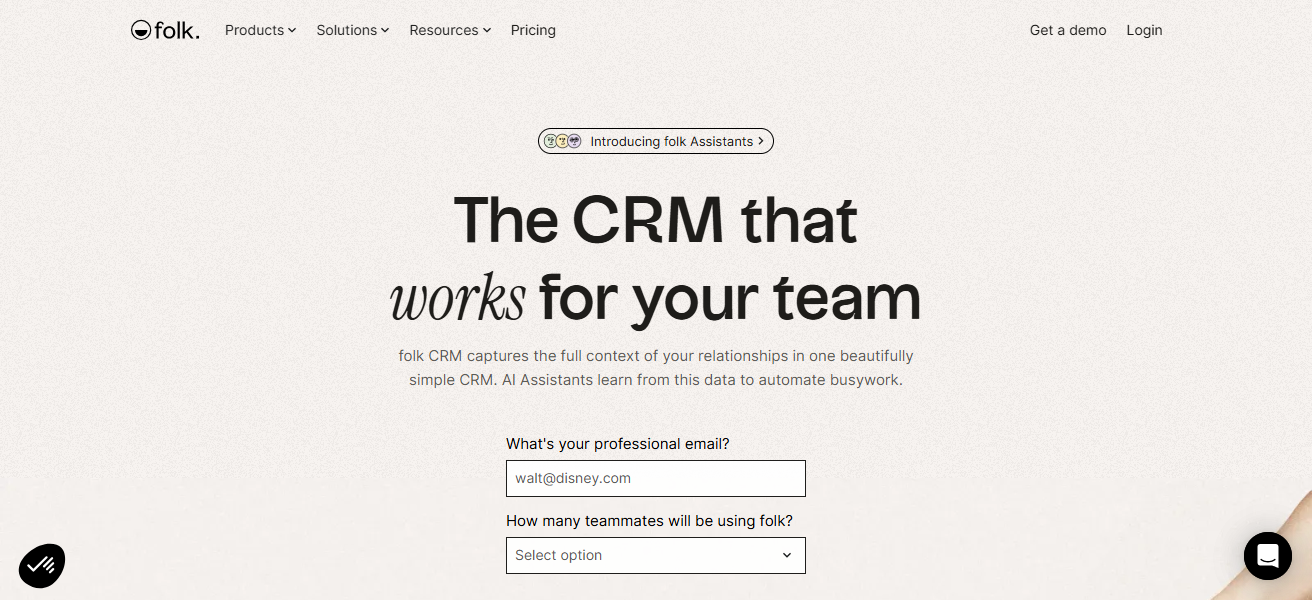
Folk is preferred by bootstrapped startups because it retains the flexibility needed to cater a plugin-free CRM for growth-stage teams. It is particularly suited for agencies, consultants, and businesses that thrive on personal connections with clients versus massive sales pipelines.
| Pros | Cons |
|---|---|
| Lightweight CRM focused on relationships | Still evolving with fewer advanced features |
| Simple and easy setup for founders | Limited scalability for large enterprises |
| Great for managing investors and leads | Smaller integration ecosystem |
| Clean, modern user experience | Not suitable for complex sales pipelines |
9. Mailchimp
While newer automation tools leapfrogged Mailchimp into leading the email marketing space for startups, they remain a key player.
Thus, it was extensively used for newsletters, onboarding sequences, and basic marketing automation in 2026. Its free tier and super-simple drag-and-drop email designer are popular with bootstrapped startups.

That said, new SaaS patterns are starting to emerge where some startups have migrated away from basic analytical platforms because pricing scales with larger volumes of contact.
However, Mailchimp drives millions of small business campaigns around the world and is still a solid option for new startups wanting fast, basic segmentation, and fundamental customer engagement features.
| Pros | Cons |
|---|---|
| Easy email marketing setup for startups | Pricing increases with contact growth |
| Strong automation for newsletters and campaigns | Limited advanced segmentation in lower tiers |
| Free plan available for beginners | UI can feel cluttered over time |
| Widely trusted platform globally | Not as powerful as newer marketing tools |
10. Canva
Canva is the new go-to option for you and other bootstrapped startups — ditching costly enterprise design software. It helps founders write a social media post, a pitch deck, marketing creatives, and branding assets without having to hire designers.
Fast forward to 2026, and Canva’s AI features can automatically generate designs, resize them as needed, and maintain branding consistency across platforms.

Instead of enterprise design tools like Adobe suites, startups report they were able to cut design costs up to 70% by using Canva!
With its drag-and-drop interface, even a non-designer can not only use it but shine at it, making it a must-have tool for fast-moving startups that require high-quality visuals with limited resources.
| Pros | Cons |
|---|---|
| Easy drag-and-drop design for non-designers | Limited advanced professional design control |
| AI tools speed up content creation | Some premium features require paid plan |
| Reduces need for expensive design software | Can feel template-heavy |
| Ideal for social media and marketing visuals | Internet required for full functionality |
SaaS Tools Every Bootstrapped Startup Uses Instead of Enterprise Software (Comparison)
| SaaS Tool | Key Purpose & Why Startups Use It |
|---|---|
| Notion | All-in-one workspace combining docs, wikis, databases, and task management. Startups replace multiple enterprise tools with Notion to manage roadmaps, SOPs, and team collaboration in one place. Its AI features now help auto-generate content and workflows, reducing operational workload and tool costs significantly for lean teams. |
| Slack | Real-time communication platform replacing traditional enterprise messaging systems. Startups use Slack for channels, integrations, and remote teamwork. AI summaries and automation reduce meeting overload and improve decision speed, making it essential for fast-growing distributed startup teams in 2026. |
| ClickUp | Unified productivity platform combining tasks, goals, docs, and automation. Startups replace Jira, Asana, and enterprise PM tools with ClickUp to streamline workflows. Its AI and automation help small teams manage complex projects without hiring dedicated operations staff. |
| Trello | Simple Kanban-based project management tool used for lightweight workflow tracking. Startups prefer Trello for content planning, small projects, and visual task management due to its simplicity and free-tier flexibility, avoiding enterprise-level complexity. |
| Airtable | Hybrid spreadsheet-database platform used for building custom workflows without coding. Startups replace multiple enterprise data tools with Airtable for CRM, inventory, and operations dashboards. Its automation and AI fields improve efficiency for small teams managing structured data. |
| HubSpot CRM | Free-to-use CRM offering contact management, email automation, and sales pipelines. Startups choose HubSpot to avoid expensive enterprise CRMs while still accessing powerful marketing and sales tools, including AI-driven deal predictions and automation workflows. |
| Pipedrive | Sales-focused CRM designed for deal tracking and pipeline management. Startups use it instead of complex enterprise CRMs due to its simplicity, visual interface, and affordability, helping small teams improve sales conversion speed and forecasting accuracy. |
| Folk | Lightweight modern CRM focused on relationship management and networking. Startups use Folk to manage leads, investors, and partnerships without enterprise CRM complexity, making it ideal for founders who rely on personal connections and outreach. |
| Mailchimp | Email marketing and automation platform used for newsletters, onboarding, and campaigns. Startups prefer Mailchimp for its easy setup and free tier, though some migrate later due to scaling costs. It remains widely used for basic customer engagement. |
| Canva | Design platform enabling startups to create visuals, pitch decks, and marketing content without designers. Canva’s AI tools automate design generation and branding consistency, helping startups cut design costs by up to 70% compared to enterprise design software. |
Final Verdict
SaaS tools will be your new best friend when replacing enterprise software for bootstrapped startups (Oct 2023). Notion, Slack, ClickUp, Airtable, and Canva kind of gather tons of tools to help their teams do better work “for less” and to scale efficiently.
Modern solutions provide flexibility, automation, and collaboration that legitimize 2018 startups to grow faster in the future (2026).
Productivity and business success in the long run can improve drastically by selecting the right SaaS stack.
FAQ
Why do startups prefer SaaS tools over enterprise software?
Startups prefer SaaS tools because they are affordable, flexible, easy to scale, and eliminate the need for heavy enterprise-level systems.
Is Notion enough to replace multiple enterprise tools?
Yes, Notion can replace several enterprise tools by combining documentation, databases, project management, and AI-powered workflow automation in one platform.
How does Slack help bootstrapped startups?
Slack improves communication through real-time messaging, channels, integrations, and AI summaries, reducing dependency on costly enterprise communication systems.
Why is ClickUp popular among startups?
ClickUp is popular because it combines task management, docs, automation, and dashboards, replacing multiple enterprise project management tools efficiently.