
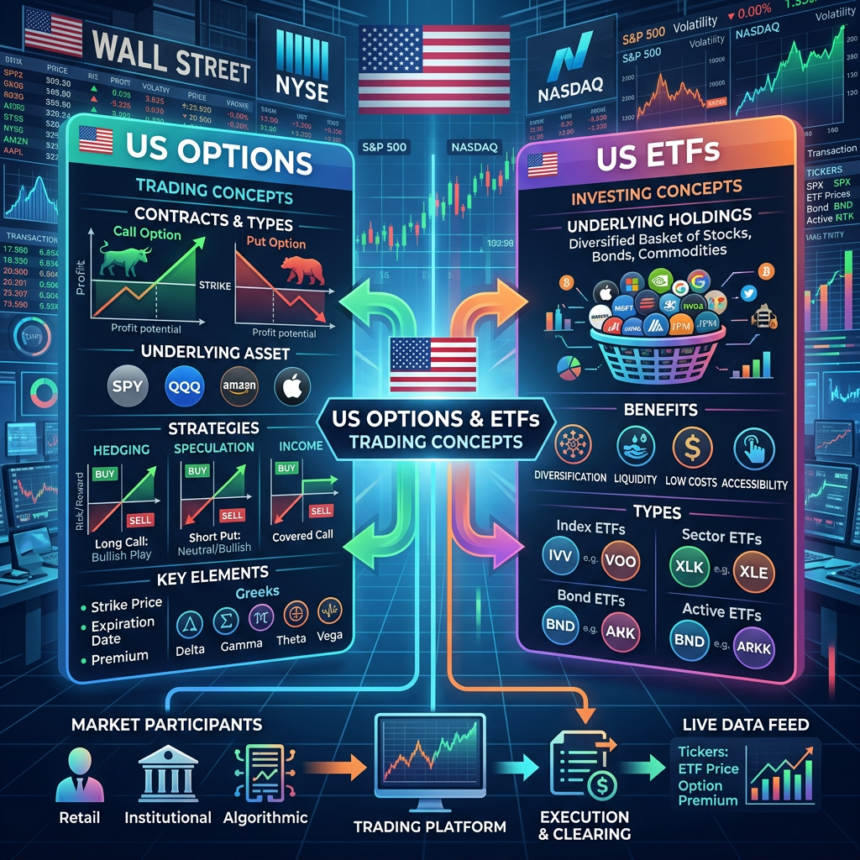
This article will explore the top global trading brokerage firms available to Indian investors to trade U.S. options and ETFs. The growth of cross-border investing options and access to the largest stock market has made choosing a brokerage firm very important.
We focus on the best trading platforms based on their costs and features to U.S. trading, research, and online investing.
Key Points & Best Global Broking Platforms for Trading US Options and ETFs from India
| Global Broking Platform | Explanation |
|---|---|
| Interactive Brokers | Offers low-cost US options trading with advanced professional trading tools. |
| Charles Schwab | Provides commission-free ETFs and comprehensive research for Indian investors worldwide. |
| TD Ameritrade | Features thinkorswim platform with powerful options analysis and education resources. |
| Saxo Bank | Gives access to global markets with sophisticated multi-asset trading capabilities. |
| Webull | Enables commission-free US trading through intuitive mobile and desktop platforms. |
| TradeStation | Specializes in advanced charting and automated strategies for options traders. |
| Firstrade | Charges zero commissions on stocks, ETFs, and options transactions globally. |
| Moomoo | Provides real-time market data and commission-free ETF investment opportunities. |
| Alpaca | Best for API-based trading and automated investing in US markets. |
| Tiger Brokers | Offers seamless access to US options and ETFs from India. |
10 Best Global Broking Platforms for Trading US Options and ETFs from India
1. Interactive Brokers
Interactive Brokers is popular for Indian investors who choose this broker for direct access to the US options and ETFs. The broker prices competitively, gives access to liquidity, and has a professional-grade platform known as Trader Workstation.
Low currency conversion costs mean that investors can take thousands of US securities and use options strategies. The broker’s fractional shares service makes building a diversified portfolio easier, as investors can buy shares with lower amounts of money.
Interactive Brokers – Pros & Cons
| Pros | Cons |
|---|---|
| Extremely low trading and currency conversion fees | Trader Workstation can overwhelm beginners |
| Access to global markets and thousands of securities | Account setup may require additional verification |
| Supports advanced options strategies and margin trading | Customer support response times can vary |
| Fractional share investing available | Some research tools have steep learning curves |
| Professional-grade analytics and risk management tools | Inactivity and data fees may apply in certain cases |
2. Charles Schwab
Charles Schwab is an excellent brokerage service as it offers US-listed commission-free ETF trading and provides research services pertaining to investment. Investors get access to market reports, webinars, and portfolio analyses that help improve their understanding of the investment.

The broker also has better customer support and provides a greater variety of ETFs. This makes Charles Schwab an excellent brokerage service for investors who want to diversify their investment to the US.
Charles Schwab – Pros & Cons
| Pros | Cons |
| Commission-free ETF and stock trading | Limited direct access for some international investors |
| Excellent educational and research resources | Advanced trading tools less powerful than competitors |
| Strong reputation and financial stability | Options trading features are relatively basic |
| High-quality customer service support | Currency conversion costs may be higher |
| Large selection of low-cost ETFs | Account opening requirements can be extensive |
3. TD Ameritrade
TD Ameritrade offers the best trading platform, as it allows investors a great deal of freedom and choice through dynamic analysis, tutorials, and practice accounts for options trading, among others. Investors are also able to make advanced strategies and trade with confidence
As they have greater access to the market. The trading platform also comes with a great deal of resources to help investors better themselves. This makes it the leading choice for investors who are looking to practice options trading through the US markets.
TD Ameritrade – Pros & Cons
| Pros | Cons |
| Industry-leading thinkorswim trading platform | Interface may appear complex initially |
| Excellent educational webinars and tutorials | International account availability can be limited |
| Advanced options analysis tools | Some advanced features require experience |
| Free paper trading accounts | Customer onboarding process can be lengthy |
| Extensive market research and charting | No direct support for certain global banking methods |
4. Saxo Bank
Saxo Bank has the advantage of more than 50 global multi-asset exchanges available. Traders can trade U.S. stocks, ETFSs, options, bonds, and futures, all within the same account.

They have a well-built system of professional and detailed market analytics. Risk management and premium services that Saxo Bank provides are appreciated by his high-net-worth clients and experienced investors.
Saxo Bank – Pros & Cons
| Pros | Cons |
| Access to more than fifty global exchanges | Higher minimum deposit requirements |
| Broad range of investment products | Premium services come with higher fees |
| Sophisticated trading and risk management tools | Less suitable for beginner investors |
| Professional market research and analytics | Some advanced data subscriptions cost extra |
| Multi-currency account support | Platform complexity may intimidate new users |
5. Webull
Webull’s rapid growth can be partially attributed to the user-friendliness of the mobile app and no brokerage fee policy. Real time market data, advanced charts, customizable watchlists and more all are features of the app.
All these features have attracted many active and younger traders. Options trading is also available. The interface is easy to use, and many Indians have used the app to follow the American markets and trade with a low fee brokerage.
Webull – Pros & Cons
| Pros | Cons |
| Commission-free trading on stocks and ETFs | Limited international market access |
| Modern and user-friendly mobile app | Research tools less comprehensive than larger brokers |
| Real-time market data and charting | Fewer retirement account options |
| Competitive options trading features | Customer service can be slower during peak periods |
| Suitable for beginner and active traders | Limited fixed-income investment products |
6. Tradestation
High level and active traders have a love affair with the Trading station because of its strong and advanced trading systems and automation. High level traders have a need for strong and advanced charting, back testing, and even advanced algorithms.

Solutions offered by TradeStation include the ability to design unique trader developed indicators and automated trading systems for trading US Options and US ETFs. Trade Station has the strength of professional analytic systems and design systems.
TradeStation – Pros & Cons
| Pros | Cons |
| Excellent algorithmic trading capabilities | Platform has a significant learning curve |
| Advanced charting and backtesting tools | Some features require paid subscriptions |
| Supports custom indicators and automation | Less beginner-friendly than mobile-first brokers |
| Powerful technical analysis tools | Account fees may apply under specific conditions |
| Suitable for professional traders | Research resources are comparatively limited |
7. Firstrade
For stocks, ETF, and options trading, Firstrade has no commissions. There is no cost to use premium market research reports and other investment resources. The Account Opening process is simple. All features create and maintain a user-friendly interface.

The low cost of using the site is supplemented by the company offering programs to help investors reinvest their dividends.
Firstrade – Pros & Cons
| Pros | Cons |
| Zero commissions on stocks, ETFs, and options | Trading platform has a basic interface |
| Free access to premium research reports | Fewer advanced trading tools available |
| Dividend reinvestment programs offered | Limited educational resources for beginners |
| Simple and easy account management | Mobile application lacks advanced features |
| Cost-effective for long-term investors | Customer support options are relatively limited |
8. Moomoo
Moomoo is easily a technology-based, real-time market data brokerage. Users create and share investment insights with interactive market charts.
There are no commissions for trading ETFs. Moomoo facilitates a data-based investing approach for users who require a modern system. Advanced market data and earnings analysis are key components of the brokerage platform that help with investing decisions.
Moomoo – Pros & Cons
| Pros | Cons |
| Rich market data and analytics tools | Some advanced data services require subscriptions |
| Interactive investor community and insights | Relatively new compared to established brokers |
| Commission-free ETF trading opportunities | Customer support varies by region |
| Advanced stock screening features | Limited long-term performance history |
| User-friendly and modern interface | Fewer retirement and income investment products |
9. Alpaca
Alpaca is a broker of choice for developers and quantitative investors. Its API-first model is based on providing easy integration of third-party applications with the model’s brokerage services.

Automated trading and algorithmic investing have project-based, custom trading systems for the US market, stocks, and ETFs. The model’s innovative approach is a suitable brokerage for technologically advanced investors.
Alpaca – Pros & Cons
| Pros | Cons |
| Powerful API for automated trading | Not ideal for traditional investors |
| Supports algorithmic and quantitative strategies | Limited research and educational resources |
| Easy integration with third-party applications | Fewer manual trading features |
| Ideal for developers and fintech projects | Requires technical knowledge and coding skills |
| Efficient for building custom trading systems | Limited investment products compared to larger brokers |
10. Tiger Brokers
Tiger Brokers has gained popularity among Asian investors trying to invest in U.S. stocks, ETFs, & options, because of how easy they make it. Tiger Brokers combines low costs for trading with high-end professional tools for research and real-time market info.
Their mobile app focuses on providing a quality trading and market experience along with helping users track their portfolios. Tiger Brokers is a tech-focused solution for Indian investors looking to access global markets.
Tiger Brokers – Pros & Cons
| Pros | Cons |
| Easy access to U.S. stocks and options | Research tools less extensive than major U.S. brokers |
| Competitive brokerage and trading fees | Smaller global brand recognition |
| Excellent mobile trading experience | Certain advanced products may be unavailable regionally |
| Real-time market information and portfolio tracking | Limited physical customer support presence |
| Popular among Asian and international investors | Some services depend on local regulations |
Conclusion
In conclusion, some factors like your trading experience and investing goals will determine which global broker platform you think is the best for trading U.S. options and ETFs from India.
Competitive pricing and powerful tools characterize brokers like Interactive Brokers, Charles Schwab, and Webull; such alternative platforms provide almost seamless access to international markets.
Investors from India can safely broker worldwide to access industry leading companies and construct wealth for the long term.
FAQ
Which broker is best for trading U.S. options from India?
Interactive Brokers is widely considered one of the best platforms for advanced options trading.
What is the minimum amount required to start investing in U.S. ETFs?
Many brokers offer fractional shares, allowing investments to start with as little as $1 to $10.
Are U.S. ETFs better than Indian mutual funds?
U.S. ETFs provide global diversification and access to leading technology and multinational companies.
Do I need a U.S. bank account to trade U.S. stocks?
No. Indian investors can fund international brokerage accounts directly from Indian bank accounts under LRS.