
This article will cover the Best Global Tech Indices ETFs from India. Investing in these ETFs helps Indian Investors gain access to global top tier tech firms dealing in AI, Cloud Computing,
Semiconductors, and Digital Technologies. I will also look at the advantages and features of these international tech centric fund ETFs along with the considerations while investing.
Key Points & Best Exchange Traded Funds (ETFs) for Tracking Global Tech Indices from India
| ETF Name | Explanation |
|---|---|
| Motilal Oswal Nasdaq 100 ETF | Tracks top Nasdaq companies, offering diversified exposure to global technology. |
| ICICI Prudential NASDAQ 100 ETF | Provides access to leading American technology and growth-oriented companies worldwide. |
| Nippon India ETF Hang Seng BeES | Invests in major Hong Kong-listed technology and innovative Asian businesses. |
| Mirae Asset NYSE FANG+ ETF | Focuses on high-growth technology giants driving global digital transformation trends. |
| Motilal Oswal S&P 500 ETF | Offers exposure to America’s largest companies, including prominent tech leaders. |
| Navi US Total Stock Market ETF | Covers broad United States markets with significant technology sector participation. |
| Franklin India Feeder – Franklin U.S. Opportunities ETF | Invests in innovative American companies benefiting from technological advancements globally. |
| Invesco QQQ ETF | Tracks Nasdaq-100 Index featuring world-leading technology and internet companies exclusively. |
| Vanguard Information Technology ETF | Concentrates on established and emerging technology companies across various industries. |
| iShares Expanded Tech-Software Sector ETF | Targets software companies benefiting from growing digital adoption and innovation. |
10 Best Exchange Traded Funds (ETFs) for Tracking Global Tech Indices from India
1. Motilal Oswal Nasdaq 100 ETF
The Motilal Oswal Nasdaq 100 ETF is one of the more established investment options in modern Indian finance. With this investment, Indian retail investors can gain indirect exposure to NASDAQ-listed tech giants.

Since the ETF tracks the Nasdaq-100 Index, which consists of many of the leading tech and innovation companies, it is useful in diversifying your portfolio into the companies that are leading innovations globally.
These investments are particularly attractive because they offer the potential of growth in the AI and Cloud Computing industries, as well as Semiconductors, which are rapidly growing as well.
Motilal Oswal Nasdaq 100 ETF
| Pros | Cons |
|---|---|
| Exposure to leading global technology companies and innovators | Heavy dependence on U.S. technology sector performance |
| Easy access to international markets from Indian exchanges | Higher volatility during technology market corrections |
| Benefits from AI, cloud, and semiconductor growth trends | Currency fluctuations can affect overall returns |
| Diversified portfolio of top Nasdaq-listed companies | Limited exposure outside the United States |
| Suitable for long-term wealth creation strategies | Can underperform during value-stock market rallies |
2. ICICI Prudential NASDAQ 100 ETF
The ICICI Prudential NASDAQ 100 ETF is similar to the Motilal ETF in the sense that it offers investors direct exposure to some of the largest and most famous tech companies in the US.
The ETF tracks the Nasdaq-100 Index and offers Indian retail investors exposure to many of the leading companies in AI and Cloud Computing, as well as Cybersecurity and E-Commerce.

Because of the ETF’s diversification, retail investors need not worry about growth in specific companies; the ETF tracks some of the leading tech companies in the world that are responsible for the Digital Transformation that is occurring across the globe.
ICICI Prudential NASDAQ 100 ETF
| Pros | Cons |
|---|---|
| Broad exposure to high-growth American technology companies | Significant concentration in a few mega-cap stocks |
| Offers diversification across innovative industries | Returns depend heavily on U.S. market conditions |
| Easy investment through Indian stock exchanges | Currency risk may impact investor returns |
| Lower company-specific risk due to diversified holdings | Technology sector downturns can reduce performance |
| Ideal for long-term growth-oriented investors | Limited geographical diversification outside America |
3. Nippon India ETF Hang Seng BeES
The Nippon India ETF Hang Seng BeES focuses on large corporations listed in the Hong Kong Stock Exchange, including a number of key players in Chinese technology.
The ETF also provides diversification beyond the U.S. and gives investors the opportunity to benefit from the growth of the digital economy in Asia.

There are many e-commerce, fintech, and internet service firms in the ETF. This ETF is a great opportunity for Indian investors to get access to innovative firms in the Asian markets that are rapidly developing technologically.
Nippon India ETF Hang Seng BeES
| Pros | Cons |
|---|---|
| Provides exposure to Asian technology and internet companies | Higher geopolitical and regulatory risks in China |
| Diversifies investments beyond U.S. technology markets | Chinese market volatility can significantly affect returns |
| Benefits from growth in Asian digital economies | Currency fluctuations may impact investment performance |
| Includes leading e-commerce and fintech companies | Less stable compared with developed market ETFs |
| Offers access to emerging market opportunities | Regulatory interventions can hurt technology stocks |
4. Mirae Asset NYSE FANG+ ETF
In this ETF, Mirae uses a selective portfolio of some of the most important technology firms in the world, namely Meta, Netflix, NVIDIA, Amazon, and Alphabet.
The FANG+ Index is a selective portfolio of the same companies and offers investors a way to get access to the most important firms in AI, digital marketing, and the cloud computing industry.

The ETF is very selective, and as a result, will have a strong impact on the portfolio. Investors view this ETF with a lot of interest since it provides an opportunity to invest in some of the most important technology firms in the world.
Mirae Asset NYSE FANG+ ETF
| Pros | Cons |
|---|---|
| Exposure to globally dominant technology and internet companies | Highly concentrated portfolio increases investment risk |
| Strong growth potential from AI and cloud computing | More volatile than diversified index ETFs |
| Includes market leaders with strong innovation capabilities | Performance depends on a few major companies |
| Potential for superior long-term capital appreciation | Sharp corrections during technology market downturns |
| Focuses on companies driving digital transformation | Limited sector and geographical diversification |
5. Motilal Oswal S&P 500 ETF
Motilal Oswal S&P 500 ETF tracks the S&P 500 and offers the ability to invest in the largest companies in the United States. While this fund is not necessarily a tech fund, a fair amount of the companies in the construction of the index, including Apple, Microsoft, and NVIDIA, are tech companies.

For this reason the fund is fairly balanced, and maintains some degree of diversification, while also offering investors some level of exposure to technological advancement.
This ETF is most appropriate for investors looking to receive exposure to the United States of America while also making a substantial bet on the growth of the technology sector around the globe.
Motilal Oswal S&P 500 ETF
| Pros | Cons |
|---|---|
| Broad exposure to America’s largest and strongest companies | Lower technology exposure than Nasdaq-based ETFs |
| Well-diversified across multiple economic sectors | Performance tied closely to U.S. economic conditions |
| Includes major global technology leaders | Currency fluctuations can impact returns |
| Lower risk due to diversified portfolio structure | Less aggressive growth compared to pure tech ETFs |
| Suitable for conservative international investors | Limited exposure to emerging technology companies |
6. Navi US Total Stock Market ETF
The Navi US Total Stock Market ETF seeks to invest in a large portion of the entire universe of companies in the United States of America, including all of the mid-sized and emerging growth technology companies.
Unlike most of the other sector focused funds, this ETF is made up of thousands of individual companies, and in so doing, captures the opportunities presented across industries and lowers the risk of concentration.

A sizable amount of this fund continues to be dedicated to the technology sector. Therefore, this fund offers investors the ability to indirectly invest into emerging growth companies focused on software, chips, and artificial intelligence.
This ETF is well suited for investors with a desire to obtain a truly diversified exposure to the international markets, while simultaneously participating heavily in technology.
Navi US Total Stock Market ETF
| Pros | Cons |
|---|---|
| Exposure to thousands of U.S. companies across sectors | Lower concentration in high-growth technology stocks |
| Excellent diversification reduces company-specific risks | Broader market exposure may dilute tech returns |
| Includes emerging and mid-cap technology companies | Currency risk remains a significant factor |
| Suitable for long-term global portfolio building | Performance depends on overall U.S. market conditions |
| Provides balanced exposure to various industries | May underperform during strong technology rallies |
7. Franklin India Feeder – Franklin U.S. Opportunities ETF
The aim of the Franklin India Feeder – Franklin U.S. Opportunities ETF is to locate the next group of innovative, high-growth American companies.
The companies that fall under the ETF’s aim vary from artificial intelligence and digital healthcare to sophisticated software and technologies used to build and develop digital infrastructures.

The ETF aims to capture those companies that can sustain long-term positive earnings. For the Indian investor, this is a go-to ETF to gain the professionally managed exposure to high-quality American growth companies because it offers international diversification and innovative high-growth companies.
8. Invesco QQQ ETF
The Invesco QQQ ETF is one of the largest and most popular technology ETFs across the globe. As a Nasdaq-100 tracking fund, it contains many of the largest companies in technology, including Apple, Microsoft, Broadcom, and Amazon.

It has benefited to a large extent from the digitization of services, including cloud computing and digital payments, as well as from the adoption of Artificial Intelligence.
Capturing many of the largest industry innovators and the most disruptive technologies, it is extremely popular with investors across the globe. For Indian investors, there are few options that offer such direct exposure to technology companies.
Franklin India Feeder – Franklin U.S. Opportunities ETF
| Pros | Cons |
|---|---|
| Professionally managed portfolio of innovative companies | Expense ratio may be higher than passive ETFs |
| Focuses on long-term growth opportunities | Active management may not always outperform indices |
| Exposure to healthcare and technology innovations | Currency fluctuations can affect overall returns |
| Invests in quality businesses with strong fundamentals | Portfolio changes depend on fund manager decisions |
| Diversified exposure to American growth companies | Market volatility can impact short-term performance |
9. Vanguard Information Technology ETF
The Vanguard Information Technology ETF focuses on technology companies. Their portfolio consists of global technological drivers of software development, semiconductors, services, and hardware.
Having a low expense ratio and a great deal of diversification in the technology sector, this ETF is a favorite for a lot of long-term investors.

Offering exposure to trends like artificial intelligence, automation, and cybersecurity, this ETF is a great option for Indian investors who want to be exposed to innovations in global technology.
Invesco QQQ ETF
| Pros | Cons |
|---|---|
| Tracks some of the world’s most innovative companies | Heavy concentration in large technology companies |
| Strong historical performance driven by technology growth | High volatility during market corrections |
| Exposure to artificial intelligence and cloud computing trends | Limited exposure to traditional economic sectors |
| Highly liquid and globally recognized ETF | Valuations can become expensive during bull markets |
| Suitable for long-term growth-focused investors | Currency risk affects international investors |
10. iShares Expanded Tech-Software Sector ETF
The iShares Expanded Tech-Software Sector ETF focuses on companies, mostly in software and digital platforms, that are positioned to gain from the proliferation of AI tools and cloud-based services.
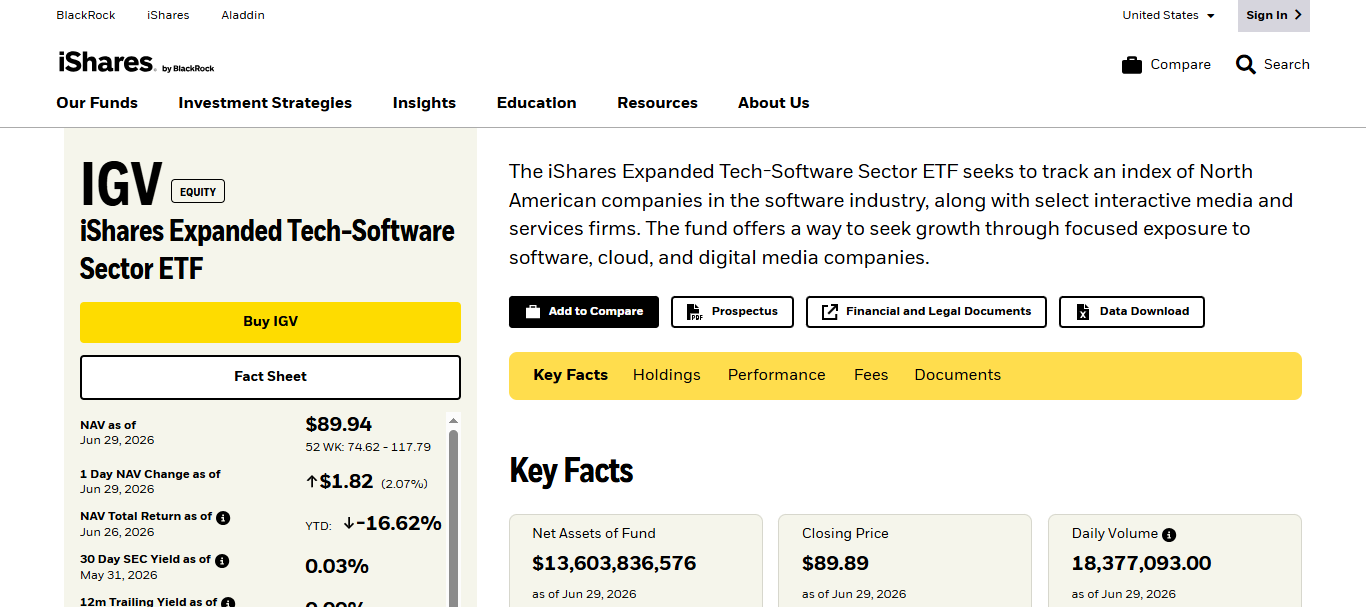
Their portfolio includes enterprise software, cybersecurity, and digital infrastructure clients of the global digital economy. Investors’ continuous and growing expenditures on automation and software will only further drive the sustainability and growth of this sector.
Indian investors who want to gain exposure to software innovations are most likely to use this ETF for their technology portfolio.
Vanguard Information Technology ETF
| Pros | Cons |
|---|---|
| Dedicated exposure to the global technology sector | Limited diversification outside technology companies |
| Low expense ratio compared to many peers | Highly sensitive to technology sector downturns |
| Includes software, hardware, and semiconductor firms | Performance can be cyclical and volatile |
| Benefits from emerging innovation trends | Overdependence on a few large technology companies |
| Strong long-term growth potential | Less defensive during economic uncertainty |
Conclusion
In conclusion, investing in the Best Exchange Traded Funds (ETFs) for Tracking Global Tech Indices from India allows investors to take part in the advancements of some of the world’s top tech firms and in some of the most exciting innovations in the world.
These ETFs are a great option for most investors because they are diversified, provide a relatively easy way to invest internationally, and have the potential to create wealth for investors over the long term.
These funds should be carefully analyzed for risk, as well as for potential currency volatility and other personal investment goals, when assessing which of the global tech ETFs to include in one’s portfolio.
FAQ
Can Indian investors invest in global tech ETFs?
Yes, Indian investors can invest through Indian-listed international ETFs, feeder funds, or overseas brokerage accounts.
Which ETF is best for exposure to U.S. technology companies?
The Motilal Oswal Nasdaq 100 ETF and Invesco QQQ ETF are among the best options for gaining exposure to major U.S. technology companies.
Are global technology ETFs risky?
Yes, they can be volatile because technology stocks are sensitive to interest rates, economic conditions, and market sentiment.
Do global tech ETFs offer diversification?
Yes, these ETFs provide diversification by investing in multiple companies and various technology subsectors globally.
What is the minimum investment required for global ETFs?
The minimum investment depends on the ETF and broker, but investors can usually start with a relatively small amount.