In this article, we will talk about the Best Perpetual DEX Infrastructure Providers that help businesses build secure, scalable and efficient decentralized derivatives trading platforms. We will look at their key features, trading technology, liquidity solutions, blockchain compatibility and security capabilities.
This overview will help entrepreneurs, startups and enterprises to compare leading providers and identify suitable infrastructure for their perpetual decentralized exchange development needs.
Key Points & Best Perpetual DEX Infrastructure Providers
| Provider | Explanation |
|---|---|
| Hyperliquid | Offers high-performance onchain perpetual trading with deep liquidity and a dedicated Layer 1 blockchain. |
| Aster | Provides decentralized perpetual trading with multi-chain access, diverse markets, and privacy-focused trading features. |
| dYdX | Delivers professional-grade perpetual markets with advanced trading tools and a specialized blockchain infrastructure. |
| Lighter | Offers low-latency perpetual trading powered by zero-knowledge proofs and scalable Ethereum-based infrastructure. |
| Variational | Provides peer-to-peer perpetual trading infrastructure with customizable markets and capital-efficient derivatives execution. |
| GMX | Enables decentralized perpetual trading through liquidity pools, transparent pricing, and non-custodial smart contracts. |
| ApeX Protocol | Supports decentralized perpetual markets with cross-chain accessibility, leveraged trading, and performance-focused infrastructure. |
| Drift Protocol | Combines perpetual futures, spot trading, lending, and liquidity infrastructure within the Solana ecosystem. |
| Grvt (Gravity) | Delivers institutional-focused perpetual trading with self-custody, privacy features, and high-performance execution infrastructure. |
| Blockchain App Factory | Develops custom perpetual DEX platforms with trading engines, liquidity integrations, smart contracts, and scalable blockchain infrastructure. |
10 Best Perpetual DEX Infrastructure Providers In 2026
1. Hyperliquid
Hyperliquid is a perpetual exchange on its own Layer 1 blockchain with the order book and matching engine entirely on-chain under HyperBFT consensus. These two layers, HyperCore for trading and HyperEVM for intelligent contracts, enable a fast exchange-like experience with self-custody.
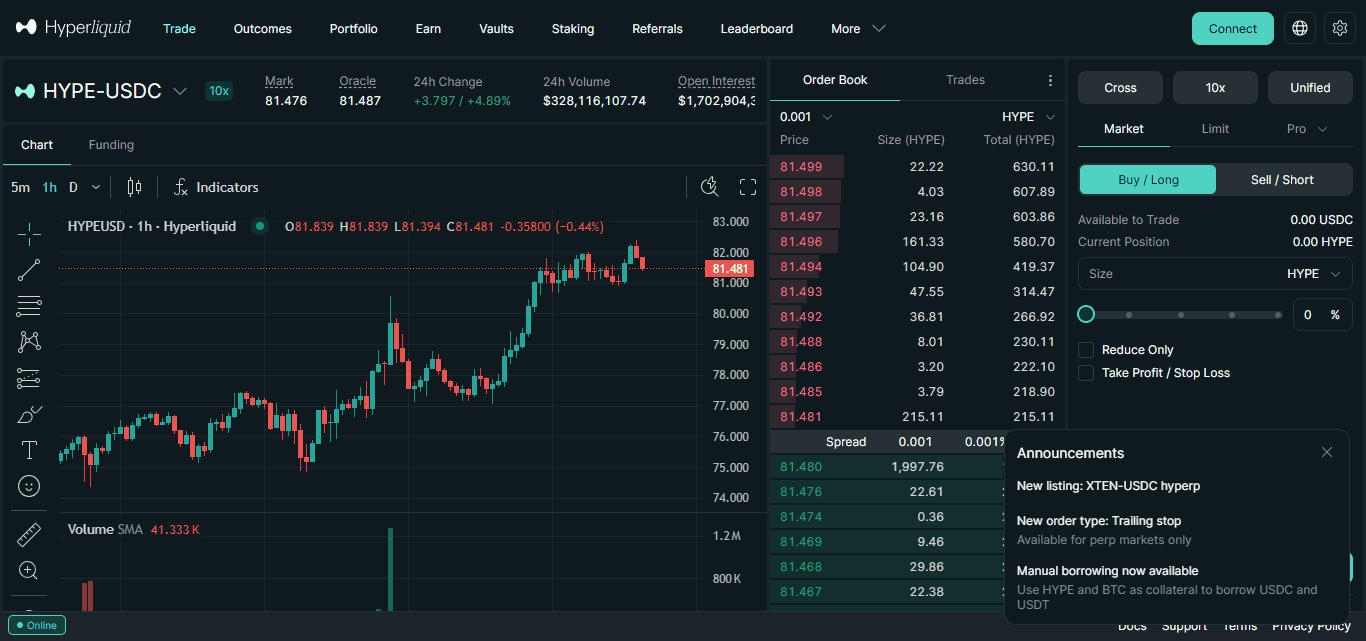
No trading fees, block finality in under a second, and deep liquidity with tight spreads on major pairs. Traders can trade with up to 50x leverage on top assets across over a hundred perpetual markets, while the HIP-3 framework enables builders to launch new markets. You bridge USDC from Arbitrum and then all trading is native on Hyperliquid’s own chain.
Hyperliquid Feature
| Feature | Explanation |
|---|---|
| High-Speed Trading | Supports fast onchain trading with low-latency order execution. |
| Deep Liquidity | Provides liquid perpetual markets for efficient trade execution. |
| Onchain Order Book | Uses an order-book model for transparent trading. |
| Native Blockchain | Operates on its own Layer 1 blockchain optimized for trading. |
2. Aster
Developed in collaboration between Astherus and APX Finance and backed by YZi Labs, Aster is a decentralized perpetual exchange. It is designed to combine centralized-exchange usability with on-chain transparency. It offers perpetuals and spot trading, and yield-bearing collateral like asBNB and USDF so margin can earn while positions remain open.

Execution is fast and hidden orders allow large traders to avoid front running and market impact. In simple mode, it has leverage of up to 1001x for selected pairs, but usually around the 100x mark in pro mode, across the crypto majors, altcoins and tokenized stock perpetuals. Aster is available on BNB Chain, Ethereum, Solana, Arbitrum, with a dedicated Aster Chain coming soon for more speed and privacy.
Aster Feature
| Feature | Explanation |
|---|---|
| Multi-Chain Access | Supports trading opportunities across multiple blockchain ecosystems. |
| Perpetual Markets | Offers leveraged perpetual trading across supported markets. |
| Trading Modes | Provides different trading experiences for various user preferences. |
| Privacy Features | Includes privacy-oriented trading capabilities in supported modes. |
3. dYdX
dYdX is one of the first decentralized derivatives exchanges. It started on Ethereum and then used StarkEx, but then launched v4 as a standalone Cosmos SDK blockchain secured by validators and DYDX stakers. Orders are matched off-chain in an order book in validator memory and settled on-chain.

This allows for fast placement and cancelation without per-order gas, and since the chain is dedicated to trading, unrelated apps cannot congest it. It has hundreds of perpetual markets, often added through governance, and generally offers up to about 20x leverage on major assets with USDC as collateral. Through Noble and IBC, users bridge funds in from Ethereum and other networks.
dYdX
| Feature | Explanation |
|---|---|
| Decentralized Trading | Enables non-custodial perpetual trading through decentralized infrastructure. |
| App-Specific Blockchain | Uses a dedicated blockchain built around trading requirements. |
| Advanced Order Types | Supports sophisticated order management for active traders. |
| Risk Management | Incorporates trading controls and liquidation mechanisms for derivatives markets. |
4. Lighter
Lighter is a zero-knowledge rollup on Ethereum that uses cryptographic proofs to verify its matching engine, allowing users to verify that trades were matched fairly and funds cannot be misused. It operates a low latency central limit order book and has garnered attention for its zero trading fees for regular retail accounts while providing premium tiers for professional traders.

Major assets have leverage of about 50x, and riskier pairs have lower limits. The platform offers both cross and isolated margin, USDC collateral, and liquidity pools. Markets are moving away from crypto into other asset classes. Lighter, as an Ethereum Layer 2, inherits Ethereum’s security, and escape-hatch mechanisms enable users to recover funds if the operator goes offline.
Lighter Feature
| Feature | Explanation |
|---|---|
| Zero-Knowledge Technology | Uses zero-knowledge proofs to support verifiable trading operations. |
| Ethereum Ecosystem | Connects its infrastructure with Ethereum-based blockchain technology. |
| Perpetual Trading | Supports leveraged derivatives trading across available markets. |
| Execution Efficiency | Focuses on efficient order processing and trading performance. |
5. Variational
Omni, Variational’s flagship product, uses a peer-to-peer request-for-quote model, rather than a traditional order book. Liquidity providers compete to quote a trade, which tends to reduce slippage on larger trades and reduces exposure to front-running and sandwich attacks. Omni is known for no trading fees and a clean, simple interface.

It has hundreds of perpetual markets, including long-tail and emerging assets that are hard to find on other decentralized exchanges. Liquidity providers can quickly quote bespoke pairs. Liquidity will determine the leverage, which will be higher on big assets and lower on small caps. Built on the Arbitrum ecosystem, the infrastructure offers users low fees and security aligned with Ethereum, with wider network support coming soon.
Variational Feature
| Feature | Explanation |
|---|---|
| Peer-to-Peer Trading | Supports peer-to-peer trading through its derivatives infrastructure. |
| Perpetual Derivatives | Provides perpetual trading products across supported markets. |
| Flexible Market Access | Offers access to various derivatives markets and trading opportunities. |
| Capital Efficiency | Focuses on efficient collateral usage and derivatives execution. |
6. GMX
GMX is a long-running decentralized perpetual protocol which uses a pool-based model priced by oracles, instead of an order book. Liquidity providers deposit into pools (GLP in V1, GM pools in V2) and receive a share of the trading fees. Traders open positions against those pools at oracle prices. The design is well executed, with low slippage in liquid markets and is easy to trade.

However, pool based designs make liquidity providers exposed to the profits of the traders. Leverage is up to around 50x on major assets, with dozens of markets in V2 and isolated markets for some pairs. GMX is primarily used on Arbitrum and Avalanche, but has also expanded to Solana. It caters to users who value a protocol that is transparent, shares revenue, and is community-driven.
GMX Feature
| Feature | Explanation |
|---|---|
| Decentralized Perpetuals | Enables leveraged perpetual trading through decentralized smart contracts. |
| Liquidity Pools | Uses liquidity pools to facilitate trading and market exposure. |
| Non-Custodial Access | Allows users to trade without transferring custody to a centralized exchange. |
| Onchain Settlement | Uses blockchain transactions to support transparent trading operations. |
7. ApeX Protocol
ApeX Protocol is a decentralized derivatives platform that offers a more advanced perpetual trading experience based on an order book through its ApeX Omni product. It is powered by zero-knowledge technology on StarkEx, giving users the ability to self-custody their funds while providing fast execution and cheap costs. Central limit order book, advanced order types and competitive fees for traders.

Leverage can be as high as 100x on selected pairs, and it lists more than a hundred perpetual markets across major crypto assets and trending tokens. Omni supports multiple networks including Ethereum, Arbitrum, Base and BNB Chain, which makes it easier for users to deposit if they are already active on these chains. It is for traders who want high leverage and an exchange style interface they know.
ApeX Protocol Feature
| Feature | Explanation |
|---|---|
| Perpetual Markets | Provides decentralized access to leveraged perpetual contracts. |
| Cross-Chain Capabilities | Supports blockchain connectivity according to its deployed products. |
| Trading Infrastructure | Offers tools designed for efficient decentralized derivatives trading. |
| Self-Custody | Supports user-controlled asset access within its applicable trading architecture. |
8. Drift Protocol
Drift Protocol is a leading spot and perpetual trading platform on Solana that uses the speed and low fees of the network to provide an efficient trading experience. We have a hybrid liquidity design that combines a decentralized limit order book, a dynamic AMM, and just-in-time auctions where market makers compete to fill orders, resulting in good pricing and low slippage.

Drift has dozens of perpetual markets, leverage up to ~100x on major assets, and cross margin accounts for capital efficiency. It also offers spot trading, borrowing and lending, and vaults for passive strategies. Being native to Solana , users trade using Solana wallets and enjoy fast confirmations and low transaction costs . The downside is that it is single chain .
Drift Protocol
| Feature | Explanation |
|---|---|
| Perpetual Futures | Supports leveraged perpetual contracts within the Solana ecosystem. |
| Spot Trading | Combines spot markets with derivatives trading functionality. |
| Lending and Borrowing | Provides lending and borrowing features within its DeFi ecosystem. |
| Risk Management | Uses collateral and liquidation mechanisms to manage leveraged positions. |
9. Grvt (Gravity)
Grvt, or Gravity, is a hybrid derivatives exchange which seeks to combine the performance of a centralized exchange with the security of the on-chain. It’s built on a zero-knowledge validium architecture on ZKsync, settled on Ethereum, so users can keep custody of assets, but still enjoy fast, low-cost trading.

The platform uses a central limit order book and high-performance matching engine and focuses on privacy, offering a level of confidentiality for positions and strategies. Grvt offers perpetuals and other derivatives with leverage up to around 50x to 100x depending on the asset and growing list of markets. It’s Ethereum-aligned via ZKsync and its yield and vault products offer users additional opportunities.
Grvt (Gravity) Feature
| Feature | Explanation |
|---|---|
| Perpetual Trading | Provides perpetual derivatives trading through decentralized infrastructure. |
| Self-Custody | Emphasizes user control over assets within its trading architecture. |
| Privacy-Oriented Design | Incorporates privacy-focused technology into supported trading operations. |
| Performance Optimization | Focuses on efficient execution for active derivatives traders. |
10. Blockchain App Factory
Blockchain App Factory is a blockchain development company that builds white-label perpetual DEX platforms for businesses and entrepreneurs, and not a trading venue. Services include smart contract development, order-book or AMM-based matching engines, liquidity pool setup, oracle integration and admin dashboards, security audits and ongoing support.
The platforms are customizable, allowing clients to set their trading performance goals, fee arrangements, leverage limits, and the markets they want to list, including crypto and synthetic assets.

Their DEXs can be deployed on networks such as Ethereum, BNB Chain, Solana, Arbitrum and Polygon depending on the client needs. It is geared toward startups that want to launch a branded perpetual exchange without building the technology from scratch.
Blockchain App Factory Feature
| Feature | Explanation |
|---|---|
| Custom DEX Development | Develops tailored decentralized exchange platforms for business requirements. |
| Smart Contract Development | Builds smart contracts for trading, collateral, and liquidation workflows. |
| Liquidity Integration | Integrates suitable liquidity mechanisms and market-making solutions. |
| API and Platform Integration | Supports integrations with wallets, trading interfaces, and external services. |
Conclusion
To summarize, selecting the Best Perpetual DEX Infrastructure Providers is critical for developing secure, scalable, and efficient decentralized trading platforms. Businesses should evaluate the trading performance, liquidity, compatibility with blockchain, security, and customization options before making a decision.
Although the existing protocols are informative, development partners like Blockchain App Factory can assist companies in building custom perpetual DEX solutions that meet their technical requirements, operational objectives, and long-term growth strategies.
FAQ
Which features should businesses prioritize when selecting providers?
Prioritize security, liquidity, scalability, execution speed, and blockchain compatibility.
Why is liquidity important for perpetual DEX platforms?
Liquidity enables smoother trades, reduced slippage, and more efficient order execution.
How do perpetual DEX platforms manage trading risks?
They use collateral requirements, liquidation mechanisms, and automated risk management systems.
Can businesses build customized perpetual DEX platforms?
Yes, development providers can customize trading engines, smart contracts, and integrations.