The Top Digital Asset Reporting Platforms for Institutional Investors in 2026 will be covered in this post. I’ll go over the main characteristics, reporting features, supported assets, integrations, costs, and advantages of the top ten platforms.
Institutional investors can use this guide to assess options, comprehend their capabilities, increase the accuracy of financial reporting, and select the best platform for managing investments.
How Institutional Investors Can Select the Best Digital Asset Reporting Platforms
- Data Accuracy: Check the accuracy of financial reporting, transaction records, and portfolio valuations.
- Supported Assets: Verify compatibility with tokenized assets, stablecoins, cryptocurrencies, and other investments.
- Reporting Capabilities: Assess financial statements, performance reports, NAV computations, and reconciliation.
- Security: Evaluate audit trails, access controls, encryption, and custody protection.
- Integrations: Examine relationships with accounting systems, blockchains, exchanges, and custodians.
- Compliance: Look at tools for transaction monitoring, regulatory reporting, and compliance management.
- Cost: Examine institutional pricing flexibility, transaction fees, and subscription prices.
- Scalability: Evaluate how well the platform can handle expanding transaction volumes and portfolios.
- User Experience: Assess reporting accessibility, dashboard customization, and usability.
- Institutional Support: Take into account specialized account management, implementation services, and client support.
Key Points & Best Digital Asset Reporting Platforms for Institutional Investors
| Platform | Explanation |
|---|---|
| Cryptio | Automates crypto accounting, reconciliation, audit trails, and financial reporting for institutional portfolios. |
| Fireblocks | Offers secure digital asset custody, treasury management, transaction monitoring, and reporting solutions. |
| Talos | Streamlines institutional trading, portfolio management, execution, and reporting across digital asset markets. |
| BitGo | Provides institutional custody, wallet infrastructure, settlement services, and digital asset portfolio reporting. |
| Securitize | Facilitates tokenized asset management, compliance, investor servicing, and transparent ownership reporting solutions. |
| HedgeGuard | Delivers consolidated portfolio management, NAV calculations, reconciliation, and reporting for digital assets. |
| GenieAI | Leverages artificial intelligence to streamline financial research, document analysis, and reporting workflows. |
| Wyden | Integrates digital asset trading, treasury operations, reconciliation, settlement, and institutional reporting workflows. |
| Preqin | Provides alternative investment data, fund performance benchmarks, analytics, and institutional market intelligence. |
| FactSet | Delivers financial data, portfolio analytics, performance measurement, and comprehensive institutional reporting solutions. |
10 Best Digital Asset Reporting Platforms for Institutional Investors In 2026
1. Cryptio
The goal of Cryptio, an institutional digital asset accounting and reporting platform, is to streamline intricate financial processes. Cryptocurrencies, tokens, DeFi positions, and assets from other blockchain networks are all supported.
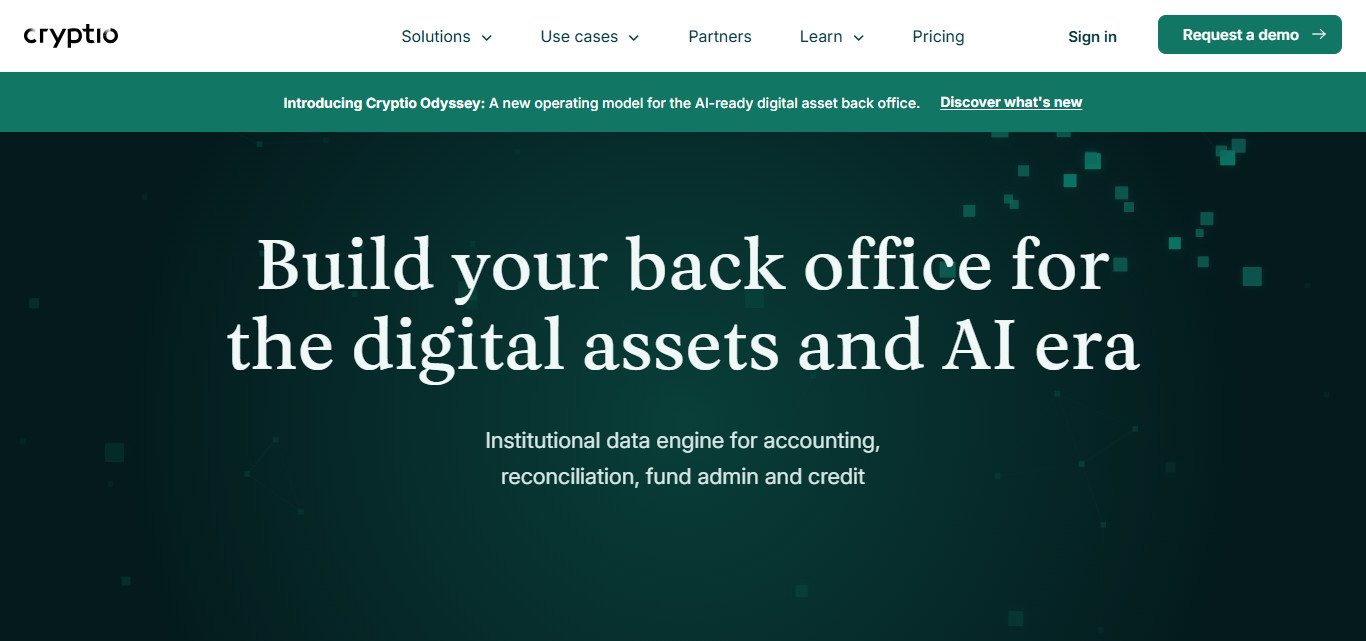
Automated reconciliation, transaction classification, balance verification, and audit-ready records are some of its data accuracy capabilities. In addition to ERP programs like SAP, NetSuite, and Xero, integration features link over 150 blockchains, exchanges, custodians, and internal systems.
Financial statements, NAV computations, portfolio balances, transaction histories, and GAAP and IFRS reporting are all examples of reporting capabilities. Pricing is tailored to specific modules, transaction volumes, integrations, and institutional needs.
Cryptio Best For
- Accounting and financial reporting for institutional cryptocurrency.
- Regulatory compliance and audit-ready documentation.
Consolidated portfolio management for digital assets. - Automated data accuracy and transaction reconciliation.
Cryptio Feature
| Feature | Explanation |
|---|---|
| Automated Data Ingestion | Pulls transactions from blockchains, exchanges, and wallets automatically. |
| Accounting & Reconciliation | Matches on-chain and off-chain records to remove manual errors. |
| ERP Integration | Syncs journal entries to systems such as NetSuite, QuickBooks, and Xero. |
| Audit-Ready Reporting | Produces cost-basis, P&L, and balance reports with a full audit trail. |
2. Fireblocks
Secure custody, treasury management, transaction processing, and operational visibility are all included in Fireblocks’ institutional digital asset infrastructure. Cryptocurrencies, stablecoins, fungible tokens, and tokenized financial assets from various blockchain networks are among its supported assets.
Wallet visibility, integrated financial data procedures, and transaction monitoring all contribute to data accuracy. Through its connections, exchanges, liquidity providers, custodians, and financial apps are linked to over 150 blockchain networks.
Institutions can keep an eye on asset movements, staking activity, balances, and transaction histories with the aid of reporting features. Customized institutional offers are available; pricing is typically determined by custody needs, transaction volumes, chosen services, and integration complexity.
Fireblocks Best For
- Safe custody of digital assets for institutions.
- Monitoring transactions and managing the treasury.
- Asset transfers and blockchain connection.Wallet operations and reporting for institutions.
Fireblocks Feature
| Feature | Explanation |
|---|---|
| MPC Custody & Wallet Security | Uses multi-party computation to protect keys and assets. |
| Transaction Policy Engine | Sets approval workflows, limits, and role-based controls. |
| Transaction & Balance Reporting | Gives real-time visibility into movements and holdings across wallets. |
| Network & API Connectivity | Connects to exchanges, DeFi, and banks for transfers and data export. |
3. Talos
Talos provides trading, execution, settlement, risk monitoring, and portfolio management for institutional digital assets. Cryptocurrencies, fiat money, spot holdings, futures, perpetuals, and options are among its supported assets. Through ongoing reconciliation, transaction tracking, and position verification across linked trading venues, data accuracy is preserved.
Along with custodians and current portfolio management systems, its connectors link over 60 controlled and decentralized trading venues, exchanges, and liquidity providers.
Reporting features include exposure analysis, profit and loss tracking, real-time portfolio valuations, and personalized performance reports. Pricing is usually tailored according to platform capability, connectivity, institutional trading needs, and service agreements.
Talos Best For
- Management of institutional digital asset trading.
- Reporting on trading performance and risk.
- Real-time analytics and portfolio tracking.
- Trade execution and multi-exchange connectivity.
Talos Feature
| Feature | Explanation |
|---|---|
| Multi-Venue Trading Access | Provides one interface to many liquidity venues and OTC desks. |
| Execution Analytics (TCA) | Measures slippage, fill quality, and execution performance. |
| Post-Trade Processing | Handles allocation, settlement tracking, and trade confirmations. |
| Portfolio & Credit Reporting | Reports on positions, exposures, and counterparty limits. |
4. BitGo
BitGo offers qualified custody, wallet management, trading, staking, and settlement services as part of its institutional digital asset infrastructure. Bitcoin, Ethereum, stablecoins, cryptocurrencies, and different blockchain-based tokens are among its supported assets.
Transaction-level records, wallet monitoring, audit trails, and regulated asset movements all improve data accuracy. WebSocket communication, trading platforms, FIX, REST APIs, and external portfolio management systems are examples of integration capabilities.
Asset holdings, transaction histories, profit and loss, billing, and custody activity are all covered by reporting capabilities. Customized commercial agreements are available, and pricing is determined by custody arrangements, trading volumes, supporting services, and institutional account needs.
BitGo Best For
- Digital asset custody of institutional quality.
- Infrastructure and asset management for secure wallets.
- Custody reporting and transaction tracking.
- Staking and settlement of cryptocurrencies.
BitGo Feature
| Feature | Explanation |
|---|---|
| Regulated Qualified Custody | Offers insured, institution-grade storage of digital assets. |
| Multi-Signature Wallets | Requires several approvals, which lowers theft and misuse risk. |
| Custody Statements & Reporting | Provides holdings, transaction history, and proof-of-reserve style reports. |
| Staking & Lending Services | Tracks yield-generating activity alongside custody records. |
5. Securitize
Tokenized securities, physical assets, investor management, and regulated digital asset infrastructure are among Securitize’s areas of expertise. Tokenized funds, securities, and financial products issued across supported blockchain networks are among its supported assets.
Regulated recordkeeping, ownership verification, transaction monitoring, and automated compliance procedures all support data accuracy. Blockchain networks, custodians, transfer agents, and pertinent financial infrastructure providers are all connected through integrations.
Investor statements, fund administration, NAV computations, ownership records, payouts, and compliance reporting are all examples of reporting capabilities. Tokenization requirements, fund management, transfer agent services, transaction volumes, and institutional platform requirements are typically taken into account when determining pricing.
Securitize Best For
- Real assets and tokenized securities.
- Investor management and digital fund administration.
- Records of ownership and compliance.
- The distribution management and tokenization lifecycle.
Securitize Feature
| Feature | Explanation |
|---|---|
| Asset Tokenization | Issues real-world assets (funds, bonds) as digital securities. |
| Investor Onboarding & KYC/AML | Automates compliance checks and accreditation. |
| Cap Table & Transfer Agent Services | Maintains ownership records and handles transfers on-chain. |
| Investor & Regulatory Reporting | Generates holder reports, distributions, and compliance filings. |
6. HedgeGuard
HedgeGuard offers software for managing institutional portfolios that combines investments in traditional and digital assets. Bitcoin, Ethereum, stablecoins, cryptocurrencies, stocks, fixed income, derivatives, and DeFi positions are among its supported assets.
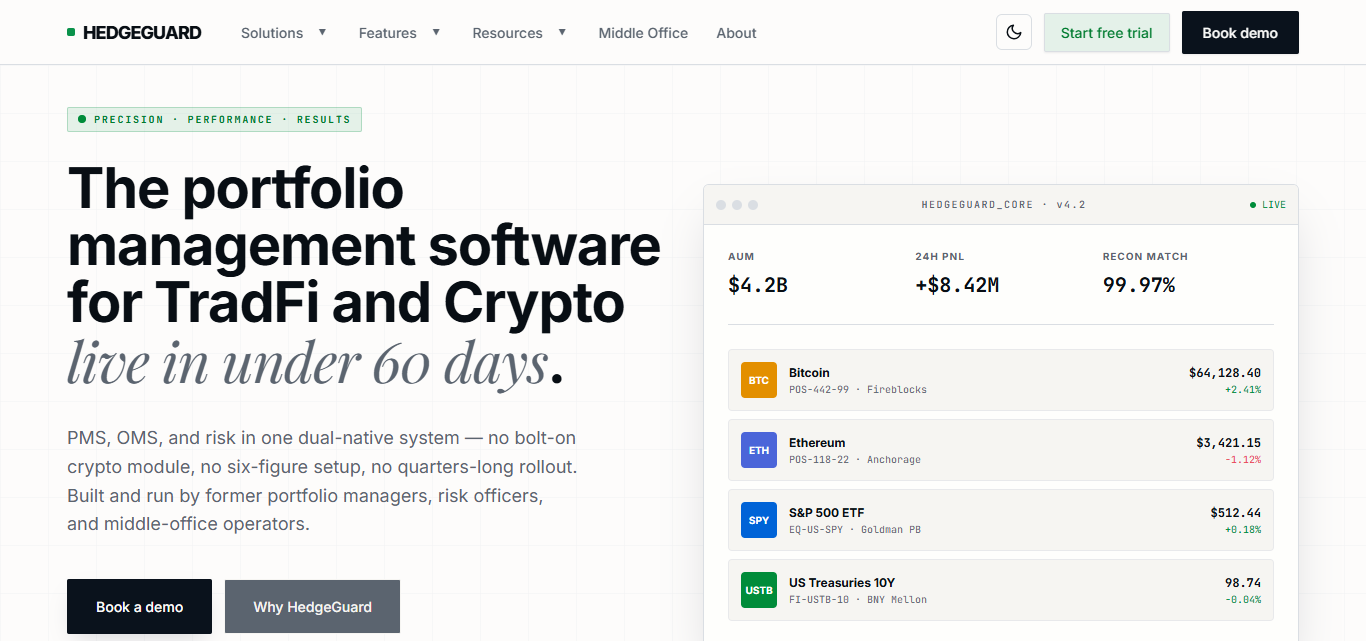
Transaction-level audit trails, defined valuation techniques, and automatic reconciliation all help to ensure data accuracy. More than 115 suppliers are connected by its integrations, including traditional financial institutions, market data providers, institutional custodians, and cryptocurrency exchanges.
Consolidated NAV, portfolio exposure, profit and loss, tax-lot information, and investor statements are among the reporting options. The complexity of the portfolio, integrations, chosen modules, and institutional reporting needs all affect pricing; customized solutions are offered.
HedgeGuard Best For
- NAV computations and portfolio reconciliation are automated.
- Analytics and performance monitoring for several assets.
- Investor reporting and accounting for institutional funds.
- Portfolios of both digital and conventional assets.
HedgeGuard Feature
| Feature | Explanation |
|---|---|
| Fund Accounting & NAV | Calculates net asset value for hedge funds holding digital assets. |
| Portfolio Monitoring | Tracks positions, P&L, and performance in near real time. |
| Risk & Exposure Analysis | Measures concentration, leverage, and market risk. |
| Investor Reporting | Produces statements and performance reports for LPs. |
7. GenieAI
For institutional investment firms and digital asset funds, GenieAI offers AI-powered investment operations and portfolio management solutions. Analysis of bitcoin portfolios, automation of investment processes, reconciliation, and risk management are among its features.
Verified performance records, transaction data, and regulated operational workflows are the main components of data accuracy. Spreadsheets, internal financial systems, administrators, custodians, and exchanges are all connected by integrations.
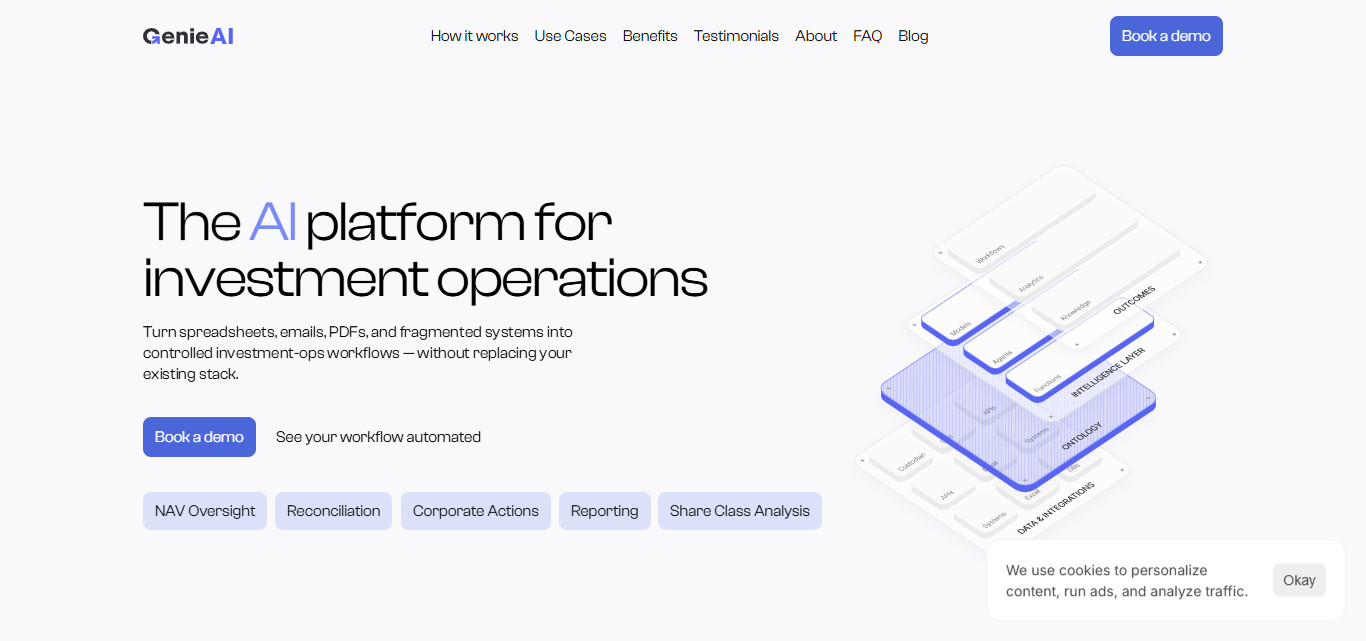
Portfolio performance, risk analytics, NAV supervision, reconciliation, and verified strategy track records via its Allo data platform are among the reporting features. Institutional needs, particular services, data connection, and tailored implementation plans are typically the basis for pricing.
GenieAI Best For
- Automated document analysis and financial research.
- Performance reporting for digital asset funds.
- Risk assessment and portfolio monitoring.
- Analytics and investment activities driven by AI.
GenieAI Feature
| Feature | Explanation |
|---|---|
| AI Document Analysis | Reviews agreements and extracts key terms automatically. |
| Contract Drafting Automation | Generates standard legal documents quickly. |
| Risk & Compliance Flagging | Highlights unusual clauses and regulatory concerns. |
| Workflow & Reporting Support | Organizes legal and compliance records for institutional teams. |
8. Wyden
Wyden provides banks, brokers, and other financial organizations with institutional digital asset trading and operations technologies. Cryptocurrencies, stablecoins, and other digital instruments accessible through linked trading sites are among its supported assets.
Transaction reconciliation, balance verification, position monitoring, and consistent internal records all support data accuracy. More than 65 exchanges, brokers, OTC desks, custodians, banking systems, and market data suppliers are connected by its integrations.
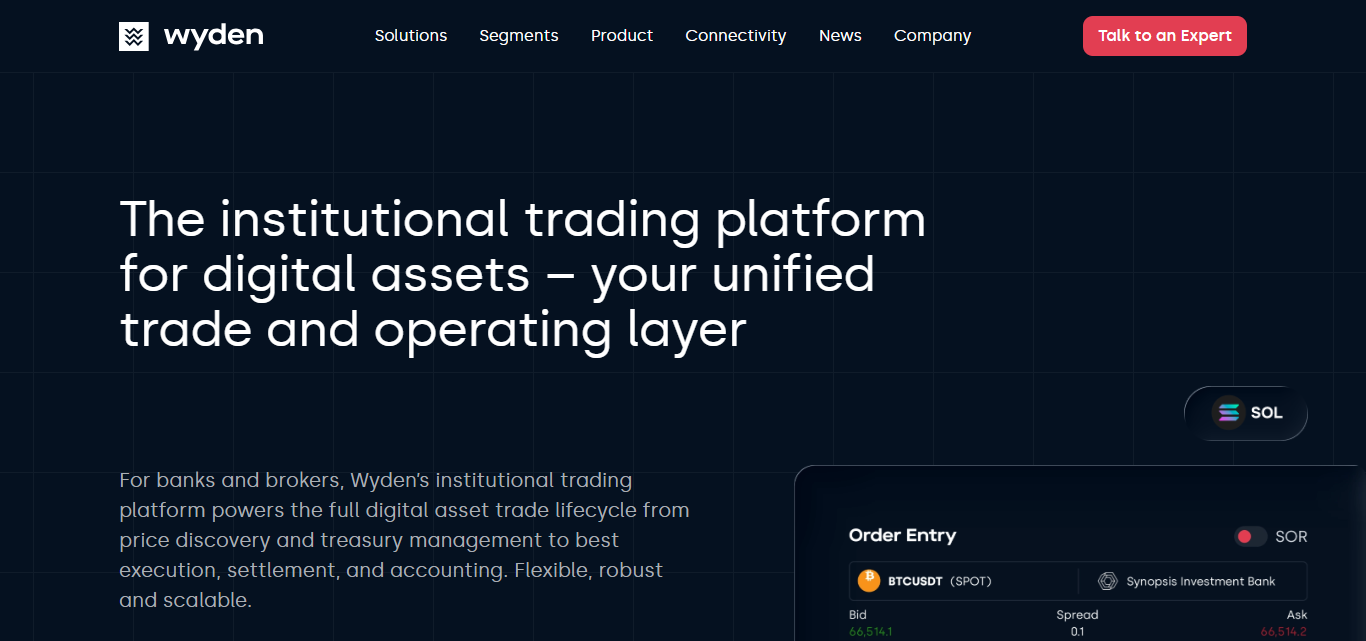
Trade histories, portfolio positions, financial tracking, settlement data, and assistance with regulatory reporting are all examples of reporting capabilities. Pricing is tailored based on institutional service agreements, trading requirements, connection, and implementation complexity.
Wyden Best For
- Connectivity between many exchanges and liquidity providers.
- The trade of digital assets by institutions.
- Automated workflows for trading and settlement.
- Monitoring portfolios and reporting transactions.
Wyden Feature
| Feature | Explanation |
|---|---|
| Trading & Execution Infrastructure | Provides order and execution management across venues. |
| Pre-Trade & Post-Trade Risk Controls | Applies limits and monitoring around trading activity. |
| Market Connectivity | Offers API access to exchanges and liquidity providers. |
| Trade & Position Reporting | Delivers trade history and position data for oversight. |
9. Preqin
Institutional investors can assess private markets and investment performance with the use of Preqin’s alternative investment data and analytics. Private equity, private credit, hedge funds, infrastructure, and real estate investments are among its main areas of coverage.
Structured datasets, research procedures, performance data, and market intelligence are all necessary for data accuracy. APIs, data feeds, partner platforms, and standardized data exports for current investing systems are examples of integration capabilities.
Fund benchmarking, portfolio tracking, performance analysis, investor intelligence, and cash-flow forecasts are all included in the reporting capabilities. Selected datasets, subscription access, user needs, API connection, and institutional license agreements all affect pricing.
Preqin Best For:
- Market intelligence and alternative investing data.
- Benchmarking for hedge funds and private equity.
Analysis of the performance of institutional portfolios. - Investment comparisons and fund research.
Preqin Feature
| Feature | Explanation |
|---|---|
| Alternative Assets Database | Covers funds, investors, and deals across private markets. |
| Performance Benchmarking | Compares fund returns against peers and indices. |
| Market Intelligence & Analytics | Supplies fundraising, allocation, and trend insights. |
| Custom Data Export & Reports | Delivers datasets and reports for research and due diligence. |
10. FactSet
FactSet provides investment reporting tools, performance measurement, portfolio analytics, and institutional financial data. Through specific integrations, it covers digital asset market data as well as stocks, fixed income, funds, and alternative investments.
Consolidated financial data, data validation, and controlled datasets all contribute to data accuracy. Portfolio management systems, third-party suppliers, enterprise data streams, and APIs are examples of integration capabilities.
Performance attribution, risk analysis, portfolio valuations, personalized reports, and investment research are examples of reporting capabilities. Data subscriptions, analytical modules, user access, integration needs, and enterprise license agreements are typically taken into account when determining pricing.
FactSet Best For
- Investment analytics and institutional financial data.
- Monitoring and valuing multi-asset portfolios.
Risk analysis and performance attribution. - Personalized financial analysis and reporting.
FactSet Feature
| Feature | Explanation |
|---|---|
| Multi-Asset Financial Data | Combines market, fundamental, and alternative data in one platform. |
| Portfolio Analytics | Offers attribution, risk, and performance measurement. |
| Workflow & Excel/API Integration | Fits into existing research and reporting processes. |
| Customizable Institutional Reporting | Builds client-ready reports and dashboards at scale. |
Conclusion
In conclusion, your investment requirements, reporting needs, security, and budget will determine which digital asset reporting platforms are best for institutional investors. While Preqin and FactSet offer more comprehensive investment analytics, platforms
like Cryptio, Fireblocks, Talos, and BitGo offer specialist digital asset solutions. To guaranty long-term investment management efficiency, evaluate a platform’s features, supported assets, cost, integrations, and reporting capabilities before choosing one.
FAQ
What are digital asset reporting platforms?
They help institutions track, manage, reconcile, and report digital asset investments.
Which platform is best for crypto accounting?
Cryptio specializes in cryptocurrency accounting, reconciliation, and institutional financial reporting.
Are these platforms suitable for institutional investors?
Yes, many support institutional portfolio management, custody, compliance, and reporting requirements.
What features should investors consider?
Focus on data accuracy, security, supported assets, integrations, reporting, and pricing.