If you’re a startup looking to deploy applications, manage containers and scale infrastructure efficiently, you’ll need to choose the right Kubernetes hosting provider.
In this article, I’ll be discussing the Best Kubernetes Hosting Providers for Startups and comparing their key features, pricing, performance, security, scalability, integrations, etc. to help you find an affordable and reliable Kubernetes hosting solution for your growing business.
How We Rank the Best Kubernetes Hosting Providers for Startups
- Pricing & Plans: Compare the price of the control plane, worker nodes and other infrastructure.
- Performance: Evaluate the computing resources, uptime, network speed, and reliability of the workload.
- Scalability: Think about autoscaling, node management, resource expansion.
- Security: Look at access control, encryption, firewalls and workload protection.
- Ease of Use: Consider how easy it is to set up, deploy, monitor, and manage a cluster.
Features: Compare managed control planes, load balancing, storage, and automation tools. - Integrations: Works with CI/CD platforms, container registries, APIs, and developer tools.
- Startup suitability: Evaluate affordability, technical needs, adaptability, and long-term growth potential for your business.
Key Points & Best Kubernetes Hosting Providers for Startups
| Provider | Control Plane Cost | Best For | Key Trade-off | Main Advantage |
|---|---|---|---|---|
| DigitalOcean Kubernetes (DOKS) | Free control plane | Startups seeking simple, affordable Kubernetes hosting solutions | Limited advanced enterprise features compared with major cloud platforms | Easy deployment, predictable pricing, and beginner-friendly management tools. |
| Civo | Free control plane | Startups needing fast Kubernetes clusters and affordable infrastructure | Smaller global infrastructure footprint than hyperscale cloud providers | Rapid cluster provisioning, competitive pricing, and developer-friendly Kubernetes features. |
| Linode Kubernetes Engine (LKE) | Free control plane | Budget-conscious startups building scalable cloud-native applications | Fewer advanced managed integrations than larger cloud platforms | Affordable compute resources, straightforward management, and reliable performance. |
| Vultr Kubernetes Engine (VKE) | Free control plane | Startups requiring flexible infrastructure and global deployment options | Fewer enterprise ecosystem integrations and advanced managed services | Global data centers, competitive pricing, and flexible deployment options. |
| Google Kubernetes Engine (GKE) | Free for eligible Autopilot or zonal management configurations; fees may apply | Startups building data-intensive and cloud-native applications | Additional infrastructure costs and potentially complex pricing structures | Advanced automation, strong scalability, and native Kubernetes expertise. |
| Amazon Elastic Kubernetes Service (EKS) | Cluster management fee applies | Startups building applications within the AWS ecosystem | Complex configuration, additional costs, and ongoing operational management | Extensive AWS integrations, enterprise scalability, and flexible infrastructure. |
| Azure Kubernetes Service (AKS) | Free standard tier; paid tiers available | Startups developing Microsoft-based cloud applications | Networking configuration and Azure pricing can become complicated | Strong Microsoft integrations, flexible scaling, and enterprise-ready security. |
| Scaleway Kapsule | Free control plane | European startups seeking affordable managed Kubernetes infrastructure | Smaller ecosystem and geographic coverage than hyperscalers | European data centers, competitive pricing, and simplified cluster management. |
| OVHcloud Managed Kubernetes | Free control plane on eligible configurations | Startups prioritizing European hosting and data sovereignty | Smaller managed-services ecosystem than AWS, Google, and Azure | European infrastructure, transparent pricing, and flexible cloud resources. |
| Hetzner Cloud | No fully managed Kubernetes control plane | Startups prioritizing low-cost infrastructure and technical flexibility | Requires more manual Kubernetes setup, maintenance, and administration | Low-cost cloud servers, excellent price-performance, and flexible infrastructure. |
10 Best Kubernetes Hosting Providers for Startups
1. DigitalOcean Kubernetes (DOKS)
DigitalOcean Kubernetes (DOKS) is a managed Kubernetes hosting service for startups wanting simple container deployment without managing their own control plane. It provides managed control plane, node pools, auto scaling, load balancers and persistent storage.
Its control plane is free, and then companies pay for worker nodes and other infrastructure resources. Performance DOKS leverages DigitalOcean infrastructure for reliable application deployment and steady workload management.
Scalability: Startups can scale up the worker nodes, setup autoscaling, and manage the increasing traffic to the application. Security Cloud firewalls, control of access, and Kubernetes security integrations. Integrations DOKS integrates with kubectl, Terraform, DigitalOcean Container Registry, APIs and monitoring tools.
Kubernetes on DigitalOcean (DOKS) features
- Managed Kubernetes Control Plane: Eliminates the need to manage the control plane which reduces cluster management complexity.
- Automatic Scaling: Automatically scales worker nodes to handle changing application traffic and workloads.- Load Balancing: efficiently distributes incoming application traffic across available back-end services.
- Container Registry Integration: Integrates with DigitalOcean’s Container Registry to store and deploy images easily.
DigitalOcean Kubernetes (DOKS) Pricing
| Pricing Point | Details |
|---|---|
| Control plane | Fully managed and included at no cost. |
| HA control plane | Costs $40/month, prorated hourly. |
| HA uptime SLA | An HA control plane carries a 99.95% SLA. |
| Worker nodes | Worker nodes start at $12/month. |
| Bandwidth | Free outbound transfer starts at 2,000 GiB/month and can be pooled. Outbound overage is $0.01/GiB. |
| Load balancers | Load balancers cost $12/month each. |
| GPU nodes | GPU worker nodes are billed per second at GPU Droplet prices. |
2. Civo
Civo is a managed Kubernetes hosting platform for startups that need fast cluster provisioning, flexible infrastructure and easy cloud management. Its platform is designed for cloud-native workloads, enabling developers to deploy containerized applications without having to manage each control-plane component themselves.
Civo offers a managed control plane, multiple deployment regions, node management and infrastructure automation. Performance Its Kubernetes platform is built for fast provisioning and efficient infrastructure for modern apps. Scalability: Startups can scale worker nodes and add resources as the application’s demand grows.
Security Managed infrastructure, kubernetes control of access and network configuration help secure workloads. Integrations Civo is compatible with Terraform, CLI, APIs, container workflows, and the usual Kubernetes tools. It also has startup-specific programs and learning resources.
Civo features
- Fast Cluster Provisioning: Quickly provision Kubernetes clusters, helping startups deploy apps faster.
- Managed Control Plane: Kubernetes control-plane operations are managed, reducing the need to manage infrastructure.
- Autoscaling Support: Helps scale cluster resources according to application changes.
- Developer Friendly Tools: APIs, Terraform, CLI, and standard Kubernetes management workflows are offered.
Civo Pricing
| Pricing Point | Details |
|---|---|
| Control plane | Core control plane components are free. |
| High availability | The free control plane includes built-in high availability. |
| Billing model | Flat per-node pricing, with no per-cluster fee. |
| Small node cost | A small node starts around $5–$10/month. |
| Typical cluster | Clusters commonly start near $22/month for a usable node set. |
| Entry listing | Listed as a free plan, with paid usage from $5.43/month. |
| Extras | GPU nodes, node autoscaling and managed upgrades are available. |
3. Linode Kubernetes Engine (LKE)
Linode Kubernetes Engine (LKE) is Akamai Cloud’s managed Kubernetes infrastructure for startups building containerized applications and micro services. It makes administering clusters easier by managing the Kubernetes control plane while letting developers configure worker nodes as needed for applications.
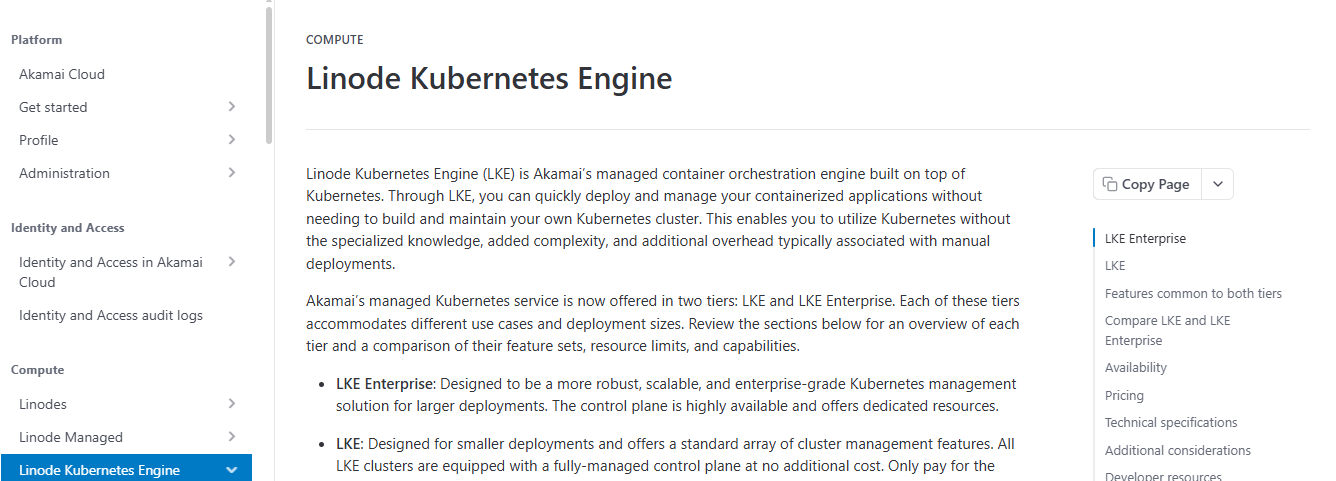
Linode’s virtual machines, networking, storage and load-balancing services give startups the building blocks for their application infrastructure. Performance It gives a cloud compute infrastructure for web apps , APIs and distributed workloads .
Scalability Node pools provide the ability for businesses to scale computing capacity as traffic increases. Security Kubernetes role-based access control, cloud networking and firewall configs help secure deployments. Integrations LKE works with kubectl, Terraform, the Linode APIs, container registries, and standard Kubernetes development tools.
Linode Kubernetes Engine (LKE) features
- Managed Kubernetes Service: Control-plane managed, developers are able to focus on app development.
- Node Pool Management: Enables startups to set up worker nodes for various workloads.
- Cloud Load Balancers: Distribute incoming traffic to application services to ensure reliable delivery.
- Storage Integration: Allows for persistent storage of databases and stateful containerized applications.
Linode Kubernetes Engine (LKE) Pricing
| Pricing Point | Details |
|---|---|
| Control plane | The standard managed control plane is included at no cost. |
| HA upgrade | HA control plane starts at US$60 per cluster per month. |
| Enterprise tier | LKE Enterprise costs US$300 per cluster per month with a dedicated HA control plane. |
| Billed separately | You pay for worker nodes, NodeBalancers and storage volumes. |
| Cheapest node | Nodes start around $12/month. |
| Regional pricing | Pricing varies by region. |
| Add-ons | Longview monitoring and automated backups are add-ons. |
4. Vultr Kubernetes Engine (VKE)
Vultr Kubernetes Engine (VKE) is a managed Kubernetes service that allows startups to deploy, operate and scale containerized applications on Vultr’s global cloud infrastructure. It manages the Kubernetes control plane, freeing development teams from the need to maintain cluster components and allowing them to focus on application development.
Businesses can use Kubernetes with Vultr’s compute instances, block storage, networking and load balancing. Performance: The cloud infrastructure supports application workloads with configurable compute resources and regional deployment options.
Scalability Startups can add worker nodes and scale resources to meet changing demand. Security: Workload protection is enabled through access management, private networking, and Kubernetes security configurations. Integrations VKE integrates with kubectl, Terraform, container registries, APIs and standard Kubernetes ecosystem tools.
Vultr Kubernetes Engine (VKE) features
- Managed Control Plane: Makes it easy to run Kubernetes without managing the control plane yourself.
- Global Infrastructure Applications serving global customers can be deployed regionally.
- Configurable Compute Resources : Offers configurable worker nodes for specific application needs.
- Cloud Integration: Integrates Kubernetes workloads with Vultr networking, storage and container services.
Vultr Kubernetes Engine (VKE) Pricing
| Pricing Point | Details |
|---|---|
| Control plane | Fully managed control plane at no additional cost. |
| What you pay for | Worker nodes, load balancers and block storage volumes. |
| Cheapest node | Worker nodes from $10/month each (1 vCPU / 2 GB). |
| HA control plane | Optional HA deploys multiple control plane nodes. Check the current fee in the console. |
| Node pool types | AMD High Performance, Intel High Performance or High Frequency. |
| Load balancer | A Vultr load balancer costs about $10/month. |
| Billing and reach | Hourly billing with monthly totals capped at 672 hours. 30+ locations worldwide. |
5. Google Kubernetes Engine (GKE)
Google Kubernetes Engine (GKE) is a managed Kubernetes platform provided by Google Cloud that enables startups to deploy, manage, and scale containerized applications. It has Autopilot and Standard operating modes, so businesses can manage infrastructure and cluster resources with flexibility.
GKE integrates with Google Cloud services, making it suitable for applications that use analytics, machine learning, databases, and microservices. Performance: Google Cloud infrastructure, optimized networking and workload management, support for demanding applications.
Scalability: Cluster autoscaling, workload autoscaling and flexible node pools help you scale to meet your growing traffic. Security Workload Identity, IAM, encryption, and security monitoring are all layers of protection. Integrations: GKE integrates with Cloud Monitoring, Artifact Registry, Cloud Logging, BigQuery, and CI/CD platforms.
Google Kubernetes Engine (GKE) features
- Autopilot and Standard Modes: Provides flexible cluster management options to cater to varied technical needs.
- Auto Scalable: Supports node and workload autoscaling to meet changing demand of applications.
- Security: IAM, Workload Identity, encryption, and security monitoring capabilities.
- Google Cloud Integration: Integration with Artifact Registry, Cloud Monitoring, BigQuery and more.
Google Kubernetes Engine (GKE) Pricing
| Pricing Point | Details |
|---|---|
| Control plane | $0.10 per hour per cluster for Standard and Autopilot. |
| Monthly equivalent | About $73/month per cluster. |
| Free-tier credit | A $74.40 monthly credit per billing account covers one Autopilot or zonal Standard cluster. |
| Autopilot rates | $0.0445 per vCPU-hour and $0.00498 per GB-hour for pod requests. |
| Mixed modes | Autopilot compute classes run inside Standard clusters since March 2026. |
| Cheapest node | Small nodes from about $24/month. |
| Egress | Egress creates the biggest cost variance between providers. |
6. Amazon Elastic Kubernetes Service (EKS)
Amazon Elastic Kubernetes Service (EKS) is AWS’s managed Kubernetes hosting service, which helps startups run containerized applications on Amazon’s cloud infrastructure. It supports Kubernetes control-plane operations, but allows developers to configure worker nodes with EC2, managed node groups or supported serverless options such as AWS Fargate.
EKS is particularly helpful for companies building applications that rely on multiple AWS services. Performance: AWS networking, compute and storage services are built to support demanding application workloads.
Scalability: Cluster Autoscaler, Karpenter, and node groups help scale infrastructure capacity. Security: Workloads are protected with IAM integration, encryption, private networking and security policies. Integrations EKS integrates with Amazon RDS, S3, ECR, CloudWatch, IAM and AWS deployment services.
Amazon Elastic Kubernetes Service (EKS) features
- AWS Managed Control Plane: Makes Kubernetes easier to manage with managed cluster control-plane operations.
- Flexible Compute: Supports EC2 managed node groups and AWS Fargate workloads.
- Advanced Autoscaling: Leverages Karpenter and Cluster Autoscaler to manage infrastructure capacity.
- AWS Service Integration: Integrated with Amazon S3, RDS, ECR, IAM and CloudWatch.
Amazon Elastic Kubernetes Service (EKS) Pricing
| Pricing Point | Details |
|---|---|
| Standard support | $0.10 per cluster per hour. |
| Free tier | No free control plane. |
| Extended support | $0.60 per cluster per hour, which is standard plus $0.50. |
| Support windows | Standard support lasts 14 months, then extended support lasts 12 months. Upgrading returns billing to $0.10/hour. |
| Provisioned Control Plane | Extra tiers range from XL at $1.65/hour to 8XL at $13.90/hour. |
| Auto Mode | A per-instance management fee is added on top of EC2 cost. |
| Fargate | $0.04048 per vCPU-hour and $0.004445 per GB-hour |
7. Azure Kubernetes Service (AKS)
Azure Kubernetes Service (AKS) is Microsoft’s managed Kubernetes platform for deploying, managing and scaling containerized applications. It simplifies infrastructure administration by managing Kubernetes control-plane components and providing flexible options for configuring worker nodes.
Startups can take advantage of Microsoft’s networking, database, identity and developer services to build cloud-native applications using AKS. Its free management tier offers you standard cluster capabilities, while paid tiers add more reliability and support features.
Performance: Azure compute, networking, and storage services for production workloads. Autoscaling: Handle changing application demands with cluster and workload autoscaling. Security is provided through Microsoft Entra ID, Azure RBAC, network policies, and Defender for Cloud. Integrations: Integrate AKS with Azure DevOps, Container Registry, Monitor, Key Vault and GitHub Actions.
Azure Kubernetes Service (AKS) features
- Managed Kubernetes Infrastructure: Reduces control-plane administration effort for dev and ops teams.
- Automatic Scaling: Supports autoscaling of cluster and workload for growing applications.
- Enterprise Security: Includes Microsoft Entra ID, Azure RBAC and network policies
- Integrated with Microsoft Ecosystem: Works with Azure DevOps, Container Registry, Key Vault and Monitor.
Azure Kubernetes Service (AKS) Pricing
| Pricing Point | Details |
|---|---|
| Free tier | $0 control plane for up to 1,000 nodes, with no financially backed uptime SLA. |
| Standard tier | $0.10/hour (about $73/month), with an uptime SLA. |
| Premium tier | $0.60/hour (about $438/month), adding long-term support for Kubernetes versions. |
| Best use of Free | Suits staging and dev clusters where a best-effort SLA is acceptable. |
| AKS Automatic | Hands-off mode with cost bundled into node pricing. |
| Cheapest node | Small nodes from about $30/month. |
| Load balancing | The lowest data processing rate of the big three, at $0.005/GB |
8. Scaleway Kapsule
Scaleway Kapsule is a managed Kubernetes hosting solution for businesses that want to run containerized applications on European cloud infrastructure. It simplifies Kubernetes cluster management with managed control-plane features, configurable worker nodes, and integrations with Scaleway’s cloud services.
Kapsule allows startups to run web apps, APIs, microservices and other cloud-native workloads without having to manage all the Kubernetes components themselves. Performance: Scaleway compute resources and regional infrastructure provide application deployment and workload processing.
Scalability: With auto-scaling and scalable node pools, you can scale up to meet increasing demand. Security: secure clusters with Kubernetes security configurations, private networking and managing access. Integrations Kapsule integrates with Scaleway Container Registry, Terraform, APIs, kubectl and standard Kubernetes tools.
Scaleway Kapsule features
- Managed Kubernetes Clusters: Provides a managed control plane to ease cluster operations.
Flexible Node Pools: Startups can configure compute resources for application workloads. - European Cloud Infrastructure: Offers regional hosting solutions for businesses targeting European customers.
Developer Tooling Integration: Works with Terraform, APIs, kubectl and Scaleway Container Registry.
Scaleway Kapsule Pricing
| Pricing Point | Details |
|---|---|
| Mutualized control plane | Free, with up to 4 GB shared memory. |
| Dedicated-4 | €0.11/hour, or €80.30/month. |
| Dedicated-8 | €0.18/hour, or €131.40/month. |
| Dedicated-16 | €0.35/hour, or €255.50/month. |
| Tax note | Prices are before tax. |
| Plan switching | You can switch between shared and dedicated control planes via the API. |
| Cheapest node | Nodes start around $7/month. |
9. OVHcloud Managed Kubernetes
OVHcloud Managed Kubernetes is a managed environment that allows startups to deploy and run containerized applications on OVHcloud infrastructure. It reduces Kubernetes administration by managing control plane components, but lets development teams configure worker nodes, storage and networking.
The platform can be used by businesses for microservices, application backends and cloud-native development projects. It’s European infrastructure can also attract companies with specific data-location needs. Performance OVHcloud compute and networking resources are built to handle a wide range of application workloads.
Scalability: Add more worker nodes and cluster resources to meet the expanding needs of your business. Security: Identity management, network isolation and infrastructure security features assist in protecting deployments. Integrations Integrates with Kubernetes APIs, Terraform, container registries, storage services, and CI/CD pipelines.
OVHcloud Managed Kubernetes features
- Managed Cluster Operations: Reduce infrastructure maintenance with managed Kubernetes control-plane services.
- Flexible Worker Nodes: Businesses can configure resources as per the application requirement.
- European Data Centers: Offers choices for regional infrastructure and data location requirements.
- Kubernetes Ecosystem Ready: Integrates with Kubernetes APIs, Terraform, container registries and CI/CD tools.
OVHcloud Managed Kubernetes Pricing
| Pricing Point | Details |
|---|---|
| Free plan | Control plane is free, and you pay only for worker nodes and resources. |
| Free plan limits | 99.5% SLO, a single zone and up to 100 nodes. |
| Standard plan price | Starts at €0.09 per hour per deployed cluster. |
| Standard SLA | 99.9% in 1-AZ regions and 99.99% in 3-AZ regions. |
| Standard capacity | Dedicated etcd up to 8 GB and up to 500 nodes. |
| Cheapest node | Nodes start around $20/month. |
| Discounts and API | Savings Plans are available for worker nodes. No extra charge for API calls. |
10. Hetzner Cloud
Hetzner Cloud is a budget-friendly infrastructure provider that enables startups to build Kubernetes environments with the aid of cheap virtual machines, storage and networking resources. Hetzner however does not have a first-party fully managed Kubernetes control plane like the other providers listed.
Businesses must deploy and maintain Kubernetes distributions like K3s or RKE2 themselves. Performance : Hetzner offers competitive compute resources for web applications, APIs and development workloads. Scalability: If infrastructure needs increase, startups can simply increase server capacity and add worker nodes.
Security: Firewalls, SSH access, private networking, and Kubernetes security settings help to protect workloads. Integrations Hetzner offers Terraform, APIs, Cloud Controller Manager, CSI drivers and standard Kubernetes tools.
Hetzner Cloud features
- Cheap Cloud Servers: Offers affordable virtual machines for setting up Kubernetes infrastructure.
- Flexible Infrastructure: Enables startups to provision resources such as computing, networking and storage.
Private Networking – Network isolation for communication between infrastructure components. - Kubernetes Compatibility: Compatible with self-managed Kubernetes distributions, Terraform, and compatible storage integrations.
Hetzner Cloud Pricing
| Pricing Point | Details |
|---|---|
| Service type | Listed as self-managed, with no managed control plane fee. |
| Cheapest node | Roughly $4/month for a small node. |
| Cost-optimized CX23 | €5.49/month (2 vCPU / 4 GB / 40 GB) in the EU after the June 2026 adjustment. |
| Arm CAX11 | €5.99/month for the same shape. |
| Dedicated-vCPU rise | CCX plans rose about 113% to 173% in June 2026. |
| CCX example | CCX13 went from €15.99 to €42.99. |
| Availability risk | CX/CAX plans showed “not available” in autumn 2026, while CPX and CCX stayed orderable |
Conclusion
Conclusion Choosing the Best Kubernetes Hosting Providers for Startups The best Kubernetes hosting provider for your startup depends on many factors, such as your budget, your technical needs, and your business expansion plans.
GKE, EKS and AKS provide advanced cloud infrastructure, while DigitalOcean, Civo and Linode offer beginner friendly options. Scaleway and OVHcloud serve European businesses, while Hetzner is a good choice for budget-conscious developers. Compare pricing, performance, security and scalability before making your final decision.
FAQ
Which Kubernetes hosting provider is best for startups?
DigitalOcean, Civo, and Linode offer beginner-friendly Kubernetes hosting with affordable infrastructure and simple management.
Is Kubernetes hosting expensive for startups?
Costs vary depending on worker nodes, storage, networking, and managed services.
Which provider offers free Kubernetes control planes?
DigitalOcean, Civo, Linode, Scaleway, and eligible OVHcloud configurations offer free control-plane options.
Is Google Kubernetes Engine good for startups?
Yes, GKE provides automation, scalability, security, and powerful Google Cloud integrations.