
In this article, I will review the best edge hosting providers for global websites. Speed matters now more than ever. Edge hosting brings your content closer to visitors around the world, lowering latency and increasing reliability.
I’ll compare top platforms like Cloudflare, Vercel, Fastly, Netlify and AWS including their features, pricing and performance so you can confidently choose the right one.
How We choose the top edge hosting providers for global websites
Global network coverage: We consider the number of edge locations and regions that each provider has, and how close they are to users worldwide.
Performance and speed: We consider latency, cold-start behavior, caching efficiency, and how quickly content loads for visitors in various regions.
Scalability and reliability: We discuss each platform’s ability to automatically handle traffic spikes, uptime guaranties and SLA commitments.
Pricing and free tier: We examine free plans, entry-level pricing, usage-based billing, and whether overage charges are predictable as traffic grows.
Edge compute capabilities: We look at serverless and edge functions support, runtime options, and built-in storage options like databases, key-value stores, and object storage.
Security features: We look for built-in DDoS protection, WAF, bot management, free SSL, and strong compliance standards to safeguard global sites.
Developer experience: Includes Git-based deployments, preview environment, framework support, documentation quality, and ease of setup for developers.
Integrations and ecosystem: We look at how well the platform works with popular frameworks, cloud services, CI/CD tools, and third-party add-ons that can extend the platform.
Support and Observability: We look at monitoring, real-time logs, analytics, and the quality of support, from community help to enterprise support.
Best-fit use cases: We help match each provider to specific use cases, such as Jamstack sites, enterprise media delivery, containers, or budget CDN delivery.
Key Points & Best Edge Hosting Providers for Global Websites
| Platform | Explanation | Pricing |
|---|---|---|
| Cloudflare (Workers & Pages) | Serverless functions and static sites running across hundreds of cities. | Free (100,000 daily Worker requests); paid from $5/month |
| Vercel | Frontend-focused hosting built for Next.js with fast global edge delivery. | Free non-commercial Hobby tier; Pro from $20/month |
| Fastly | Programmable edge CDN with WebAssembly compute, security, and real-time observability. | Not specified |
| Netlify | Jamstack-focused hosting with Git workflows, preview deployments, and edge functions. | Free personal plan; paid around $9–$19/month |
| Fly.io | Runs Docker containers in global regions close to your users. | Pay-as-you-go |
| Deno Deploy | Edge runtime for JavaScript and TypeScript using modern web standards. | Not specified |
| Akamai | Enterprise edge delivery and security with massive traffic capacity worldwide. | Not specified |
| Bunny.net | Affordable global CDN for fast static assets and image optimization. | Budget-friendly (exact pricing not specified) |
| AWS (CloudFront / Lambda@Edge) | CloudFront CDN and Lambda@Edge serverless execution within the AWS ecosystem. | Pay-as-you-go |
| Azure Static Web Apps | Hosts static frontends and serverless APIs with global content distribution. | Free or paid tiers from around $9/month |
10 Best Edge Hosting Providers for Global Websites
1. Cloudflare
Built with Workers & Pages, Cloudflare’s serverless edge hosting is made for running backend functions and static or full-stack sites close to visitors. Its network covers 300+ cities worldwide, with Workers in over 335 locations, so your code runs close to your users almost anywhere.
Performance is a huge plus as requests are served from the nearest edge location, thus reducing latency and avoiding the traditional cold-start delays. Scalability is automatic as Workers scale with traffic without server management and bindings like D1 (database),
R2 (object storage) and KV (key-value storage) support complete applications. The free plan comes with 100,000 Worker requests a day, and paid plans start at $5 a month, which makes it ideal for startups and big global projects.
Cloudflare (Workers & Pages) Pricing
Free plan: 100,000 Worker requests per day, unlimited static asset requests on Pages.
Paid plan: Workers Paid starts at just $5/month with a generous monthly request allowance.
Extras: D1, R2 and KV have their own free allowances, and R2 doesn’t charge egress fees.
Enterprise: Custom pricing, dedicated support and advanced security.
Features Edge Hosting Cloudflare (Workers & Pages)
- Serverless edge compute: Code executes in 300+ cities with near zero cold start.
- Storage built-in: D1 (SQL database), R2 (object storage) and KV (key-value) bindings.
- Security Included: All plans come with free DDoS protection, WAF, and SSL.
- Easy deployment: Deploys, previews, and unlimited static bandwidth with Git-based Pages
2. Vercel
Vercel is a frontend-cloud platform built for Next.js and other modern frameworks. Deploy React apps, marketing sites and AI-powered products with minimal configuration. It serves content from a global edge network, using Edge Functions and Fluid Compute to run logic near users in multiple regions.
Fast static and server rendered delivery, auto caching and image optimization to boost performance, good for SEO sensitive sites. Projects can grow from prototypes to high-traffic production apps without manual infrastructure work, because scaling is automated. There is a free Hobby tier for non-commercial use, and Pro plans start at $20 per month for teams and commercial projects.
Vercel Pricing
Hobby plan: Gratis, limited to non-commercial personal projects.
Pro plan: Starting at $20/month per team member, including usage allowance.
Usage billing: Additional bandwidth, function execution, and image optimization are charged beyond the included limits.
Enterprise: Custom quotes with SLAs, advanced security and priority support.
Vercel Features
- Next.js optimized: Created by the Next.js team, with zero-config framework support.
- Edge and Fluid Compute: Efficient, scalable execution of functions close to users.
- Preview deployments: Each git push or pull request receives its own shareable URL.
- Integrated optimization: Automatic caching, image optimization, analytics and Web Vitals monitoring
3. Fastly
Fastly is a programmable edge cloud platform, providing a high-performance CDN, WebAssembly-based edge compute and integrated security, with a focus on media-heavy and enterprise applications.
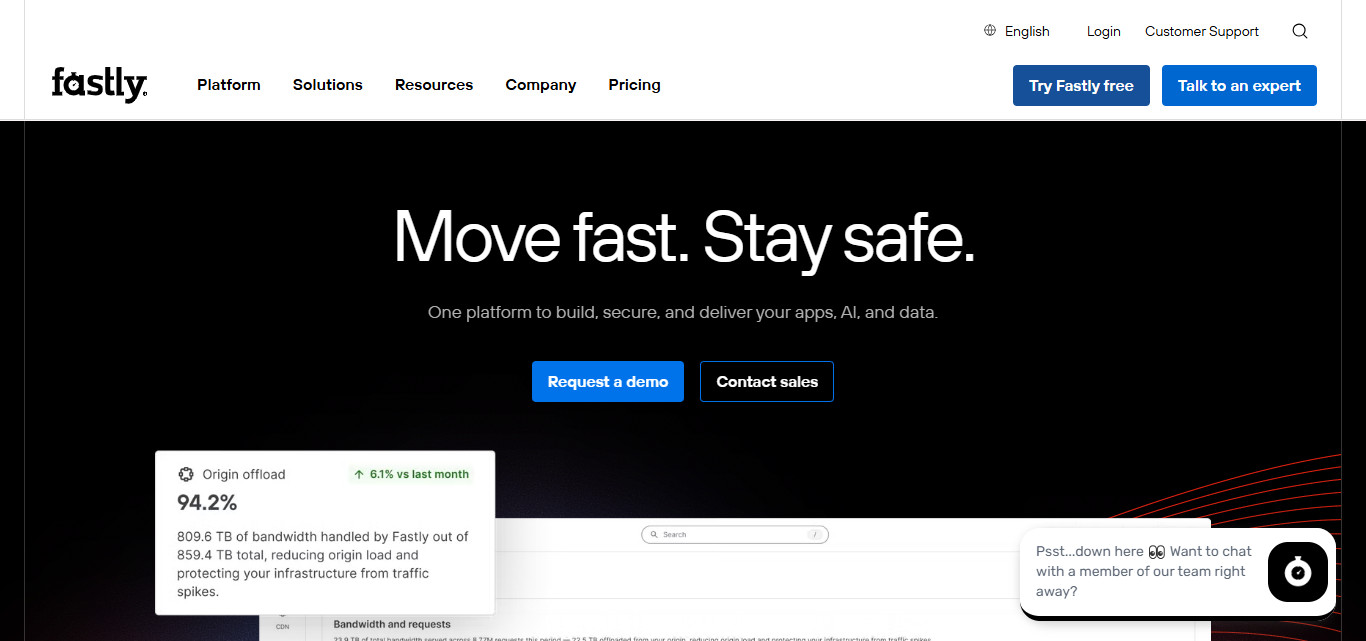
Its points of presence around the globe serve content and run custom logic close to users, backed by real-time observability and rapid configuration updates. Performance is a big selling point, with fast cache purging and low-latency compute suitable for streaming, e-commerce and news sites.
Strong scalability for high-throughput traffic and sudden spikes. Built-in WAF, bot protection and DDoS defense secure sites at scale. Fastly is business-oriented and usage-based, so any free or trial access should be verified on its current pricing page.
Fastly Pricing
Billing model: Pay as you go, mostly based on bandwidth and number of requests.
How to get in: Check the current page for a free trial or starter credit.
Commitments: Big plans often have monthly minimums or committed-spend discounts.
Add-ons: Security (WAF, bot protection, DDoS) and Compute available at extra cost.
Fastly Features
- Programmable CDN: VCL and edge configuration for custom caching and routing logic.
- WebAssembly compute: Run secure, fast code at the edge in multiple languages.
- Instant purging: Cache updates are propagated globally in ~150 ms.
- Security and observability: WAF, bot protection, DDoS protection, real-time logs and analytics.
4. Netlify
Netlify is a hosting service for modern frontend and Jamstack sites with Git-based workflows, automatic builds and a preview deployment for every pull request. Content is delivered via a global CDN and edge network, while serverless and edge functions provide dynamic functionality such as forms, authentication, and personalization.
Static and hybrid sites do well because the assets are prebuilt and cached close to users globally. Scalability is automatic, so you don’t have to manage servers as traffic grows, and teams can collaborate easily on deployments. There’s a free personal plan and paid credit-based plans starting at about $9 to $19 per month for professional and team projects.
Netlify Pricing
- Free plan: A personal plan with limited builds, bandwidth, and function calls.
- Paid plans: Credit-based plans start at about $9 to $19/month per member.
- Overages: Additional usage draws from credits or is billed as an add-on.
- Enterprise: Custom pricing, SSO, higher limits, and dedicated support
Netlify Features
- Git-based workflow: Automatically build and deploy from GitHub, GitLab or Bitbucket.
- Deploy previews: Test URLs for each pull request, with instant rollbacks.
- Functions: Dynamic functionality without the hassle of managing servers, via serverless and edge functions.
- Native tools: Forms, identity and authentication, split testing, and a plugin ecosystem
5. Fly.io
Fly.io is a container hosting platform that deploys Docker containers and lightweight VMs to regions around the world. Good for full-stack apps, APIs and databases. It’s not a traditional CDN, but rather deploys your application itself to multiple global regions near end users, reducing latency for dynamic and persistent workloads.
Apps are real servers, so the startup is fast and the routing is low-latency, so the performance is good. Scalability is flexible. You can add or remove machines and regions, or scale them up and down, based on demand. Pricing is pay as you go and free allowances for new users are limited so check current trial offers.
Fly.io Pricing
- Billing model: Pay as you go, with per-second running time for machines.
- Free tier: New users typically only receive a limited trial, and no free tier is permanent.
- Extra charges: Persistent volumes, IP addresses and outgoing bandwidth all have separate fees.
- Savings: Reserved compute and stopped machines can help reduce your monthly bill
Fly. io Features
- Container deployment: Runs Docker images as fast-starting lightweight VMs (Firecracker).
- Multi-region deployment: Deploy apps in multiple global regions close to your users.
- Persistent workloads: Supports volumes, databases and long running services rather than just functions.
- Private networking: Built-in private network, load balancing and automatic request distribution
6. Deno Deploy
Deno Deploy is an edge runtime platform for JavaScript and TypeScript apps, built on top of modern web standards like Fetch API and Web Streams. This is great for APIs, server rendered sites, and lightweight full stack apps that deploy code to a globally distributed network that runs close to users.
Performance advantages of fast startup time and running at the edge – fewer round trips to a central server. Scalability is automatic, with the platform automatically managing traffic growth and distribution without manual configuration.
There is a free tier for hobby and small projects with paid plans for higher usage. Make sure to check the limit on the official site.
Deno Deploy Pricing
- Free tier: For hobby and small projects, with monthly request and bandwidth limits.
- Pro plan: Paid plans start at around $20/month and have higher limits.
- Overages: Overage usage beyond the included quota is charged by requests and bandwidth.
- Enterprise: Customized plans for big organizations with special needs
Deno Deploy Features
- Web-standard runtime: Uses Fetch API, Web Streams and other modern standards.
- TypeScript-first: Native TypeScript execution, no build step.
- Worldwide distribution: Code is deployed instantly on a worldwide edge network.
- Simple data choices: Native Deno KV storage and smooth GitHub integration.
7. Akamai
Akamai is one of the oldest and biggest enterprise edge delivery and security platforms. It was designed for content delivery, application acceleration and protection against attacks at massive scale.
It has one of the largest networks in the world with thousands of locations in many countries, especially in the Asia-Pacific region, and at the carrier level. Its performance is consistent for high traffic volumes, live events, streaming, and global enterprise sites that require reliable delivery everyplace.
Scalability is great with massive traffic spikes handled, plus WAF, bot management and DDoS protection. “Akamai is a big company service that you pay for, and it doesn’t really have a free tier, it’s really meant for companies that have serious budgets.
Akamai Technology Pricing
- Billing model: Custom enterprise contracts, usually based on traffic volume and commitments.
- Free tier: None, platform is made for big companies.
- Pricing: Quotes are sales-led and will differ based on the products and security services purchased.
- Cost factors: Pricing is based on bandwidth, requests, and add-ons like WAF and bot management.
Akamai Features
- Massive network: One of the largest edge platforms in the world, with global reach.
- Enterprise security: WAF, bot management and DDoS protection.
- Media delivery: Optimized for live streaming, video on demand and large downloads.
- Enterprise support: Reporting, deep traffic controls, SLAs, and dedicated account support
8. Bunny.net
Bunny.net is a low cost global CDN and edge delivery service that focuses on fast static asset delivery, video streaming and image optimization. It has a global network of points of presence on several continents, so it provides pretty good coverage for most audiences at a low cost.
Performance is a strong point. Fast delivery. Simple caching controls. Built-in tools like image optimizer and edge storage. Scalability is easy because usage-based pricing grows with traffic, and can accommodate everything from small sites to large media libraries. It doesn’t have a permanent free tier, but does have a free trial and its pricing is among the most affordable on the market.
Bunny.net Pricing
- Billing model: Pay as you go CDN pricing per GB with low rates for Europe and North America.
- Minimum spend: A very low monthly minimum of about $1
- Free trial: A free trial is available, but there is no “free-forever” option.
- Extras: Edge storage, image optimization and video streaming are extra
Bunny.net Features
- Global CDN: Low cost delivery with points of presence all over the place.
- Bunny Optimizer: On-the-fly automatic image resizing and compression.
- Edge services: A single platform for edge storage, edge scripting, and DNS.
- Video streaming: Native video hosting, encoding and delivery tools
9. AWS
If your business is already invested in the AWS ecosystem, then you can take advantage of edge hosting through Amazon CloudFront, a content delivery network, and Lambda@Edge, which executes serverless code at edge locations. CloudFront has hundreds of edge locations worldwide to serve websites, APIs and video with low latency.
Tight integration with S3, EC2 and other AWS services, advanced caching and security options, all result in high performance. Scale is virtually unlimited, automatically managing traffic for small sites to global enterprises on a pay-as-you-go basis. CloudFront provides a free tier for data transfer and requests each month but Lambda@Edge is billed based on usage so keep an eye on your costs.
AWS (CloudFront/Lambda@Edge) Pricing
- Free tier: CloudFront has a free monthly data transfer and request quota that is forever free.
- Billing model: Pay as you go for use over the free allowance, based on data transfer and number of requests.
- Lambda@Edge: More expensive than regular Lambda by request and compute time.
- Discounts: For high traffic, volume discounts and committed-use pricing are available.
AWS (Lambda@Edge/CloudFront) Features
- Global CDN: CloudFront provides hundreds of edge locations across the globe to serve your content.
- Edge code execution: Customize requests and responses using Lambda@Edge and CloudFront Functions.
- AWS integration: Integrates smoothly with S3, EC2, Route 53 and more.
- Security controls: AWS Shield, WAF, signed URLs, SSL/TLS encryption
10. Azure Static Web Apps
Azure Static Web Apps is Microsoft’s hosting service for static front ends with built-in serverless APIs, designed for apps built with React, Angular, Vue and similar frameworks. Azure’s network delivers content globally, with automated builds and deployments from GitHub or Azure DevOps.

Performance is good for static sites, with assets served from distributed locations close to the user, and preview environments enable teams to test changes. Scalability is automatic, with serverless API backends scaling with traffic.
The free plan is great for personal or small projects, while the Standard plan begins at around $9 per month and includes higher limits, custom authentication, and more advanced features.
Azure Static Web Apps Pricing
- Free plan: Good for personal and small projects but with limited bandwidth and features.
- Standard plan: $9/month per app, higher limits, and custom authentication.
- Overages: Additional charges will be applied for bandwidth overages.
- Extras: Connected Azure services like Functions or databases are billed separately.
Azure App Web Static Features
- Static hosting with APIs: For front ends and integrated serverless Azure Functions back ends.
- CI/CD automation: Automatic builds and deployments from GitHub or Azure DevOps.
- Staging environments: Preview environments created by pull requests for testing changes.
- Authentication built-in: Easy sign-in with GitHub, Microsoft Entra ID, and more.
Conclusion
Conclusion The best edge hosting provider for global websites depends on your goals, budget, and technical requirements.
Cloudflare is good at everything, Vercel and Netlify are good for modern front-end projects, Fastly and Akamai are for enterprises, Fly.io is for containers, and Bunny.net is cheap. Look closely at features, pricing, performance, and start a free tier to find your best fit.
FAQ
What is edge hosting?
Edge hosting serves your website from servers closest to visitors.
Which is the best edge hosting provider overall?
Cloudflare is widely considered best for speed, security, and value.
Which provider is best for Next.js websites?
Vercel offers the best Next.js support with zero-configuration deployments.
Is there a free edge hosting option?
Yes, Cloudflare, Vercel, Netlify, and Deno Deploy offer free tiers.