This article examines the top AI Guardrail Platforms that support businesses in developing secure, enhanced, and responsible AI systems. AI safeguard solutions help meet the challenges of harmful AI outputs and model governance.
With generative AI’s growing risks, these solutions are needed to ensure the secure use of this technology. AI guardrails are features used to meet AI safety, security, and compliance needs. This includes AI monitoring, content filtering, and protective measures for safety and security.
Key Points
| AI Guardrail Platform | Explanation |
|---|---|
| NVIDIA NeMo Guardrails | Controls AI conversations with programmable safety rules and customizable behavioral boundaries. |
| Guardrails AI | Provides validation frameworks ensuring reliable, safe, and compliant AI outputs. |
| Microsoft Azure AI Content Safety | Detects harmful content and protects enterprise AI applications through filters. |
| Google Cloud Vertex AI | Offers responsible AI controls, monitoring, and safety management capabilities. |
| AWS Bedrock Guardrails | Applies safety policies reducing risks across generative AI applications. |
| Lakera Guard | Protects AI systems against prompt attacks, data leaks, and misuse. |
| Protect AI | Secures machine learning pipelines with AI risk detection solutions. |
| CalypsoAI | Delivers enterprise AI security, governance, and model protection features. |
| WhyLabs | Monitors AI models for drift, quality issues, and safety concerns. |
| Arthur AI | Provides AI monitoring, explainability, and governance for responsible deployment. |
1. NVIDIA NeMo Guardrails
NVIDIA NeMo Guardrails is a flexible open-source software solution to add flexible safety guardrails and behavior policies to large language models and conversational AI. Developers can engineer their own policies, discourage undesired responses, and control the topics and user engagement of AI assistants.
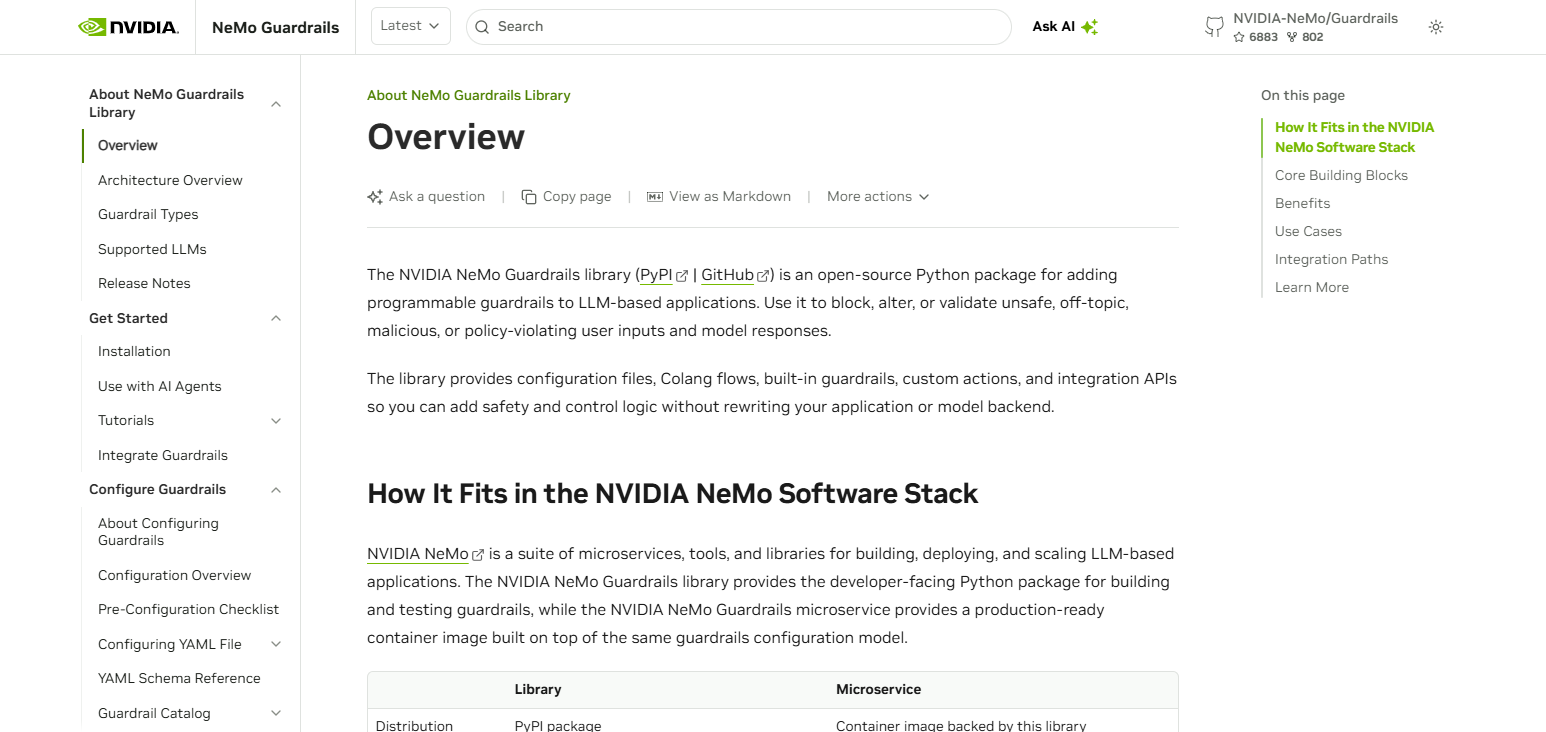
The solution is a set of programmable safety rails for flexible input, output, and security filtering as well as the responsible and safe deployment of AI. Enterprises that build generative AI applications value the reliability, transparency, and compliance of the NVIDIA NeMo Guardrails solution with the most popular LLM frameworks.
The platform provides organizations the means to develop flexible high-performance AI safety and compliance solutions. AI safety is a key concern for enterprises, and the NVIDIA NeMo Guardrails range of solutions is of enormous interest to many organizations.
NVIDIA NeMo Guardrails Pros & Cons
| Pros | Cons |
|---|---|
| Open-source framework provides high customization for developers. | Requires technical expertise for implementation and configuration. |
| Supports flexible safety rules and conversational controls. | Deployment can be complex for smaller teams. |
| Integrates with multiple large language models and AI workflows. | Limited built-in enterprise monitoring features compared with competitors. |
| Helps prevent unsafe AI responses and improves reliability. | Requires continuous maintenance of custom guardrail policies. |
2. Guardrails AI
Guardrails AI offers an array of customizable safety validators and an AI output quality framework. From harmful and policy violating responses to privacy compromising or inaccurate information,
the Guardrails AI platform helps enterprises create a safety layer around their generative AI applications. The safety layer is formed by validating AI application inputs and outputs. Safety validators can be utilized across multiple large language models and integrated into already existing AI workflows.
Value-added and safety-conscious AI systems especially designed for customer-facing applications are of great importance to many organizations and the Guardrails AI platform helps bring such applications to market faster.
Guardrails AI Pros & Cons
| Pros | Cons |
|---|---|
| Provides customizable validators for improving AI output quality. | Advanced features may require developer knowledge. |
| Supports multiple LLM integrations and workflows. | Validator configuration can become complicated at scale. |
| Helps detect errors, harmful content, and compliance issues. | Smaller ecosystem compared with major cloud providers. |
| Improves trust and accuracy of generative AI applications. | Requires additional monitoring for complex AI systems. |
3. Microsoft Azure AI Content Safety
With Microsoft Azure AI Content Safety, organizations can mitigate the potential harms posed by generative AI applications by identifying harmful, inappropriate, or unsafe content.
Microsoft offers automated content filters for text, image, or AI-generated content. Microsoft Azure AI Content Safety can be used to mitigate the risk of harmful content, such as hate speech, violence, self-harm, and abuse.
Microsoft Azure AI Content Safety can be used to develop and deploy AI responsibly by integrating Azure AI content safety with Azure AI services and enterprise applications.
Organizations can modify Azure AI Content Safety to meet the needs of their industry and their compliance and safety requirements.
Microsoft Azure AI Content Safety is frequently employed by organizations who want to maintain user trust and meet compliance requirements, while maximizing the protection that AI safety services offer.
Microsoft Azure AI Content Safety Pros & Cons
| Pros | Cons |
|---|---|
| Provides enterprise-grade content filtering and safety controls. | Best performance depends on Azure ecosystem adoption. |
| Supports text and image moderation capabilities. | Pricing can increase with high-volume AI usage. |
| Integrates easily with Microsoft AI services. | Customization options may be limited compared with open-source tools. |
| Helps organizations meet responsible AI requirements. | Requires Azure expertise for advanced configurations. |
4. Google Cloud Vertex AI
The responsible AI features of Google Cloud Vertex AI provide organizations the ability to build, secure, and manage the AI generative and machine learning applications that they have implemented in a highly monitored and managed environment.
Google Cloud Vertex AI employs a safety framework to AI that incorporates content filtering, the monitoring of models and their outputs, assessment tools, and control features.
Google Cloud Vertex AI encourages safe and responsible use of AI by aiding the identification of issues in AI model reliability and helps developers to strengthen this reliability.
Google Cloud Vertex AI combines advanced AI infrastructure with framework safety to support enterprise level AI. Clarity and compliance are important to organizations when developing AI tools. Google Cloud Vertex AI helps to develop the tools while addressing these concerns and managing the AI outputs to a far greater extent.
Google Cloud Vertex AI Pros & Cons
| Pros | Cons |
|---|---|
| Offers advanced AI governance and monitoring capabilities. | Can be complex for beginners and small businesses. |
| Provides scalable infrastructure for enterprise AI applications. | Costs may become high for large workloads. |
| Supports responsible AI development with evaluation tools. | Requires Google Cloud knowledge for optimization. |
| Integrates with powerful machine learning services. | Some features are focused mainly on Google ecosystem users. |
5. AWS Bedrock Guardrails
Amazon Web Services Bedrock Guardrails places mechanisms of safety for generative AI services founded upon base models from Amazon Bedrock. It enables organizations to set up parameters that control moderation of harmful content, exposure to sensitive data, and undesirable AI responses.
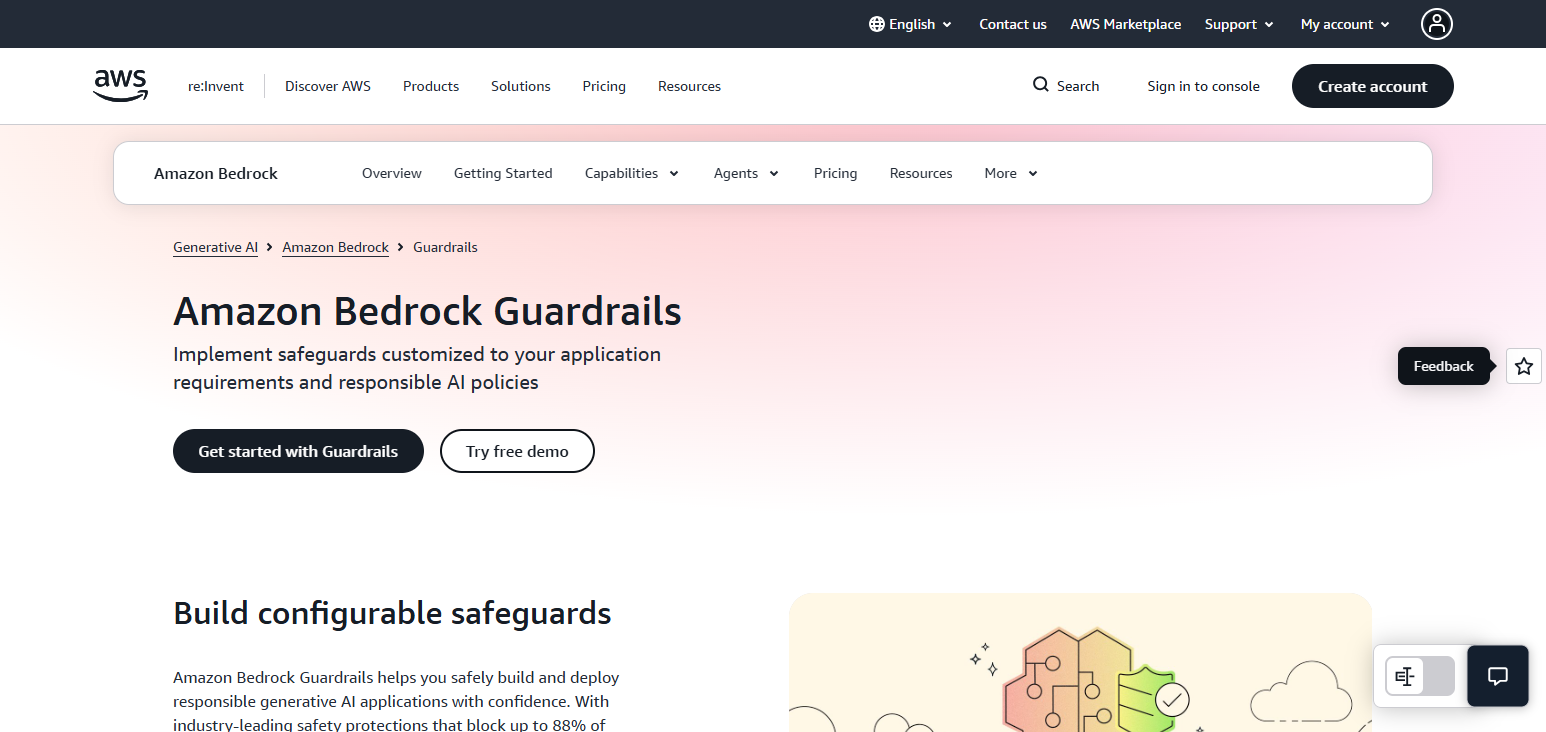
It includes customizable filters, prohibited topics, privacy protection, and features of governance for responsible AI. AWS Bedrock Guardrails enables a multi-base models approach for organizations and applies safety standards throughout AI services. It is a great fit for organizations that require safety, security, and scalability of generative AI offered in the cloud.
AWS Bedrock Guardrails Pros & Cons
| Pros | Cons |
|---|---|
| Provides strong safety controls for foundation models. | Mainly beneficial for AWS-based applications. |
| Supports customizable content filters and policies. | Requires AWS technical knowledge for setup. |
| Works with multiple generative AI models. | Advanced customization may require additional development. |
| Helps enterprises deploy secure AI applications. | Pricing depends on usage and model integration. |
6. Lakera Guard
Lakera Lakera Guard secures AI applications from threats of security such as prompt injection, data leakage, jailbreaks attempts, and malicious input. The application offers layers of monitoring and protection in real-time AI security and enables organizations to safely innovate with Large Language Models.
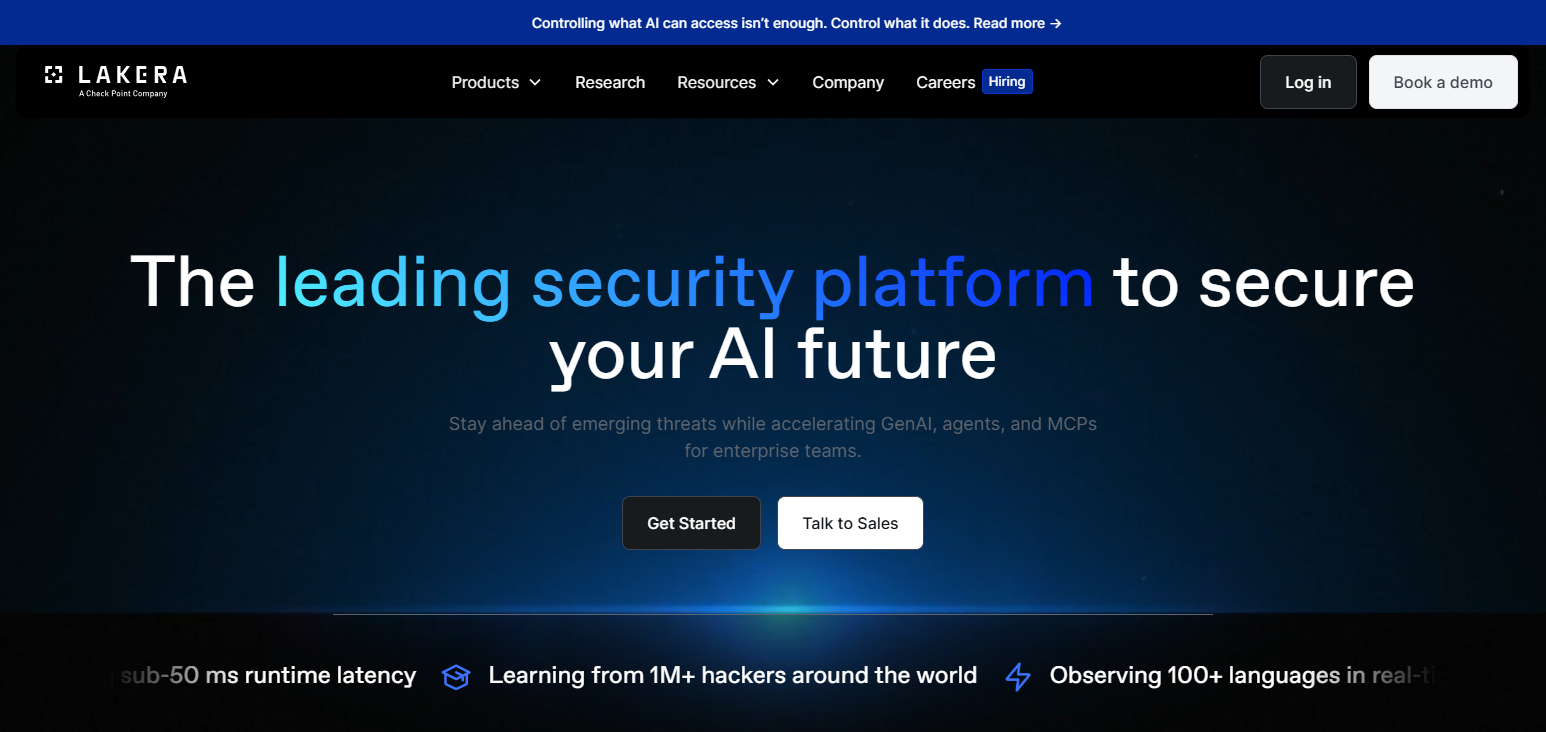
Lakera Guard reviews user behavior and analyzes AI responses to spot the threat and mitigate the risks before they impact applications. Lakera Guard is designed for developers and enterprises that require the highest level of security design and control in customer-facing AI solutions.
The application offers organizations the ability to strengthen AI and safeguard sensitive data and implement security measures for a reliable safe user experience.
Lakera Guard Pros & Cons
| Pros | Cons |
|---|---|
| Strong protection against prompt injection attacks. | Primarily focused on AI security rather than full governance. |
| Detects jailbreak attempts and sensitive data leaks. | Enterprise pricing details are less transparent. |
| Provides real-time AI application protection. | May require integration work with existing systems. |
| Helps secure customer-facing AI solutions. | Smaller market presence compared with cloud platforms. |
7. Protect AI
Protect AI focuses on offering security solutions for protecting the infrastructure of machine learning and AI. Protect AI helps customers secure the entire machine learning lifecycle by identifying AI-related threats and managing AI risks.
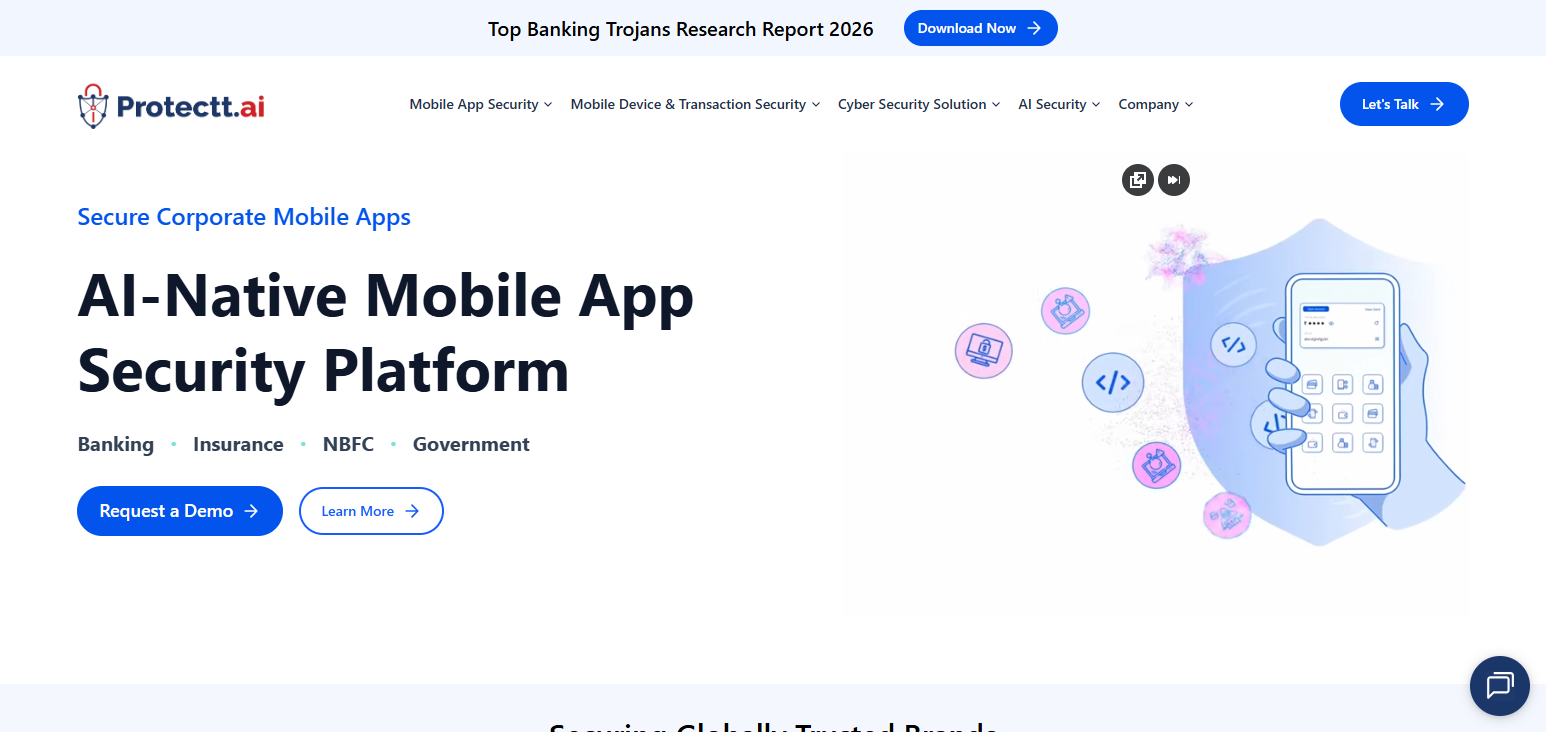
Protect AI’s model scanning, threat detection, compliance, and governance tools help secure AI systems. Protect AI is aimed at enterprises that need more security along the AI development and deployment processes.
Protect AI improves the visibility of AI-related threats, allowing development teams to build machine learning systems with less exposure to the threats and risks of AI.
Protect AI Pros & Cons
| Pros | Cons |
|---|---|
| Provides comprehensive AI security lifecycle protection. | More focused on security teams than general developers. |
| Detects vulnerabilities across machine learning pipelines. | Implementation may require cybersecurity expertise. |
| Supports compliance and AI risk management. | Can be complex for smaller organizations. |
| Improves visibility across AI infrastructure. | Requires integration with existing security tools. |
8. CalypsoAI
CalypsoAI offers solutions of enterprise AI security and governance that enable organizations to secure the safe adoption of generative AI. CalypsoAI focuses on protecting AI models and controlling sensitive data, all while adhering to the organization’s compliance stance.
CalypsoAI’s generative AI security services help safeguard AI systems of high importance to the organization. The platform is designed to help organizations in more regulated industries where AI governance and safety are critically important.
CalypsoAI’s platform helps organizations securely integrate AI and provides visibility and control of the AI security threats that the organization faces.
CalypsoAI Pros & Cons
| Pros | Cons |
|---|---|
| Offers enterprise AI security and governance solutions. | Primarily designed for large organizations. |
| Provides strong protection for sensitive AI applications. | Pricing may be higher than lightweight alternatives. |
| Supports compliance-focused AI deployments. | Requires specialized knowledge for deployment. |
| Helps manage risks in regulated industries. | Limited suitability for small AI projects. |
9. WhyLabs
WhyLabs is an AI observability technology that enables businesses to monitor ML models and discover problematic areas regarding performance, quality, and safety. WhyLabs offers behavior tracking, data drift detection, and the capability to support AI operations.
WhyLabs analyzes patterns and outputs of their AI after the business has deployed it, allowing teams to better understand its AI systems.
WhyLabs advocates responsible AI by increasing visibility and decreasing the probability of unforeseen failures. It is best used by companies that operate extensive AI systems and require constant oversight and support for governance and operations.
WhyLabs Pros & Cons
| Pros | Cons |
|---|---|
| Provides powerful AI monitoring and observability features. | Focuses more on monitoring than prevention. |
| Detects model drift and performance issues. | Requires understanding of machine learning operations. |
| Improves AI reliability after deployment. | May need additional tools for complete AI security. |
| Supports enterprise-scale machine learning monitoring. | Advanced capabilities may require paid plans. |
10. Arthur AI
Arthur AI is an AI observability and governance technology whose purpose is to cultivate the development of clear, just, and reliable AI systems. Arthur AI helps businesses track performance, detect bias, and understand the explainability of workflows.
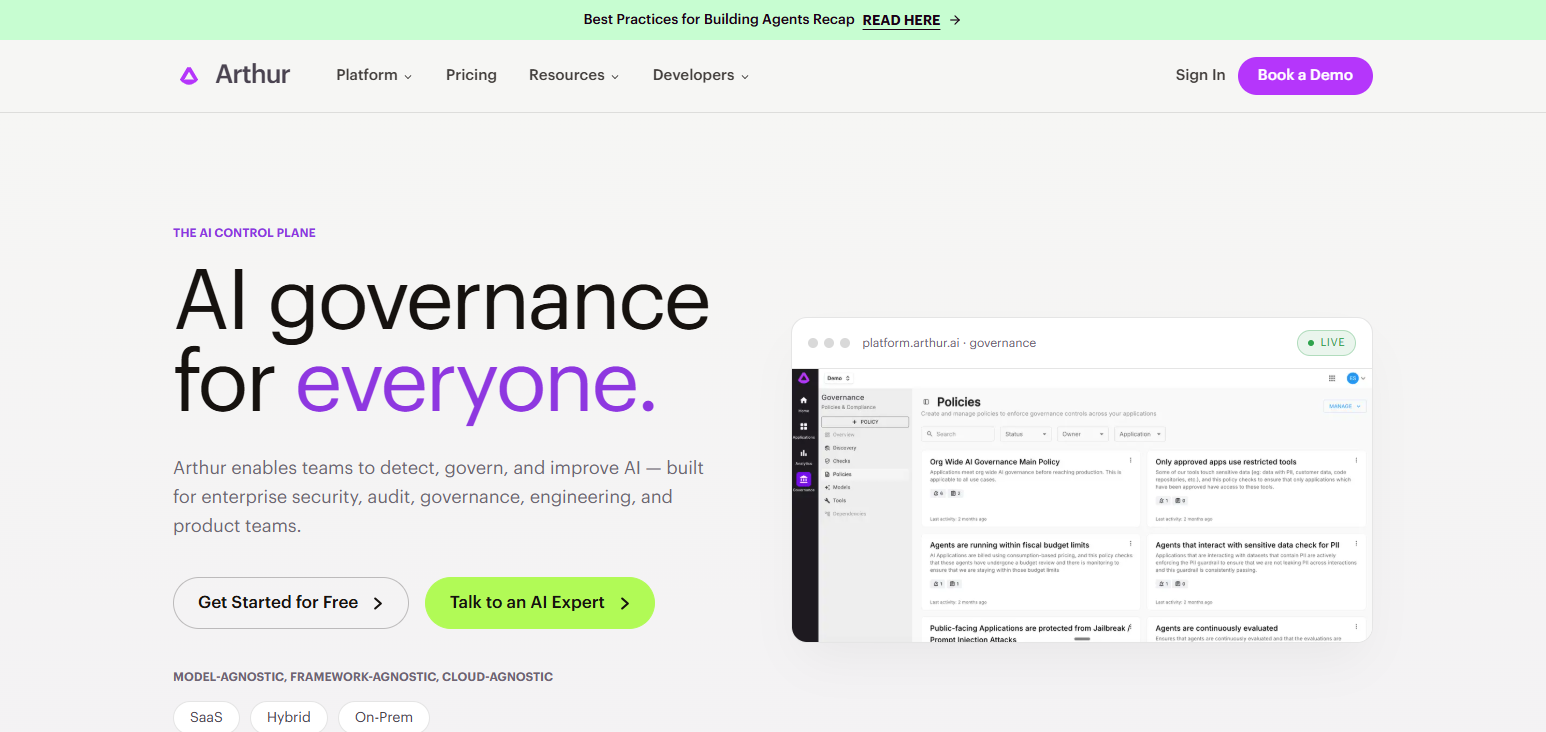
Arthur AI is particularly useful to ML teams to understand the operational and business aspects of the decisions AI is making and, most importantly, to comply with the growing demand for governance of responsible AI.
Arthur AI is popular with corporations that require improvement of governance, control, and justification at the level of their AI models and applications.
Arthur AI Pros & Cons
| Pros | Cons |
|---|---|
| Provides AI explainability and governance features. | Can require technical expertise for implementation. |
| Helps monitor model performance and bias issues. | Pricing may not suit smaller companies. |
| Supports responsible AI deployment practices. | Less focused on real-time security threats. |
| Improves transparency and accountability of AI systems. | Integration can be complex with existing infrastructure. |
Conclsuion
In summary, the Best AI Guardrail Platforms instill safe, trustworthy, and ethically designed AI applications. These platforms assist organizations in restricting negative outputs, controlling and diminishing risks, optimizing compliance, and upholding AI system reliability.
Ranging from open-source tools to enterprise-grade security, guardrails assert user control and augment the functionality and transparency of contemporary AI systems. As a result, these guardrails enhance the generative AI security of corporate enterprises.
FAQ
What are AI Guardrail Platforms?
AI guardrail platforms ensure safer, controlled, and responsible artificial intelligence operations.
Why are AI Guardrail Platforms important?
They reduce AI risks, harmful outputs, security threats, and compliance issues.
What is NVIDIA NeMo Guardrails used for?
It controls AI conversations through customizable safety rules and policies.
What does Azure AI Content Safety provide?
It filters harmful content and protects enterprise AI applications effectively.