
This article talks about the Best AI Tools for Financial Workflow Exception Resolution These new solutions help finance teams automate reconciliation, identify anomalies and address exceptions faster.
Basically, bringing in AI minimizes the manual errors, speeds up approvals and provides better visibility into financial workflows which enhance accuracy, compliance and overall operational efficiency across AP, Audit and reconciliation processes.
Key Poinst & Best AI Tools for Financial Workflow Exception Resolution
Osfin.ai – Automates financial exception handling, ensuring accurate reconciliation and faster approvals across accounting workflows.
Stampli – AI-driven platform that streamlines invoice approvals and resolves payment exceptions efficiently with collaboration features.
Vic.ai – Uses AI to detect anomalies, automate invoice processing, and resolve financial discrepancies quickly.
MindBridge – Combines AI and machine learning to identify irregularities and prevent errors in financial workflows.
Booke.ai – Automates transaction classification and exception resolution, reducing manual effort in accounting processes.
Nanonets Flow – Extracts data from invoices and documents to automatically resolve workflow exceptions accurately.
HighRadius – Provides AI-powered accounts receivable and payable solutions to handle financial discrepancies efficiently.
Trullion – Automates complex accounting tasks, detecting errors and resolving exceptions in financial documents.
Numeric – Leverages AI to detect discrepancies and streamline exception handling in accounting workflows.
DataSnipper – Uses AI to review, cross-check, and resolve accounting exceptions within financial documents efficiently.
10 Best AI Tools for Financial Workflow Exception Resolution
1. Osfin.ai
Osfin. ai is an AI-first finance automation platform designed to manage complex reconciliation, high-volume transaction matching and exception resolution across financial systems.
Its A.I. can analyze millions of entries in minutes, auto‑detect unrecorded transactions and sort exceptions by contextual patterns, drastically lowering noise and error rates.
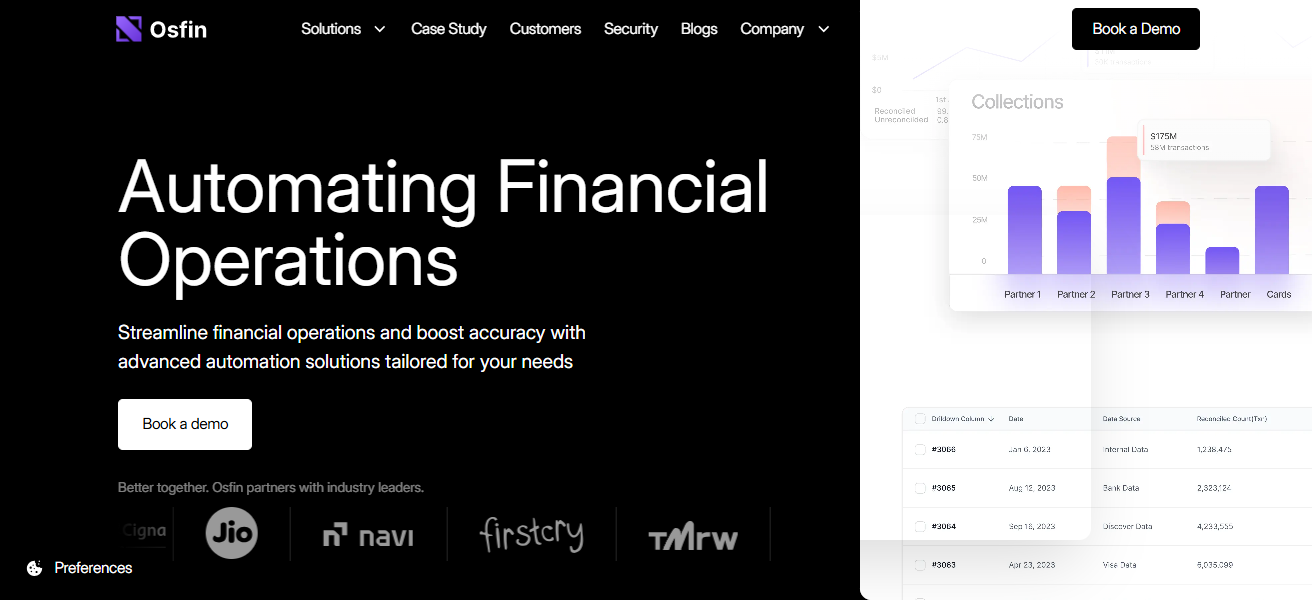
With over 170+ integrations to ERPs, banks, payment gateways and CSV/PDF data sources by design Osfin’s intelligent workflows give real-time dashboards and audit trails that allow
Financial teams to focus on strategic problems rather than manual reconciliation tasks. This enables CFOs and controllers to improve close accuracy, compliance, and operational speed.
| Pros | Cons |
|---|---|
| Exceptional at high‑volume reconciliation and exception grouping | May require configuration effort for complex enterprise stacks |
| Strong contextual pattern detection reduces false positives | Smaller brand ecosystem than mature incumbents |
| 170+ integrations across ERP, bank, payment sources | Some advanced dashboards need training to use effectively |
| Offers real‑time audit trails and visibility | Initial setup may need finance + IT coordination |
| Helps accelerate close cycles and compliance | Not widely known yet among global finance teams |
2. Stampli
Stampli’s AI-powered solution revolutionizes AP and invoices workflows by eliminating manual data entry and substantially decreasing exception handling time.
And it’s AI gets smarter over time, learning from historical decisions to route invoices automatically to the appropriate approvers, recommending
When is best to pay and consolidating exception-based communications directly on each invoice, minimizing delays and miscommunication.
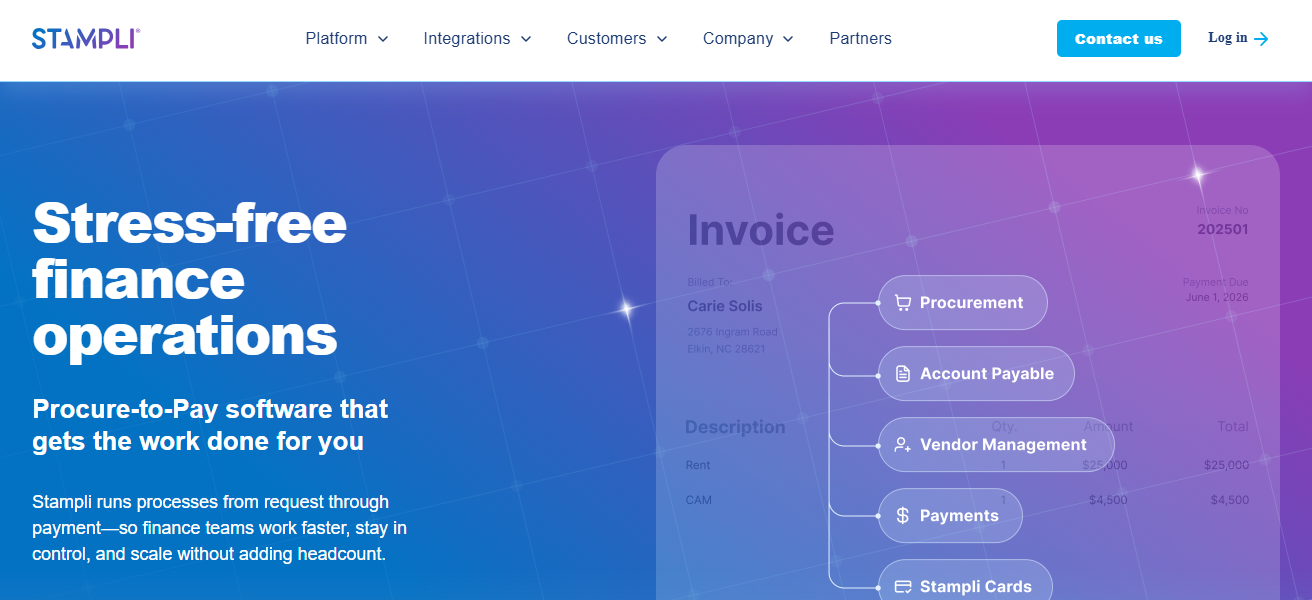
Stampli connects with top ERPs including SAP, Oracle, QuickBooks and more while offering visibility into vendor payments compliance in real time.
Intelligent OCR extraction, built‑in audit trails and collaborative resolution capabilities empower finance teams while eliminating AP process bottlenecks.
| Pros | Cons |
|---|---|
| Intuitive AP automation and centralized invoice communication | Primarily focused on AP, not full record‑to‑report workflows |
| Smart AI routing reduces approval delays | Custom workflows may need admin refinement |
| Great OCR accuracy and vendor payment visibility | Some complex ERP integrations may require support |
| Built‑in audit trails and compliance tracking | Price may be high for small businesses |
| Collaboration features reduce email bottlenecks | Limited predictive analytics beyond AP |
3. Vic.ai
Vic. ai is an independent AI platform specialized in revolutionizing invoices processing, approval workflows and exception resolution for finance teams.
Leveraging unsurpassed proprietary AI, trained on hundreds of millions of invoices gives you over 99% accuracy in extracting and coding data with no template setup needed.
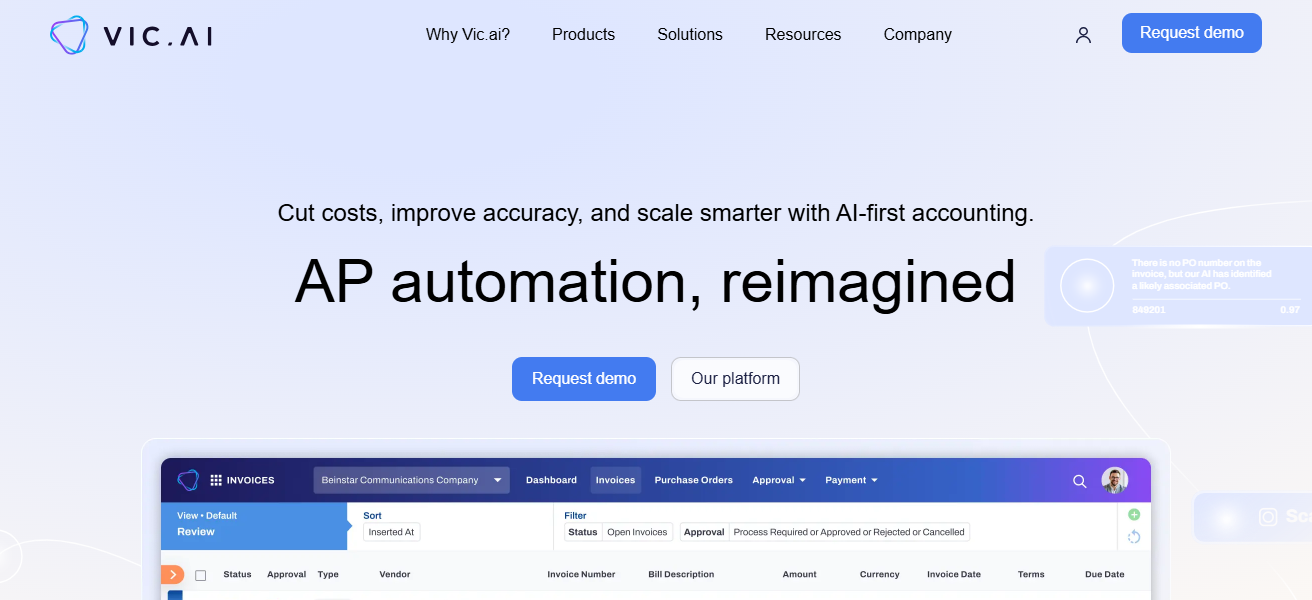
When confidence thresholds have been met, its Autopilot feature can handle invoices end to end with no human involvement, enabling teams to focus on strategic activity.
Additionally, Vic. ai analytics and real‑time insights proactively surface discrepancies, streamline PO matching, and enhance cash flow visibility—all while scaling with increasing invoice volumes.
| Pros | Cons |
|---|---|
| Very high extraction accuracy (>99%) | Strong focus on invoice processing only |
| Autopilot eases repetitive finance work | May require confidence threshold tuning |
| Template‑free AI recognition simplifies onboarding | Not designed for deep audit risk scoring |
| Scales with growing invoice volume | Limited for broader reconciliation beyond invoices |
| Proactive discrepancy insights | Analytics dashboards can be complex |
4. MindBridge
MindBridge is an AI tool in the field of financial risk detection, audit automation and anomaly analysis. Its machine learning models query 100% of finance transactions to uncover anomalies indicating fraud or gaps in controls that typical sampling-based techniques overlook.
Rather than flagging simple errors, MindBridge provides risk scores and explanations, allowing auditors and finance professionals to focus on significant variances
While resolving exceptions more quickly. It provides better compliance, audit readiness and data integrity by integrating with your finance systems and visualize key risk indicators.
With this, MindBridge becomes an essential platform for teams requiring robust anomaly detection with exception resolution functionality.
| Pros | Cons |
|---|---|
| Full‑transaction anomaly detection for risk teams | Not a full AP/AR workflow automation tool |
| Examines 100% of transactions (no sampling) | May be overkill for small finance teams |
| Assigns risk scores with context | Requires training to interpret analytics fully |
| Excellent for audit and fraud detection | Focused more on risk than productivity features |
| Integrates with accounting datasets for audits | Pricing often aimed at larger auditors |
5. Booke.ai
Booke. ai by _an AI‑powered bookkeeping assistant automating the categorization and reconciliation of transactions as well as error detection in accounting workflows.
Its machine learning engine learns from historic data to identify new classes of transactions, and detect anomalies for improving straight-through processing — reducing the need for manual adjustments and reconciliation exceptions.
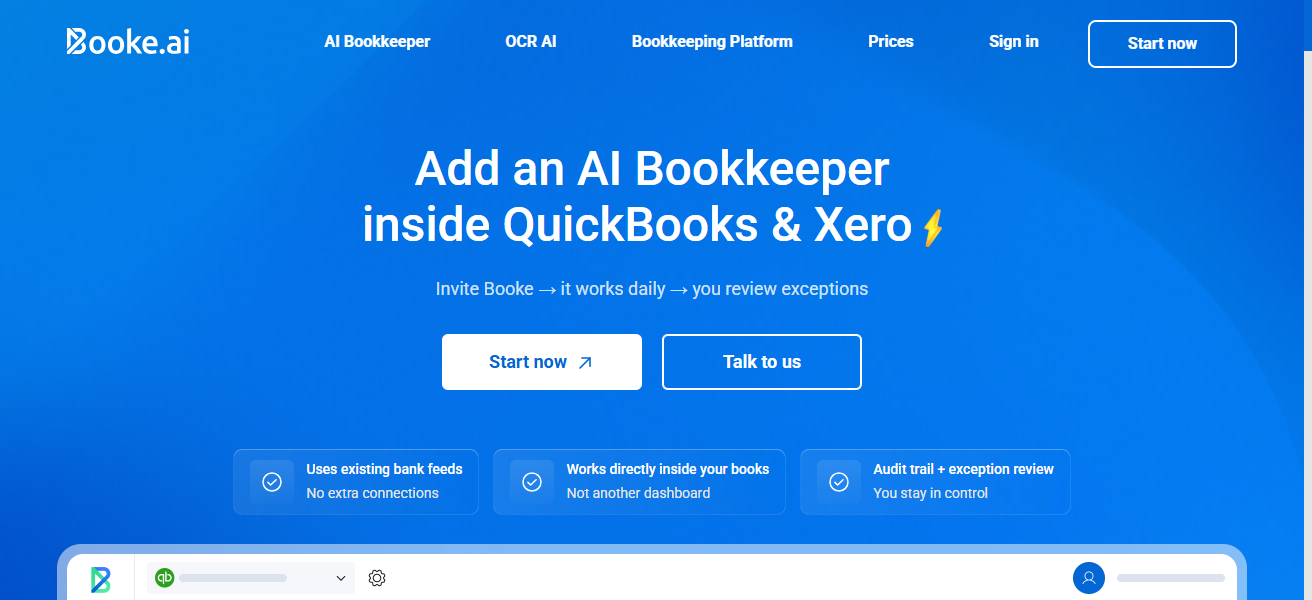
Booke is built to work with systems like QuickBooks and Xero. ai streamlines month‑end closing with aggregation of financial activity, enabling real‑time visibility into accounts.
Its next-generation error detection recognizes causes of issues like miscodings, duplicates and preventative errors on a scale much earlier than they ever rise to exceptions
Saving time for small to medium business owners as well as improving the general accounting level in this market for accounting firms.
| Pros | Cons |
|---|---|
| Automates bookkeeping and categorization | Geared toward smaller businesses and accounting firms |
| Learns historical patterns to reduce errors | Not suited for large enterprise scale |
| Improves month‑end close accuracy | Limited advanced analytics beyond categorization |
| Reduces manual reconciliation workload | Fewer ERP/enterprise connectors compared to big tools |
| Good real‑time account visibility | May need manual tweaks for unusual cases |
6. Nanonets Flow
Nanonets Flow employs AI and optical character recognition (OCR) technology to automate data extraction from unstructured financial documents—such as invoices, receipts, bank statements and purchase orders—resulting in far more efficient reconciliation and exception resolution.
Its platform automatically collects and classifies data from various formats, uses intelligent matching based on contextual criteria (amount, date, description) and highlights exceptions for easy review.

Using customizable workflows and a centralized dashboard in Brake, finance teams can effectively monitor reconciliation status against any parameters to help spot unmatched entries and provide real‑time insights. Nanonets is incredibly scalable and integrates with popular ERPs to simplify financial close and exception workflows.
| Pros | Cons |
|---|---|
| Excellent OCR for unstructured documents | Strong data extraction focus, not full finance stack |
| Intelligent matching highlights exceptions fast | Workflow automation depends on configuration |
| Handles many document types (POs, receipts, invoices) | Requires setup for business‑specific rules |
| Centralized dashboard for reconciliation tasks | Not focused on predictive analytics |
| Helps reduce manual entry errors | ERP integration requires tech support |
7. HighRadius
HighRadius provides an autonomous finance platform that automates AI across credit, collections, accounts payable, treasury and particularly record‑to‑report and reconciliation workflows.
Its generative AI and agentic tools automate the daily revenue reconciliation, balance sheet matching and cash application with reduced human involvement.

HighRadius’s platform helps finance and treasury teams speed up close cycles and optimize the working capital efficiency by unifying fragmented financial data and automating exception flagging and routing.
Trusted by large enterprises for comprehensive exception management, forecasting and finance operations optimization with dashboards that find reconciliation variances, real‑time insights on cash positions.
| Pros | Cons |
|---|---|
| Enterprise‑grade automation across finance ops | Complex platform onboarding and training |
| Strong record‑to‑report and exception automation | Pricing geared toward large enterprises |
| Balances sheet matching and cash application | May be too robust for mid‑sized teams |
| AI‑enabled working capital insights | Some users report steep learning curve |
| Real‑time analytics dashboards | Customization may require professional services |
8. Trullion
Trullion brings AI to accounting and audit workflows by not only extracting data from structured and unstructured sources — like contracts, leases, and financial statements — but also linking it directly to accounting records.
Its platform automates compliance work and reconciliations, producing audit-ready reports that decrease manual exceptions and speed up month-end workflows.

Facilitating reconciliation in real-time with invoice automation and ERP integrations, Trullion keeps all complex financial transactions and documentation aligned and updated within accounting systems.
This not just significantly reduces errors but also gives the finance teams visibility with respect to their workflows as well as fast resolution paths for any exceptions, thus improving both reporting reliability and operational control.
| Pros | Cons |
|---|---|
| Extracts data from contracts and statements | Focus on audit/compliance, less on AP workflows |
| Generates audit‑ready documentation | Best‑fit for teams with strong accounting focus |
| Integrates directly to ERP systems | Setup may need accounting expertise |
| Improves transparency and control | Not focused on predictive risk scoring |
| Reduces manual exception resolution effort | Smaller ecosystem than legacy platforms |
9. Numeric
Numeric is an AI‑driven transaction matching and monitoring platform that consolidates close and reconciliation workflows within in collaboration tools such as Slack and spreadsheets.
It automatically tracks differences across ledgers and real‑time data feeds, generating audit‑ready records and eliminating exceptions before they become problematic.
Numeric helps modern finance teams support an exception queue with automated alerts, and advanced match logic that goes beyond simple rule‑based systems (multiple criteria).

Its lightweight architecture allows for quicker deployments by mid‑sized business owners needing to enhance the accuracy of financial close processes and reduce exception turnarounds while keeping IT overhead low.
| Pros | Cons |
|---|---|
| Lightweight, fast transaction matching | Not as deep feature set as enterprise automation |
| Integrates with collaboration tools like Slack | Focused on matching, not full audit automation |
| Real‑time discrepancy tracking | Limited advanced finance analytics |
| Automated alerts speed exception handling | Smaller vendor community & resources |
| Quick deployment for mid‑sized teams | May need custom match logic tuning |
10. DataSnipper
DataSnipper supercharges productivity in audit and finance teams by bringing the power of AI right inside their spreadsheets, enabling them to extract, cross‑reference, and validate data considerably quicker than doing it manually.
Smart automation minimizes repetitive tasks, increases traceability in documentation and embeds audit evidence directly into processes resulting in significant reduction of reconciliation exceptions and errors in documentation.

Excel Agents and Disclosure Agents automate the complex work in auditing and exception handling, while built‑in safeguarding helps protect sensitive financial information.
DataSnipper helps bringing evidence organized and speeds up reviews allowing for clearer insight into processes, along with improved control — making it an essential tool for internal auditors, controllers and other finance professionals looking to ensure error‑free financial statements.
| Pros | Cons |
|---|---|
| Embedded AI speeds spreadsheet audit tasks | Core focus on spreadsheets, not broader systems |
| Excellent traceability and documentation capture | Not a full workflow automation suite |
| Automates repetitive financial audit work | Best used with Excel‑centric teams |
| Improves data cross‑referencing and verification | Limits outside of audit and control tasks |
| Built‑in security for sensitive finance data | Less suited to real‑time ERP processing |
Why use AI tools for financial Exception Resolution?
Automation of Repetitive Tasks – Less time and effort spent on manual data entry or processing.
Enhances accuracy – identifies discrepancies and errors more quickly than humans.
Easily scalable – Transactions can be processed without delay, even at high volumes.
Faster reconciliation – Speeds up financial close cycles and approvals.
Real-time insights – Supports dashboards and alerts to help you make decisions faster.
Cost Effectiveness – Reduces manual labor that saves operational costs.
Audit readymade – Automated, traceable and compliant financial records.
How To Choose Best AI Tools for Financial Workflow Exception Resolution
Define your goals – Is automating focus AP or reconciliation audit or Full finance automation.
Integrability — Compatibility with ERP, accounting software and banking systems
AI accuracy & reliability – Validate extraction accuracy, anomaly detection, and exception resolution performance.
Scalability – Ensure the tool will cope with your current and future transaction volumes.
Ease of use – Search for user-friendly dashboards, workflows, and simple to learn.
Security & compliance – Protect your data, enable audit trails, and follow regulations.
Cost vs Return On Investment – Analyze licensing, per-user/document fees against operational efficiency gains.
Conclsuion
Finally, top AI products for financial workflow exception resolution facilitate reconciliation cutting down on manual touch points and expediting the financial close.
Platforms like Osfin. ai, Stampli, and Vic. ai utilize AI to spot abnormalities, strew approvals as well as give real-time insights.
Choosing the appropriate tool is based on whether your workflow focuses on integration needs, scalability, and accuracy while promoting efficiency and compliance in finance operations at competitive costs.
FAQ
How do these AI tools differ from traditional financial software?
Unlike rule‑based systems, AI tools learn patterns over time, automatically identify exceptions, extract unstructured data, offer predictive insights, and minimize human oversight in repetitive tasks.
Are these tools suitable for small businesses?
Some tools like Booke.ai, Numeric, and Nanonets Flow are suitable for small to mid‑sized organizations; others like HighRadius, MindBridge, and Osfin.ai are more enterprise‑oriented.
Which tools are best for accounts payable and invoice exception handling?
Stampli and Vic.ai specialize in automating AP processes, offering strong invoice extraction, approval routing, and exception reduction.
What is financial workflow exception resolution?
Financial workflow exception resolution refers to identifying, investigating, and correcting discrepancies, mismatches, or errors that occur during automated processes like invoice processing, reconciliation, and record matching, using AI to reduce manual work and error rates.