
In this article, I will cover the best cryptocurrency trading AI desks built on autonomous AI systems. I will explain how AI and automation are changing the trading crypto industry as well as describe the features, fees, trading pairs, pros and cons, and optimal use cases of each system.
This will help you understand each of the offered services and make an informed decision as to which system you should use to cater to your trading objectives.
Key Points & Best Autonomous AI Agent Crypto Trading Desks
| Platform | Explanation |
|---|---|
| Pionex | Centralized exchange offering free automated Grid, DCA, and futures trading bots. |
| TradeSanta | Beginner-friendly cloud bot automating long and short strategies across exchanges. |
| ElizaOS Agents | Open-source agents enabling high-frequency decentralized trading, especially across Solana. |
| Virtuals Protocol | Coordinates autonomous AI agents operating and executing tasks within Web3 ecosystems. |
| Fetch.ai | Decentralized machine-learning infrastructure powering autonomous agents for automated economic tasks. |
| Olas (Autonolas) Network | Infrastructure enabling developers to build, own, and operate autonomous agent services. |
| AIXBT | AI market-monitoring agent analyzing real-time cryptocurrency sentiment, trends, and market signals. |
| Cryptohopper | Cloud trading platform supporting algorithmic strategies, signals, and automated cryptocurrency trading. |
| 3Commas | Advanced platform providing DCA bots, smart trading terminals, and bot-copying features. |
| Kryll | Visual strategy editor lets traders create automated crypto systems without coding. |
10 Best Autonomous AI Agent Crypto Trading Desks
1. Pionex
Pionex’s main proposition is built-in automated trading, instead of requiring users to integrate additional bot services. Moreover, Pionex’s origins are in making algorithmic trading strategies available to standard users through Grid, DCA, rebalancing, arbitrage, and futures trading strategies.

Launched: Starting operations in 2019, Pionex’s main idea is an exchange with built-in automated trading tools. Crypto support: It offers a wide variety of coins and trading pairs that include major BTC and ETH, several altcoins, and more; availability is market and jurisdiction specific.
Fees: Currently, Pionex cites 0.05% maker and taker fees for spot trades, while futures are 0.02% maker and 0.05% taker. One advantage is that, unlike most exchanges, it is not required for Pionex’s bots to have a software subscription; the trading fees are the primary cost.
Pionex Features
- Built-in Trading Bots: Offers trading bots for grid, DCA, futures, and more all built directly into the exchange.
- No Coding Required: Automating simple strategies requires no coding on your part.
- Multiple Crypto Assets: Supports hundreds of different cryptocurrencies and trading pairs for automated use.
- Simple Fee Structure: Charges primarily on trading fees, making bot access simple for beginners.
| Pros | Cons |
|---|---|
| Built-in Grid, DCA, rebalancing, and futures bots simplify automation. | Bot performance still depends heavily on market conditions and configuration. |
| No coding makes automated trading accessible to beginners. | Centralized exchange custody introduces counterparty and platform risks. |
| Supports many cryptocurrencies and trading pairs. | Advanced traders may find customization less flexible than coding their own systems. |
| Straightforward trading-fee model without a separate bot subscription. | Trading fees can accumulate significantly with frequent automated transactions |
2. TradeSanta
TradeSanta is a cloud-based crypto automation service that provides tools to help users with little to no coding experience. TradeSanta offers tools to help users develop automated long and short trading strategies.
The service also offers tools to help users manage DCA style orders and integrate technical analysis indicators. Launched: The service was created and launched in 2018 to help users during the crypto trading frenzy and boom of trading bots.
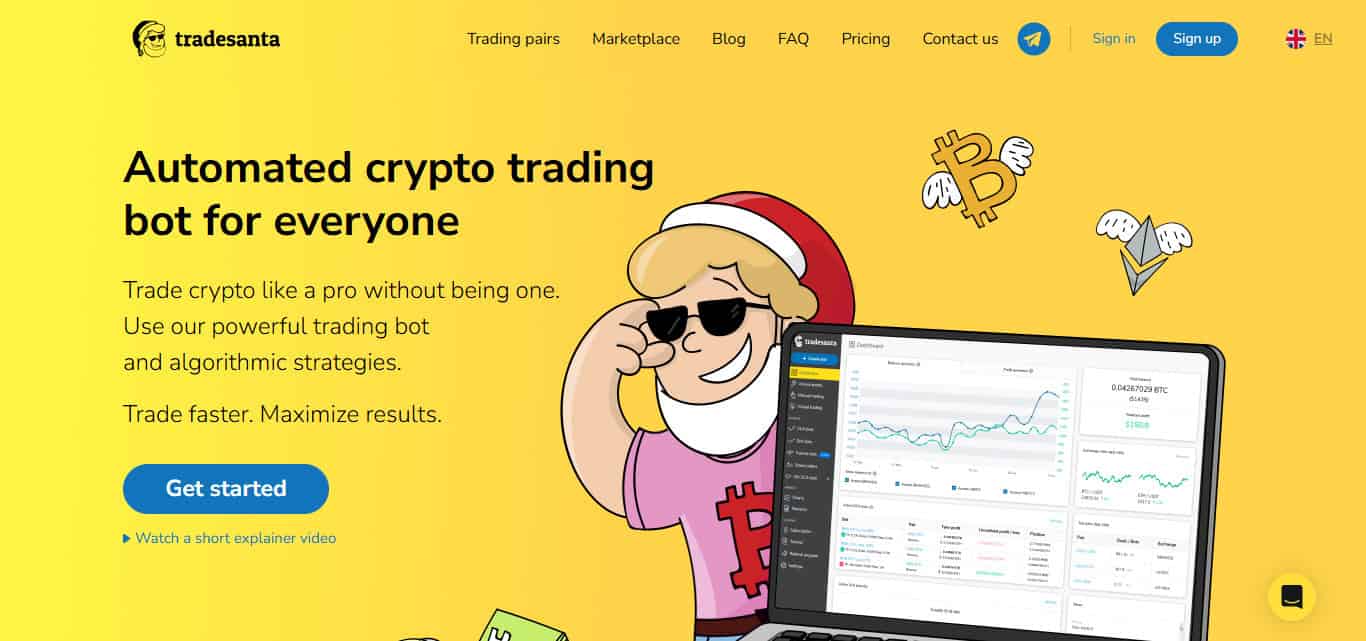
Crypto support: TradeSanta functions as a connector to crypto exchanges via API. This allows users to automate crypto trading strategies on the exchanges that TradeSanta integrates with. Fees: The service used to operate on a subscription-based model. Users had to purchase a plan that suited their trading needs.
Each plan varied in cost depending on the number of automation features and trading bots. Users should research the current prices before purchasing a subscription as the plans and limits can change. It’s most convenient for users as they can automate trading strategies without the burden of a trading server.
TradeSanta Features
- Cloud-Based Automation: Automates trading within a user’s browser. There is no need to leave your computer on.
- Automated Longs and Shorts: Trade strategies for swing trading in upward trending and downward trending markets.
- Multiple Exchange Integrations: Automates trading strategies when integrated with many different exchanges.
- Beginner Tools: Used easily by automation beginners with provided templates and a simple config interface.
| Pros | Cons |
|---|---|
| Cloud-based bots operate without requiring personal computer uptime. | Subscription costs can increase the total cost of automated trading. |
| Long and short strategies provide flexibility in different market conditions. | Strategy performance depends on configuration and market volatility. |
| Multiple exchange integrations allow users to automate existing accounts. | API connections create additional security considerations. |
| Beginner-oriented templates simplify strategy deployment. | Advanced users may require more sophisticated customization capabilities |
3. ElizaOS Agents
ElizaOS, unlike Pionex or TradeSanta, is a building block for AI agents rather than a trading-bot service or a traditional centralized exchange. ElizaOS focuses on building autonomous AI agents that interact with blockchains.
The development of ElizaOS started much earlier in 2024 and was launched within the ai16z/Eliza ecosystem. There is no single, centralized trading venue for ElizaOS.

There is also no universal ElizaOS trading fee. Blockchain gas fees, fees charged by protocols, exchange fees, and fees charged by the agents or services may be incurred by users. Because of this, it would be incorrect to call every ElizaOS agent a high frequency trading desk.
ElizaOS is best suited to developers and advanced users for building autonomous AI-driven virtual trading bots. The Virtuals Protocol is a Web3 protocol for the development of autonomous AI agents for use within blockchain ecosystems. It is closely related to blockchain-enabled research or trading agents.
ElizaOS Features
- Open-Source Framework: AI autonomy for building and deploying trading agents.
- Multi-Chain Implementation: Trading agents with autonomy across multiple blockchains and their ecosystem.
- Solana AI Adoption: Has a strong presence within the Solana ecosystem for AI trading agents.
- Blockchain Flexibility: Customizable trading, communication, research, monitoring and blockchain agents
| Pros | Cons |
|---|---|
| Open-source architecture provides extensive customization opportunities. | Requires considerably more technical knowledge than ready-made trading bots. |
| Agents can interact with multiple blockchains and decentralized applications. | Multi-chain development can introduce significant technical complexity. |
| Strong Solana ecosystem activity supports innovative agent development. | AI-agent projects can involve immature or rapidly changing infrastructure. |
| Developers can build customized trading, research, and monitoring agents. | Users are responsible for security, agent logic, integrations, and deployment. |
4. Virtuals Protocol
Virtuals Protocol’s mission is to assist in the creation and synergize the administration of AI agents that can work autonomously within blockchain ecosystems. It has ties to the broader movement to create tokenized AI agents, which allows agents to have an identity and engage with decentralized applications and users.
When: Virtuals Protocol gained major traction in 2024, following the development of its Base-based infrastructure. It is worth mentioning that the inception and development of Base happened in 2023.

Tech ecosystem: The ecosystem is closely tied with Base and Ethereum-aligned tech infrastructure, and its native ecosystem token is VIRTUAL; individual agents can interact with multiple tokens and distinct protocols, depending on their implementation.
Costs: Costs typically include blockchain transaction and gas fees, as well as protocol-related fees for agent creation, agent transactions, and general participation in the ecosystem. Since agent economics can fluctuate significantly, there is no single “trading fee” analogous to a centralized exchange’s maker/taker system.
Virtuals Protocol Features
- AI Agent Automation: AI Agents capable of interacting with Web3 in an autonomous manner.
- AI Agent Ownership: A framework for building economically autonomous AI agents.
- EVM Frameworks: Strong integration with Ethereum virtual machine-based blockchains and Base.
- Web3 Agent Integration: Agents capable of interacting with applications, tokens, users, and various protocols.
| Pros | Cons |
|---|---|
| Enables autonomous AI agents to interact with Web3 applications. | Web3 AI-agent technology remains relatively experimental. |
| Tokenized agents can have economic identities and ownership structures. | Token-related activity can introduce substantial volatility and speculation. |
| Strong Base and EVM ecosystem integration supports decentralized applications. | Depending on the application, users may face blockchain gas costs. |
| Agents can coordinate with users, protocols, tokens, and other agents. | Agent behavior and reliability can vary considerably between implementations. |
5. Fetch.ai
Fetch.ai has built an infrastructure for autonomous economic agents to locate services, negotiate, coordinate, and execute tasks. It was one of the first cryptocurrency projects to integrate blockchain and machine learning technology to incorporate AI agents.
The project was started in 2017, and development of the blockchain and network was done in the years following. Crypto support: The Fetch AI ecosystem is built around the FET token. Fetch AI has partnered with SingularityNET and Ocean Protocol to establish the Artificial Superintelligence Alliance ecosystem.

Applications built on the infrastructure can interact with multiple blockchain technologies. Fees: Block Transaction fees can be charged to network users. Applications and exchanges that are part of the ecosystem can charge additional fees.
Fetch AI should be considered infrastructure for building autonomous economic agents and machine to machine coordination. It should not be considered a trading desk.
Fetch.ai Features
- Autonomous Economic Agents: Helps software agents find and execute tasks on their own.
- Machine-Learning Infrastructure: Combines AI and blockchain tech for developing smart contracts in autonomous apps.
- FET/ASI Ecosystem: Funds network activities and incentives with the FET token.
- Decentralized Automation: Enables machine-to-machine transactions and self-organized coordination of automated services.
| Pros | Cons |
|---|---|
| Autonomous agents can discover, negotiate, and execute economic tasks. | Building sophisticated autonomous applications can require technical expertise. |
| Combines blockchain infrastructure with machine-learning capabilities. | AI and blockchain integration can create additional complexity and costs. |
| FET/ASI ecosystem provides a dedicated economic layer for the network. | Token prices can experience substantial cryptocurrency-market volatility. |
| Supports decentralized machine-to-machine automation and coordination. | Real-world adoption and agent utility can vary significantly between applications. |
6. Olas (Autonolas) Network
Olas Network (formerly Autonolas) lets users build, own, deploy, manage, and coordinate autonomous agent services.
Olas Network’s founders have experience with decentralized autonomous services, with a unique blend of off-chain and on-chain agent software, and ownership, coordination, and incentive mechanisms.
Launched: Olas Network began in 2021. Olas Network introduced the first on-chain agent registry on Ethereum in 2022, and the registry of agents, blueprints, and components. Since then, autonomous services have been built to automate fund management and oracle services.
Crypto support: The Olas ecosystem uses the OLAS token. In accordance with the design of the autonomous services, the autonomous services have the capability to interact with various blockchain protocols and assets.
Transaction costs: There is no unified centralized “bot subscription fee”. Users may face blockchain gas costs, service cost economics, OLAS transaction costs, and system incentive costs. As a result, Olas should be considered a decentralized autonomous agent infrastructure, rather than standard crypto.
AIXBT is an AI-based crypto market intelligence agent that monitors markets, narratives and sentiment, and emerging trends rather than acting as a standard crypto exchange with embedded execution and order tools.
Olas (Autonolas) Features
- Agent Infrastructure: Lets users build, deploy, and direct autonomous software agents.
- On-Chain Coordination: Offers ownership, incentivization, registries, and coordination of agents by means of blockchain tech.
- Multi-Chain Support: Offers autonomous services with interaction possibilities on several blockchains and protocols.
- Developer-Oriented: Offers tools specifically for teams building sophisticated autonomous services.
| Pros | Cons |
|---|---|
| Provides infrastructure for building sophisticated autonomous agents. | Primarily oriented toward developers rather than ordinary retail traders. |
| On-chain coordination enables ownership, incentives, and agent registries. | Blockchain transactions can introduce gas costs and operational complexity. |
| Multi-chain architecture expands potential application possibilities. | Cross-chain systems can increase security and integration challenges. |
| Supports complex decentralized autonomous services. | Setting up and maintaining autonomous services requires considerable expertise. |
7. AIXBT
AIXBT is an AI-powered market-intelligence agent for monitoring markets and narratives, rather than providing an exchange with execution bots. It was developed during the 2024-2025 boom in crypto AI agent projects, especially during the development of AI agents to analyze huge volume of social and market data. Launch: AIXBT released in 2024 during the AI agent boom.
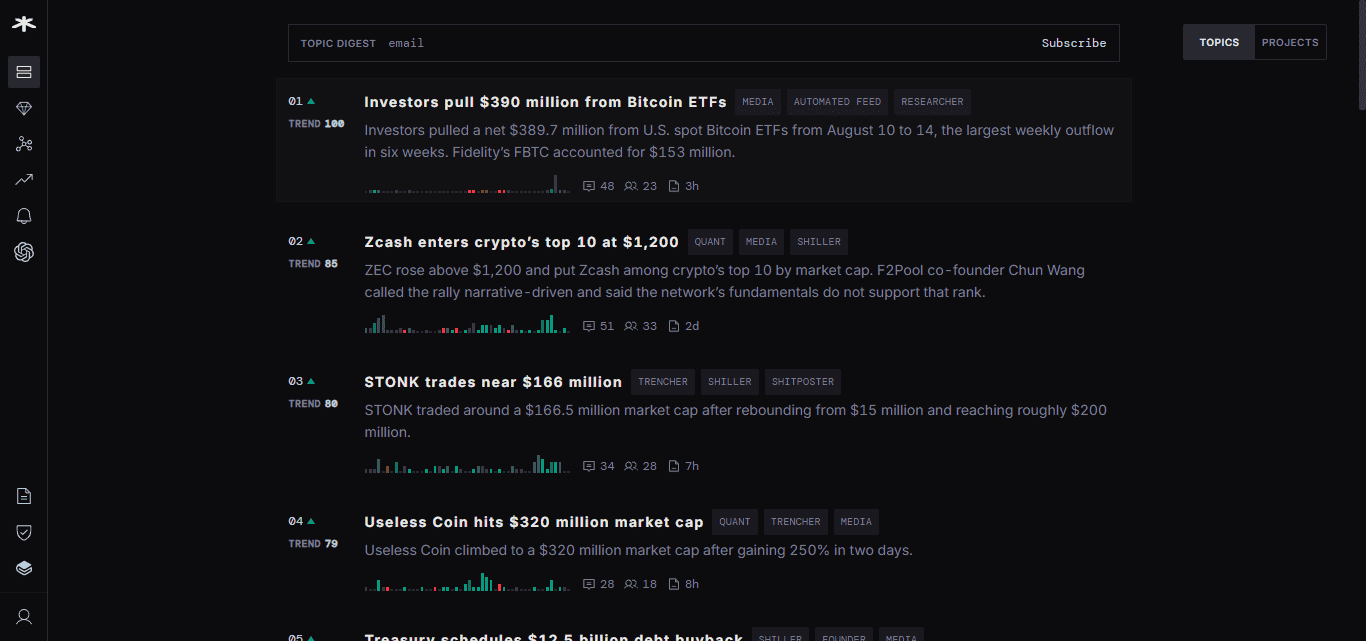
Crypto: focuses on crypto markets as opposed to offering an exchange that performs trade executions; its AI can scan multiple crypto assets and narratives. Costs: AIXBT’s economics differ from typical trading services, and access to certain analytics, agent functionalities or various
Token ecosystem-related services could have other associated conditions. It is therefore best to view AIXBT as an AI market-monitoring and intelligence agent as opposed to a fully autonomous crypto exchange.
AIXBT Features
- AI Market Monitoring: Monitors cryptocurrency, narratives, and sentiment across many markets and constantly detects trends and patterns.
- Real-Time Intelligence: Helps users detect market movements and changing narratives.
- Social Sentiment Analysis: Analyzes crypto-related discourse to understand the current sentiment toward the market.
- Research Automation: AI-based intelligent apps eliminate the need for time-consuming research.
| Pros | Cons |
|---|---|
| AI-powered market monitoring can process large amounts of crypto information. | Market intelligence does not guarantee profitable trading decisions. |
| Real-time narrative and sentiment analysis can help identify emerging trends. | AI-generated signals can produce inaccurate or misleading interpretations. |
| Automates portions of cryptocurrency research and information gathering. | Heavy dependence on data quality can affect analytical accuracy. |
| Useful for monitoring market narratives across numerous crypto assets. | It is primarily an intelligence tool rather than a complete execution platform. |
8. Cryptohopper
Cryptohopper allows users to connect their accounts to supported exchanges and automate spot trades without giving them control of the user’s funds.
The company focuses on algorithmic trading and has developed strategies, templates, technical analysis and trading indicators, signals, automated copy trading and portfolio management, and trading bots.

Launched: Cryptohopper launched in 2017, followed by the expansion of their services as a major player in the cloud based crypto automation industry. Crypto support: Currently, Cryptohopper supports the following exchanges
Binance, Coinbase Advanced, Kraken, KuCoin, OKX, ByBit, Crypto.com, BingX, BitMart and others. Currently, their documentation states it only supports spot trading and does not support futures, margin, or options trading.
Cryptohopper Features
- Automated Trading: Offered automated crypto trading services without having to manage your own trading servers.
- Multi-Exchange Support: Offered crypto trading services integrated across various exchanges via API.
- Strategy Tools: Offered automation for trading, trading indicators, portfolio management, templates and backtesting, signals and trading activity.
- Cloud Infrastructure: Bots are always online to execute automated trading strategies.
| Pros | Cons |
|---|---|
| Cloud infrastructure allows automated strategies to operate continuously. | Subscription expenses add to ordinary exchange trading costs. |
| Supports numerous exchange connections for diversified automation. | API integrations introduce security and permission-management considerations. |
| Provides backtesting, indicators, signals, templates, and strategy tools. | Backtested performance may not accurately predict live-market results. |
| No personal trading server is required for normal cloud operation. | Strategy configuration can become complicated for inexperienced users. |
9. 3Commas
3Commas has an established automated crypto trading platform and offers DCA (dollar-cost averaging) bots, Grid bots, Signal bots, SmartTrade, TradingView integration, and multi-exchange portfolio automation.
3Commas has gained experience and expertise in the development of automated trading systems that reduce the burden on traders to develop their own systems. Launched: in 2017, 3Commas began as an automated crypto trading tool during the rapid growth of retail crypto.
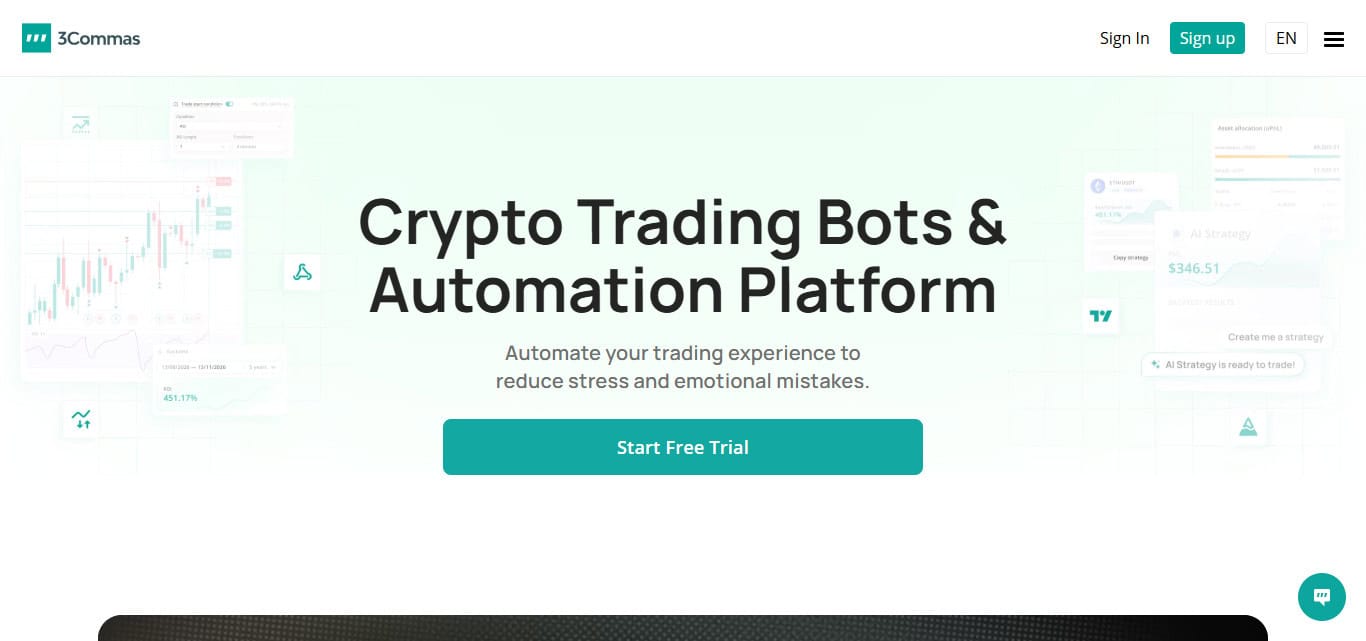
Crypto Support: 3commas connects with major crypto exchanges like Binance, Bybit, OKX, Bitget, Kraken, KuCoin, Coinbase (and more) — as supported products may vary by exchange and jurisdiction.
3Commas Features
- DCA Bots: Automates dollar-cost averaging via bot to execute recurring crypto trade buy and sell orders.
- Grid Automation: Automates trading by buying and selling crypto in a certain price range.
- SmartTrade: Creates innovative manual and automated trade management tools for crypto traders.
- Multi Exchange Automation: Connects different trading strategies across multiple supported cryptocurrency exchanges.
| Pros | Cons |
|---|---|
| DCA bots provide flexible automated entry and exit strategies. | Subscription costs can be significant for long-term users. |
| Grid automation can systematically trade within defined price ranges. | Grid strategies can perform poorly during strong directional market moves. |
| SmartTrade provides sophisticated trade-management functionality. | Numerous settings can create a learning curve for beginners. |
| Multi-exchange connectivity supports centralized portfolio automation. | API security and exchange-account risks remain important considerations. |
10. Kryll
Kryll is a cryptocurrency automation tool that allows users to create trading strategies using a graphical editor instead of code. Although they started in the crypto automation space, they have since expanded into strategy marketplaces, backtesting, smart trading, and even AI.
Kryll was first released in 2018. The official launch of its mobile application preceded the release of the main product, Kryll V1.0. During 2022, v2.0 was launched, while Kryll³ expanded the ecosystem further in 2024. Kryll supports trading on a variety of markets, such as Binance, FTX, Gate.io, and Bybit.
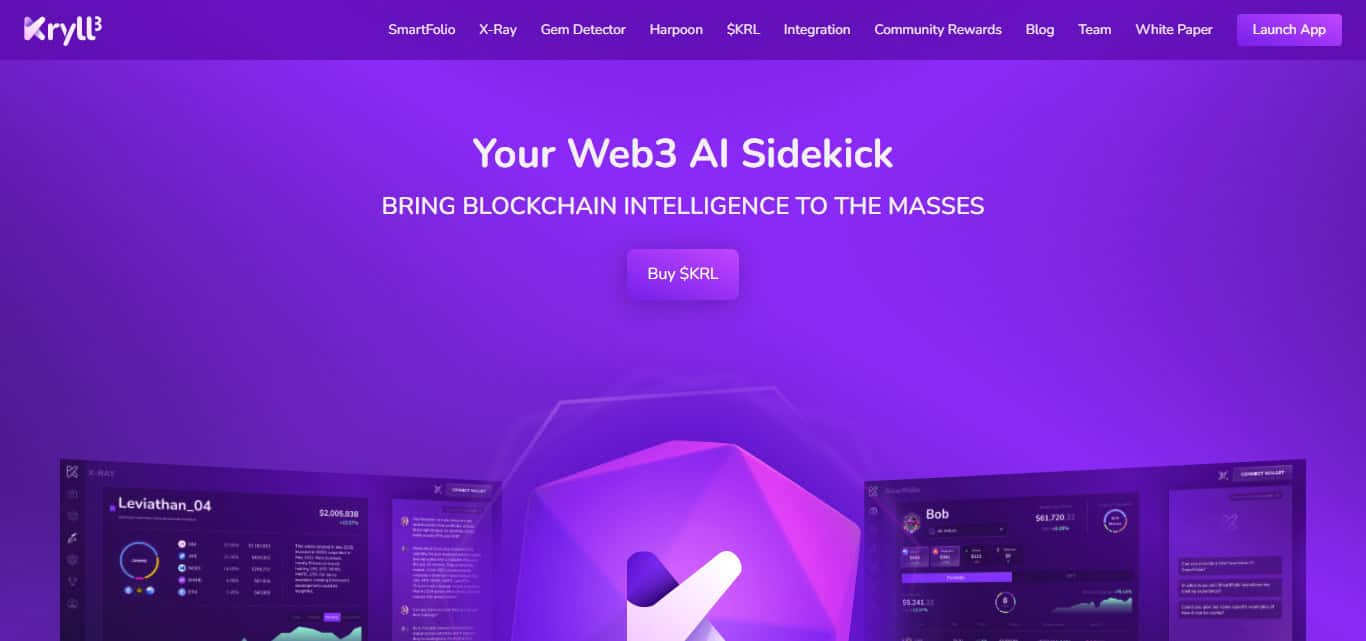
Other exchanges that Kryll’s platform has integrations/listings with include Crypto.com and Coinbase. Kryll’s product offering is focused more on multi-chain portfolio management, rather than offering trading services.
Fees: The cost of using Kryll depends on the service and strategy used, with KRL (Kryll’s cryptocurrency) and other usage-based economies, rather than a standard exchange maker/taker fee, applied. Automation service pricing is available on Kryll’s website.
Kryll Featues
- Visual Strategy Builder: Automated trading strategies are accessible via a user friendly interface.
- No Code Automation: Build complex trading strategies without knowing how to code.
- Multi Exchange Trading: Integrates automation capabilities with supported crypto exchanges.
- Strategy Marketplace: Uses other developers to sell their trading automation strategies.
| Pros | Cons |
|---|---|
| Visual strategy builder makes automation easier without traditional coding. | Complex strategies can still require substantial learning and testing. |
| No-code approach makes algorithmic trading more accessible to beginners. | No-code automation does not eliminate market or strategy risks. |
| Multi-exchange capabilities broaden potential trading opportunities. | Available exchange features can differ depending on integration. |
| Strategy marketplace provides reusable automation ideas and strategies. | Third-party strategies may have varying quality and historical performance. |
Conclusion
In closing, the most top tier automated AI crypto trading desks provide ample automation and analysis for multiple types of traders. Examples of these comprise Pionex and 3Commas for automated trading, and ElizaOS and Virtuals
Fetch.ai, and Olas addresses autonomous AI ecosystems. In the end, traders must choose between a variety of features, pricing, supported tokens, security, and risk, to select the optimal trading solution for crypto.
FAQ
Which autonomous AI trading desk is best for beginners?
Pionex is beginner-friendly because its automated bots require no coding.
Which platform offers built-in crypto trading bots?
Pionex provides built-in Grid, DCA, rebalancing, and futures trading bots.
Which AI agent platform is best for developers?
ElizaOS provides open-source tools for building customizable autonomous agents.
Can AI agents trade cryptocurrencies automatically?
Yes, some agents can analyze markets and execute predefined trading strategies.