This article will cover the best alternatives to Coinigy for automation and API trading. I will cover various services and APIs that provide automated trading, level 2 data, and routine trading-related tasks.
Each entry will provide its own set of APIs and tools for automated trading, integration and comparison to Coinigy, to assist in the selection process for users with advanced and specific trading needs.
Key Points
| Competitor | Explanation |
|---|---|
| CCXT | Unified library connecting traders with multiple cryptocurrency exchanges through standardized APIs. |
| CoinAPI | Provides unified cryptocurrency market data APIs for applications, analytics, and trading. |
| Binance | Major exchange offering powerful APIs for automated trading, market data, and account management. |
| Bitsgap | Automated crypto trading platform supporting bots, portfolio management, and multiple exchange connections. |
| 3Commas | Trading automation platform offering bots, smart trading tools, and exchange API integrations. |
| HaasOnline | Advanced crypto trading software providing customizable bots, automation, and technical trading strategies. |
| WunderTrading | Automated trading platform supporting bots, copy trading, portfolio management, and exchange APIs. |
| Coinrule | No-code crypto automation platform enabling users to create rule-based trading strategies easily. |
| Kraken | Established cryptocurrency exchange offering APIs for trading, market data, and account automation. |
| Bybit | Crypto exchange providing API access for automated trading, derivatives, and market-data applications. |
| CoinMarketCap API | Cryptocurrency data API delivering market prices, rankings, metadata, and historical information. |
| Good Crypto | Multi-exchange trading terminal offering automated bots, advanced orders, and portfolio management tools. |
| Mudrex | Crypto investment platform offering automated strategies, trading tools, and portfolio-focused solutions. |
| Trality | Algorithmic crypto trading platform enabling customizable bots through code or visual rule builders. |
| Amberdata | Institutional-grade blockchain data APIs supporting market intelligence, analytics, and digital-asset applications. |
15 Best Coinigy Competitors for API Trading
1. CCXT
CCXT has technical APIs for 100+ exchanges and offers unified REST and WebSocket APIs. It provides algorithms for trading, retrieving market data and account balances. Users can write custom code for trading and automation using CCXT’s APIs and interfaces.

CCXT’s technical APIs provide unified interfaces for various functions for each exchange. As a Coinigy competitor, CCXT offers API trading for end users and developers. The best use case is for users who want to integrate customized trading bots and terminals for digital asset trading.
CCXT Pros & Cons
| Pros | Cons |
|---|---|
| Unified API for 100+ exchanges | Requires coding skills |
| Supports REST & WebSocket | No built‑in GUI |
| Great for custom bots | Complex for beginners |
| Fast, reliable endpoints | Exchange quirks require handling |
2. CoinAPI
CoinAPI provides ultra low latency market data for 350+ exchanges. It offers various data streaming and transport protocols for large scale data ingestion. CoinAPI provides market data and trading metadata for various time frames and levels. Its clients include trading firms and financial services.

CoinAPI provides normalized and unified data for trading. As a Coinigy competitor, CoinAPI is ideal for users that require data for financial research and trading. The best use case is for quantitative research and HFT.
CoinAPI Pros & Cons
| Pros | Cons |
|---|---|
| 350+ exchange data | Expensive plans |
| FIX, REST, WebSocket | No trading execution |
| Institutional-grade quality | Complex setup |
| Normalized datasets | Overkill for beginners |
3. Binance API
Binance API has access to trading services for spot, futures, margin, and options. Binance has some of the best API’s and provides endpoints to allow clients to manage their accounts, retrieve market data and place orders.
Clients can automate trading strategies using the Binance APIs and leverage algorithms to manage their account. Binance has adequare programatic infrastructure and data structures to allow clients to develop trading strategies and apply them using a low latency infrastructure.

Binance allows users to build trading strategies using many order types. As a Coinigy competitor, Binance provides deep liquidity and advanced order types to its clients. Best use case: creating trading strategies to manage futures positions.
Binance API Pros & Cons
| Pros | Cons |
|---|---|
| Deep liquidity | Regional restrictions |
| Advanced order types | Single‑exchange only |
| Fast execution | Rate‑limit sensitive |
| Great for futures bots | Complex for beginners |
4. Bitsgap
Bitsgap provides its clients with trading services and tools to manage their accounts across multiple exchanges. Clients can retrieve market data and manage their accounts to place orders. Clients can use Bitsgap’s APIs to write trading strategies to manage their portfolios. Clients can also use Bitsgap’s grid and DCA strategies to trade.

Bitsgap also allows clients to manage orders across multiple exchanges. The order management and routing features provide clients with tools to help identify and execute arbitrage. Bitsgap also has an API to store users’ secret keys to provide users with a secure environment to manage their exchange APIs.
As a Coinigy competitor, Bitsgap offers its clients trading infrastructure to aid them in automating trading strategies and managing their portfolios. Best use case: integrating trading strategies across multiple exchanges.
Bitsgap Pros & Cons
| Pros | Cons |
|---|---|
| Easy bot automation | Limited customization |
| Supports major exchanges | Fewer integrations |
| Arbitrage tools | Subscription cost |
| Great for beginners | No advanced scripting |
5. 3Commas
3Commas supports 20+ exchanges using APIs to facilitate trading with Binance, Coinbase, Kraken, and Bybit. It also has features for automated trading, tracking your crypto portfolio, and trading bots.
Their premium plan gives you real-time charts, trading signals and other data. You can make trading rules and strategies, and automate copy trading and trade execution.

You can also test your strategies in a virtual trading environment. 3Commas also has features for secure API key management. Retail traders appreciate their automation tools and trading bots. 3Commas is a great alternative to Coinigy.
3Commas Pros & Cons
| Pros | Cons |
|---|---|
| DCA & Grid bots | API sync delays |
| Copy trading | Subscription pricing |
| Easy automation | Limited scripting |
| Multi‑exchange support | No deep customization |
6. HaasOnline
HaasOnline also allows algorithmic trading with APIs from 25+ exchanges, including Binance and Bitfinex. It has a scripting language (HaasScript) and provides templates for users to write custom trading bots.
It also has systems for trading arbitrage and other strategies, and provides data at the tick level. HaasOnline gives users a lot of flexibility to write custom trading rules and strategies. It also has features for trading safety and insurances.

From an enterprise perspective, HaasOnline offers extensive services and customs solutions. It can also be hosted on a user’s premise. HaasOnline is another great alternative to Coinigy. Both 3Commas and HaasOnline’s strongest features are retail and professional algorithmic trading, respectively.
HaasOnline Pros & Cons
| Pros | Cons |
|---|---|
| Advanced scripting | Hard for beginners |
| On‑premise option | Expensive |
| Arbitrage tools | Complex setup |
| Deep customization | Requires coding expertise |
7. WunderTrading
WunderTrading offers API integration with Binance, Kraken, Coinbase, Bybit and more. It provides automation for trading and coping as well as bot creation.
It automates trading strategies on Tradingview, helping users implement Pine Scripts for trading. It provides data and analysis for users’ portfolios. It offers automation for different trading strategies.

From a tech standpoint, WunderTrading provides advanced features for automating trades and bot creation. It provides features for creating DCA and grid bots.
As a Coinigy competitor, WunderTrading stands out in view rule based trading strategy automation. Best use case: traders wanting to automate Pine Script strategies across different exchanges.
WunderTrading Pros & Cons
| Pros | Cons |
|---|---|
| TradingView automation | Limited scripting |
| Copy trading | Fewer exchanges |
| DCA & Grid bots | Occasional delays |
| Easy setup | Less advanced tools |
8. Coinrule
Coinrule also uses API keys for integration with exchanges like Binance, Kraken, KuCoin and Coinbase. It offers a rule based automation system for traders to create trading strategies with if this then that conditions. It provides real time data for strategy implementation.

Some of the strategies it automates are trend following and mean reversion. It provides users with templates for strategies and offer users the ability to test strategies.
From a tech standpoint it provides users the ability to create and automate trading rules. As a Coinigy competitor, it excels at rule based trading strategies. Best use case: Traders wanting to create simple trading bots.
Coinrule Pros & Cons
| Pros | Cons |
|---|---|
| No‑code automation | Limited logic |
| Easy templates | No scripting |
| Cloud execution | Fewer pro tools |
| Beginner‑friendly | Limited backtesting |
9. Kraken API
Kraken API provides reliable and secure REST and WebSocket connections for Spot, Futures, Staking and Margin trading APIs. It provides Advanced Order Types and Account Management APIs, and provides historical market data (OHLC) and other account related data.
Traders can build automated trading bots using Kraken APIs. Overall, Kraken provides secure and low latency trading APIs and provides ample documentation.

Kraken API is a good alternative to Coinigy. It is best suitable for customers in regulated markets, and prefers security. E.g. Institutional Automated Trading.
Kraken API Pros & Cons
| Pros | Cons |
|---|---|
| Highly secure | Fewer pairs |
| Regulated exchange | Slower onboarding |
| Reliable feeds | Regional limits |
| Good for institutions | Less liquidity than Binance |
10. Bybit API
The Bybit API also has REST and WebSocket APIs for Spot and Derivatives trading. Conditional Orders are available to provide more flexibility to traders.
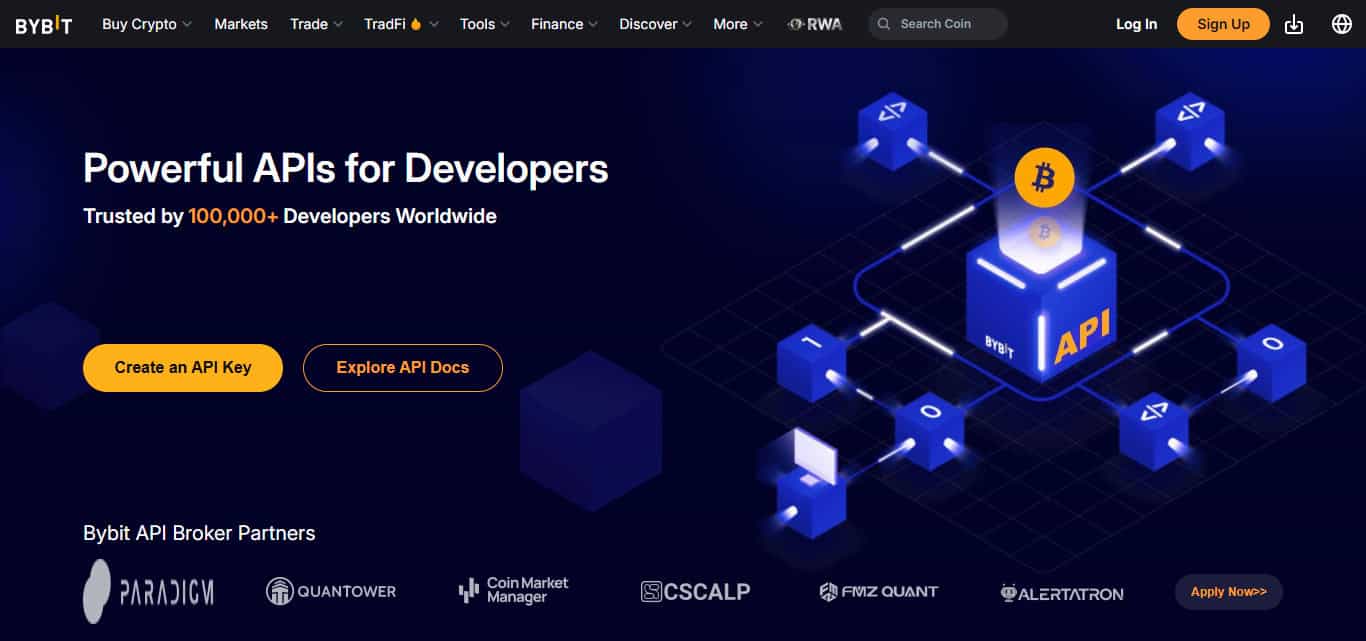
Bybit provides low-latency trading APIs, and provides sophisticated Derivatives Trading infrastructure. It also is a good alternative to Coinigy. E.g. Automated Futures and Options trading bots.
Bybit API Pros & Cons
| Pros | Cons |
|---|---|
| Great derivatives API | No U.S. access |
| Fast execution | Single exchange |
| Advanced orders | Rate limits |
| Ideal for scalping | Limited spot pairs |
11. CoinMarketCap API
The CoinMarketCap API offers thousands of cryptocurrency and exchange global market data. They offer REST APIs for prices, market caps, OHLCV, metadata and rankings. While it doesn’t support trading, it provides the basis for analytics and research.
Automation is achievable using data and custom scripts. From a technical standpoint, it provides normalize data, responds data requests quickly and offers a broad set of metadata.

As a Coinigy competitor, the data aggregation capabilities of CoinMarketCap APIs excel for creating research, analysis and dashboards datasets covering the cryptocurrency market. The best use cases include developing research, analysis and dashboards applications.
CoinMarketCap API Pros & Cons
| Pros | Cons |
|---|---|
| Huge data coverage | No trading |
| Fast responses | Limited depth |
| Normalized data | Rate limits |
| Great for analytics | No execution tools |
12. Good Crypto
Good Crypto unifies trading and portfolio management across 35+ crypto exchanges via its API. It provides smart order routing and trading, automated trading via bots, and trailing stops, and other order routing and execution strategies.

It offers real time market data, and customizable analytics and notifications. Good Crypto’s API storage and mobile apps provide secure access to trading APIs. From a technical standpoint, Good Crypto excels for mobile unified crypto trading. The best use cases include mobile unified crypto trading and automation.
Good Crypto Pros & Cons
| Pros | Cons |
|---|---|
| Mobile‑first | Limited advanced bots |
| Smart orders | Subscription cost |
| Multi‑exchange | API sync delays |
| Great UX | Less pro scripting |
13. Mudrex
Automated crypto trading and investing is made easy with the services of Mudrex. Mudrex offers services through integrations with exchanges like Binance and Coinbase. Features like data analytics and automation help users make informed investment decisions.

Automated investments and trades can be made using strategies created by Mudrex or by the user themselves. Mudrex can help users create and manage their investments.
Because of this, Mudrex and Coinigy serve similar purposes. Best suited for users looking to automate their long-term investments and gain passive income from the crypto market.
Mudrex Pros & Cons
| Pros | Cons |
|---|---|
| Automated portfolios | Limited trading |
| Risk scoring | Fewer exchanges |
| Easy for beginners | No scripting |
| Long‑term focus | Limited bot tools |
14. Trality
Trality provides users with the tools necessary to create automated trading bots with the help of APIs from exchanges like Binance and Kraken. Users can build rules, create and test strategies, and monitor their bots through the services provided by Trality.

Users have control over the bot architectures, and can create bots that trade on multiple exchanges. Because of this Trality and Coinigy serve similar purposes. Best suited for users looking to algorithmically trade crypto.
Trality Pros & Cons
| Pros | Cons |
|---|---|
| Python scripting | Requires coding |
| Modular bots | Fewer exchanges |
| Strong backtesting | Limited mobile UX |
| Cloud execution | Complex for beginners |
15. Amberdata
Through its APIs, Amberdata provides its users with access to algorithms and models to gain insight into the crypto and DeFi market. Using Amberdata’s APIs, users can create automated trading strategies. Amberdata can be used for analytics as well.

High-frequency trades can be made using Amberdata. Amberdata’s API trading services compete directly with Coinigy’s. Best suited for quant funds looking to trade across multiple crypto exchanges.
Amberdata Pros & Cons
| Pros | Cons |
|---|---|
| Institutional data | Expensive |
| Multi‑exchange | No trading |
| Normalized datasets | Complex setup |
| Enterprise SLAs | Overkill for retail |
Conclusion
When it comes to the best competitors of Coinigy, there are some alternatives to consider. These may offer different combinations of exchange integrations, automation, data and developer services. Some of the competitors are CCXT, CoinAPI, and others.
Some competitors focus on trading automation services, for example, Bitsgap and 3Commas. There are others like Coinrule and HaasOnline.
To decide on the best competitor to Coinigy, consider your trading strategies, the level of integration you need, coverage of data, trading automation and API services.
FAQ
What is the best Coinigy alternative for API trading?
CCXT offers flexible exchange connectivity for developers building automated trading applications.
Which Coinigy competitor supports multiple cryptocurrency exchanges?
CCXT connects applications with numerous cryptocurrency exchanges through unified APIs.
Which platform is best for cryptocurrency market data APIs?
CoinAPI provides standardized market data across numerous cryptocurrency exchanges and sources.
Which Coinigy alternative supports automated trading bots?
3Commas provides automated bots, trading strategies, and multiple exchange API integrations.