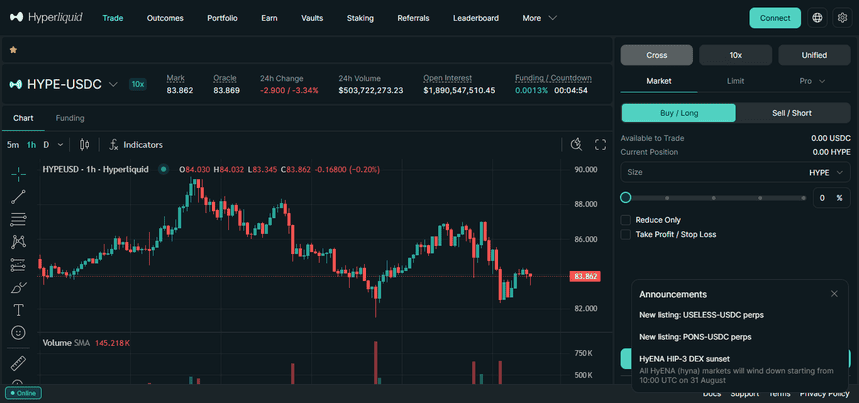
This article reviews the best on-chain volatility index trading desks and how they can give traders access to the crypto volatility markets.
We will discuss key features, trading tools, options infrastructure, degree of transparency, and the liquidity/risk equation. This report also covers liquidity and counterparty risk and how they relate to on-chain volatility index trading desks.
Key Points & Best On-Chain Volatility Index Trading Desks
| On-Chain Volatility Index Trading Desk | Explanation |
|---|---|
| Volmex Finance | Provides decentralized volatility indices for trading crypto market volatility directly. |
| Derive | Offers decentralized options and volatility trading with transparent on-chain settlement. |
| Ribbon Finance | Uses structured strategies to provide exposure to options-based crypto volatility. |
| Lyra | Enables decentralized options trading and volatility exposure across crypto assets. |
| Premia | Provides permissionless options markets supporting customizable volatility trading strategies. |
| Dopex | Decentralized options protocol offering tools for managing crypto volatility exposure. |
| Hegic | Provides on-chain options markets for hedging and trading volatility efficiently. |
| Panoptic | Enables perpetual options trading with flexible decentralized volatility strategies on-chain. |
| Squeeth | Provides squared ETH exposure, creating leveraged on-chain volatility trading opportunities. |
| Opyn | Offers decentralized options infrastructure for constructing customized volatility trading strategies. |
10 Best On-Chain Volatility Index Trading Desks
1. Volmex Finance
Volmex Finance is the best name on this list for on-chain volatility-index trading specifically because the company focuses on crypto volatility benchmarks.
Their platform includes forward-looking implied volatility indices including BVIV for Bitcoin and EVIV for Ethereum, plus indices for Solana, Hyperliquid, realized volatility, funding and lending rates, and spot-volatility correlations.

Volmex calculates implied volatility from crypto options data and posts their index methodology. The platform also claims BVIV and EVIV are tradable on centralized, on-chain, and prediction market venues.
traders that want benchmark-based exposure to crypto volatility, Volmex is better suited compared to other platforms which focus on directional spot trading.
Volmex Finance — Pros & Cons
| Pros | Cons |
|---|---|
| Crypto Volatility Focus — Tracks measurable volatility indexes similar to VIX. | Niche Use‑Case — Primarily useful for advanced traders, not beginners. |
| Non‑Directional Exposure — Allows volatility trading without betting on price direction. | Lower Liquidity — Volatility markets often have thinner liquidity. |
| Risk Hedging Tool — Useful for hedging during market uncertainty. | Complex Metrics — Volatility indexes require deeper understanding. |
| DeFi‑Native Design — Built for on‑chain volatility products. | Limited Asset Coverage — Mostly ETH/BTC volatility only. |
2. Derive
Derive is a decentralized derivatives platform with programmable on-chain options and perpetual contracts and other structures built on top of their offering. Their Optimistic Rollup over Ethereum settles on Derive DAO. Derive DAO takes care of governance.
For trading volatility, Derive options can be used to create structures to frame price volatility exposure, instead of a directional view on the underlying. Derive can empower trading strategies for volatility.

When comparing trading desks, benchmarks, and derivative-based volatility trading strategies, it is important to differentiate between an options venue and dedicated provider of volatility indices. Volmex publishes volatility indices while Derive offers derivatives.
Derive — Pros & Cons
| Pros | Cons |
|---|---|
| Multi‑Instrument Suite — Offers options, perps, structured products. | High Complexity — Broad instruments require advanced knowledge. |
| Unified Trading Layer — Single platform for multiple derivative types. | Smart‑Contract Risk — More instruments = larger attack surface. |
| Capital Efficiency — Cross‑margining improves capital usage. | Volatile Market Exposure — Derivatives amplify market swings. |
| Institutional‑Style Tools — Advanced features for pro traders. | Higher Learning Curve — Not ideal for new DeFi users. |
3. Ribbon Finance
Ribbon Finance is more about options and structured products with a focus on flexible structures in DeFi, rather than aiming to be a volatility-index marketplace.
Ribbon employs options vaults to manage risk and generate yield, employing strategies such as covered calls and put selling. Ribbon describes decentralized option vaults as core to its original product design, while now its website focuses on decentralized options vaults and lending.

Options-based strategies can create exposure to volatility through premium collection, hedging, or structured payoffs.
That said, Ribbon should not be considered a standalone digital version of a VIX-style volatility index. Rather, it is best described as an on-chain structured-products platform for options trading that is predominantly used by traders engaged in volatility and options trading.
Ribbon Finance — Pros & Cons
| Pros | Cons |
|---|---|
| Automated Strategies — Covered calls, puts, and structured vaults. | Strategy Risk — Vaults can incur losses during volatility. |
| Passive Yield — Users earn yield without active management. | No Customization — Pre‑built strategies limit flexibility. |
| DeFi‑Native Options — Makes options accessible to non‑experts. | Vault Saturation — High demand can reduce APY. |
| Strong Community Adoption — Popular structured‑product vaults. | Smart‑Contract Dependence — Fully reliant on automation. |
4. Lyra
Lyra has sought to develop more accessible and programmable options markets with an emphasis on trading volatility, and so it has gained market recognition and interest. Options enable traders to take a position on trading opinions on risk, conservatism, or even creative views on the future value of an asset.
Traded option positions can be combined to create very high exposure to volatility as well as some very sophisticated trading positions and structures that are predominantly based on the trading Greeks and volatility.

While discussing Lyra in a recent article in 2026, it is crucial to distinguish Lyra’s and Derive’s earlier ecosystems and offerings so that Lyra can be viewed as a pioneer in decentralized options and trading volatility on the blockchain.
Thus, rather than describing Lyra as a currently operating volatility desk, it should correctly be classified as a decentralized options volatility trading platform.
Lyra — Pros & Cons
| Pros | Cons |
|---|---|
| Decentralized Options AMM — Pioneered on‑chain options market‑making. | Implied Volatility Risk — AMM pricing can diverge from market reality. |
| Accessible UI — Easier for beginners to explore options. | Liquidity Fragmentation — Multiple markets dilute liquidity. |
| Cross‑Chain Deployment — Available on multiple L2s. | Capital Inefficiency — AMMs require large liquidity pools. |
| Strong Developer Ecosystem — Many integrations in DeFi. | High Volatility Exposure — Options inherently carry risk. |
5. Premia
Premia’s V3 Protocol offers decentralized options infrastructure for building markets leveraging calls, puts, strikes, and maturities along with various underlying assets. Documentation states that for directional and volatility related views, options can be employed.
In addition, traders can analyze positions using Greeks such as delta, gamma, theta and vega. Premia V3 offers a variety of options to engage with liquidity sources such as AMMs, order books/RFQ systems, vaults, and external protocols.

Options are ERC-1155 tokens and the protocol uses an on-chain oracle for pricing and settlement. Premia V3 is currently documented as operating on Arbitrum Mainnet. Thus, it should be considered a decentralized on-chain options facility offering volatility trading as opposed to a dedicated volatility-index provider.
Premia — Pros & Cons
| Pros | Cons |
|---|---|
| Permissionless Options — Anyone can create markets. | Market Fragmentation — Many small markets reduce depth. |
| Customizable Contracts — Flexible expiries and strikes. | User Complexity — Customization increases difficulty. |
| Efficient Pricing Models — Uses advanced pricing algorithms. | Lower Retail Adoption — More suited for advanced traders. |
| DeFi‑Native Architecture — Fully on‑chain options ecosystem. | Smart‑Contract Risk — Complex code increases risk. |
6. Dopex
Dopex is a decentralized derivatives and options protocol focused on permissionless options markets and structured trading strategies.
Dopex’s connection to options and volatility markets is due to the nature of options contracts which can provide asymmetric exposure to large price movements and/or provide downside protection and premium selling strategies.

When assessing Dopex, traders must evaluate the products, available liquidity, assets, collateral, and the method of settlement. Additionally, one must distinguish between a protocol and a traditional trading desk. Unlike a trading desk, which is a counterparty to a trade, most decentralized protocols provide smart contracts-based markets.
Thus, in an on-chain volatility comparison, Dopex would be better described as derivatives infrastructure supporting options strategies for volatility trading and not a dedicated volatility-index provider.
Dopex — Pros & Cons
| Pros | Cons |
|---|---|
| Structured Derivatives — SSOVs, Atlantic options, and more. | High Complexity — Many products require deep knowledge. |
| Deep Liquidity — Popular vaults attract liquidity. | Vault Loss Risk — SSOVs can lose value in volatile markets. |
| Innovative Mechanisms — Unique DeFi‑native option designs. | High Gas Costs — Some strategies cost more on L1. |
| Strong Community — Active governance and participation. | Complex Tokenomics — DPX/RDPX mechanics can confuse users. |
7. Hegic
One example of an on-chain options protocol is Hegic. The options markets on Arbitrum are currently accessible on their website. ETH and BTC call and put options along the strike price are made available.
Additionally, Hegic offers option strategies to traders based on their views of the market as bullish, bearish, high volatility, or low volatility. Because of this specific feature, this protocol is relevant to those traders interested in options as a way of gaining volatility exposure.

Hegic states on its website that users can buy options using their one-click strategy and that users pay the option premium which else would be traded for a fee in the market. Therefore, this protocol is more of an on-chain options trading platform than a volatility-index desk. Traders must consider liquidity and the current offerings of the platform before using it.
Hegic — Pros & Cons
| Pros | Cons |
|---|---|
| Simple Options UI — Easy for beginners. | Limited Features — Fewer advanced tools than competitors. |
| On‑Chain Settlement — Fully decentralized execution. | Lower Liquidity — Smaller markets than Lyra/Dopex. |
| Fixed‑Premium Options — Predictable pricing. | Pricing Inefficiency — Fixed premiums may misprice risk. |
| Beginner‑Friendly — Great entry point for new traders. | Limited Customization — Few strike/expiry choices. |
8. Panoptic
Panoptic is a project focused on on-chain derivatives and options which provide opportunities to construct positions that are flexible, similar to options, in the decentralized marketplaces. One way this project relates to volatility trading is that the perpetual options can be used for hedging, speculation, and even trading with an active strategy of targeting changes to volatility.

However, it should be noted that the risks and the mechanics of using these options are different from the volatility index products.
For traders who are interested in this area, Panoptic should be analyzed as a platform for creating options infrastructure, rather than as a provider of a VIX tool. Collateral design, liquidity, pricing of the options, contract risk, and available markets are all important elements to consider.
Panoptic — Pros & Cons
| Pros | Cons |
|---|---|
| Perpetual Options — No expirations, continuous exposure. | Novel Risk Profile — New mechanism = unfamiliar risks. |
| Built on Uniswap — Uses concentrated liquidity for options. | High Volatility Sensitivity — Perpetual options react strongly to price swings. |
| Capital Efficiency — Leverages LP positions. | Complex Math — Nonlinear payoff requires deeper understanding. |
| Innovative Design — First perpetual options protocol. | Limited Market Adoption — Still early‑stage. |
9. Squeeth
Building on Opyn’s design of non-liquidation finance to provide leveraged exposure to the movement of ETH, the innovation of Squeeth was to provide exposure to squared-ETH. Squeeth followed the characteristics of other non-linear payoffs, making it relevant to certain other volatility strategies, where the exposure is not linear. Unfortunately, at the time of this writing (2026), Squeeth is not an active trading desk.

Per Opyn’s Squeeth website, the Squeeth protocol will be shut down on November 4, 2024, at which time positions will be eligible for redemption.
As such, Squeeth should not be viewed as an active trading desk for 2026. Rather, it is a useful example of innovative construction of on-chain volatility and non-linear derivatives in the context of this paper.
Squeeth — Pros & Cons
| Pros | Cons |
|---|---|
| Squared ETH Exposure — Unique nonlinear payoff. | High Liquidation Risk — Leverage increases downside. |
| Simple Mechanism — Easier than complex options. | Volatility Amplification — Squared exposure magnifies swings. |
| Composable in DeFi — Works with vaults and structured products. | Narrow Use‑Case — Mostly ETH‑focused. |
| Innovative ETH Derivative — First of its kind. | Not Beginner‑Friendly — Requires understanding nonlinear payoffs. |
10. Opyn
The Opyn protocol was perhaps the first of its kind to provide programmable flexibility to the options infrastructure within DeFi. Opyn’s Gamma protocol provided users with the ability to club together and create options and spreads to buy or sell an asset at a given strike and expiry.
Opyn’s documentation describes a version of the V2 architecture where all options are cash-settled in European style, and exercised if they are in-the-money. Options enable hedging, speculation and the expression of volatility views, making Opyn an important part of the on-chain volatility ecosystem.

Unlike Volmex, Opyn is not an index publisher. Rather, Opyn and its sister project, Squeeth, are notable examples of infrastructure for options and derivatives that enable traders and developers to construct their own sui generis derivatives.
Opyn — Pros & Cons
| Pros | Cons |
|---|---|
| Programmable Options — Highly customizable derivative structures. | High Complexity — Advanced tools require expertise. |
| Composable Architecture — Integrates with many DeFi protocols. | Gas‑Heavy — Some operations cost more on L1. |
| Robust Risk Framework — Strong collateral & margin systems. | Steep Learning Curve — Hard for new users. |
| Flexible Market Creation — Supports custom expiries, strikes, and payoffs. | Lower Retail Adoption — More suited for advanced traders. |
Conclusion
Conclusion As seen with the first examples of on-chain volatility index trading desks, specialized ways of analyzing and accessing cryptocurrency volatility markets are available. With their focus on volatility indices, Volmex Finance is an example of a platform that addresses this market gap.
Alternative approaches for managing exposure to markets include the options protocols. When evaluating potential trading venues, traders must assess the supported assets, liquidity, pricing, fees, smart contract security, the adequacy of available products, and the risk control framework to ensure that the trading approach addresses their trading objectives.
FAQ
What are on-chain volatility index trading desks?
They provide blockchain-based tools for trading or tracking crypto volatility.
How do on-chain volatility indices work?
They measure expected crypto price volatility using derivatives market data.
Can beginners use on-chain volatility trading platforms?
Beginners should understand options, volatility, liquidity, and blockchain risks first.
What assets can volatility platforms cover?
Coverage varies, commonly including Bitcoin, Ethereum, and other cryptocurrencies.
Are on-chain volatility products decentralized?
Many operate through smart contracts and decentralized blockchain infrastructure.