In this post , I cover the Best MiCA-Compliant Institutional Exchanges based on trading regulations, institutional offerings, fees, liquidity, customer service, and top benefits.
This comparison should assist both businesses and professional traders to find the right platforms for trading in the regulated crypto markets of Europe.
Key Points & Best MiCA-Compliant Institutional Exchanges
| Exchange | Explanation |
|---|---|
| Coinbase | Institutional-grade trading, custody, and compliance through Luxembourg’s MiCA authorization. |
| Kraken | Institutional trading and custody backed by Ireland’s MiCA authorization framework. |
| Bitstamp | Longstanding institutional exchange offering regulated European trading under MiCA requirements. |
| OKX | Global exchange providing institutional liquidity through its Malta MiCA authorization. |
| Crypto.com | Institutional services supported by Malta’s MiCA authorization and European compliance. |
| Bitpanda | European platform combines institutional trading, custody, and MiCA-regulated services securely. |
| Bybit | Institutional crypto trading supported by Bybit EU’s Austrian MiCA authorization. |
| Gate | Institutional liquidity and trading available through Gate’s Malta MiCA authorization. |
| Bullish | Institutionally focused exchange combining deep liquidity with German MiCA authorization. |
| eToro | Regulated European platform offering crypto services under MiCA compliance requirements. |
10 Best MiCA-Compliant Institutional Exchanges
1. Coinbase
Now one of the most established institutional crypto-asset platforms, Coinbase offers trading, custody, lending, execution, and prime brokerage services. The CSSF’s authorization for European MiCA was granted to Coinbase Luxembourg S.A.
Coinbase Luxembourg S.A. may now provide crypto-asset services throughout the EEA. Coinbase Luxembourg S.A. Fees: Coinbase uses volume based maker-taker model where the price for standard exchange is currently between 0.00% – 0.40% maker fee or between 0.04% – 0.60% taker fee based on the respective volume and program.
Customer support: Help-center support is available. Eligible high volume/VIP clients may receive concierge support and a dedicated relationship manager. Institutional advantage: Prime combines trading, custody, access to liquidity, and execution.
Coinbase Features
- MiCA Regulation: Coinbase Luxembourg, S.A. has MiCA authorization from Luxembourg’s CSSF for EEA services.
- Institutional Services: Offers custody, prime brokerage, execution, financing, liquidity, and professional trading services.
- Fees: Employs maker/taker pricing that adjusts based on trading volume and program.
- Support: Has a help center with relationship management for eligible institutional and VIP clients.
| Pros | Cons |
|---|---|
| Strong MiCA-regulated European presence through Luxembourg | Institutional pricing may vary based on volume and agreement |
| Comprehensive custody and prime brokerage services | Advanced features may be more complex for smaller institutions |
| Deep liquidity and professional execution infrastructure | Some services vary by European jurisdiction |
| Dedicated support available for eligible institutional clients | Not every global Coinbase product is necessarily MiCA-authorized |
2. Kraken
Launched in 2011, Kraken is one of the industry pioneers among major crypto exchanges. Since then, Kraken has built institutional markets for crypto trading, custody, liquidity and execution. The Central Bank of Ireland gave them MiCA authorization in June 2025.
Kraken’s regulated services in the EEA are provided by its CASP subsidiaries in Ireland, with the necessary permissions and within the permitted limits.
Fees: Generally, Kraken uses maker/taker pricing. For trading volume and product, the pricing is dynamic. For certain institutions, pricing can be arranged according to the institution’s specific activity and the nature of the relationship.
Customer support: Kraken offers on-page support and account assistance. Some of these support services can be arranged on an institutional basis. Institutional advantage: Kraken publishes its quarterly Proof of Reserves report, which potentially enables institutions to assess the operational and business transparency of Kraken’s assets.
Kraken Features
- MiCA Regulation: Kraken obtained MiCA authorization for regulated European activities through the Central Bank of Ireland.
- Institutional Services: Provides professional trading and custody, liquidity, and execution along with institutional accounts.
- Fees: Uses maker/taker pricing that adjusts based on trading volume, while institutional clients may have the opportunity for tailored commercial terms.
- Support: Provides online assistance and account support with dedicated arrangements for institutional clients.
| Pros | Cons |
|---|---|
| Long-established cryptocurrency exchange since 2011 | Institutional pricing may require direct negotiation |
| MiCA authorization through Ireland provides European regulatory coverage | Product availability can vary across EEA countries |
| Strong custody, trading, liquidity, and execution capabilities | Advanced trading features require professional expertise |
| Publishes Proof-of-Reserves information for transparency | Some institutional services may require eligibility approval |
3. Bitstamp
Establishing in 2011, Bitstamp is one of the oldest crypto exchanges in Europe, and it has historically focused on regulated digital asset infrastructure. Institutional customers can utilize its offering for professional trading, liquidity, custody, and other operational services.
MiCA status: Bitstamp is moving its European operations to fit the MiCA regulatory framework, subject to authorizations and the regulatory standing of the relevant European entities. Bitstamp implements a maker/taker model for trading fees and charges institution trading customers a fee based on trading volume.
Bitstamp offers customer support, but larger customers can expect more dedicated support. Given its long standing operational history, Bitstamp is well equipped to offer European clients compliant trading and custody facilities, thus appealing to customers seeking an exchange with compliance and maturing market infrastructure.
Bitstamp Features
- European Regulation: Bitstamp has aligned its regulated European activities with MiCA and applicable authorization frameworks.
- Institutional Services: Offers professional trading, liquidity, custody, and digital asset infrastructure for institutions.
- **Fees:**generally follows maker/taker pricing, with potential for institutional clients to have negotiated pricing.
- Support: Customer support and higher-touch account support for institutional relationships is provided.
| Pros | Cons |
|---|---|
| One of Europe’s longest-established cryptocurrency exchanges | Smaller product ecosystem than some global competitors |
| Strong emphasis on regulatory compliance and institutional infrastructure | Institutional pricing may not be publicly standardized |
| Provides custody, liquidity, and professional trading services | Certain products may have regional restrictions |
| Established reputation among European financial customers | Advanced institutional tools may be less extensive than larger platforms |
4. OKX
Launched in 2017, OKX provides spot trading, derivatives, custody, institutional liquidity, APIs, and professional trading services. MiCA status: OKX Europe Limited received a full MiCA authorization from the Malta MFSA on January 27, 2025.
This allowed the company to provide its authorized services through the EEA passporting scheme. Fees: OKX uses tiered maker/taker fees, this is further differentiated by the product, market, trading volume, and customer classification.
Additionally some stablecoin pairs can have extremely low fees, one recent example is 0% maker and 0.05% taker out of the UAE. Customer support: Standard users have access to online and in-app support, while Institutional and VIP clients are assigned relationship managers.
Institutional advantage: OKX offers deep liquidity, APIs, professional trading tools, and relationship management for institutional clients. OKX is a strong contender to service the professional market.
OKX Features
- MiCA Regulation: In January 2025, OKX Europe Limited obtained MiCA authorization from the MFSA in Malta.
- Institutional Services: Offers deep liquidity, APIs, spot and derivatives trading, several tools, and institutional services.
- Fees: Maker/taker fees are determined on a product, volume, market, and client classification basis.
- Support: Offers online and in-app support and relationship manager support for institutional clients.
| Pros | Cons |
|---|---|
| MiCA authorization through Malta supports EEA operations | Broad product range can increase operational complexity |
| Strong liquidity across multiple crypto markets | Derivatives availability varies by jurisdiction |
| Advanced APIs and professional trading infrastructure | Fee schedules can be complicated across products |
| Institutional relationship-management options available | Not every OKX global service is available under MiCA |
5. Crypto.com
Crypto.com was established in 2016. It began as a crypto app for retail, their offering has since expanded to provide digital asset services for consumers, businesses, and institutions. Their branch operations in Europe have evolved under the regulatory umbrella of Malta.
Crypto.com’s EU MiCA authorized entity offers regulated crypto-asset services. In February of 2026, Crypto.com received Limited Financial Institutions Licence from Malta’s MFSA for payment services for MiCA regulated electronic money tokens. Pricing: Crypto.com has tiered trading fees based on monthly trading volume and product. Institutional clients may negotiate additional pricing.
Client Support: Help and support options can be found on the web and within the app. Some clients may be offered one-to-one account support. Institutional Edge: Crypto.com provides competitive edge to institutions due to their regulated European framework, broad ecosystem, liquidity infrastructure, and additional payment licensing.
Crypto.com Features
- MiCA Regulation: Crypto.com offers European regulated services through its license in Malta and MiCA authorization.
- Institutional Services: Offers trading, liquidity, infrastructure, payment, and solutions for the broader institutional ecosystem.
- Fees: Implemented tiered trading fees based on trading volume, product, and customer specifications.
- Support: Provides online and in-app assistance to customers, with larger clients having account management.
| Pros | Cons |
|---|---|
| Broad European regulatory and MiCA infrastructure | Large ecosystem can be complex for institutional users |
| Offers trading, liquidity, payments, and digital-asset services | Institutional pricing may require customized arrangements |
| Strong technology and global brand recognition | Product availability differs between jurisdictions |
| Additional European payment infrastructure strengthens ecosystem | Some services are more consumer-oriented than institutional |
6. Bitpanda
A digital assets company, Bitpanda was founded in 2014 and has built an impressive institutional and regulatory offering throughout Europe. Bitpanda GmbH received its Austrian MiCA/CASP license in April 2025 to offer custody, trading, execution, order placement, transfer, and related services for crypto assets.

Bitpanda notes that subsequent MiCAR licenses were received in Germany and Malta providing multiple regulatory regimes across Europe. Bitpanda’s pricing is contingent on the product and type of transaction. Bitpanda offers a custom pricing arrangement for institutional clients.
The digital customer support and account assistance are offered by Bitpanda. Business clients are provided with a higher level of service. The combination of Bitpanda’s European regulatory framework, custody, trading, and its focus on compliance make this a highly attractive service for EU-focused institutions.
Bitpanda Features
- MiCA Regulation: Bitpanda GmbH gets authorization under Austrian MiCA for custody, exchange, execution, placement, and transfer.
- Institutional Services: Offer custody, trading, brokerage, liquidity, and professional European infrastructure.
- Fees: Dependent on the transaction and product with possible bespoke arrangements for institutions.
- Support: Customer assistance is digital with account and specialized business service support.
| Pros | Cons |
|---|---|
| Strong European regulatory focus and MiCA authorization | Smaller global footprint than Coinbase or OKX |
| Austrian regulatory foundation supports institutional confidence | Pricing varies significantly by product and transaction type |
| Offers custody, trading, brokerage, and liquidity services | Some advanced institutional features may have eligibility requirements |
| Multiple European regulatory bases strengthen market coverage | Primarily focused on the European market |
7. Bybit
Started in 2018, Bybit has grown into a significant global cryptocurrency trading platform offering spot, derivatives, and liquidity, and trade technology infrastructure. MiCA status: Bybit EU GmbH received Austrian MiCAR authorization through the Austrian FMA in May 2025, for services including custody, crypto-to-fiat exchange, crypto-to-crypto exchange, placing, and transfers.
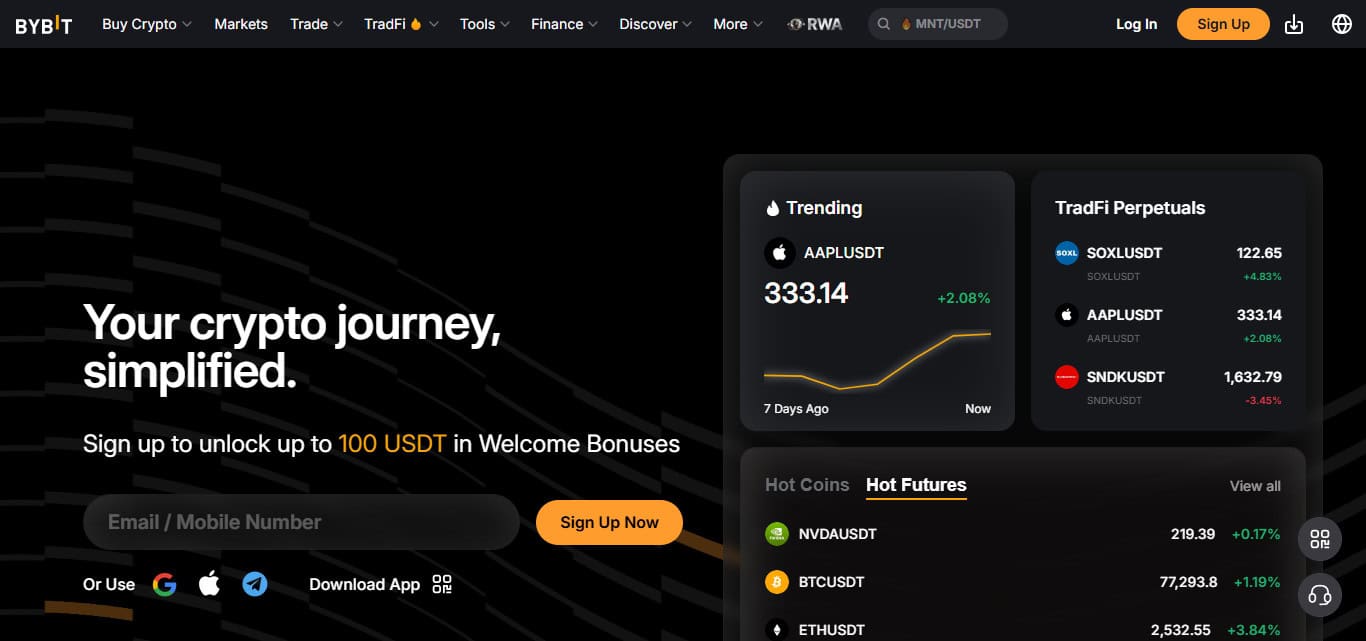
Bybit EU then developed a dedicated European platform to offer MiCAR services. Fees: Bybit implements maker/taker fees at varying levels depending on trading volume, product, and account tier.
Customer support: Users have access to online support, and professional clients have access to account service. Institutional advantage: With adequate liquidity in European MiCAR-aligned trading technology, it does service sophisticated trading organizations.
Bybit Features
- MiCA Regulation: Bybit EU GmbH gets authorization under Austrian MiCAR for custody, exchange, placing, and transfer services.
- Institutional Services: Includes spot trading, derivatives, liquidity, APIs, and advanced technology for professional trading operations.
- Fees: Priced based on trading volume, product, and account classification with tiered maker/taker pricing.
- Support: Offers online customer support for professional clients with potentially higher account service.
| Pros | Cons |
|---|---|
| Austrian MiCAR authorization supports regulated European operations | European product availability can differ from global Bybit |
| Strong spot and derivatives trading infrastructure | Complex products may not suit conservative institutions |
| Deep liquidity and advanced trading technology | Institutional fee arrangements can vary by account |
| Robust API capabilities for professional traders | Regulatory permissions differ across products and jurisdictions |
8. Gate
Established in 2013, Gate has established an extensive cryptocurrency ecosystem consisting of spot markets, derivatives, custody, liquidity, and professional trading offerings. MiCA status: Gate Technology Ltd has obtained a full MiCA license in Malta, providing a regulated European base for its crypto-asset services.
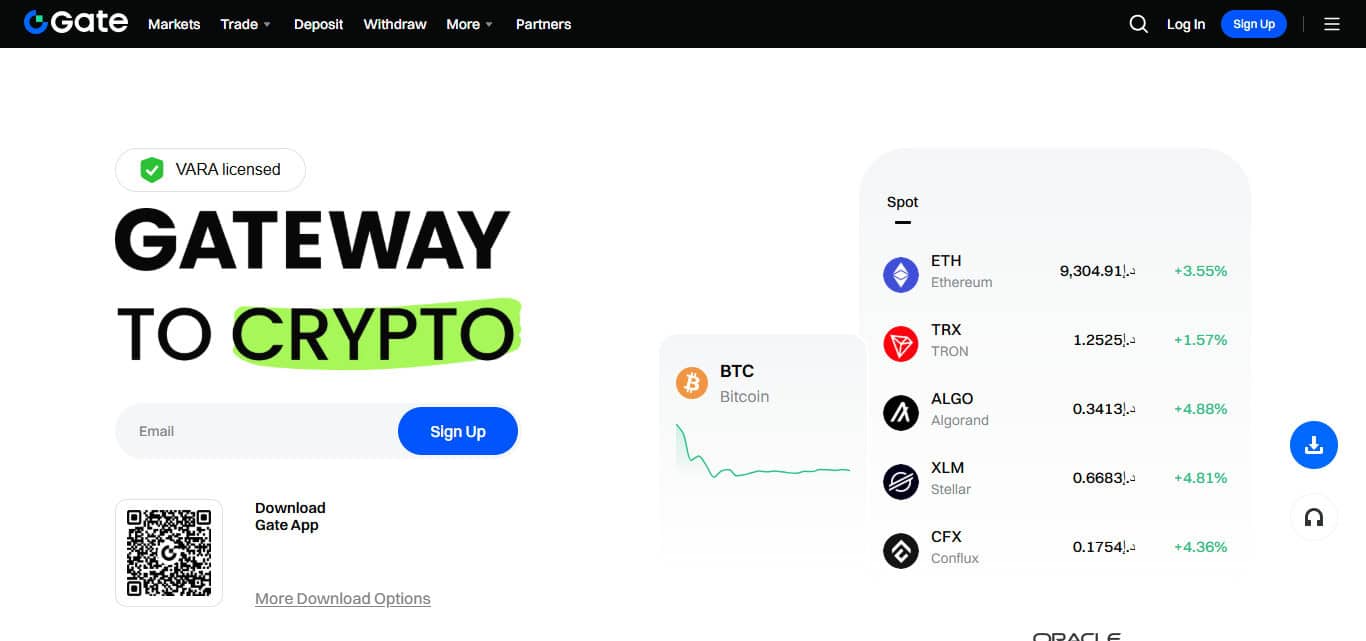
In March 2026, Gate also announced a Malta Financial Institution License under PSD2, providing further strength to Gate’s European payment infrastructure and stablecoins. Fees: Gate has implemented a system of progressive trading fees, which is influenced by trading volume, account level, product, and in some instances, token holdings. Institutional pricing is negotiable based on volume and liquidity.
Customer support: Gate has developed online help and customer support, with institutional clients afforded further support. Institutional Advantage: it’s large asset selection, liquidity, APIs, trading infrastructures, and European regulatory expansion, makes it a flexible option for digital asset operations.
Gate Features
- MiCA Regulation: Gate Technology Ltd. has a MiCA license from Malta for its regulated European crypto-asset operations.
- Institutional Services: Extensive asset availability with spot, derivatives, and professional APIs and infrastructure.
- Fees: Based on trading volume, account level, product, and token holding with tiered pricing.
- Support: Provides online support and offers specialized assistance and account services to institutional clients.
| Pros | Cons |
|---|---|
| Malta MiCA license supports regulated European operations | Very large asset selection can increase due-diligence requirements |
| Extensive cryptocurrency and trading-market coverage | Fee structure can be complex across account tiers |
| Strong APIs and professional trading infrastructure | Institutional services may require customized arrangements |
| Additional European payment infrastructure strengthens its ecosystem | Product availability can vary by jurisdiction |
9. Bullish
Bullish began operations in 2021 with an emphasis on the needs of institutions. Its focus is on regulated infrastructure and markets with liquidity and security for professional digital asset markets. Its expansion into Europe includes obtaining MiCA in Germany which allows it to operate its European services in the EU’s integrated digital asset regulatory framework.
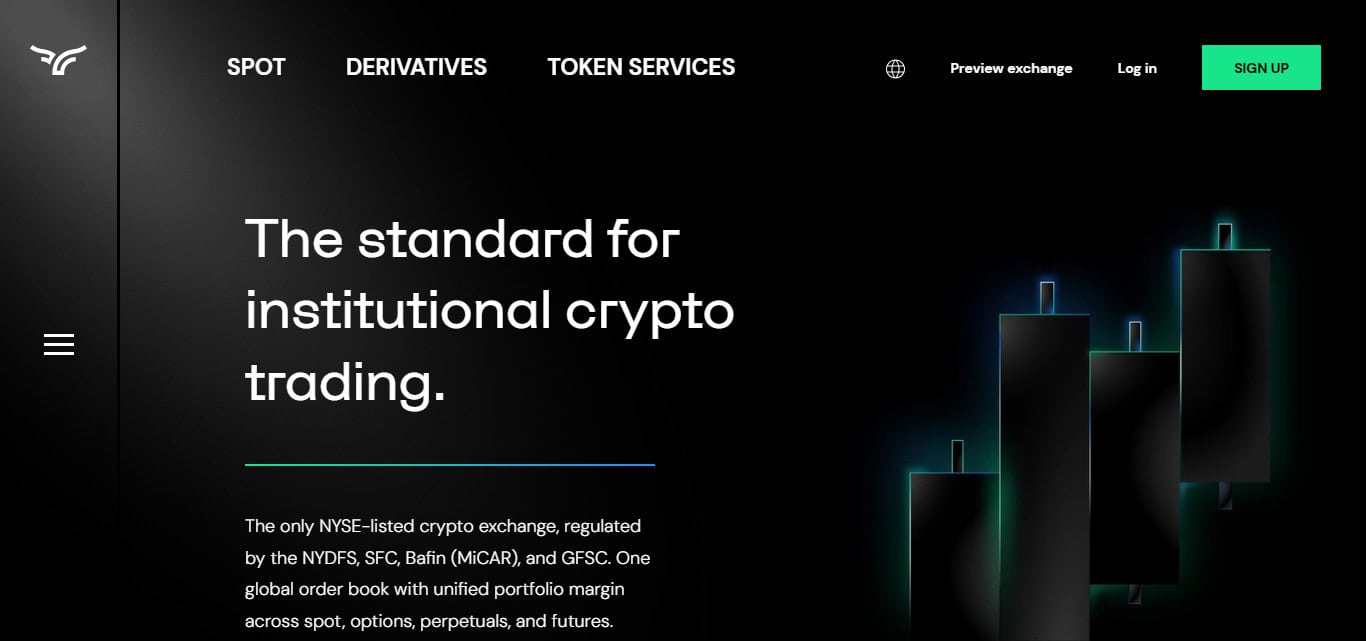
Fees: Bullish uses pricing aimed at professionals in the market, which institutional clients tend to prefer, and fees will depend on liquidity, trading volume, markets, and discount arrangements. Customer support: Institutional clients receive a higher level of personalized service, including account management support, adequate for professional trading activities.
Institutional advantage: Bullish is unique in its dedication to an institutional focus, liquidity, regulated markets, and professional trading. For large funds, market makers, and financial institutions, these features are likely more important than the consumer-centric features of a digital asset exchange.
Bullish Features
- MiCA Regulation: Bullish’s European operations have MiCA authorization for regulated crypto-asset services in Germany.
- Institutional Services: Provides services and platforms focused on institutional trading, deep liquidity, and professional execution, as well as security and regulated market infrastructures.
- Fees: Professional pricing is flexible and can be further negotiated based on individual client agreements.
- Support: Institutional clients also receive account management and professional services on a dedicated basis.
| Pros | Cons |
|---|---|
| Designed primarily around institutional digital-asset markets | Less retail-oriented than many competing exchanges |
| Strong focus on liquidity and professional execution | Smaller overall ecosystem than some global exchanges |
| MiCA authorization supports European regulatory positioning | Institutional access may involve onboarding requirements |
| Professional infrastructure suits funds and financial institutions | Pricing may be less transparent than standard retail schedules |
10. eToro
eToro was founded in 2007 and is a multi-asset option for investing in equities and ETFs and CFDs where applicable, along with crypto offerings. Its European subsidiary, eToro (Europe) Ltd, received a MiCA permit from Cyprus’ CySEC in January 2025.
This allows regulated crypto asset services to be offered throughout the EU, provided the proper notifications and authorizations have been obtained. Fees: eToro currently has a 1% flat fee for crypto trading. Fees vary depending on the service and jurisdiction.

Customer support: eToro provides support to clients through various service channels and support offered online. Institutional Advantage: eToro’s long operating history, multi-asset environment, regulatory structure, and established
European presence may offer a broad investment market opportunity to some institutions. Specialized platforms may be the preferable option to institutions for which the quality of first exchange liquidity is the primary consideration.
eToro Features
- MiCA Regulation: eToro Europe received MiCA from Cyprus’s CySEC for providing regulated European crypto services.
- Institutional Services: Offers products and services that provide exposure to crypto alongside other assets and provides crypto services within the scope of its existing European infrastructure.
- Fees: eToro claims it has a 1% crypto trading fee, although other factors can impact fees.
- Support: Offers customer service and support via online assistance for clients operating in the supported jurisdictions.
| Pros | Cons |
|---|---|
| MiCA authorization supports regulated European crypto services | Primarily known as a multi-asset investment platform |
| Long operating history dating back to 2007 | Less exchange-native infrastructure than specialist platforms |
| Combines crypto with broader investment products | Institutional trading tools may be less extensive |
| Simple 1% advertised crypto trading fee | Additional spreads or costs may apply depending on service |
Conclusion
In Conclusion The decision on which is the Best MiCA-Compliant Institutional Exchange depends on regulatory cover, security, liquidity, fees, custody, trading infra, and support. Some of the top exchanges for professional use are Coinbase, Kraken, OKX, Bitstamp, etc.
Institutions must assess what MiCA authorization each of the exchanges has, the services offered, pricing, and the operational as well as investment limits within each respective jurisdiction, in order to select the exchange which best meets their needs.
FAQ
Which exchange is best for institutional investors?
Coinbase offers comprehensive custody, trading, liquidity, and institutional infrastructure.
Is Coinbase MiCA-compliant?
Coinbase Luxembourg holds MiCA authorization for eligible EEA services.
Is Kraken MiCA-compliant?
Kraken received MiCA authorization through Ireland’s Central Bank.
Are MiCA exchanges safe for institutions?
They provide regulated frameworks, but institutions should conduct independent due diligence.