In this article, I will analyze the top Liquid Restaking Token (LRT) DEX platforms, describing their analysis, pros and cons.
You will understand how leading projects like Pendle, Uniswap, Ether.fi, Kelp DAO, Renzo, Puffer, Swell, Restake Finance, YieldNest, and Balancer support LRT trading, liquidity, yield farming on DeFi, and platform growth.
Key Points & Best Liquid Restaking Token (LRT) DEX Platforms
| Protocol | Explanation |
|---|---|
| Pendle | Tokenizes and trades future yield from LRTs like eETH and rsETH. |
| Uniswap | Enables decentralized spot swaps between LRTs and ETH or base assets. |
| Ether.fi | Leading liquid restaking protocol offering eETH and deep DEX liquidity. |
| Kelp DAO | Issues rsETH across multiple chains, providing diversified restaking liquidity. |
| Renzo Protocol | Manages EigenLayer strategies and issues ezETH for decentralized liquidity. |
| Puffer Finance | Provides liquid restaking through pufETH using anti-slashing architecture for security. |
| Swell Network | Offers swETH and rswETH with broad DeFi routing integrations. |
| Restake Finance | Provides modular liquid staking infrastructure designed specifically for EigenLayer restaking. |
| YieldNest | Combines multiple restaking strategies into unified yield-bearing tokens across networks. |
| Balancer | Provides weighted LRT pools designed to reduce impermanent loss exposure. |
1. Pendle
Pendle is a special modular yield trading protocol that allows separate trading of principal and yield, and therefore makes for an excellent complement to Liquid Restaking Tokens (LRTs) like eETH and rsETH.
Using Pendle, users don’t even need to hold the underlying token to stake it or restake it and still gain exposure to the future rewards. 2021 witnessed the expansion of DeFi yield markets and the subsequent important role that Pendle played as a market for trading tokenized yields in liquid staking and restaking.

Pendle offers its users the option to lock in yield, speculate on future yield rates, and even get yield exposure in a leveraged direction, by using their Principal Tokens (PT) and Yield Tokens (YT).
When it comes to LRTs, Pendle offers more than a typical spot-swapping platform, and thanks to its Restaking Assets, Pendle helps establish a connection of high yield management to the EigenLayer ecosystem.
Pendle Features
- Yield Tokenization: Principled and yield separated for trading.
- LRT Support: Involves market making using eETH and rsETH.
- Fixed-Yield Strategies: Yields lock-in and speculation.
- Advanced DeFi: Yield trading beyond regular spot swaps.
| Pros | Cons |
|---|---|
| Separates principal and yield, creating flexible yield-trading opportunities. | Yield strategies can be complex for beginners to understand. |
| Supports LRT-related assets and future-yield markets. | Yield-token prices can fluctuate significantly with market conditions. |
| Enables fixed-yield and speculative yield strategies. | Smart-contract and protocol risks remain relevant. |
| Provides advanced strategies beyond ordinary spot trading. | Sophisticated strategies may involve higher financial risk. |
2. Uniswap
Among the pioneer decentralized exchanges in DeFi, Uniswap lays the spot market trading infrastructure for LRTs vs ETH and stablecoins and other cryptocurrencies. It went live on Ethereum on Nov 2, 2018, when botmaker Hayden Adams deployed the first version of Uniswap as an Automated Market Maker (AMM).
In the early days of Uniswap, users were able to swap tokens for ETH, and later the functionality was upgraded through Uniswap V2, V3 and other releases. As restaking tokens such as weETH, ezETH, and other LRTs became popular, Uniswap pools created an important market for users to enter and exit their positions in LRTs.
Automated liquidity models let users skip centralized order books when trading. More recent model upgrades provide more advanced liquidity management. With all this in mind, the best way to look at Uniswap is as a general spot DEX for LRTs, rather than a protocol built for yield restaking.
Uniswap Features
- Spot Trading: LRT swap with Ethereum and stablecoins.
- AMM Model: Deployed automated liquidity pools without an order book.
- Broad Liquidity: All major LRTs such as ezETH, weETH, and eETH.
- DeFi Integration: Infrastructure for liquidity for numerous LRT-related DeFi applications.
| Pros | Cons |
|---|---|
| Provides deep spot-trading infrastructure for many cryptoassets. | It is not specifically designed for liquid restaking. |
| Supports trading of LRTs against ETH and stablecoins. | Liquidity conditions vary significantly between different LRT pools. |
| Uses decentralized automated market-making technology. | Traders can experience price impact on lower-liquidity LRT pairs. |
| Widely integrated throughout the DeFi ecosystem. | Liquidity providers face impermanent-loss risks. |
3. Ether.fi
Ether.fi is a liquid staking and liquid restaking ecosystem built around the eETH standard. Its goal is to offer users liquidity while they maintain staking and restaking exposure to ETH. The project launched in the early stages of the Ethereum liquid restaking and EigenLayer ecosystem, and eETH rapidly became an important LRT of DeFi.
Rather than limiting eETH to the staking infrastructure, Ether.fi has focused on the non-custodial staking and liquidity sectors as well as the broader DeFi ecosystem. As a result, Ether.fi eETH can be used across numerous DeFi apps as opposed to being stuck in the staking ecosystem.

The development of Ether.fi has been primarily driven by the growth of the EigenLayer and the LRT market in 2023-2024. eETH can be traded and deployed across all DeFi protocols, DEX liquidity pools, and the yield markets, due to the extensive liquidity and integration opportunities.
For users focused around LRTs, Ether.fi is a key player due to the integrated restaking product and the rapidly growing ecosystem around liquidity and yield markets.
Ether.fi Features
- eETH LRT: eETH for liquid restaking of staked ETH.
- Non-Custodian: Designed for greater control of assets.
- DeFi Composability: eEITH is usable in all DeFi.
- Restaking Ecosystem: Integration of Ethereum staking, EigenLayer restaking, and DeFi.
| Pros | Cons |
|---|---|
| Provides eETH as a liquid representation of staked and restaked ETH. | Users remain exposed to risks associated with staking and restaking. |
| Strong integration with the broader DeFi ecosystem. | eETH liquidity and market conditions can change over time. |
| Allows users to maintain liquidity while participating in staking strategies. | Protocol complexity may make it difficult for inexperienced users. |
| Offers extensive opportunities across DEXs and yield markets. | Smart-contract and ecosystem risks cannot be completely eliminated. |
4. Kelp DAO
Kelp DAO is a liquid restaking protocol that wants to offer users liquidity when they restake their assets on EigenLayer. With Kelp DAO’s main product LRT, rsETH, users are able to have a liquid DeFi asset that earns them rewards from the resting ecosystem.
Kelp DAO was developed in 2023 as EigenLayer’s restaking ecosystem started to grow and more users wanted liquid ways to put their assets in the restaking ecosystem.
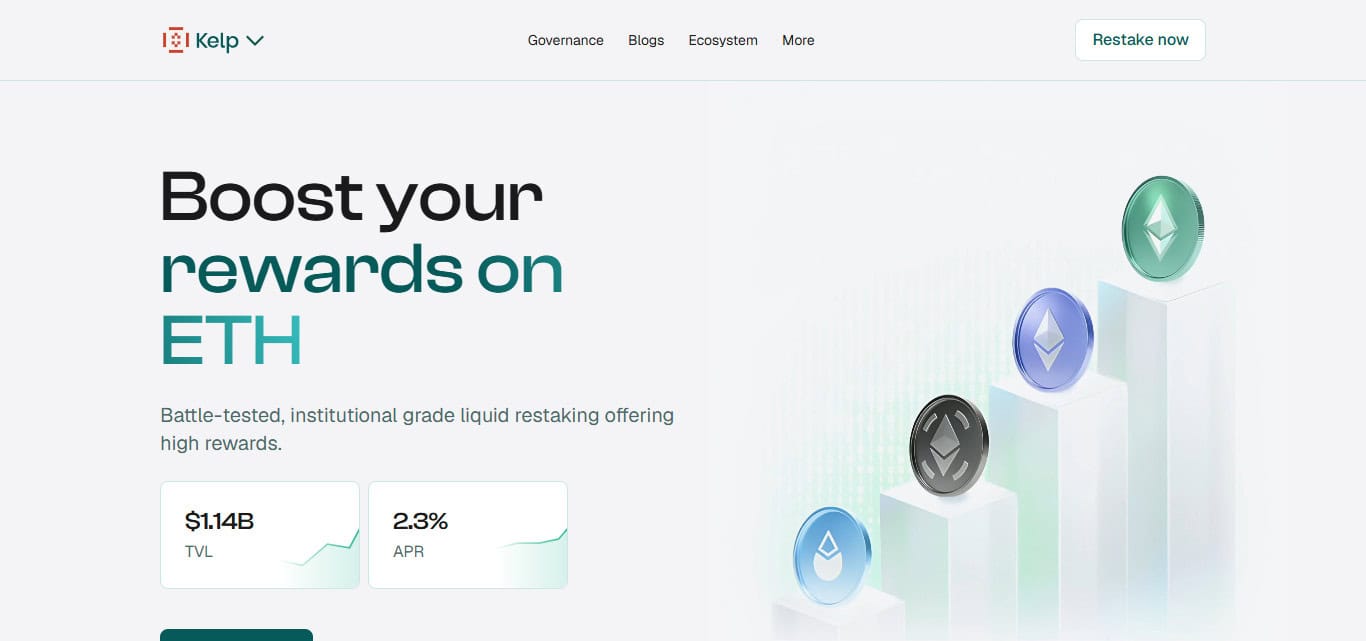
The focus of the Kelp DAO protocol is to make resting assets liquid across DeFi and support multiple assets across different blockchain infrastructures.rsETH can be put to work in other DeFi apps since it is a liquid restaked asset.
Kelp DAO’s approach is more user-centric since liquid restaking proposals are still fragmented across several blockchains. By introducing rsETH, Kelp DAO allows users to make restaking capital more liquid and get more usecase utility than holding restaking assets.
Kelp DAO Features
- rsETH Token: rsETH for diversified restaking.
- Multi-Asset Support: Restaked assets collectors.
- DeFi Utility: Used in DeFi trading and alternative liquidity protocols.
- Multi-Chain Focus: Creating restaking liquidity across supported blockchains.
| Pros | Cons |
|---|---|
| Provides rsETH as a liquid representation of restaked assets. | Restaking introduces additional protocol and market risks. |
| Helps make traditionally locked restaking capital more transferable. | Cross-chain functionality can introduce additional technical complexity. |
| Designed for integration with multiple DeFi applications. | rsETH liquidity may vary across different platforms and networks. |
| Supports broader utilization of restaking assets. | Users depend on the underlying restaking infrastructure and strategies. |
5. Renzo Protocol
Renzo Protocol has created the primary liquid restaking token, ezETH. Renzo’s strategy management protocol began the first phase of its public release and launch into the EigenLayer restaking ecosystem on December 18, 2023.
The aim of the Renzo Protocol is to offer users the ability to participate in the restaking market while taking care of the management of various active restaking strategies. As an added benefit, users receive a liquid token to represent their position.

Through its integration within DeFi markets, ezETH can be traded, placed as collateral, or utilized in liquidity pools. Rather than just offering swaps, Renzo’s model differs from typical decentralized exchanges to manage liquidity within the restaked capital.
However, the significant other players and liquidity within ezETH (most notably through yield and decentralized exchanges) contribute to ezETH’s importance within the broader restaking token markets. This makes Renzo an important element of the broader restaking token markets.
Renzo Protocol Features
- ezETH LRT: For users’ record of liquid restaking.
- ezETH Management: Optimizes restaking strategies.
- DeFi Liquidity: ezETH allows for participation in DEXs, lending markets, and yield strategies.
- User Accessibility: Makes EigenLayer restaking easier without requiring users to manage their strategies
| Pros | Cons |
|---|---|
| Provides ezETH as a liquid restaking token. | ezETH is exposed to market volatility and liquidity risks. |
| Manages restaking strategies for users. | Strategy management introduces additional protocol complexity. |
| ezETH can be used as collateral and in liquidity pools. | Smart-contract and underlying restaking risks remain. |
| Strong integration with DeFi markets increases token utility. | Users must understand the risks of multiple integrated protocols. |
6. Puffer Finance
Puffer Finance developed a liquid staking protocol for Ethereum staking and pufETH, its native restaking token, in the boom of 2023 for EigenLayer and liquid staking. Puffer Finance aims to develop technologies for native Ethereum staking while keeping technology for Ethereum staking as secure as possible.

PufETH allows users to stake ETH and provide users with a token that is redeemable for staked ETH. When users stake ETH, the staked ETH is locked and cannot actively participate in DeFi. While staked ETH is locked, pufETH can be traded and used to provide liquidity to DeFi protocols.
The combination of Ethereum-native staking and DeFi liquid staking tokens places Puffer Finance in a unique position in the LRT space.
Puffer Finance Features
- pufETH Token: Provides users with a liquid capital representation of restaked ETH.
- Native Restaking: Has a strong focus on the development of Ethereum-native staking and restaking technologies.
- Anti-Slashing Design: Implemented anti-slashing design and specialized architecture to mitigate validator slashing.
- DeFi Compatibility: pufETH can be used within liquidity pools and can be integrated across other DeFi applications.
| Pros | Cons |
|---|---|
| Provides pufETH as a liquid restaking asset. | Native restaking involves technical and operational risks. |
| Focuses on Ethereum-native staking infrastructure. | The protocol’s architecture can be difficult for beginners to understand. |
| Anti-slashing technology aims to improve validator security. | pufETH remains exposed to market and liquidity fluctuations. |
| Allows pufETH to participate in wider DeFi applications. | DeFi integrations introduce additional smart-contract risks. |
7. Swell Network
Swell Networks’ initial protocol, rswETH, began as Ethereum’s liquid staking. It later provided liquid restaking. Seawolf, Swell Networks’ first live mainnet, was released in April 2023, offering its liquid staking token swETH.
As the restaking market grew, Swell created its LRT rswETH in January 2024. As a restaked version of ETH, rswETH became usable in DeFi while providing staking rewards and restaking rewards. Swell places a high emphasis on composability, security and integration of their DeFi protocols.
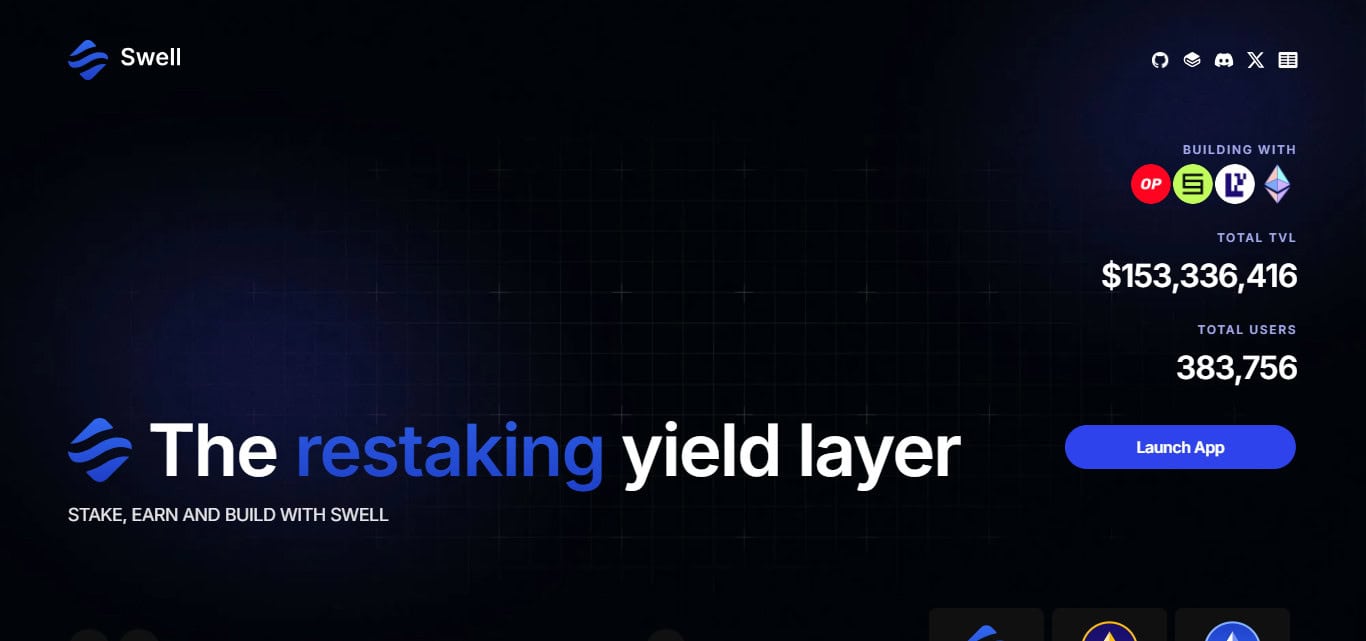
Swell’s LRT has high liquidity through DEXs and high yield through DeFi farms such as Pendle. This creates Swell’s niche between liquid staking and liquid restaking by allowing users to stake ETH and restake ETH while improving DeFi’s capability for restaked ETH.
Swell Network Features
- LRT Offering: offers rswETH as its liquid restaking token.
- DeFi Composability: Built to be integrated with various DeFi protocols and yield markets.
- Yield Opportunities: Offers staking and restaking opportunities while keeping liquidity.
- Ecosystem Integration: Offers liquid staking, liquid restaking, and DeFi.
| Pros | Cons |
|---|---|
| Provides both liquid staking and liquid restaking products. | Users face risks associated with both staking and restaking. |
| rswETH can be used across various DeFi applications. | LRT prices can diverge from the value of underlying assets. |
| Strong composability with DEXs and yield protocols. | DeFi integrations can increase overall protocol complexity. |
| Integration with yield markets provides additional opportunities. | Yield opportunities may carry higher risk than simple ETH holding. |
8. Restake Finance
Restake Finance provides modular and composable infrastructure for liquid restaking on Ethereum and EigenLayer. The project was created during the development of 2023–2024 expansion of the EigenLayer ecosystem by builders for the formation of various methods for shifting formerly illiquid, restaked positions into tradeable assets in DeFi.
The architecture of the project aims for separating staking, restaking, and DeFi, providing the users a high degree of flexibility for their funds.

Restake Finance’s approach to liquid restaking means that users get a token representation for their restaked position that is capable of being used in various applications across the DeFi ecosystem.
Therefore, Restake Finance is pertinent to markets for LRT because the primary goal is not solely earning staking rewards. The approach of Restake Finance reflects the trend in restaking infrastructure for the division of staking, security, management of strategies, and liquidity.
Restake Finance Features
- Modular Architecture: Separates staking, restaking, and DeFi into modular components.
- Liquid Restaking: Restaked positions can be converted into liquid representations.
- DeFi Accessibility: Improves the usability of restaked capital within decentralized applications
- EigenLayer Focus: Designed to work alongside the developing EigenLayer and Ethereum restaking ecosystems.
| Pros | Cons |
|---|---|
| Uses a modular approach to liquid restaking infrastructure. | Modular systems can be complicated for ordinary users. |
| Designed for composability across the DeFi ecosystem. | Multiple components can create additional technical dependencies. |
| Makes restaked positions more accessible and transferable. | Users remain exposed to EigenLayer and restaking-related risks. |
| Separates staking, restaking, strategy, and liquidity functions. | Relatively specialized compared with major general-purpose DEXs. |
9. YieldNest
YieldNest aims to simplify the process of combining multiple strategies into yield-bearing products by designing intuitive and user-friendly solutions. The development of YieldNest coincided with the expansion of liquid restaking in 2024 and the rapidly growing demand for EigenLayer and associated ecosystems.
Unlike other restaking solutions, YieldNest will provide a simplified approach by aggregating strategies and presenting them as a unified token.
This will help simplify the process of providing access to diversified yield opportunities. LRT users will find this service the most convenient as restaking involves multiple protocols, operators, networks, and various risk adjustments.

YieldNest offers a unique services that provides a diversified risk space in a simplified manner. In addition, the products offered by YieldNest are capable of interfacing with the existing DeFi infrastructure, thereby enabling interaction with liquidity markets and decentralized exchanges.
Therefore, YieldNest serves as the strategy aggregation layer of the LRT ecosystem amongst the other specialized restaking protocols and DEXs that offer liquidity.
YieldNest Features
- Strategy Aggregation: restaking strategies combined into easily digestible products.
- Yield Optimization: Provides exposure to several opportunities within restaking.
- Unified Tokens: simplifies access to underlying components.
- DeFi Integration: connects aggregated restaking strategies to liquid decentralized markets.
| Pros | Cons |
|---|---|
| Aggregates multiple restaking strategies into simplified products. | Strategy aggregation can make underlying risks less obvious. |
| Provides diversified exposure to different yield opportunities. | Diversification does not eliminate smart-contract or market risks. |
| Simplifies management of complex restaking strategies. | Users have less direct control over individual strategies. |
| Connects strategies with broader DeFi liquidity infrastructure. | Performance depends on the quality of underlying strategies. |
10. Balancer
Balancer was one of the first to create decentralized automated market makers (AMM) to programmatically create any liquidity pool, including multi-token pools.
Balancer was launched in 2020, and became recognized for building the first flexible weighted pool structure, which broke the mold of the traditional equal weight AMM.
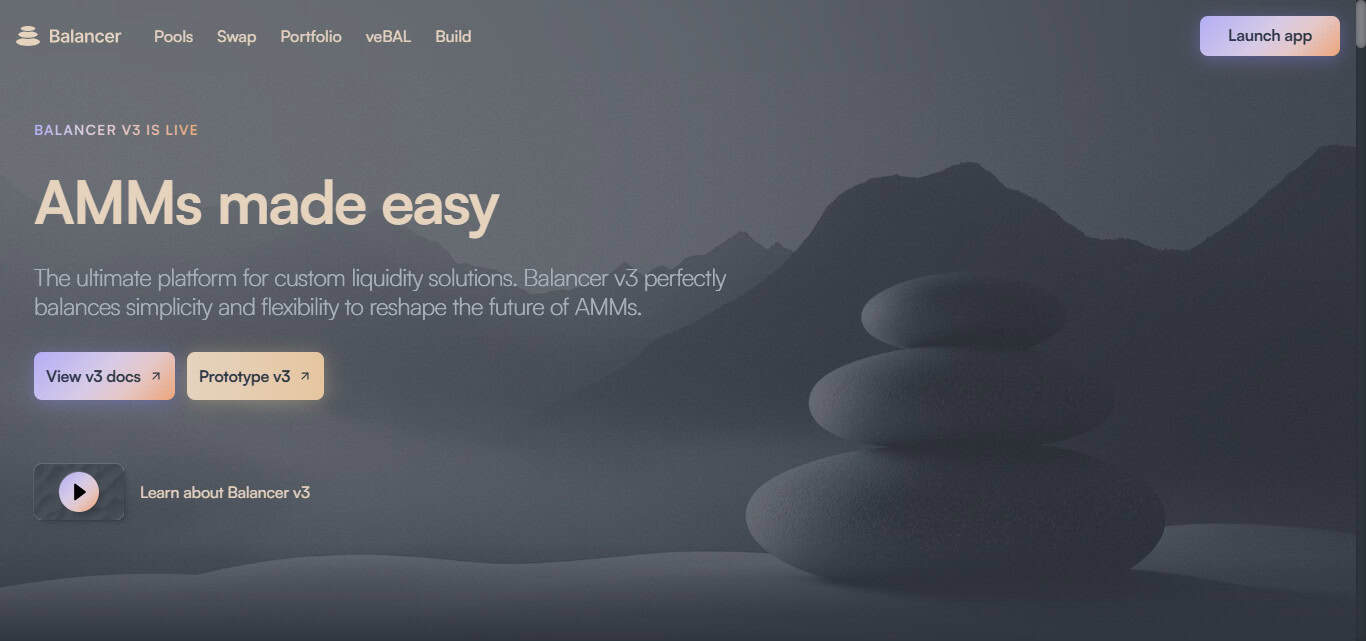
Weighted pools enable liquidity providers to set different parameter distributions for portfolio weighting of different riskstaking assets and correlated assets. Balancer offers building blocks for LRT liquidity and automated market making (AMM) across DeFi.
Because Balancer’s weighted pools support portfolio liquidity and can manage risks differently from traditional pools, they can help establish deeper pools for LRTs.
Balancer Features
- Weighted Pools: Supports customized pools with differing ratios of LRTs to other assets
- DeFi Integration: connects aggregated restaking strategies to liquid decentralized markets
- LRT Liquidity: Participation in automated market making pools across multiple assets.
- Portfolio Flexibility: Ability for liquidity providers to select weighted portfolios.
- Impermanent Loss: Weighted and correlated pools can potentially offer lower risk when compared to 50/50 pools.
| Pros | Cons |
|---|---|
| Supports flexible weighted liquidity pools for LRTs. | Weighted pools can be more complicated than standard AMM pools. |
| Enables customized asset allocations within liquidity pools. | Liquidity providers remain exposed to impermanent-loss risks. |
| Useful for diversified LRT and correlated-asset liquidity. | Pool performance depends on trading volume and liquidity demand. |
| Provides flexible AMM infrastructure across DeFi. | Managing pool weights and risks requires additional expertise. |
Conclsuion
In Conclusion The Best Liquid Restaking Token (LRT) DEX Platforms have many different opportunities for trading, liquidity, yield generation, and restaking. Pendle focuses on yield trading.
Uniswap and Balancer have more flexible liquidity trading. Ether.fi, Kelp DAO, Renzo, Puffer, Swell, Restake Finance, and YieldNest all have more opportunities for restaking and yield farming in their LRT’s. Before choosing a platform, users should consider the liquidity pools, fees, smart contract risks, supported tokens, and trading strategies.
FAQ
Which DEX is best for LRT trading?
Pendle specializes in yield trading, while Uniswap supports broad spot LRT trading.
What is Pendle used for with LRTs?
Pendle lets users trade future yield separately from underlying LRT principal.
Can LRTs be traded on Uniswap?
Yes, supported LRTs can be exchanged against ETH, stablecoins, and cryptocurrencies.
Why use LRTs instead of locked restaked assets?
LRTs provide liquidity, allowing restaked positions to remain usable throughout DeFi.