In this article, I will examine the Best Crypto APIs for Automated Trading Bots. Well designed trading APIs make it easy for developers and traders to create automated trading systems that are reliable, secure, and highly performant.
APIs are often integrated as part of a system and provide real-time data, lightning fast execution, advanced analytics, and connectivity to different exchanges.
I will be looking at the various features and benefits and some of the downsides to each API as it pertains to the automation of Cryptocurrency trading in 2026.
What Are Crypto APIs?
Crypto APIs (Application Programming Interfaces) enable applications and software to interact with blockchain technology and cryptocurrency exchanges. They provide application builders with access to information such as market statistics and prices, as well as account and wallet management and automated trading.
Crypto APIs are heavily relied upon in the construction of trading bots, portfolio management systems, and DeFi apps and financial systems. Thanks to crypto APIs, automation of crypto trading and related activities become both secure and efficient to the builders and users of the exchanges and the blockchain technology.
Why Use Crypto APIs for Automated Trading Bots?
- Speedier Execution of Trades: Automated systems minimize delays and outperform manual systems by instantly processing trade orders.
- Constant Crypto Market Monitoring: Automation allows continuous monitoring of crypto markets.
- More Sophisticated Trading Techniques: Automated systems facilitate more complex trading strategies.
- Minimizes Emotional Trading: Automation reduces the risk of emotional decisions by executing trades based on data and set conditions.
- More Complex High-Frequency Trading: Automation increases the ability to conduct numerous trades in a short time by implementing intricate algorithms.
Key Points & Best Crypto APIs for Automated Trading Bots
| API | Explanation |
|---|---|
| Binance API | Provides deep liquidity, fast execution, and reliable access for crypto trading applications. |
| Coinbase API | Offers secure account management with strong compliance features for US-based users. |
| Kraken API | Supports multiple trading protocols with advanced security and flexible integration options. |
| Bybit API | Enables powerful derivatives and futures trading with high-performance market infrastructure. |
| OKX API | Provides diverse altcoin access and smart trading tools for investors. |
| CoinMarketCap Pro API | Delivers global market data and historical insights for advanced backtesting. |
| CoinAPI | Aggregates exchange data into one comprehensive hub for developers worldwide. |
| CoinStats API | Tracks portfolios across chains with detailed analytics and performance insights. |
| Glassnode API | Provides advanced on-chain metrics and blockchain intelligence for market analysis. |
| DexScreener API | Offers free real-time DEX pair data for decentralized trading analysis. |
10 Best Crypto APIs for Automated Trading Bots
1. Binance API
The Binance API is popularly known for its deep liquidity, speedy order execution, and comprehensive market coverage. The Binance API also gives developers access to account management, order endpoints, and the ability to create automated trades.

The API has the capabilities to process spot, futures, and margin orders, making the Binance API a great option to create advanced trading bots, portfolio tools, and apps with institutional grade features. The low latency systems Binance has deployed helps create high frequency trading systems well into 2026.
Binance API Features
- Comprehensive Liquidity: Binance is one of the largest crypto marketplaces with many trading opportunities.
- Data Retrieval: Provides applications with access to real time prices, order books, trades, and market data.
- Trading Automation: Developers can create trading bots, advanced algorithms, and automated trading.
- Versatile Trading Markets: Applications can partake in Spot, Futures, and Margin trading.
- Rapid Speed: High-frequency trading is the primary use case for this low-latency service.
| Pros | Cons |
|---|---|
| Provides extremely high liquidity and supports fast trade execution worldwide. | Complex API structure can be challenging for beginners and small developers. |
| Supports spot, futures, margin, and automated trading applications efficiently. | Regulatory restrictions may affect availability in certain countries. |
| Offers extensive market data with real-time price and order information. | High trading volume may increase competition among algorithmic traders. |
| Provides advanced developer tools for professional trading platforms. | API rate limits can impact applications requiring massive data requests. |
| Enables low-latency solutions suitable for high-frequency trading systems. | Security management requires careful handling of API keys. |
2. Coinbase API
The Coinbase API is designed for developers who are looking for a secure way to transact with cryptocurrency, and want a regulated and reliable way to manage accounts.
The API has a simple way to code the buying, selling, and transferring of digital assets while maintaining strong compliance, especially in the US.

The API can also be used for payment methods and wallet services, in addition to real time data for crypto. The Coinbase API is also a great choice for developers looking to create secure and customer friendly crypto solutions while remaining compliant in 2026.
Coinbase API Features
- Transaction Safety: Buy, sell, transfer, and manage your crypto assets safely.
- Compliance Ready: Coinbase provides solutions for businesses in regulated markets.
- Create a Wallet: Developers can create crypto wallets and payment solutions.
- Up to the Minute Crypto Data: Receive updated prices and market stats, as well as transaction data.
- Build with Ease: A simple API for developers to create crypto focused applications.
| Pros | Cons |
|---|---|
| Offers strong security features and compliance-focused cryptocurrency infrastructure. | Trading fees can be higher compared to many competitors. |
| Provides simple integration for wallets, payments, and crypto transactions. | Limited advanced trading features compared with professional exchanges. |
| Trusted platform with strong reputation among US-based businesses. | API access may require additional verification processes. |
| Supports reliable account management and real-time market data. | Fewer supported cryptocurrencies compared with global exchanges. |
| Ideal for businesses needing regulated crypto solutions. | Some developer features have usage limitations. |
3. Kraken API
The Kraken API also harnesses the power of professional market access, but focuses even more on strong trading functionality, security, and reliability. The Kraken API also has a variety of futures and spot trading services, as well as enhanced order management features for developers.
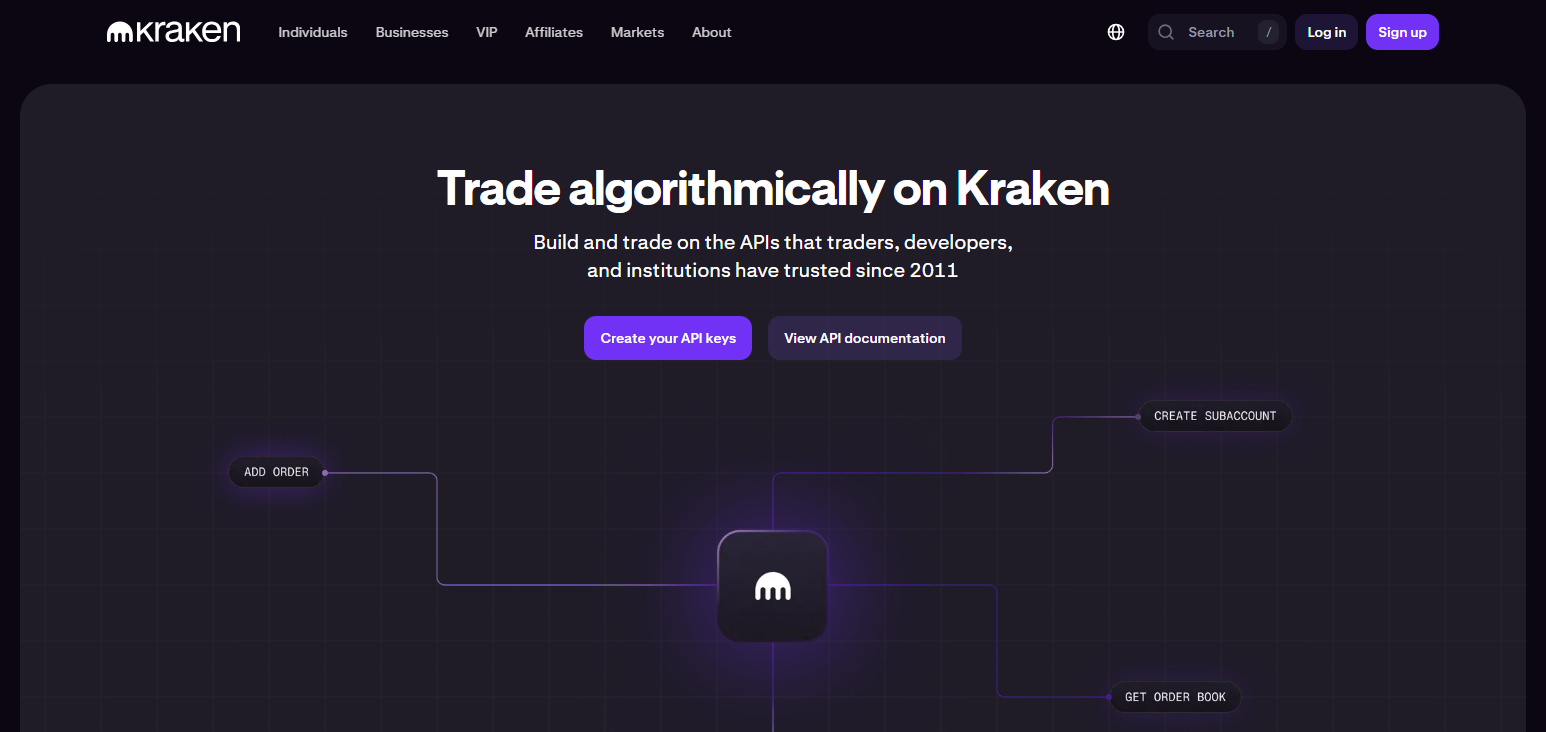
The API infrastructure is reliable and stable, making it a favorite among developers and traders to create financial applications and algorithmic trading systems. With sophisticated and enhanced security and authentication, the Kraken API is the go to crypto trading API in 2026.
Kraken API Features
- Spot & Futures Trading: Professional trading is fully supported.
- Security First: Multiple secure integration measures like advanced authentication.
- Automate Your Orders: Applications can use any trading style and fully automate it.
- Consistent Reliability: Perfect for financial and trading applications.
- Create Algo Trading: Advanced automated/quant trading solutions are supported.
| Pros | Cons |
|---|---|
| Provides strong security architecture with reliable trading performance. | API documentation can feel complex for new developers. |
| Supports advanced orders, futures, and professional trading features. | Lower liquidity compared with the largest crypto exchanges. |
| Suitable for algorithmic trading and institutional applications. | Some advanced features require deeper technical knowledge. |
| Offers stable API infrastructure with strong authentication methods. | Trading interface may not suit beginner-focused applications. |
| Provides access to multiple cryptocurrency markets. | Occasional API maintenance can affect availability. |
4. Bybit API
Bybit API is for developers designing crypto trading platforms that use derivatives, futures, and automation. Bybit API offers tools for advanced order types, leverage, and fast execution of trades. It also provides near real-time market data.
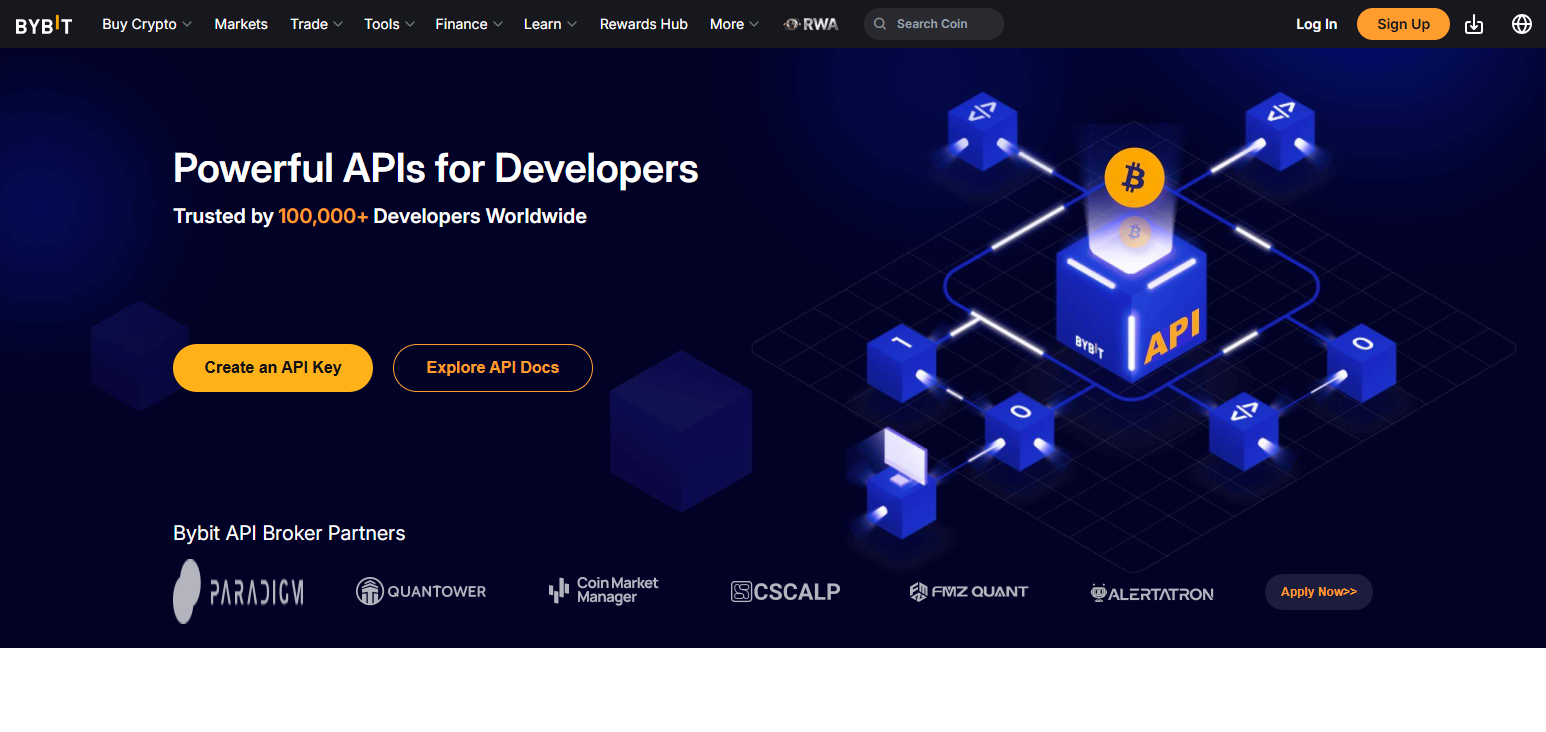
Because of this, Bybit API appeals to quantitative traders and developers designing platforms that use perpetual contracts and crypto derivatives. Bybit has a developer-friendly, expanding ecosystem. In 2026, it will be one of the better options for a modern trading app.
Bybit Features
- Offers robust solutions for trading futures and perpetual contracts.
- Fast execution of trades.
- Enable Leveraged Trading: Designed for leveraged and pro trading positions and tactics.
- Live Trading and Pricing: Access to pricing and trading data as it happens.
- Supports Trading Bot Development: The infrastructure is built to assist the creation of trading bots and quantitative systems.
| Pros | Cons |
|---|---|
| Excellent for derivatives, futures, and perpetual contract applications. | Mainly focused on advanced traders rather than beginners. |
| Provides fast execution and real-time market data access. | Regulatory availability varies across different regions. |
| Supports automated trading strategies and quantitative systems. | Limited usefulness for businesses needing traditional financial services. |
| Offers advanced order types and leverage trading capabilities. | High-risk derivatives features require careful risk management. |
| Developer-friendly tools support modern crypto applications. | API complexity may increase for large-scale integrations. |
5. OKX API
OKX API provides access to many cryptocurrencies, sophisticated trading tools, and Web3 features. With this API, developers can automate the execution of strategies, analyze the market, and build dApps.

Among APIs, OKX offers the widest selection of altcoins and the most agile trading systems. With its advanced Web3 and smart trading features, OKX allows the automation of investment strategies and the creation of crypto-based apps and portfolio tools for traders around the world.
OKX API Features
- Access to Major Cryptos: Access to almost every cryptocurrency and altcoins.
- Automated and Smart Trading: Automated trading, advanced order placements, and trading analysis.
- Web3 Compatible: dApps and Blockchain based development solutions are supported.
- Trading Automation: Developers can design personalized trading and portfolio automation systems.
- Professional Trading Support: Offers insights to aid trading.
| Pros | Cons |
|---|---|
| Supports a wide range of cryptocurrencies and trading products. | Interface complexity may challenge inexperienced developers. |
| Provides Web3 integration and decentralized application support. | Regulatory limitations exist in some markets. |
| Offers smart trading tools and advanced automation features. | Documentation may require technical expertise. |
| Provides strong market data and trading infrastructure. | Some features are unavailable in specific regions. |
| Suitable for innovative crypto and blockchain applications. | Large feature set may require longer learning time. |
6. CoinMarketCap Pro API
Among APIs for market data, CoinMarketCap Pro offers one of the best solutions to access crypto data for pricing, research, and financial data analysis. It offers data on a market’s history and structure, rankings, trading volumes, and blockchain metrics.

Developers use CoinMarketCap Pro to build tools to track portfolios and analyze investments and trade data. In 2026, its reliability will make CoinMarketCap Pro one of the best solutions to access forecasting data for global crypto markets.
CoinMarketCap Pro API Features
- Worldwide Crypto Information: Access to every cryptocurrency’s price, rank, and market data.
- Access to Past Market Data: Records of past data for research and back testing.
- Helps Build Portfolio Trackers: Develop investment tracking and analytic systems.
- Blockchain and Market Analysis Tools: Provides helpful market analysis and blockchian data.
- Data Based Crypto Research and Trend Analysis: Assists in tools for research and data based analysis of crypto trends.
| Pros | Cons |
|---|---|
| Provides extensive global cryptocurrency market data coverage. | Premium plans can become expensive for startups. |
| Offers historical data useful for research and backtesting. | Does not provide direct trading execution features. |
| Easy integration for analytics dashboards and applications. | Free access has limited API request capacity. |
| Trusted data source used by many crypto platforms. | Some advanced metrics require paid subscriptions. |
| Supports thousands of cryptocurrency listings and information. | Data accuracy depends on external exchange sources. |
7. CoinAPI
Building a unified infrastructure for global cryptocurrency data is possible through the information CoinAPI aggregates from over 600 worldwide cryptocurrency exchanges. This platform provides real-time data for prices, orders, trades, and exchange rates along with historical data.
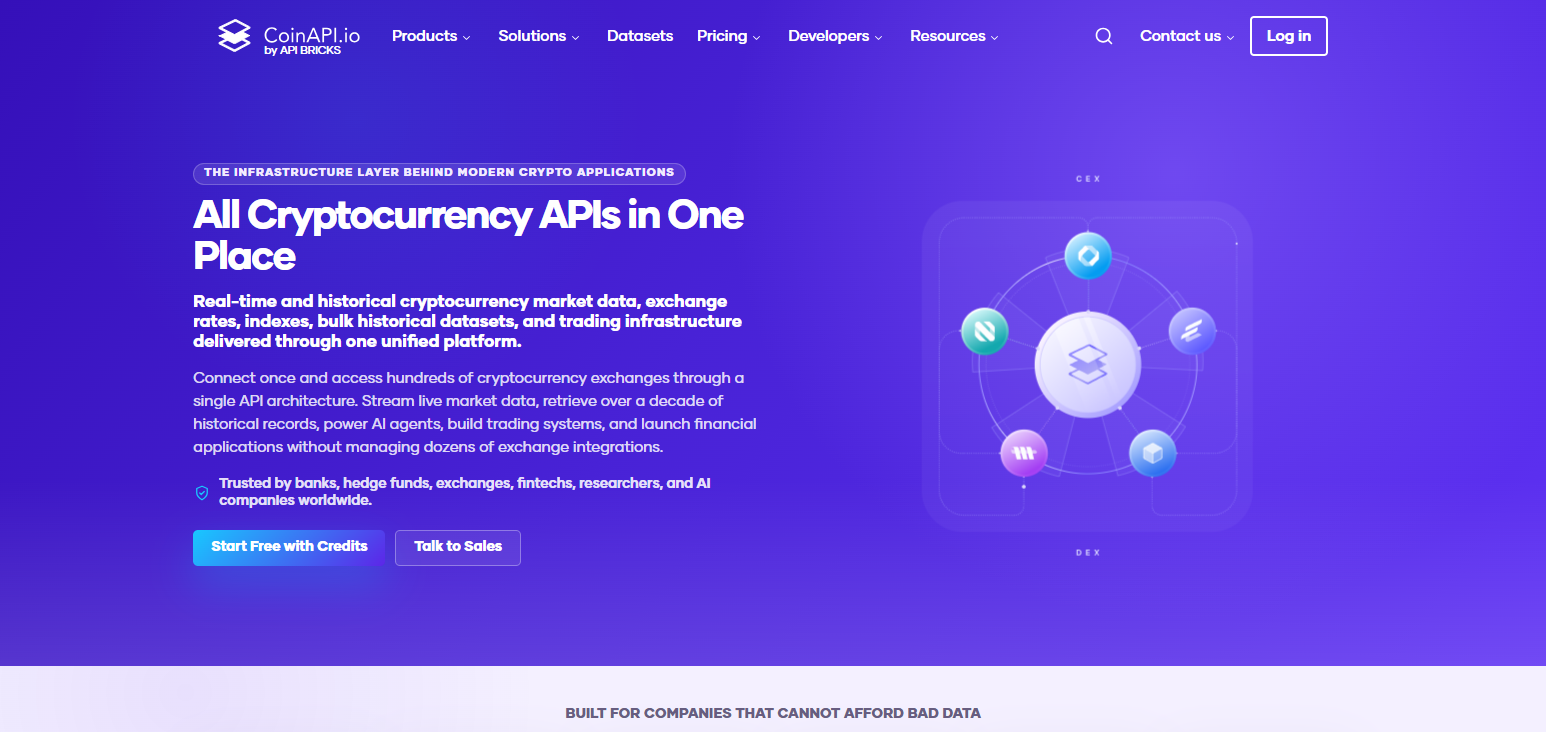
CoinAPI is the go-to solution for many fintech firms and quantitative analysts because of its extensive data and developer-friendly APIs. Because of its extensive data and developer-friendly APIs, it is also the preferred solution for many professional crypto data services.
| Pros | Cons |
|---|---|
| Provides extensive global cryptocurrency market data coverage. | Premium plans can become expensive for startups. |
| Offers historical data useful for research and backtesting. | Does not provide direct trading execution features. |
| Easy integration for analytics dashboards and applications. | Free access has limited API request capacity. |
| Trusted data source used by many crypto platforms. | Some advanced metrics require paid subscriptions. |
| Supports thousands of cryptocurrency listings and information. | Data accuracy depends on external exchange sources. |
8. CoinStats API
CoinStats API provides application developers with the tools to integrate and customize portfolio management systems for cryptocurrencies with multi-chain wallets and exchange tracking. Users can consolidate numerous wallets and exchanges to monitor investment performance, transactions, and management.
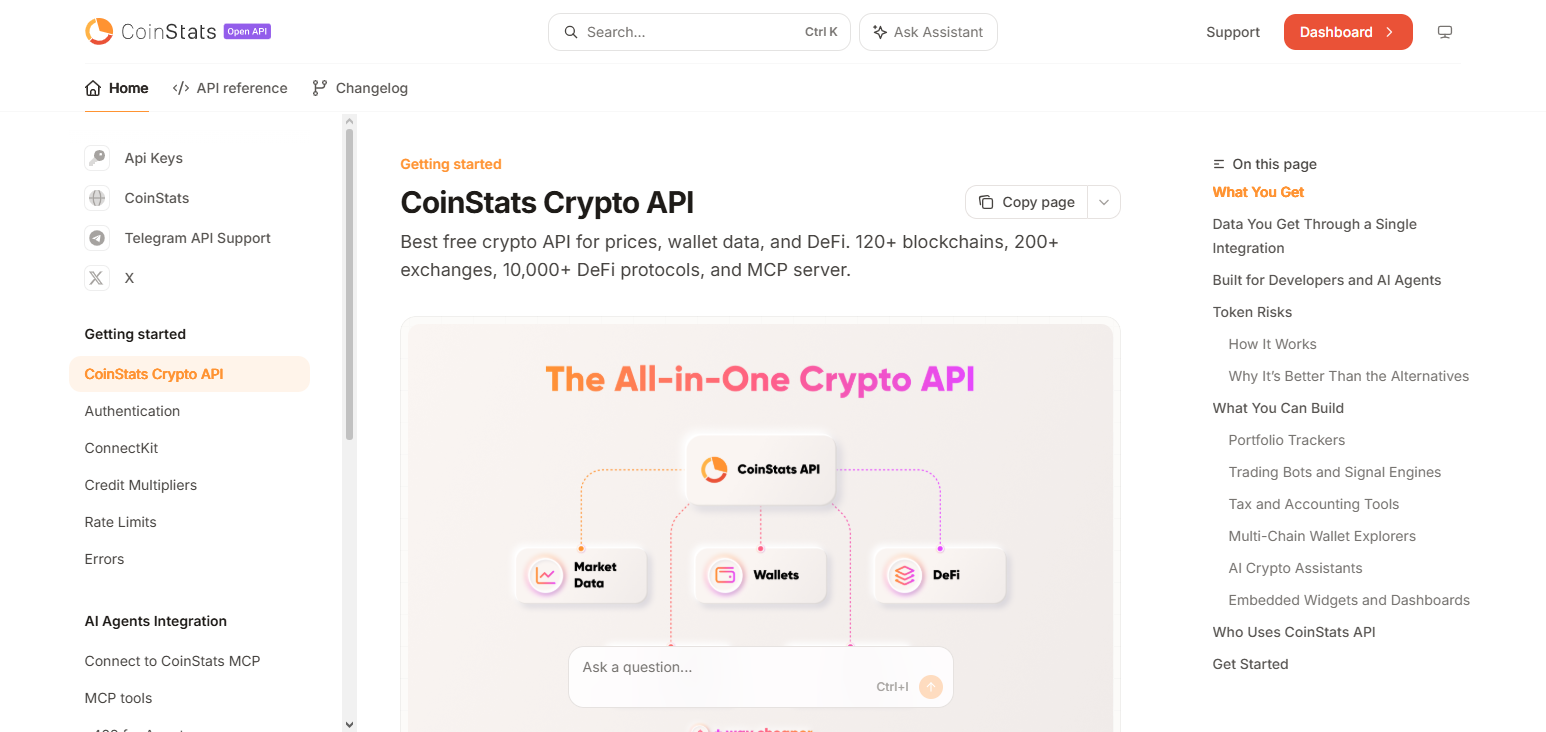
The API helps users with portfolio tracking through structured financial data and analytics. CoinStats API will make it possible to develop customized investor tools that manage and track investments in real time, along with personalized cryptocurrency dashboards.
CoinAPI Features
- All Cryptocurrency Data, Multiple Exchanges: Aggregated data from thousands of exchanges.
- Instant Market Data: Data on trades and order books are available instantly.
- Detailed Historical Market Data: Comprehensive trading history is available.
- Simplified Complex API: One API for accessing numerous crypto data.
- Advanced Analytics: Fintech firms can design sophisticated crypto analytic systems.
| Pros | Cons |
|---|---|
| Enables multi-chain portfolio tracking and investment analysis. | Mainly focused on portfolio management use cases. |
| Helps create personalized crypto dashboards easily. | Advanced features may require premium access. |
| Supports wallet and exchange portfolio monitoring. | Less suitable for high-frequency trading applications. |
| Provides organized financial insights for users. | Limited compared with full exchange APIs. |
| Useful for retail and professional investment platforms. | Data dependency on connected wallets and exchanges. |
9. Glassnode API
Glassnode API offers sophisticated analytics for on-chain data and cryptocurrency markets. This API provides data of numerous metrics including wallet transactional data, exchange data, and market and network analyses.

Professional market analysts and researchers use Glassnode API to track blockchain data and determine market flow. With the demand for data analytics and research for the cryptocurrency markets in 2026, Glassnode will continue to be a leader in the institutional research and analysis of blockchain.
Glassnode API Features
- Advanced On-Chain Analytics: Elaborates on blockchain data for search and research.
- Wallet Activity Tracking: Tracks movements on the blockchain and buying patterns.
- Exchange Flow Data: Document crypto transfers between wallets and exchanges.
- Institutional Research Tools: Aids in the analysis of investment research.
- Market Intelligence Metrics: Defines new crypto market metrics.
| Pros | Cons |
|---|---|
| Provides advanced blockchain analytics and on-chain intelligence. | Pricing is expensive for individual developers. |
| Helps analyze investor behavior and market trends. | Not designed for direct trading operations. |
| Offers valuable metrics for institutional research. | Requires knowledge of blockchain analytics concepts. |
| Supports data-driven investment decision-making. | Access to premium metrics may require higher plans. |
| Useful for professional crypto research platforms. | Less suitable for beginner-level applications. |
10. DexScreener API
For developers creating DeFi applications and trading platforms, the DexScreener API is an invaluable resource. It provides real-time data from decentralized exchanges, tracking token pairs, liquidity pools, pricing, volume, and blockchain activities across DEX networks.

This API facilitates the discovery of new and trending tokens and the analysis of market trends within a decentralized framework. In 2026, the DexScreener API will still be useful to Web3 developers needing quick, clear, and real-time data from the DeFi market.
DexScreener API Features
- Real-Time DEX Data: Provides instant data across all decentralized exchanges.
- Token Pair Tracking: Monitors trading pairs, liquidity, and price.
- DeFi Market Analysis: Enables the analysis of decentralized finance.
- Blockchain Network Support: Supports wider market coverage across multiple blockchain networks.
- Trending Token Discovery: Alerts on new projects and movements in crypto.
| Pros | Cons |
|---|---|
| Provides real-time DEX market data for DeFi applications. | Limited features compared with centralized exchange APIs. |
| Helps track new tokens and liquidity pools quickly. | Data quality depends on blockchain network activity. |
| Supports multiple decentralized exchange ecosystems. | Not ideal for traditional trading platforms. |
| Useful for Web3 analytics and token discovery tools. | May require blockchain development knowledge. |
| Provides fast access to decentralized market information. | Advanced historical analysis capabilities are limited. |
Factors To Consider When Selecting the Best Crypto API for Trading Bots
- Assess API consistency and response time. Fast, consistent API responses mean trading won’t need to be interrupted.
- Analyze API coverage of exchanges and cryptocurrencies. Make sure the APIs you’re looking for will cover the exchanges and digital assets you will need.
- Review the cost of the API and the limits. Make sure your funds and the potential request volume are sufficient for your trading needs.
- Evaluate the security of the API. Strong authentication, encryption, and secure API key storage should be a must.
- Look for integrations that are simple and supported through documentation and SDKs, as well as ongoing responsive support.
- Take into consideration your planned trade automation and volume.
Conclusion
In conclusion, the Best Crypto APIs for Automated Trading Bots deliver highly efficient solutions for the development of automated cryptocurrency trading systems. They offer things like real-time market data or rapid and secure connections to crypto exchanges, advanced trading functions, and more.
When selecting the best Automated Trading Bot API, you need to consider reliability, the features it supports, security, and scalability. Crypto markets are evolving and so are the Automated Trading Bots. These APIs will be very important for cool new features and improvements in trading automation.
FAQ
What are Crypto APIs for Automated Trading Bots?
Crypto APIs allow trading bots to connect with exchanges, access market data, and execute automated trades.
Which is the best Crypto API for trading bots?
Binance API, Coinbase API, Kraken API, and OKX API are popular choices for automated trading.
Are Crypto APIs safe for automated trading?
Yes, secure Crypto APIs use encryption, authentication, and API key protection to safeguard accounts.
Can beginners use Crypto APIs to build trading bots?
Yes, beginners can use developer-friendly APIs with documentation and ready-made integration tools.