This article discusses major platforms for buying Tokenized RWAs and analyzes them based on features, fees, cryptocurrencies, international availability, security, and customer service. We will look at centralized and decentralized trading, as well as dedicated RWA trading platforms.
This will help investors understand the pros and cons of the different structures to determine how practical each is for accessing tokenized real-world assets across global markets.
Key Points
| Platform | 12-word explanation |
|---|---|
| Kraken | Best centralized exchange for diverse tokens, tokenized equities, and xStocks expansion. |
| Binance | Strong regional institutional access, supporting TradFi perpetuals and RWA token pairings. |
| Bybit | Offers advanced tokenized equity collateral options for sophisticated derivatives trading. |
| Securitize | Premier institutional platform for regulated primary-market tokenization of Treasuries and funds. |
| Ondo Finance | Market leader tokenizing US Treasuries and providing institutional equity market access. |
| Grvt | Leading decentralized exchange offering leveraged perpetuals across commodities, forex, and equity RWAs. |
| Franklin Templeton (BENJI) | Traditional asset manager offering direct on-chain tokens representing government money-market funds. |
| Centrifuge | Decentralized credit infrastructure connecting invoice and trade finance with blockchain pools. |
| Maple Finance | Institutional on-chain credit marketplace providing lending infrastructure and capital access globally. |
| WisdomTree | Traditional financial provider expanding broad investor access to digital tokenized funds. |
| STOKR | Compliant issuance gateway enabling alternative securities and Bitcoin-based financial products. |
| Spiko | European platform specializing in regulated tokenized money-market funds for investors. |
| Superstate | Bridges short-term government securities with DeFi-native wrappers for blockchain investors. |
| Kinexys by J.P. Morgan | Enterprise banking infrastructure enabling institutional tokenization of value and cash equivalents. |
| Uniswap / Curve (DeFi Ecosystem) | Decentralized liquidity layers supporting wrapped gold and stable-asset secondary-market trading. |
1. Kraken
Kraken is an established, centralized cryptocurrency exchange that offers a broad access option to the crypto market with its expanding tokenized asset offering. Founded in 2011, Kraken offers an institutional product and is located in the United States.
Kraken offers a wide variety of crypto products, and rates differ according to product and trading volume. Fees are typically maker/taker. The crypto support offered is a large variety of both established and emerging assets, but availability does vary by country.

Kraken offers robust services to a large variety of international clients, provided they meet the applicable regulatory requirements. Kraken offers robust client support with various support channels, and a help center.
Foundation: 2011 | Fees: Maker/taker, volume based | Crypto support: Range of cryptocurrencies | Country Support: Numerous international markets, restrictions apply | Support: Help center and support tickets.
Features of Kraken
- Extensive Crypto Trading: Supports the trading of established and nascent cryptocurrencies across spot markets.
- Tokenized Assets: Expansion into trading products of tokenized equities and tokenized-Stocks for RWA (Risk-Weighted Assets).
- Advanced Trading Infrastructure: Maker/Taker pricing, institutional services, and various trading tools.
- Global Reach: Serves multiple jurisdictions with country-specific regulatory frameworks and restrictions. This service is supported by a helpdesk.
2. Binance
Binance is one of the biggest cryptocurrency exchanges globally, and offers extensive spot, derivatives, and institutional markets infrastructure. The company started operations in 2017. It offers products pertaining to cryptocurrencies, stablecoins, derivatives, and a few real world assets trading.
When it comes to competitive spot fees, Binance generally charges about 0.10%, with other varied fees, and discounts depending on the circumstances.

Binance supports a large variety of cryptocurrencies, with users prevalent in most countries, although products and services vary drastically depending on the location.
Binance’s main customer support channel is their online Help Center, with 24/7 support, which is ideal for active international crypto traders.
2017 | Competitive fees (generally 0.10% for spot trading), depending on the circumstances | Very Extensive | Global but varies depending on the jurisdiction | 24/7 online support.
Features of Binance
- Wide Range of Cryptocurrency: Supports a large selection of cryptocurrencies and digital assets.
- Spot and Derivatives: Offers Spot and a range of margin, futures, and advanced trading products.
- Global Trading Ecosystem: International accessibility, a full range of institutional services, and 24/7 customer support.
3. Bybit
Bybit is an international crypto exchange that is heavily focused on derivatives, advanced trading tools, and diversified digital assets. Bybit started operations in 2018, and offers spot trading, perpetual contracts, options, and other crypto related financial products.
Bybit’s foray into tokenized equity collateral and real world asset technology makes it attractive for crypto traders that want to take exposure in traditional markets and combine it with crypto derivative markets.

Fees vary across products and account tiers, with maker/taker fees along trading volume. Bybit operates internationally; however services are restricted to a few countries based on regulatory needs. Customer support is available 24/7 via online, and through help documentation and support tickets.
Established: 2018 | Fees: Maker/taker and volume-based | Crypto Support: Extensive cryptocurrencies and derivatives| Country Support: International, with restricted jurisdictions | Customer Support: 24/7 online support.
Features of Bybit
- Advanced Derivatives: Trading of perpetual contracts, options, futures, and other advanced products for experienced cryptocurrency derivatives traders.
- Tokenized Equity Integration: Integrates tokenized equity collateral and other projects connecting traditional and digital markets.
- Multiple digital assets: Provides spot and derivatives trading of various digital assets and cryptocurrencies.
- Professional Trading Tools: Advanced trading interfaces, and online documentation with 24/7 professional customer support.
4. Securitize
Securitize offers a unique perspective on crypto exchanges, offering an end-to-end solution for the regulated tokenization of real-world assets and securities. Established in 2017, Securitize helps with the issuance, control, and distribution of blockchain securities, including tokenized Treasuries and private market funds.
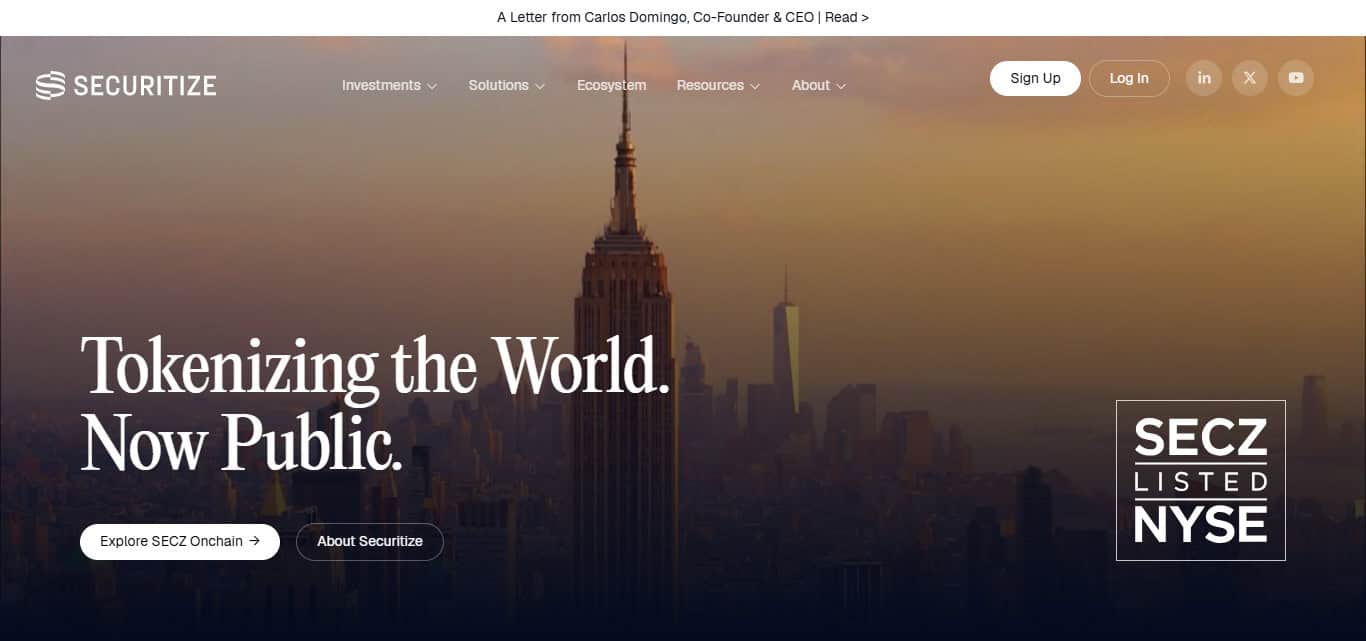
Unlike most crypto exchanges that focus on being low-cost and high-volume, Securitize takes a compliance-first, higher investor participation, regulated issuance focus, where its fees are more product and transaction-specific than a public exchange maker/taker model.
Its crypto support is infant whereas its blockchain-based tokenized securities and digital assets will vary by product offered. Availability is heavily jurisdiction dependent. Customer support is designed to be more institutional and verified investor centric.
Established: 2017 | Fees: Product/transaction specific |Crypto Support: Blockchain-based tokenized securities and digital assets |Country Support: Regulation-dependent |Customer Support: Investor and institutional support.
Features of Securitize
- Tokenization Infrastructure: Offers compliant infrastructure for digital securities and traditional securities tokenization.
- Institutional RWA Products: Tokenized U.S. Treasuries, private market funds, and other licensed investment products.
- Primary Market: Offers infrastructure for the issuance, management, and distribution of digital securities. Also includes investor on-boarding and administration.
- Compliance-Focused Platform: Uses investor verification and regulatory processes, with availability based on jurisdiction and eligibility.
5. Ondo Finance
Ondo Finance is an early player in moving financial assets onto public blockchains. The company was founded in 2021. It became known for products related to securitization of U.S. Treasury debt – the first of its kind – while also creating a platform for securitization of global debt.
Unlike most centralized exchanges, fees are not standardized at Ondo Finance. They depend on specific products and transactions, the blockchain, and the arrangement made. The focus is on stable assets and blockchain tokens.
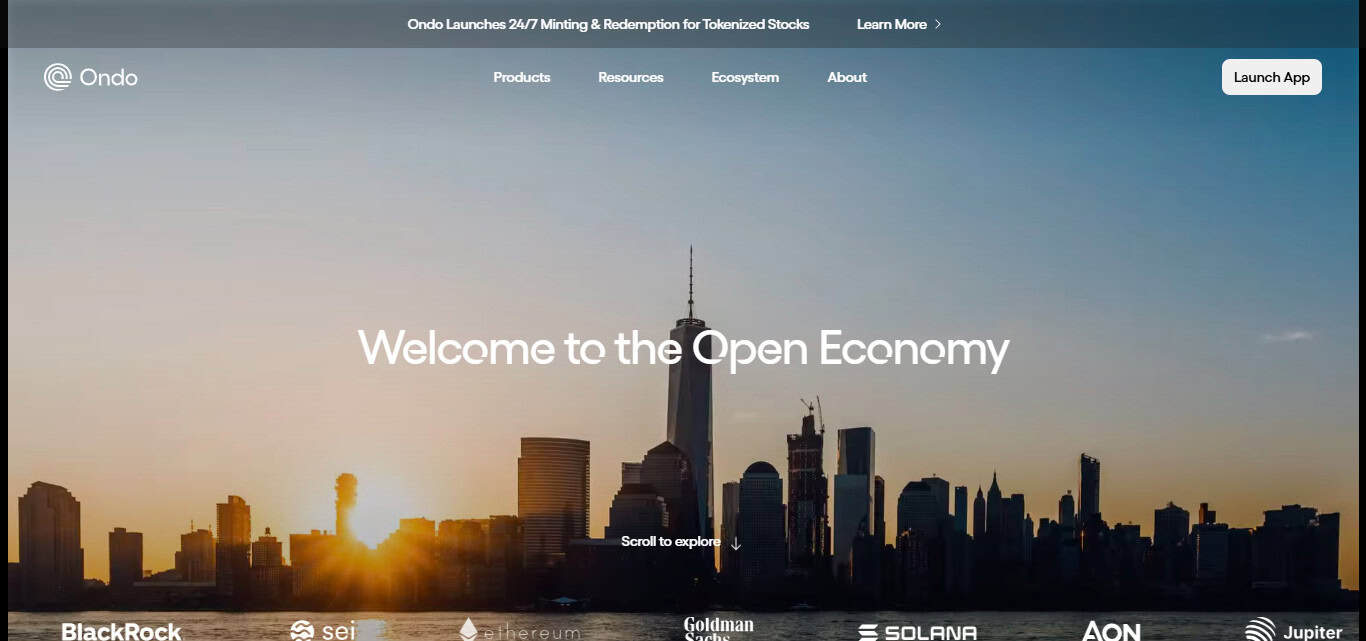
Strong regulations and compliance constraints on security offerings determine country availability. Customer support is through online documentation and digital communication.
Founded: 2021 | Fees: Product, transaction specific | Crypto Support: Blockchain tokens, RWA products | Country Support: Jurisdiction specific | Customer Support: Online documentation, digital support.
Features of Ondo Finance
- Tokenized Treasury Products: Has blockchain-based access to U.S. Treasury-related assets along with specialized RWA products.
- Yield-Oriented Assets: Has products to give investors exposure to traditional financial assets with an emphasis on yield.
- Institutional RWA Infrastructure: Connects traditional financial markets to blockchain-based settlement and digital asset markets.
- DeFi Connectivity: Is designed to connect blockchain-based traditional assets to other elements of the decentralized-finance ecosystem.
6. Grvt
Grvt was founded to (in its own words) “take trading into the future”, focusing on faster, better, and more advanced derivatives. The trading focuses on commodities, foreign exchange, and tokenized or synthetically real-world assets, depending on the product.
Grvt positions itself as unique and different from centralized exchanges, meaning users interact directly with the blockchain infrastructure and may not even have custodial accounts. Trading fees are structured differentiated per market and heterogeneous trading forms.
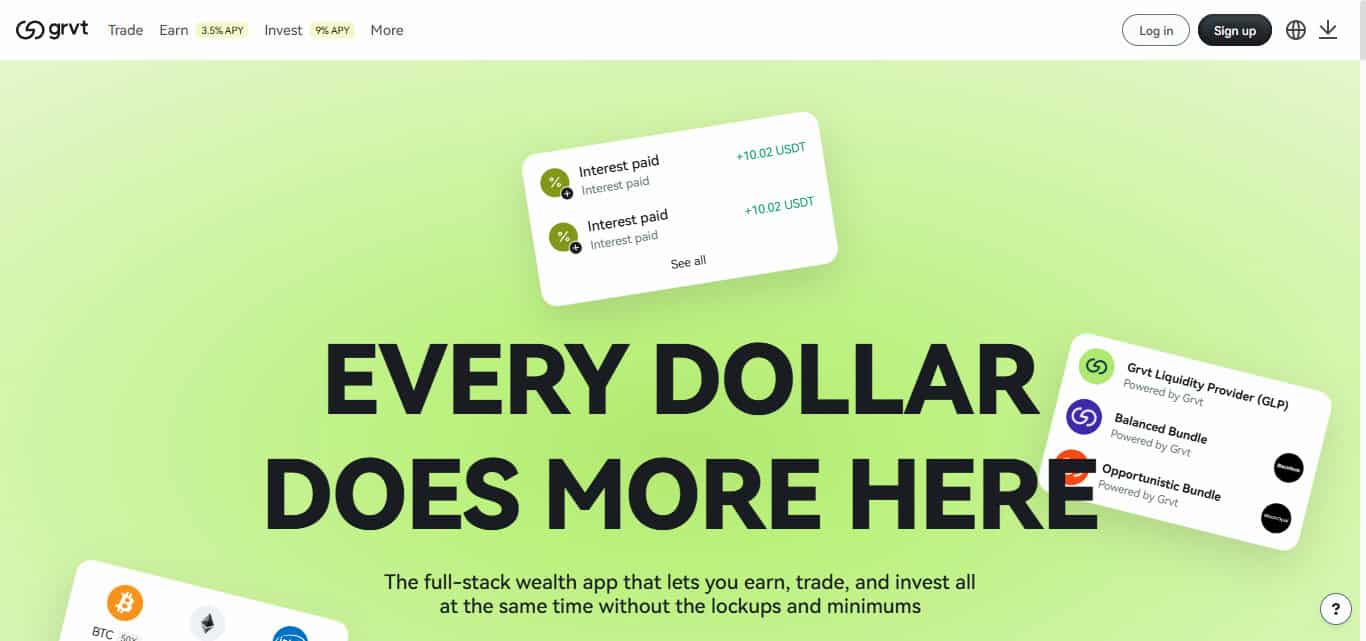
Crypto and RWA liquidity will change with new market creation. Geographic access is defined by the constraints, and customer support is online documentation and digital support, as well as community-based engagement.
Established: 2023 | Fees: Depends on market/product | Crypto Support: Derivatives and selected RWA markets | Country Support: Depends on jurisdiction | Customer Support: Online docs, digital/community support.
Features of Grvt
- Decentralized Derivatives: Has blockchain-based trading for perpetual contracts and other advanced derivatives products.
- Diversified RWA Markets: Looks at commodities, foreign exchange, and selected tokenized or synthetic real-world assets.
- High-Leverage Trading: Has markets focused primarily on high-leverage trading, geared toward derivatives trading.
- Blockchain-Based Infrastructure: Strives to have decentralized architecture, online resources, community activity, and market availability.
7. Franklin Templeton (BENJI)
Traditional asset managers using blockchain to issue regulated funds is still early days, but Franklin Templeton is showing the way. Founded in 1947, Franklin Templeton launched the first blockchain-enabled U.S. Government Money Fund in 2021, with BENJI as its first fund share token.
BENJI provides on-chain access to a government money market fund and breaks new ground in the industry with unique fees specifically designed to discourage trading.
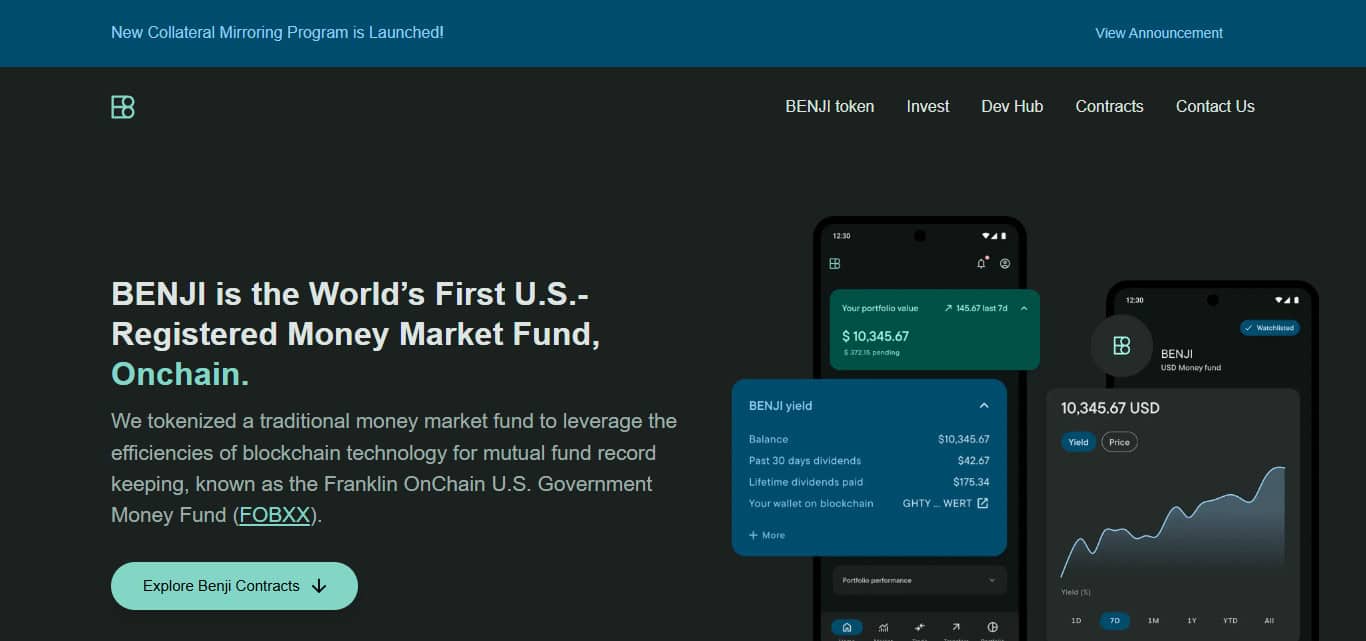
As such, Crypto support is orientated around tokenized fund shares. Availability is highly dependent on jurisdiction and professional customer support.
Established: 1947; BENJI/on-chain fund launched 2021 | Fees: Fund/product expenses apply | Crypto Support: BENJI tokenized fund shares | Country Support: Eligibility and jurisdiction dependent | Customer Support: Franklin Templeton investor support.
Features of Franklin Templeton (BENJI)
- On-Chain Money Fund: Represents blockchain-based money market funds from Franklin Templeton.
- Government Securities Exposure: Offers blockchain-based access to portfolios focused on securities of governments.
- Traditional Asset Management: Brings asset-management experience to the blockchain-based ownership and transaction infrastructure of traditional assets.
- Regulated Investment Structure: Offers regulated investment structures, depending on investor eligibility.
8. Centrifuge
Centrifuge seeks to link blockchain-based credit markets to real-world assets through decentralized financial infrastructure. Initiated in 2017, Centrifuge aims to incorporate invoices, trade finance receivables, structured credit, and various other private market assets into credit markets via tokenized pools.
Instead of building a traditional retail crypto exchange, Centrifuge offers infrastructure for asset managers, borrowers, and investors to interact with on-chain credit markets. Fees are determined by specific pools and transactions and by the nature of the service contract.

crypto support encompasses blockchain assets and tokenized credit. Geographic availability depends on meeting regulatory requirements; customer support is primarily offered through documentation, technical support, and communication and community-based channels.
Established: 2017 | Fees: Dependent on Pool/Product | Crypto Support: Blockchain assets and tokenized credit | Country Support: Regulation based | Customer Support: Documentation and community/technical support.
Features of Centrifuge
- Tokenized Private Credit: Tokenizes private credit and pool investments in trade receivables, invoices, structured credit, and other credit investments.
- RWA Financing Infrastructure: Connects borrowers, asset managers, and pooled investors using decentralized credit-market infrastructure.
- On-Chain Asset Pools: Cooperates with blockchain-based pools to shape and control exposure to conventional financial world assets.
- DeFi Integration: Links credit that is tokenized with decentralized finance infrastructure while addressing the requisite compliance issues.
9. Maple Finance
Maple Finance provides institutional borrowers with digital credit and blockchain-based lending infrastructure. Founded in 2019, Maple earned recognition for its development of crypto native credit markets, and then focused on building institutional lending products designed for experienced credit and financing professionals.
Maple is not focused on traditional retail markets, and as such, fees are determined more by the lending pools, the structure of loans, or the service contract, as opposed to simple trading fees. Crypto support encompasses digital assets and institutional credit markets.

RWA exposure is determined by the product offered. Availability is dependent on regulation and the investors served. Customer support is directed toward institutional clients through online resources and direct business support.
Established: 2019 | Fees: Loan/pool/product dependent | Crypto Support: Digital assets and institutional credit | Country Support: Eligibility and jurisdiction dependent | Customer Support: Online and institutional support.
Features of Maple Finance
- Institutional Lending: Constructs credit infrastructure that is blockchain-based primarily for institutional and professional lending.
- Credit Markets: Implements lending infrastructure and structured credit in the context of digital asset financing.
- Digital Assets: Focuses on institutional digital asset credit and digital asset trading over traditional retail trading.
- Professional Infrastructure: Provides resources and direct support to institutions and structured lending.
10. WisdomTree
WisdomTree is a major provider of traditional financial services that has begun offering blockchain-based products and services. The group was established in 1985. The company sponsors and manages traditional market-based investment products.
Meanwhile, the company also actively seeks to improve market access for tokenized funds through its digital asset initiatives. Unlike traditional cryptocurrency exchanges, WisdomTree’s token offerings charge variable fees that are dependent on the product, fund, or the nature of the transaction.

Cryptocurrency support, therefore, is more offerings focused on a few blockchain-based products than exchanges with hundreds of listed cryptocurrencies. Country availability is based on the product and regulations. Customer support is provided through established financial services. This include investor resources and operational support.
Established: 1985| Fees: Product/fund specific | Crypto Support: Selected digital and tokenized investment products | Country Support: Product and regulation dependent| Customer Support: Investor and financial services support.
Features of WisdomTree
- Tokenized Investment Products: Creates investment products utilizing blockchain alongside the traditional financial products that they offer.
- Digital Assets: Investment products and funds that are tokenized, or represented digitally, are the focus of this initiative.
- Experience with Traditional Finances: Blockchain and digital asset infrastructure, coupled with experience in asset management, is this company’s value proposition.
- Regulated Markets: Individual products differentiate themselves in terms of Russia, asset-market availability, pricing, and the degree of access afforded to investors.
11. STOKR
Launched in 2018, STOKR is Europe’s first compliant tokenized securities digital marketplace and issuance infrastructure. Focused on institutions and companies dealing with private securities, investor compliance, and regulatory frameworks, the firm provides infrastructure based on blockchain technology to facilitate such transactions.
Distinguishing itself from digital currency exchanges, STOKR focuses on alternative investments and Python-based securities. The firm levies fees according to the nature and complexity of the services requested. The fees may include both issuance and transaction fees, and may or may not follow a spot-trading mechanism.

The firm supports crypto transactions based on Bitcoin and blockchain securities. The firm’s geographic access is regulated by the securities laws and the eligible investors. Customer support is primarily based on the digital platform.
Founded: 2018, Fees: Depend on securities issued plus services/transactions, Crypto Support: Bitcoin and tokenized securities, Country Support: Access constrained to Europe/international based on applicable regulations, Customer Support: Online, Platform.
Features of STOKR
- Digital Securities Marketplace: Creates a system to tokenize and issue securities and alternative investment products in a blockchain platform.
- Compliance: Focused on the tokenization of securities and compliance regarding all digital securities.
- Bitcoin Securities: Investment products focused on securities connected to Bitcoin and blockchain-based securities.
- Alternative Investments: Provides a digital platform for alternative systems and financial networks
12. Spiko
Spiko is a European fintech platform that focuses on blockchain infrastructure for tokenized money-market funds. The firm was launched in 2023. Spiko offers products to combine short-term financial instruments and blockchain ownership and settlement.
Spiko, as an innovative Fintech platform, provides services that are more aligned to a regulated tokenized fund platform.
Fees for these services will be determined by the individual funds and products. In such circumstances, investors are required to review the relevant fund documentation.
Crypto support for Spiko is primarily focused on crypto representations of financial assets, and not a broad cryptocurrency inventory. Country access is determined by European regulatory frameworks and product distribution, and is also dependent on eligible investors. Customer support is primarily digital.
Established: 2023 | Fees: Fund/product specific | Crypto Support: Tokenized money-market funds | Country Support: Primarily European, subject to eligibility | Customer Support: Online customer assistance.
Features of Spiko
- Money Market Funds: focuses money market funds based on blockchain and represents regulated money market funds.
- European Market Focus: Concentration on the financial markets of Europe and on the European regulatory framework.
- Blockchain Settlement: merges traditional short-term financial instruments with the ownership and settlement of assets on the blockchain.
- Digital Investor Access: builds online investment infrastructure. Investment opportunities are offered based on investor classification and eligibility, as well as product availability.
13. Superstate
Founded in 2023, Superstate provides institutional investors with access to traditional short-duration government securities via blockchain technology. The firm has revolutionary tokenized investment products designed as proxies for short-term government securities.
DeFi users may be attracted to these products due to the combination of traditional asset backing and programmable on-chain infrastructure. Fees are product specific and are not conventional cryptocurrency exchange fees.
Currently, the firm’s focus is on funds and assets within liquid ecosystems. Geographic availability is subject to financial regulations and investor eligibility. Customer support is online and throughcase specific digital support systems.
Features of Superstate
- Tokenized Government Securities: focuses on short-term government securities and their use as the main underlying assets for investment products deployed on a blockchain.
- DeFi Compatibility: aims to integrate traditional capital market assets with programmable decentralized finance.
- On-Chain Investment: allows eligible investors to access traditional-asset exposure through blockchain-based products.
- Institutional RWA Focus: is designed to provide access to regulated financial assets, based on investor classification and jurisdiction.
14. Kinexys by J.P. Morgan
Focused on the institutional-side of enterprise financial services, this division of J.P. Morgan was built in 2015 and added the Kinexys brand in 2024. J.P. Morgan’s division provides financial services built on top of blockchain for tokenized money and payments, digital assets, and infrastructure for institutions to transfer value.
These services are priced on a case-by-case basis and may differ from typical retail crypto-exchange commissions. J.P. Morgan’s division offers services for crypto in the institutional space of digital assets and tokenized financial instruments.
Currently, the services are predominantly for institutional customers, and availability may vary by country. Customer support is offered through J.P. Morgan’s enterprise banking services and support networks.
Established: 2015 Blockchain Initiatives | Fees: Institutional/Product Specific | Crypto Support: Tokenized Financial Assets | Country Support: International Institutional Access, Restrictions Apply | Customer Support: Enterprise Banking Support
Features of Kinexys by J.P. Morgan
- Institutional Blockchain Infrastructure: provides a blockchain infrastructure for use by banks, corporations, and other participants in the institutional financial market.
- Tokenized Money and Payments: supports blockchain-based infrastructures for payments and cash.
- Digital Asset Infrastructure: provides blockchain-based financial assets and institutional solutions for value transfer.
- Enterprise Banking Integration: operates within J.P. Morgan’s banking ecosystem and offers professional institutional support.
15. Uniswap / Curve — DeFi Ecosystem
Uniswap and Curve are decentralized automated market maker (AMM) systems rather than centralized exchanges or dedicated RWA issuers.
Uniswap is older at 2018 and Curve launched in 2020. They both provide key secondary market liquidity for digital assets, stablecoins and tokenized real world assets.
Like centralized exchanges, users incur gas and protocol trading fees, but the fee is pool related and network dependent. Crypto asset support is vast, as users can interact with any compatible tokens and liquidity pools, however pools can still vary enormously.

There is generally blockchain based access and customer support is mainly via documentation, governance, and community channels and ecosystem resources.
Established: Uniswap (2018), Curve (2020) Fees: Pool specific trading fees and network gas Crypto Support: Very broad token ecosystem Country Support: Generally global blockchain access, restrictions may apply Customer Support: Documentation and community support.
Features of Uniswap / Curve — DeFi Ecosystem
- Automated Market Makers: leverages a model pioneered by decentralized liquidity pools and opposed to traditional central limit order books.
- Secondary RWA Liquidity: can offer secondary market liquidity for compatible tokenized assets and stable coins as well as wrapped assets.
- Broad Token Compatibility: support is dependent on the liquidity of the pool, the blockchain, and individual tokens.
- Permissionless DeFi Access: offers permissionless trading and liquidity provision, subject to the risk of smart contracts and an active market.
Conclusion
In conclusion, the best crypto exchanges for tokenized RWAs will depend on your investment plan, your preferences, and the fees. The level of regulatory access and the features of the platforms will also be critical. Kraken, Binance, and Bybit have the largest crypto market access.
On the other hand, Securitize, Ondo Finance, and other tokenized real-world assets dedicated platforms prioritize that asset class. To select a platform, investors must balance availability, security, liquidity, compliance, and risks.
FAQ
Which exchanges support tokenized RWAs?
Kraken, Binance, and Bybit increasingly support selected tokenized RWA products.
Are tokenized RWAs available worldwide?
Availability varies according to local regulations, investor eligibility, and platform restrictions.
Are tokenized RWAs safe investments?
They involve market, regulatory, liquidity, custody, issuer, and smart-contract risks.
What fees apply to tokenized RWAs?
Fees vary by platform, product, transaction type, blockchain, and trading volume.