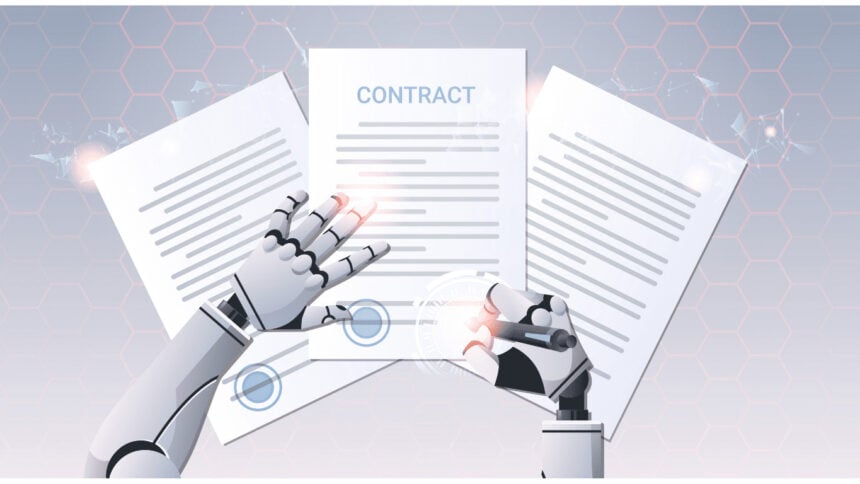
In this post, I will share Contract Review Tools Saving Hundreds of Hours for Lawyers and how modern legal workflows are being reshaped by AI-powered platforms.
Such advanced tools assist lawyers in automating contract drafting, flag risky clauses, and improve compliance while limiting a large part of repetitive manual tasks.
Businesses, whether it be startups or perhaps large law firms, are gradually moving to this intelligent contract review software to get an edge on productivity
Accuracy in the legal department and overall efficiency in the workplace, given that the present-day legal environment is ever-changing.
Key Points & Contract Review Tools Saving Lawyers Hundreds of Hours
Spellbook automates contract drafting, reviewing, and clause suggestions, reducing repetitive legal document workload.
LegalOn identifies risky clauses instantly, helping lawyers review contracts faster with improved legal accuracy.
Luminance uses machine learning analyzing contracts quickly, uncovering hidden risks and inconsistencies for lawyers.
Harvey AI assists legal professionals in drafting contracts, conducting research, and automating repetitive legal tasks efficiently.
CoCounsel streamlines legal workflows through AI-powered contract analysis, summarization, and legal research capabilities.
Kira Systems extracts important contract clauses automatically, accelerating due diligence and compliance review processes significantly.
Legalfy enhances legal productivity through automated drafting, contract analysis, and multilingual legal document support.
Definitely simplifies contract navigation using AI definitions, clause references, and document drafting assistance tools.
SpotDraft automates contract workflows, approvals, and compliance tracking, saving legal teams valuable operational time.
goHeather reviews agreements automatically, flagging legal risks and simplifying complex contract understanding for businesses.
10 Contract Review Tools Saving Lawyers Hundreds of Hours
1. Spellbook
Spellbook is one of the fastest-growing AI contract review tools for modern law firms and in-house legal teams.
The LLM is built directly in Microsoft Word and enables lawyers to draft contracts, suggest missing clauses and immediately rewrite legal language without switching platforms.
Its newest generative AI features allow legal professionals to assess agreements against company preferences in seconds.
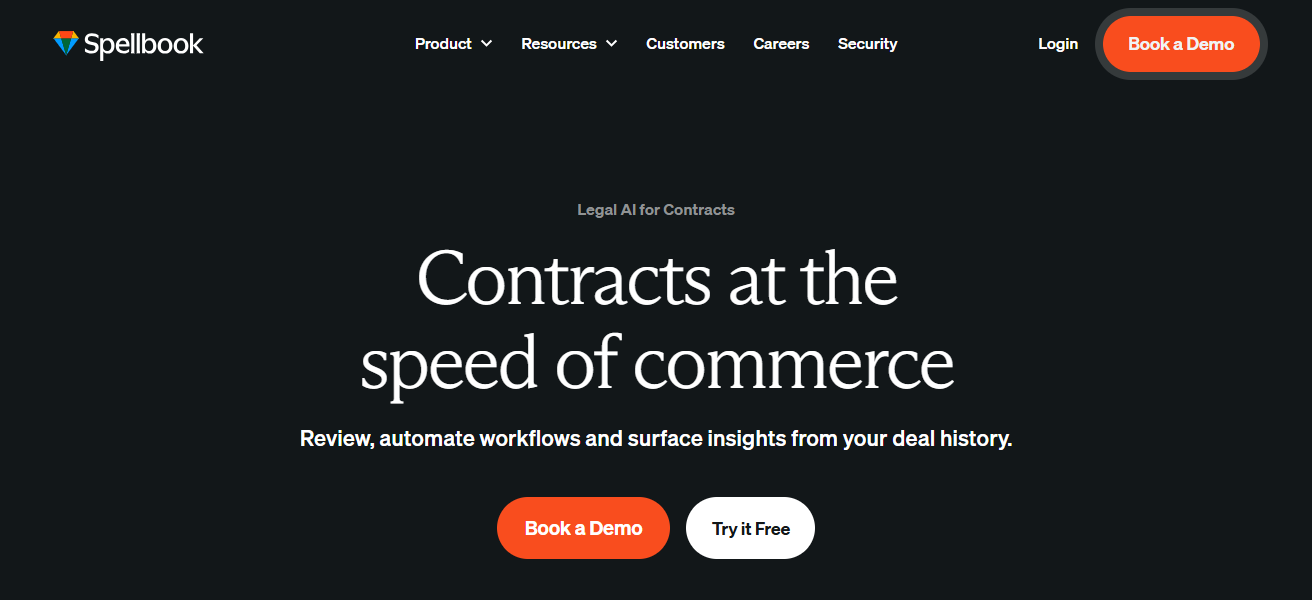
Today, Spellbook is adopted by so many firms to save hours on repetitive drafting while increasing consistency across contracts.
It is particularly popular among startups, corporate legal departments, and small firms looking for lower-cost AI-powered legal automation.
| Pros | Cons |
|---|---|
| Works directly inside Microsoft Word for seamless legal drafting workflows. | Requires internet connectivity for full AI-powered functionality and live suggestions. |
| Generates smart clause suggestions and contract rewrites within seconds automatically. | Advanced features may feel overwhelming for lawyers unfamiliar with AI platforms. |
| Reduces repetitive drafting tasks, saving law firms significant working hours daily. | Smaller firms may find premium pricing expensive for limited contract volumes. |
| Helps maintain contract consistency using company-approved legal language standards effectively. | AI-generated clauses still require human verification for sensitive legal agreements. |
2. LegalOn
LegalOn is changing how contracts are reviewed, by promoting through our software lawyers to identify the risks where clauses could lead to a negative impact on an agreement.
AI plus attorney-built playbooks make legal compliance & negotiations much easier with this powerful platform.

Its most recent updates offer intelligent recommendations of clause and fallback language, as well as automatic spotting of potential issues with NDAs, vendor agreements, and SaaS contracts.
As companies need to complete contract approvals faster and at the same time ensure legal accuracy, LegalOn is rapidly being adopted (KS).
It is designed to help busy corporate legal teams save time reviewing high volumes of contracts while still completely preserving the legal nature and protection of business obligations.
| Pros | Cons |
|---|---|
| Detects risky clauses quickly using attorney-built legal review playbooks intelligently. | Best performance mainly focused on commercial and corporate contract categories currently. |
| Smaller businesses may not fully utilize the advanced enterprise-focused compliance features available. | Best performance is mainly focused on commercial and corporate contract categories currently. |
| Excellent for reviewing NDAs, SaaS agreements, and vendor contracts efficiently daily. | Customizing internal legal standards may require additional onboarding and training initially. |
| Speeds up contract turnaround without compromising professional legal review quality standards. | Limited offline functionality compared to traditional contract management software solutions today. |
3. Luminance
Built–for–Law ML. You may already know that Luminance is on the cutting edge of legal AI, but few people understand what makes us truly special in the contract analysis system and due diligence space.
The platform can quickly read through thousands of legal documents, detect discrepancies, and reveal concealed risks that might be missed by human reviewers.
The latest AI innovations include multilingual contract analysis and smart anomaly detection in mergers, acquisitions, and compliance reviews.

Luminance is employed by global law firms and enterprise legal departments to decrease the manual review workload without compromising on accuracy.
The software is particularly useful for larger corporate transactions, when a transaction requires rapid execution, pinpoint target marking capabilities and level of visibility to the terms of documents.
| Pros | Cons |
|---|---|
| Uses advanced machine learning for accurate large-scale contract analysis and due diligence. | Enterprise-level pricing may be difficult for smaller legal practices to afford. |
| Identifies hidden inconsistencies and anomalies across thousands of legal documents rapidly. | Initial implementation may require technical setup and internal workflow adjustments carefully. |
| Supports multilingual contract review for international mergers and acquisitions efficiently worldwide. | Some complex legal interpretations still depend heavily on experienced human reviewers internally. |
| Reduces manual review workloads while improving speed and document transparency significantly overall. | Learning curve may challenge non-technical legal teams during early adoption stages initially. |
4. Harvey AI
So, Harvey AI is like the blockbuster generative AI power-house for legal professionals that has quickly grabbed the eye of many top law firms.
Powered by state-of-the-art large language model technology, Harvey helps lawyers draft contracts, summarize cases, perform legal research, and prepare litigation documents more quickly than they can with conventional methods.
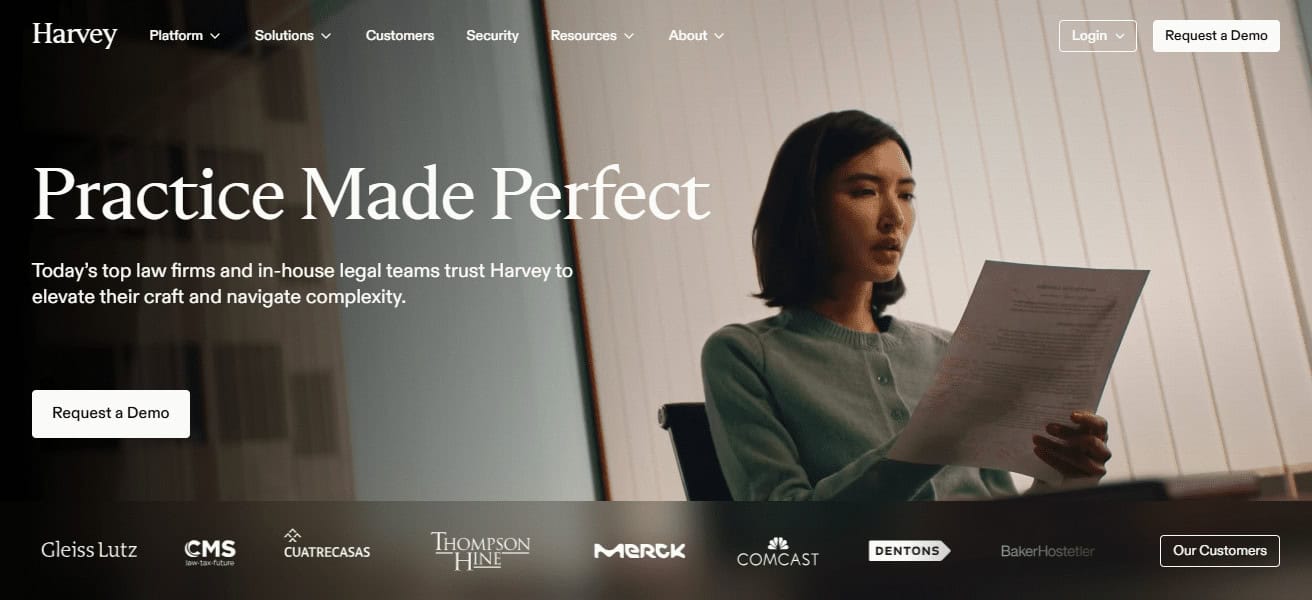
Recent releases have enhanced its readiness to handle complex legal workflows and enterprise-level legal operations.
Large enterprises worldwide are increasingly utilizing Harvey AI to boost efficiency and save on time spent performing repetitive research and drafting tasks.
The fact that it can help with legal assistance in a context-aware manner makes it ideal for modern-day law offices.
| Pros | Cons |
|---|---|
| Assists with legal drafting, research, summarization, and litigation preparation tasks efficiently. | AI-generated legal content still requires careful lawyer supervision before final submission. |
| Uses advanced generative AI technology tailored specifically for modern legal professionals globally. | Premium enterprise adoption costs may not suit small independent legal practices financially. |
| Improves productivity by reducing repetitive research and administrative legal tasks dramatically. | Some jurisdictions may have concerns regarding AI compliance and confidentiality regulations. |
| Provides context-aware assistance for complex legal workflows and case preparation effectively. | Heavy reliance on AI may reduce traditional manual research skill development gradually. |
5. CoCounsel (Thomson Reuters)
As firms look to increase the speed and reliability of their legal workflows, CoCounsel from Thomson Reuters is quickly growing into the go-to AI legal assistant.
The platform enhances the ability to review contracts, summarize long legal documents, conduct legal research and analyze compliance risks using AI.
Its latest expansion includes scaling it up as an efficient tool for large document review projects with a robust legal accuracy standard.

CoCounsel helps legal professionals save hundreds of hours spent on tedious manual research and repetitive administrative tasks.
In addition, its integration with Thomson Reuters trusted legal databases provides a competitive edge for users of professional legal research and case preparation.
| Pros | Cons |
|---|---|
| Integrates with trusted Thomson Reuters databases for accurate legal research capabilities. | Full platform access may require expensive subscriptions for advanced enterprise features. |
| Handles large-scale document review projects with strong legal accuracy and reliability consistently. | Dependence on connected legal databases may limit flexibility for independent workflows occasionally. |
| Automates contract summaries, compliance reviews, and repetitive legal administrative tasks efficiently. | AI recommendations still require careful lawyer verification for high-risk legal matters carefully. |
| Saves hundreds of working hours previously spent on manual legal research processes. | AI recommendations still require careful lawyer verification for high-risk legal matters. |
6. Kira Systems (Litera)
For years now, Kira Systems has been a key player in AI-enabled contract analysis and due diligence automation.
The platform automatically identifies the most important clauses, obligations, and essential data points from contracts to help lawyers review complex legal documents even faster.
Recent machine learning improvements enable increased customization for industry-focused agreements and compliance monitoring activities.

Kira Systems is more frequently used by law firms specializing in mergers and acquisitions, as well as corporate audits, allowing them to cut down on review time but increasing their accuracy.
The software diminishes manual document analysis, increasing time for legal teams to focus on strategic advisory work rather than mundane contract review.
| Pros | Cons |
|---|---|
| Extracts key clauses and obligations from contracts automatically with impressive speed accuracy. | Platform customization may require technical expertise and dedicated implementation support teams. |
| Ideal for mergers, acquisitions, audits, and corporate due diligence projects globally today. | Pricing structure may appear expensive for startups or smaller law firms initially. |
| Supports industry-specific customization for compliance and contract monitoring workflows effectively. | Some legal document formats may require manual adjustments before automated analysis begins. |
| Reduces repetitive document review, allowing lawyers focus strategic advisory responsibilities more effectively. | Training teams to maximize software capabilities can take additional operational time internally. |
7. Legalfly
Legalfly is re-structuring itself into a future-ready productivity tool to support simple drafting and multilingual legal communication to the upcoming wave of legal product platforms.
The software assists lawyers with automating document generation, reviewing contracts, and translating legal content across different languages with better contextual understanding.

Recent advancements, such as AI-based legal summarization tools and workflow automation (which provides support for international legal operations) are the same coin in their shoes.
Due to its emphasis on accessibility and automation, it makes the solution very attractive for global companies, legal advisors & firms dealing with cross-border contracts on a regular basis.
| Pros | Cons |
|---|---|
| Supports multilingual legal drafting and translation for international business agreements efficiently. | Translation accuracy may vary depending on highly specialized regional legal terminology occasionally. |
| Automates legal document creation and contract summarization improving workflow productivity significantly. | Advanced automation tools may require premium subscriptions for complete platform access features. |
| Useful for global legal teams managing cross-border contracts and compliance responsibilities daily. | Automates legal document creation and contract summarization, improving workflow productivity significantly. |
| Enhances accessibility with user-friendly AI-powered drafting and workflow automation systems effectively. | AI-generated translations still require human review before critical legal document submission. |
8. Definely
Definely is changing the game for how lawyers work with complex contracts and long-form legal documents.
With Contract Companion, you never leave the contract because everything you need—definitions and clause references through simple clicks as well as instant access to linked legal terms—is seamlessly integrated into the app.
The newest AI-powered drafting features assist lawyers in reviewing agreements faster and minimizing errors from missed references.

Definitely is being adopted by large commercial law firms to accelerate negotiation and document collaboration.
The platform helps lawyers gain a better understanding of documents and workflows, and allows them to spend less time sifting through contracts and more time focusing on the strategic side of legal.
| Pros | Cons |
|---|---|
| Simplifies contract navigation with instant clause references and legal term definitions automatically. | Primarily focused on document productivity rather than complete contract lifecycle management systems. |
| Improves drafting accuracy by reducing overlooked references and contractual inconsistencies significantly overall. | Advanced features may require integration with existing legal software environments carefully managed. |
| Helps lawyers review lengthy contracts faster without leaving document workspaces unnecessarily often. | Some smaller firms may consider functionality too specialized for everyday legal operations. |
| Enhances collaboration during negotiations through better document readability and accessibility improvements consistently. | Initial onboarding may require training for teams unfamiliar with AI-assisted drafting platforms. |
9. SpotDraft
SpotDraft is rapidly becoming the go-to for intelligent contract lifecycle management among corporate legal teams.
It automates drafting, approvals, e-signatures, as well as obligation tracking and compliance management within a unified workflow.
Recent updates center around AI-assisted contract summaries and analytics tools enabling businesses to better track agreement performance.

SpotDraft helps companies that process a high volume of contracts mitigate delays stemming from manual processes and disjointed approval systems.
Its modern automation capabilities help legal teams work seamlessly with sales, procurement, and finance functions — minimizing operational bottlenecks and improving overall contract visibility.
| Pros | Cons |
|---|---|
| Automates drafting, approvals, e-signatures, and compliance tracking within single workflow platform. | Complex enterprise integrations may require additional technical configuration and onboarding support initially. |
| Improves collaboration between legal, procurement, finance, and sales departments effectively organization-wide. | Smaller companies may not require all lifecycle management automation capabilities available currently. |
| AI-powered summaries and analytics improve contract visibility and performance monitoring significantly overall. | Advanced analytics features may involve higher pricing plans for enterprise customers specifically. |
| Eliminates delays caused by disconnected approval systems and manual contract handling processes. | Teams transitioning from traditional workflows may experience temporary operational adjustment challenges initially. |
10. goHeather
It is no longer just a playbook to guide you in implementing strategies to develop your business; goHeather has very swiftly become the AI-driven contract review solution for start-ups and SMEs looking for affordable legal assistance compared.
The platform automates the review of agreements, flags risky clauses, and describes legal jargon in layman’s terms understandable to non-lawyers.

The service is adding new features all the time, including template contracts that can be tailored to your needs and a way of scoring how strong or weak a legal agreement may be in an instant (such as for employment agreements, NDAs, and freelance contracts).
A large number of emerging businesses have chosen goHeather as it saves the cost of legal implications while allowing the users to comprehend contractual obligations prior to signing any documents.
The platform seems particularly appealing to tech entrepreneurs who are looking for instant, easy-to-use contract analysis without having to hire large legal teams.
| Pros | Cons |
|---|---|
| Affordable AI legal review solution ideal for startups and freelancers managing contracts. | Lacks advanced enterprise-level legal automation features offered by larger competitors currently today. |
| Explains complex legal clauses using simple language understandable for non-lawyers easily. | Best suited for simpler agreements rather than highly specialized corporate legal contracts. |
| Provides instant legal risk scoring for employment agreements and freelance contracts efficiently. | Limited customization options compared to premium enterprise-focused legal AI software platforms available. |
| Helps businesses reduce legal expenses while improving contract understanding before signing agreements. | AI analysis may occasionally oversimplify nuanced legal clauses requiring expert interpretation manually. |
Conclusion
Conclusion – As a result, AI- powered contract review tools are revolutionizing the legal sector by enabling attorneys to operate more quickly, intelligently, and precisely.
Spellbook, for example, will automate repetitive legal tasks and reduce manual risk detection through intelligent drafting assistants.
With the evolving nature of legal technology, these tools are making their way into many law firms and businesses looking to make their contract management and legal review processes more efficient, compliant, and save costs by saving time.
FAQ
What are AI contract review tools?
AI contract review tools are software platforms that analyze contracts, identify risks, suggest clauses, and automate repetitive legal review tasks quickly.
How do contract review tools save lawyers time?
These tools automate document analysis, clause extraction, proofreading, and legal summaries, reducing hours spent on manual contract review work.
Which industries use AI legal contract review software?
Law firms, startups, healthcare companies, SaaS businesses, financial institutions, and enterprise legal departments commonly use these platforms daily.
Are AI contract review tools accurate for legal work?
Most modern legal AI tools provide highly accurate results, but lawyers still verify contracts before final approval and signing.