
This article explores the leading on-chain limit order book (CLOB) solutions and how they are changing decentralized trading. We will look at pioneering CLOB platforms, their trading frameworks, marketplaces, chosen execution techniques, and blockchain technologies.
This article serves as a framework for traders, developers, and DeFi users to analyze the differences across some of the top on-chain CLOB solutions, and choose well-suited alternatives.
Key Points & Best On-Chain Limit Order Book (CLOB) Platforms
- Hyperliquid — Fast, deep, fully onchain orderbook trading for perpetual markets.
- dYdX — Mature decentralized orderbook offering professional perpetual trading infrastructure globally.
- Drift — Solana-native hybrid orderbook supporting perps, spot, and advanced trading.
- Aevo — Combines perpetuals and options through a professional orderbook interface.
- Vertex — Hybrid CLOB and AMM delivers low-fee, flexible trading execution.
- Bluefin — Sui-based decentralized orderbook providing fast, transparent derivatives trading.
- Phoenix — Solana spot CLOB enabling transparent, programmatic decentralized asset trading.
- Injective — Specialized blockchain providing infrastructure for decentralized orderbook-based exchanges.
- Orderly Network — Omnichain orderbook infrastructure helps developers launch scalable trading platforms.
- Lighter — Zero-fee zk-powered orderbook platform focused on scalable perpetual trading.
Deep Explain
1. Hyperliquid
Hyperliquid aims to solve the speed issues associated with other decentralized exchanges. This high-performance decentralized trading platform is designed to provide fast executions, deep liquidity, and transparent settlements using a fully on-chain orderbook.
Hyperliquid launched its mainnet in 2023 and early historical data suggests that markets began to active by September 2023.
Because of its design, Hyperliquid has rapidly become the most prominent example of vertically integrated high-performance on-chain derivatives in combination with its own blockchain, order book, and liquidity ecosystem.
Hyperliquid Features
- Fully On-Chain Orderbook: Hyperliquid uses an on-chain orderbook to maintain an immutable and verifiable record of bids, asks, trades, and market activities.
- Perpetual Futures Trading: Hyperliquid as a trading platform is primarily focused on perpetual futures contracts to give traders access to a leveraged derivatives market that is open ended.
- High-Speed Execution: Hyperliquid uses an optimized specialized blockchain to facilitate rapid order matching and trading as compared to general purpose blockchains.
- Integrated Trading Infrastructure: Hyperliquid offers its blockchain, orderbook, liquidity system, and trading application integrations to create a vertical infrastructure for decentralized derivatives trading.
2. dYdX
dYdX is an early adapter in decentralized derivatives trading and provides professional-grade trading with perpetual contracts, advanced order types, and margin trading.
Early iterations of dYdX included decentralized spot and margin trading, but the project has since evolved and expanded to include perpetual derivatives.
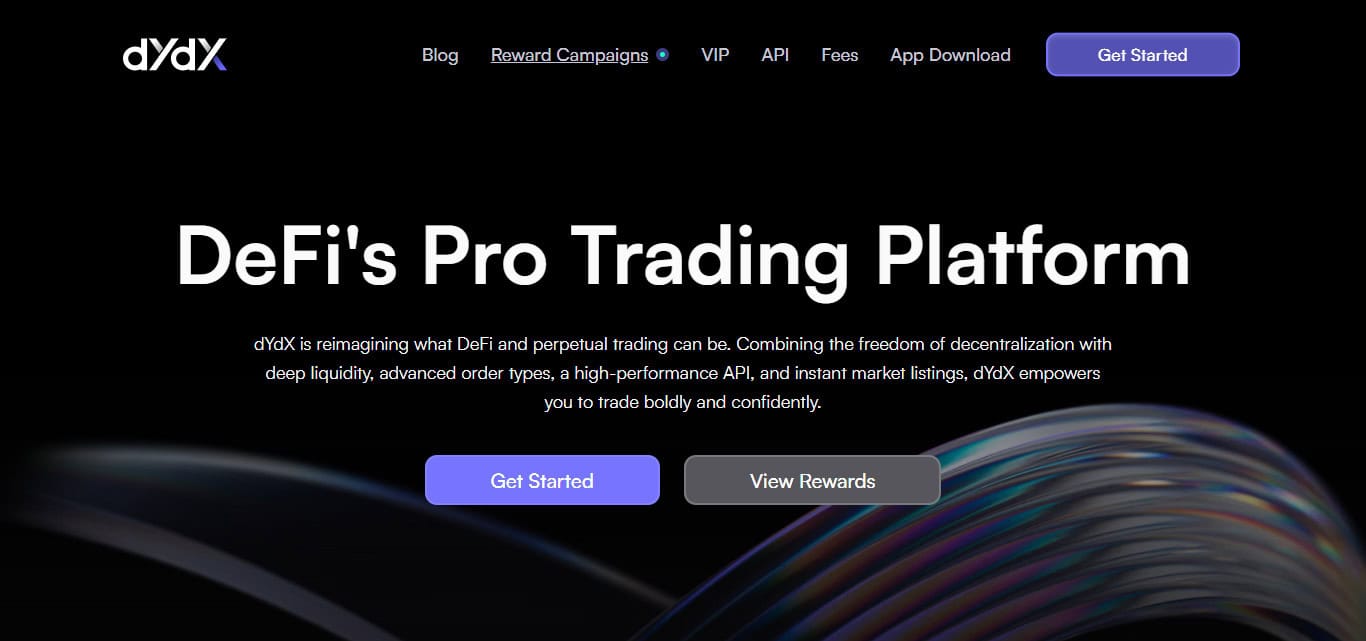
Launched in April 2020:First perpetual contract protocol dYdX built to support decentralized derivatives trading Launch Stage: dYdX has since launched it own permissionless
Blockchain to enable dYdX v4 and increase control over its trading infrastructure.This will enable the project to fully undertake a more significant level of decentralization.
dYdX Features
- Professional Perpetual Trading: dYdX built sophisticated perpetual contracts to cater to the needs of active professional traders in the market for advanced decentralized derivatives.
- Advanced Order Types: The trading platform supports complex trading and order management functionalities for users to implement more sophisticated trading strategies beyond swap and market orders trading.
- Margin and Leverage: dYdX offers traders the ability to build margin-based trading positions with leverage allowing greater market exposure.
- Independent Blockchain: dYdX v4 switched over to being an independent blockchain created on Cosmos in order to achieve greater trading and decentralized infrastructure and governance control.
3. Drift
Drift is a Solana-native decentralized trading protocol for futures, spot markets, borrowing, lending and advanced margin trading. Its architecture was inspired by previous liquidity designs. It combines order book execution and other liquidity taking mechanisms.

Drift launched in 2021, as one of the early DeFi applications for the Solana ecosystem. The mainnet in its closed alpha was first deployed on October 25th, 2021. Since then Drift has Bolstered the Solana ecosystem’s high throughput and low transaction cost by building a comprehensive trading ecosystem.
Drift Features
- Solana-Native Trading: Drift built infrastructure integrations on Solana giving it the benefits of the blockchain’s low transaction costs and high throughput for trading.
- Spot and Perpetual Markets: The protocol facilitates spot trading for all asset types while users are able to use or trade futures.
- Hybrid Liquidity Model: Drift combination of order book trading and the use of different liquidity techniques provides better execution and market depth under varying market conditions.
- Advanced DeFi: Additionally, Drift offers lending, borrowing, and margin trading. Therefore, it is a more comprehensive DeFi margin trading platform as opposed to just a derivatives exchange.
4. Aevo
Aevo is a decentralized derivatives exchange that provides orderbook access to both perpetual futures and options. Aevo was founded by the team behind Ribbon Finance. With Ribbon, the team built structured products and options before focused on the derivatives marketplace.
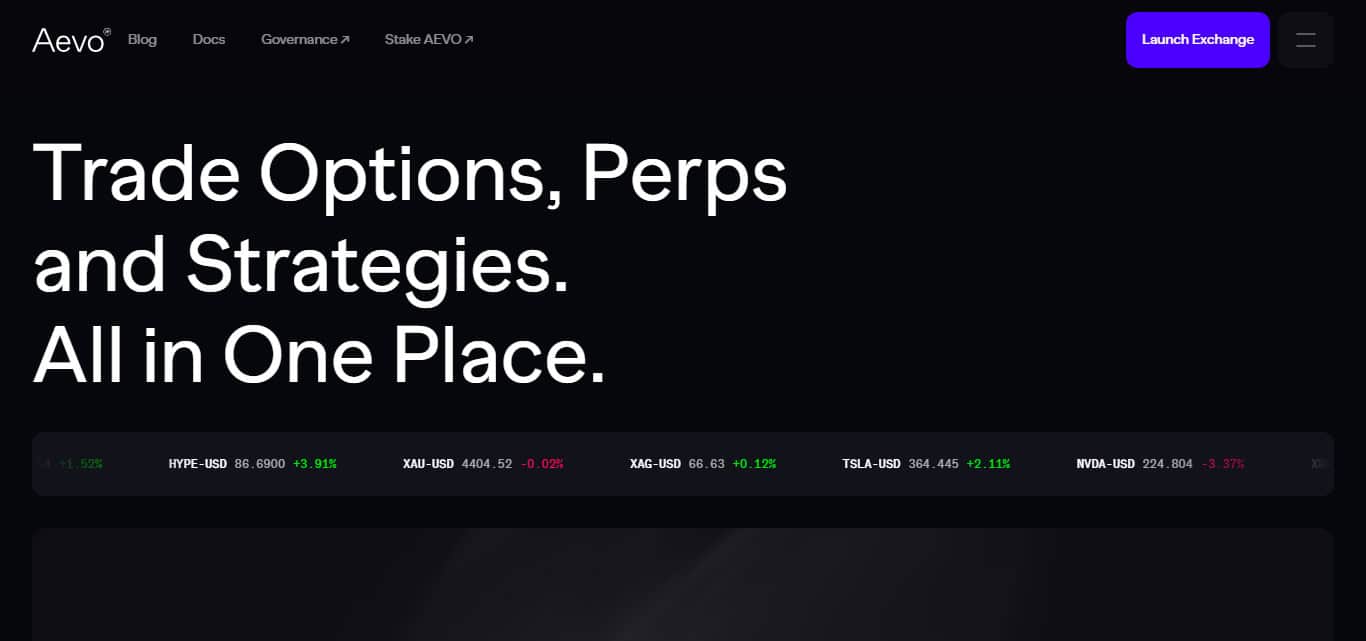
Launch date: Aevo exchange launched in 2023 and was actively discussed and being prepared in March 2023. The project brings innovative ideas to the market for the first time like options trading and launched a project entirely focused around options trading.
Aevo works to provide professional traders with a familiar trading interface while keeping the decentalized settlement.
Aevo Features
- Perpetual Futures: Aevo has built decentralized perpetual futures markets designed for active derivatives traders.
- Options: Integration of options along with perpetual futures allows users to access numerous derivatives products on a single platform.
- Orderbook Interface: A familiar order book model is utilized where traders can transact with bids and asks.
- Decentralized Options and Structured Products: Aevo is the product of Ribbon Finance with deep experience of options and structured products in the decentralized world and a focus of derivatives trading.
5. Vertex
Vertex is a hybrid decentralized exchange with a CLOB (Central Limit Order Book) and an AMM (Automated Market Maker) and supports spot, perpetual and money markets with cross margin trading.
The team built Vertex after pivoting from infrastructure for decentralized exchanges with their experience in financial markets and difficult 2022 crypto industry.

Release date: Vertex launched its Arbitrum chain on April 26 after developing on testing networks and holding some main net beta tests. The hybrid structure looks to capture the best of order book systems, Automated Market Makers, low transaction costs, and speed of execution.
Vertex Features
- CLOB + AMM Model: Vertex attempts to integrate the best of both worlds by providing an order book with an automated market maker.
- Unified Cross-Margin: Position and collateral management across supported products is provided by a unified margin system to improve capital placement.
- Multiple Markets: Vertex supports all three core market products including perpetuals, spot and money market.
6. Bluefin
Bluefin is a derivatives exchange that aims to give traders professional tools, while still keeping each trade on the blockchain. Bluefin worked on mainnets like Arbitrum and provided the team with useful knowledge for building decentralized derivatives and liquidity.
Launch date: Bluefin launched their first beta version on the platform Arbitrum in 2023, with Bluefin v2 launching the derivatives trading platform on Sui in the last quarter of 2023.
Sui is well known for having high network performance and low transaction fees. Bluefin then solidified itself as the primary and major derivatives orderbook trading platform on the Sui network.
Bluefin Features
- Optimized Settlement and Liquidity: Bluefin’s design offers fast execution and competitive fees through its hybrid architecture while guaranteeing decentralized settlement and liquidity.
- Sui: Bluefin uses Sui’s performance characteristics for trading decentralized derivatives.
- Emphasis on Derivatives: Bluefin concentrates on derivatives by offering perpetual trading.
- Pro-grade Trading: Bluefin’s trading system provides trading infrastructure to support speed and order processing for active trading.
7. Phoenix
Phoenix is a decentralized exchange built on Solana using a Central Limit Order Book (CLOB) for on-chain and automated trading of spot assets.
Unlike AMMs where orders are traded at the best price the market is willing to take at a given time, orders on Phoenix can be placed with specific pricing and order sizes. Phoenix target clients include users and applications.

Phoenix was launched in 2023, during the increase of interest surrounding Solana’s infrastructure among the newer generation of decentralized trading protocols. Its architecture is designed to support both coders and those using automated trading.
Phoenix Features
- C-LOB: Phoenix provides trading using a Central Limit Order Book directly on Solana, employing a bid-and-ask system.
- Focus on Spot Trading: Phoenix focuses on decentralized spot trading rather than futures or other derivatives.
- Automated and Programmable: Phoenix’s infrastructure is designed to be programmable to support trading applications used by bots and but also developed by traders for trading strategies.
- Transparent Execution: Phoenix provides trading infrastructure to allow members and applications to inspect activity from market order books.
8. Injective
Injective is a layer 1 financial blockchain that provides technology for decentralized applications and exchanges for spot markets, derivatives, perpetuals, lending and other financial markets. Developments for Injective began years before its mainnet, and the team built technology for its derivatives and decentralized exchanges.
Launch date: Injective’s first mainnet phase began in 2021, with the Canonical Chain mainnet launched November 8th, 2021. Using native financial infrastructure, orderbook, and cross-chain interactions, Injective has a blockchain level trading infrastructure over a single exchange.
Injective Features
- Layer 1 Financial Economic Infrastructure: Injective is a blockchain built specifically to provide financial infrastructures, rather than being a single decentralized exchange.
- Orderbook-based Infrastructures: Injective’s ecosystem provides orderbook-based exchange infrastructures for diverse financial market build by developers.
- Injective supports decentralized trading applications by facilitating derivatives, perpetual contracts, and other financial products.
- Injective incorporates cross-chain and interoperability solutions, helping financial applications access assets and liquidity across multiple blockchain ecosystems.
9. Orderly Network
Infrastructure that enables developers to build scalable exchange applications using shared order book liquidity, matching, risk management, and settlement services. Orderly Network aims to provide the tools used by other applications, rather than only providing a trading interface.
Orderly Network launched its NEAR mainnet on October 11, 2022, following a mainnet that received considerable early activity.
Orderly Network was launched in April 2022 and was incubated by both NEAR and WOO Network. Initially, Orderly Network focused on building permissionless spot and futures order book infrastructure.
Orderly Features
- Shared Orderbook Infrastructure: Orderly offers developers a more convenient solution than making them create trading application backends on their own by providing shared order book infrastructure.
- Omnichain Architecture: Their infrastructure is built to support trading applications on multiple blockchain ecosystems, helping developers create access to broader markets.
- Risk and Settlement Systems: Orderly provides developers with automated back-end services that include risk and settlement systems.
- Scalable Exchange Development: Applications can use Orderly’s services to launch trading applications instantly along with shared liquidity and trading systems.
10. Lighter
Lighter is a digital asset perpetual futures trading platform constructed on Ethereum Layer 2 and using custom zero-knowledge technologies. Lighter provides innovative, cryptographically verifiable order matching and liquidations allowing execution and order matching at the trading performance level and providing the public with verifiability.
Launch date: Lighter launched its public mainnet in October 2025, following about eight months of private beta. Its architecture employs zero-knowledge proofs to verify matching and state transitions, while currently standard accounts are provided with maker and taker trading fees.
Lighter Features
- Zero Knowledge Infrastructure: Lighter uses zero knowledge technology to verify important trading operations in a cryptographic manner to provide decentralized execution.
- Perpetual Trading: Lighter focuses on creating a platform for perpetual futures that supports trading at a high frequency for higher sophistication and professional traders.
- No Trading Fees: Lighter focuses on charging zero maker and taker fees for basic trading accounts to offer a competitive advantage.
- Ethereum Layer 2: Lighter builds an environment for trading on Ethereum like other layer 2 environments, where trading can be very fast, and settlement can be safe and still under the protection of Ethereum.
We looked at various elements to determine which of the Best On-Chain Limit Order Book (CLOB) Platforms was the most effective.
- Orderbook Placement– On-chain solutions that process or record orders and trade activity on-chain were prioritized.
- Trading Quality- We looked at trading speed, latency, order matching, and overall trading execution.
- Trading Supported- We looked at trading for spot, perpetual, options, and other trading for various asset classes.
- Technology- The technology used was assessed through the blockchain, scalability, and how easy and efficient the blockchain technology is..
- Decentralization- The systems were assessed as to how much they are dependent on centralized systems and how much they are decentralized.
Conclusion
Conclusion Onchain limit Order Books (CLOB) continuously improve the trading experience across Decentralized Finance (DeFi). Examples of these include Hyperliquid, dYdX, Drift, Aevo, Vertex and more. Different platforms use different techniques for liquidity, order execution, scalability, and decentralization.
Depending on the trading needs and coverage of allowed markets, security, performance, fees, and the degree of decentralization, users must determine the best platform for their exercise.
FAQ
What are the best on-chain CLOB platforms?
Popular platforms include Hyperliquid, dYdX, Drift, Aevo, Vertex, Bluefin, Phoenix, Injective, Orderly Network, and Lighter.
How does a CLOB differ from an AMM?
A CLOB matches individual buy and sell orders, while an AMM uses liquidity pools and mathematical formulas to determine trades.
Are on-chain CLOB platforms decentralized?
Many are designed to provide decentralized trading and transparent settlement, although their degree of decentralization varies depending on their architecture.
Why are CLOBs useful for professional traders?
CLOBs can provide familiar trading features such as limit orders, price discovery, advanced order management, and potentially tighter execution.