
This article will explain the best vector databases for powering an AI agent’s long-term memory. I will also review how the databases aid in elevating semantic search, contextual comprehension, and intelligent memory retrieval.
Most cutting-edge AI applications depend on sophisticated vector databases for scalable, on-the-fly, and customized offerings.
These tools allow both new and mature businesses to develop advanced conversational AI, recommendation, and automation solutions in the current fast-paced AI ecosystem.
Key Points & Best Vector Databases for Powering AI Agent Long-Term Memory
| Vector Database | Explanation |
|---|---|
| Pinecone | Pinecone delivers scalable vector indexing, enabling intelligent AI agent memory retrieval efficiently. |
| Weaviate | Weaviate supports semantic search, improving contextual memory understanding for advanced AI agents. |
| Milvus | Milvus handles massive datasets, ensuring accurate vector similarity searches for AI applications. |
| Qdrant | Qdrant provides fast filtering, boosting personalized AI memory storage and retrieval capabilities. |
| Chroma | Chroma simplifies embedding management, helping AI agents maintain reliable long-term contextual memories. |
| Redis Vector | Redis Vector enables real-time vector processing, supporting responsive AI agent memory operations efficiently. |
| Vespa | Vespa combines vector search and machine learning for scalable intelligent AI memory systems. |
| Elasticsearch | Elasticsearch offers vector capabilities, enhancing hybrid search experiences for AI memory applications globally. |
| Faiss | Faiss accelerates similarity searches, improving efficient long-term memory performance within AI agents. |
| LanceDB | LanceDB provides lightweight vector storage, supporting cost-effective AI agent memory infrastructure development. |
10 Best Vector Databases for Powering AI Agent Long-Term Memory
1. Pinecone
Pinecone is one of the best tools for building AI agents with long-term memory. With its fully serverless architecture, automated scaling, and low-latency indexing, building intelligent applications is no longer a hassle because the startup doesn’t have to manage infrastructure.
As a result, more AI productivity tools are adopting Pinecone for retrieval-augmented generation and conversational memory.

Besides the support for hybrid search and metadata filtering, Pinecone offers a real improvement to context accuracy.
This product is being adopted by more enterprise AI developers, thus making Pinecone a leader in the use of memory AI tools for scalable solutions.
Pinecone Pros & Cons
| Pros | Cons |
|---|---|
| Fully managed serverless infrastructure reduces operational complexity significantly. | Premium pricing becomes expensive for rapidly scaling AI startups. |
| Excellent low-latency vector search for conversational AI memory systems. | Limited customization compared with fully open-source vector databases available. |
| Supports hybrid search and metadata filtering efficiently. | Dependency on cloud infrastructure may concern privacy-focused businesses. |
| Highly scalable architecture handles enterprise-level AI workloads smoothly. | Advanced features sometimes require higher-tier subscription plans. |
2. Weaviate
Weaviate is one of the more commonly used tools for strengthening AI agents with semantic understanding.
The combination of machine learning and GraphQL allows developers to build contextual AI with memory in a short time.
Weaviate’s recent updates allow hybrid search, vector compression, and new support for Generative AI and other complex tasks.
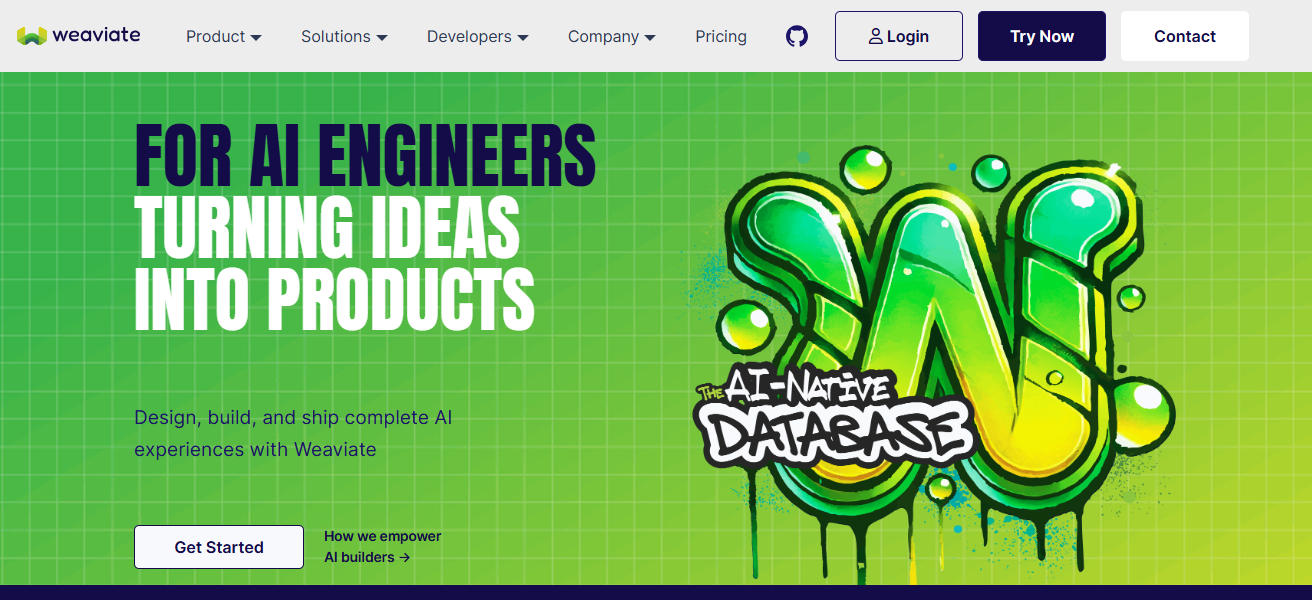
Startups prefer Weaviate because all of these characteristics are under one flexible, scalable, and intelligent platform.
The embedding of vectors alongside structured data allows the development of more intelligent AI systems with broader reasoning as well as extreme personalization across the board.
Weaviate Pros & Cons
| Advantages | Disadvantages |
|---|---|
| Open-source flexibility supports customizable AI memory infrastructure development. | Setup complexity may challenge beginners lacking vector database experience. |
| GraphQL integration improves semantic querying and contextual retrieval performance. | Enterprise deployment requires careful optimization for large-scale workloads. |
| Supports multimodal embeddings and hybrid search capabilities effectively. | Documentation can feel technical for non-developer startup teams initially. |
| Strong AI ecosystem integrations accelerate modern application development. | Resource consumption increases with extremely large vector datasets. |
3. Milvus
Milvus is known globally for processing large-scale vector workloads for modern AI applications. Milvus offers enterprise-level performance and handles billions of vectors while providing extremely fast similarity searches and efficient indexing.
AI startups prefer Milvus when building autonomous agents, recommendation systems, and complex retrieval applications that need stable, long-term memory storage.
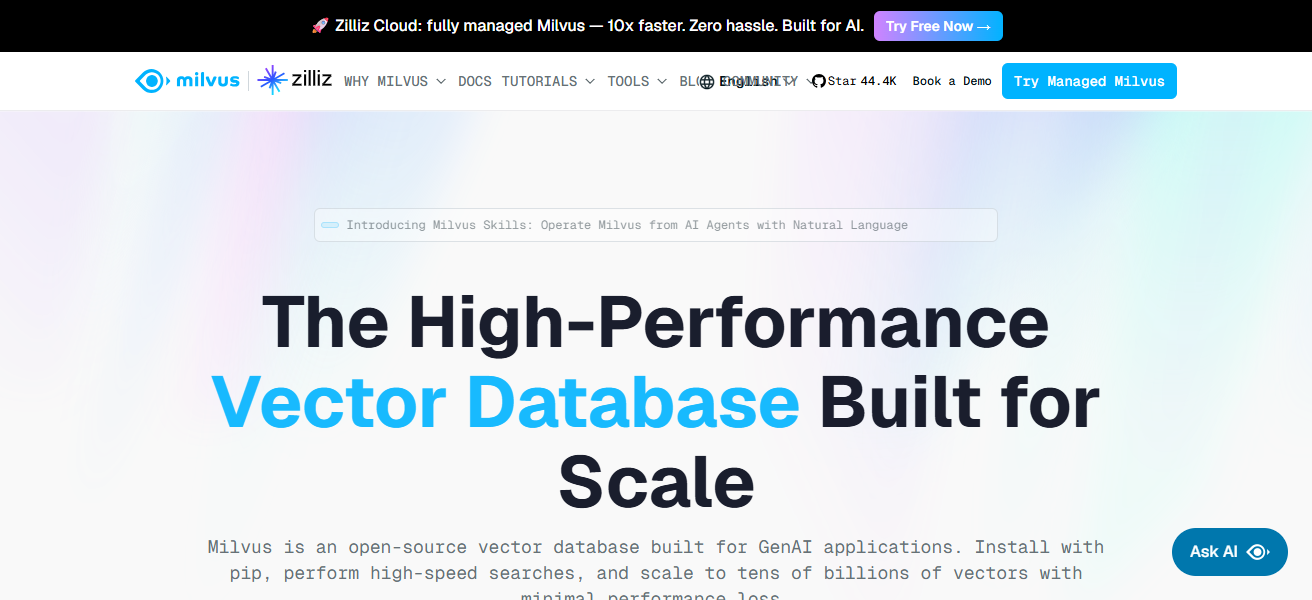
Recently, Milvus’s distributed architecture and GPU acceleration significantly improved the performance of large language models.
Milvus offers some of the best seamless integrations with AI frameworks, enabling businesses to build scalable, intelligent automation quickly.
Milvus Pros & Cons
| Benefits | Drawbacks |
|---|---|
| Handles billions of vectors with exceptional search performance globally. | Infrastructure management can become difficult for smaller startup teams. |
| GPU acceleration improves large-language-model retrieval speed dramatically. | Requires significant computing resources for maximum efficiency and scalability. |
| Distributed architecture supports enterprise AI memory applications efficiently. | Initial deployment configuration may appear complex for beginners. |
| Integrates smoothly with major AI development frameworks available today. | Maintenance overhead higher compared with serverless vector database platforms. |
4. Qdrant
Qdrant is known for performing high-speed vector searches and filtering with outstanding efficiency.
Its innovative filtering with payloads enables AI agents to retrieve memories that are large, highly relevant, and contextual.
Startups prefer using Qdrant because of its advanced performance, developer-friendly APIs, and ease of deployment of new AI products.
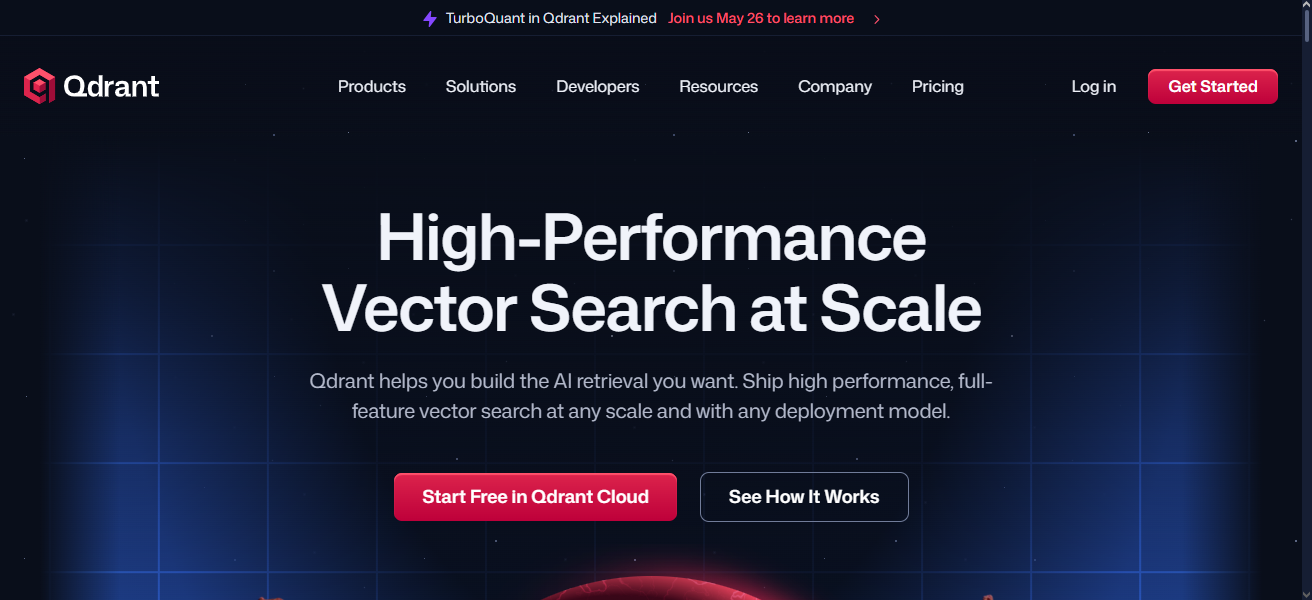
Other recent advancements include improved distributed clustering and optimized hybrid search for next-generation AI.
The real-time capabilities of Qdrant are best-suited for AI that is conversational and utilizes intelligent assistants and memory personalization for long-term recommendations.
Quadrant Pros & Cons
| Strengths | Weaknesses |
|---|---|
| Fast payload filtering improves highly contextual memory retrieval operations. | Smaller ecosystem compared with older enterprise vector database competitors. |
| Developer-friendly APIs simplify AI application integration significantly. | Advanced enterprise features still evolving compared with mature platforms. |
| Real-time vector processing supports conversational AI applications effectively. | Community resources remain limited for niche deployment challenges. |
| Efficient hybrid search improves recommendation engine performance considerably. | Large-scale deployments may require infrastructure tuning for optimization. |
5. Chroma
Chroma has been trending among developers of lightweight AI memory applications and assistants.
It has few rivals in simplifying storage, retrieval, and management of embeddings, and works well with most of the popular frameworks in generative AI.
Chroma is preferred by many startups because its developer-centric ecosystem reduces the time to prototype and deploy AI applications.

The platform offers persistent memory storage, which allows AI agents to retain context throughout the duration of a conversation and task.
Chroma’s rapid adoption in LangChain and retrieval-based AI applications is establishing it as a scalable intelligent memory infrastructure of choice globally.
Chroma Pros & Cons
| Positive Points | Negative Points |
|---|---|
| Lightweight architecture simplifies rapid AI memory application deployment processes. | Limited enterprise-grade scalability compared with larger vector databases available. |
| Seamlessly integrates with LangChain and generative AI ecosystems. | Fewer advanced indexing features for massive-scale AI operations. |
| Persistent memory storage improves conversational AI continuity efficiently. | Smaller enterprise adoption affects long-term commercial trust slightly. |
| Beginner-friendly environment supports fast AI experimentation for startups. | Optimization options remain limited for complex distributed infrastructures. |
6. Redis Vector
Redis Vector brings the power of a fast, real-time database to the world of advanced vector search in the realm of smart AI systems.
More and more companies are choosing Redis Vector for AI agents because of the need for fast digital memory operations and for instant retrieval of context.
The company’s in-memory paradigm for computing dramatically speeds the processing of AI systems and helps create rich, conversational interactions with a global audience.

Recently, Redis Vector focused on AI Infrastructure building and added better vector indexing and hybrid queries
While maintaining its position as a leader in cloud-native applications. This gives startups the ability to rapidly create and scale AI applications.
Redis Vector Pros & Cons
| Key Advantages | Key Disadvantages |
|---|---|
| Real-time in-memory performance ensures extremely fast vector retrieval capabilities. | Memory-intensive architecture increases infrastructure costs significantly over time. |
| Integrates efficiently with existing Redis-based cloud applications globally. | Not specifically designed solely for vector database workloads originally. |
| Excellent responsiveness improves AI chatbot user experiences dramatically. | Scaling massive datasets may become financially challenging for startups. |
| Supports hybrid queries and vector indexing effectively. | Advanced AI features less specialized than dedicated vector platforms. |
7. Vespa
Vespa anticipates supporting modern AI assistants and fully leveraging advanced AI systems for achieving sophisticated personal assistants and recommendation engines.
Vespa’s distributed systems are fast, contextually accurate, and help startups manage large datasets and provide improved ranking and reasoning models.

Vespa’s combined tensor processing and ranking models, along with the other improvements, significantly advanced the reasoning services of AI agents.
When combined with AI agents, Vespa demonstrates next-generation enterprise AI productivity services and capabilities for use in the large enterprise segment.
Vespa Pros & Cons
| Main Pros | Main Cons |
|---|---|
| Combines machine learning with vector search functionalities efficiently. | Enterprise-focused complexity may overwhelm smaller development teams initially. |
| Distributed systems handle massive real-time AI workloads successfully. | Requires experienced engineers for advanced configuration and optimization tasks. |
| Excellent ranking models improve intelligent AI memory reasoning accuracy. | Learning curve higher compared with beginner-friendly vector databases available. |
| Strong scalability supports next-generation AI recommendation systems globally. | Documentation can appear complicated for first-time developers. |
8. Elasticsearch
Elasticsearch has moved beyond traditional search and offers a hybrid search system incorporating the intersection of keyword relevance with semantic vector matching.
The most recent updates regarding vectors allow AI agents to remember more about the context using large datasets, something that the enterprise segment has long sought to have.

Elasticsearch has integrated analytics, observability, and AI search architecture within a single, large, scalable infrastructure, and has strong cloud support combined with real-time updating.
It remains a strong candidate for the development of memory systems that incorporate AI across the globe.
Elasticsearch Pros & Cons
| Advantages | Limitations |
|---|---|
| Hybrid keyword and vector search improves contextual AI retrieval significantly. | Vector search performance may lag behind specialized vector databases slightly. |
| Powerful analytics and observability tools included within ecosystem. | Configuration complexity increases during large-scale AI application deployments. |
| Real-time indexing supports intelligent memory systems effectively worldwide. | Infrastructure costs rise considerably with growing enterprise workloads. |
| Strong cloud integrations simplify scalable AI infrastructure management. | Requires optimization expertise for the best vector search performance results. |
9. Faiss
Meta’s Faiss tops the list for the fastest vector similarity search library available for use by developers. Faiss’s optimized indexing algorithms handle large datasets of embeddings rapidly.
The result is the efficient implementation of recommendation engines, semantic retrieval systems, and autonomous, memory-related workflows.

Since the birth of AI, the demand for large language models that are coupled with memory and retrieval operations on demand has brought Faiss lots of users.
Startups of every size have also benefited from Faiss, being that it is open source, very fast, and flexible to work with.
Faiss Pros & Cons
| Strong Points | Weak Points |
|---|---|
| Extremely fast similarity search optimized for large vector datasets. | Primarily library-based, lacking complete database management capabilities natively. |
| GPU acceleration dramatically boosts AI retrieval processing performance. | Requires additional infrastructure for production-ready deployment environments. |
| Open-source flexibility supports highly customizable AI solutions globally. | Limited built-in cloud management compared with managed vector services. |
| Ideal for recommendation systems and semantic retrieval applications. | Beginners may face integration challenges without advanced technical knowledge. |
10. LanceDB
LanceDB is a vector database that supports the development of applications geared towards AI enhancement.
Creating an AI memory system becomes even simpler due to the amalgamation of efficient storage formats with lightweight systems.
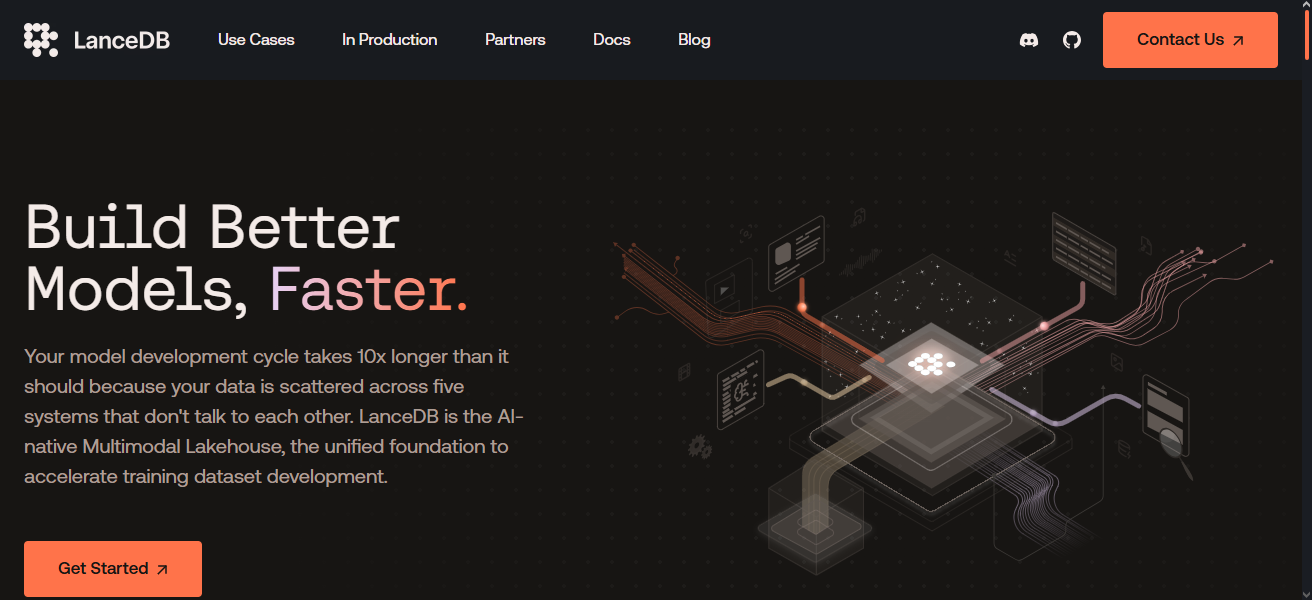
Developers have started to optimize LanceDB for persistent memory needs found in applications like augmented generation, semantic search, and conversational AI.
Novelties include rapid query execution and improved cloud optimization with data versioning. Simplicity, affordability, and quick deployment of LanceDB have seen it gain traction within AI startups.
LanceDB Pros & Cons
| Top Benefits | Possible Drawbacks |
|---|---|
| Lightweight storage architecture reduces AI infrastructure costs efficiently. | Still emerging compared with mature enterprise vector database competitors. |
| Optimized for retrieval-augmented generation and semantic search applications. | Smaller developer community limits troubleshooting resources currently available. |
| Faster querying improves AI agent memory responsiveness significantly. | Enterprise-grade scalability still evolving for massive workloads globally. |
| Affordable deployment attracts startups building AI-native productivity platforms. | Fewer integrations available compared with older established platforms. |
Final Verdict
In closing, vector databases revolutionize how AI Agents handle long-term memory, contextual comprehension, and rational decision-making.
Semantic search capabilities provided by platforms like Pinecone, Weaviate, Milvus, and Qdrant enhance modern AI solutions.
By selecting the proper vector database, the optimization of conversational AI, recommendation systems, and automation systems comes at great efficiency to the organization.
The innovative offerings profoundly impact the future development of more advanced, custom-tailored AI and enhance productivity for enterprises across the globe.
FAQ
What is a vector database?
A vector database stores embeddings for fast AI similarity searches and contextual memory retrieval.
Why do AI agents need vector databases?
They help AI agents remember conversations, preferences, and contextual information efficiently over time.
Which vector database is best for startups?
Pinecone and Chroma are popular because they offer simplicity, scalability, and strong AI integrations.
Is Weaviate open-source?
Yes, Weaviate is an open-source vector database with advanced semantic search capabilities.