
In this article, I will discuss the E-Discovery Brands Leading The Legal Tech Race and how advanced AI technologies are transforming modern legal investigations worldwide.
These leading platforms help law firms, enterprises, and compliance teams improve document review, automate legal workflows, strengthen cybersecurity investigations, and manage digital evidence efficiently.
You will also discover their unique features, advantages, and growing influence within today’s competitive legal technology industry.
Key Points & E-Discovery Brands Leading The Legal Tech Race
| E-Discovery Brand | Word Explanation |
|---|---|
| Relativity | Cloud-based discovery platform delivering scalable reviews, analytics, compliance, and litigation intelligence globally. |
| Everlaw | AI-powered workflows simplify document review, collaboration, investigations, and courtroom preparation for legal teams. |
| DISCO | Advanced automation accelerates legal document analysis, predictive coding, and evidence management for enterprises. |
| Reveal | Integrated AI discovery tools improve data processing, review speed, and legal case strategy development. |
| Logikcull | User-friendly self-service platform streamlines legal holds, document uploads, and compliance review processes efficiently. |
| OpenText | Enterprise-grade e-discovery solutions support governance, investigations, regulatory compliance, and secure data preservation worldwide. |
| Thomson Reuters | CoCounsel AI enhances legal research, discovery automation, drafting, and litigation support capabilities effectively. |
| vLex | VincentAI combines global legal research, intelligent review, and cross-jurisdictional litigation analytics seamlessly worldwide. |
| ZyLAB | AI-driven information governance platform improves investigations, compliance monitoring, and multilingual document discovery processes. |
| Nuix | Powerful data processing engine uncovers digital evidence rapidly across massive unstructured information repositories. |
10 E-Discovery Brands Leading The Legal Tech Race
1. Relativity
Relativity remains at the forefront of e-discovery with machine-learning-enpowered legal intelligence solutions for enterprises and global law firms.
The RelativityOne platform now includes generative AI workflows, multilingual analytics, and automated privilege review capabilities, enabling legal teams to process massive data sets in significantly less time.
In line with its vision, the company has announced partnerships with legal service providers to expand AI-assisted investigations and compliance management on a global scale over the past couple of years.
Relativity is now one of the most powerful players defining global digital litigation and modern legal operations, with a high-growth cloud-centered innovation engine buoyed by ongoing IPO discussions and an emerging tech stack in legaltech.
| Pros | Cons |
|---|---|
| Advanced AI workflows improve large-scale legal document reviews significantly. | Premium pricing may challenge smaller firms with limited budgets. |
| Strong cloud infrastructure supports enterprise-level litigation management globally. | Requires experienced professionals for advanced customization and deployment. |
| Multilingual analytics simplify cross-border investigations and compliance tasks efficiently. | Learning curve can appear difficult for non-technical legal teams initially. |
| Automated privilege review reduces manual legal review workloads effectively. | Implementation timelines may become lengthy for complex organizations sometimes. |
| Trusted by major corporations and international law firms worldwide. | Some advanced AI features require additional enterprise-level subscriptions. |
2. Everlaw
With cloud-native architecture and highly intuitive AI-powered litigation workflows built for the modern legal professional, Everlaw is thoughtful about where we differentiate ourselves.
The latest technology from Everlaw AI Deep Dive can search millions of documents in instantaneous time with conversational searches and summaries backed by citations.

Smart reviewer automation, multi-lingual transcription, and other predictive coding improvements for giant investigations were also added to the platform.
Everlaw is becoming the go-to platform for government agencies, corporations, and litigation teams due to its collaborative design, speed of processing, and courtroom preparation features that make complex legal issues easier while increasing evidence analysis efficiency.
| Pros | Cons |
|---|---|
| User-friendly interface simplifies litigation and evidence collaboration processes greatly. | Premium cloud services may increase long-term operational expenses considerably. |
| Conversational AI search accelerates legal document discovery workflows rapidly. | Limited offline functionality compared with traditional on-premise systems available. |
| Real-time collaboration tools improve courtroom preparation and investigations efficiently. | Smaller firms may underutilize advanced enterprise-grade AI capabilities offered. |
| Predictive coding improves review accuracy and legal productivity significantly. | Heavy internet dependency may impact performance during connectivity disruptions occasionally. |
| Strong cloud-native design supports fast remote legal operations globally. | Complex integrations sometimes require specialized technical support assistance externally. |
3. DISCO
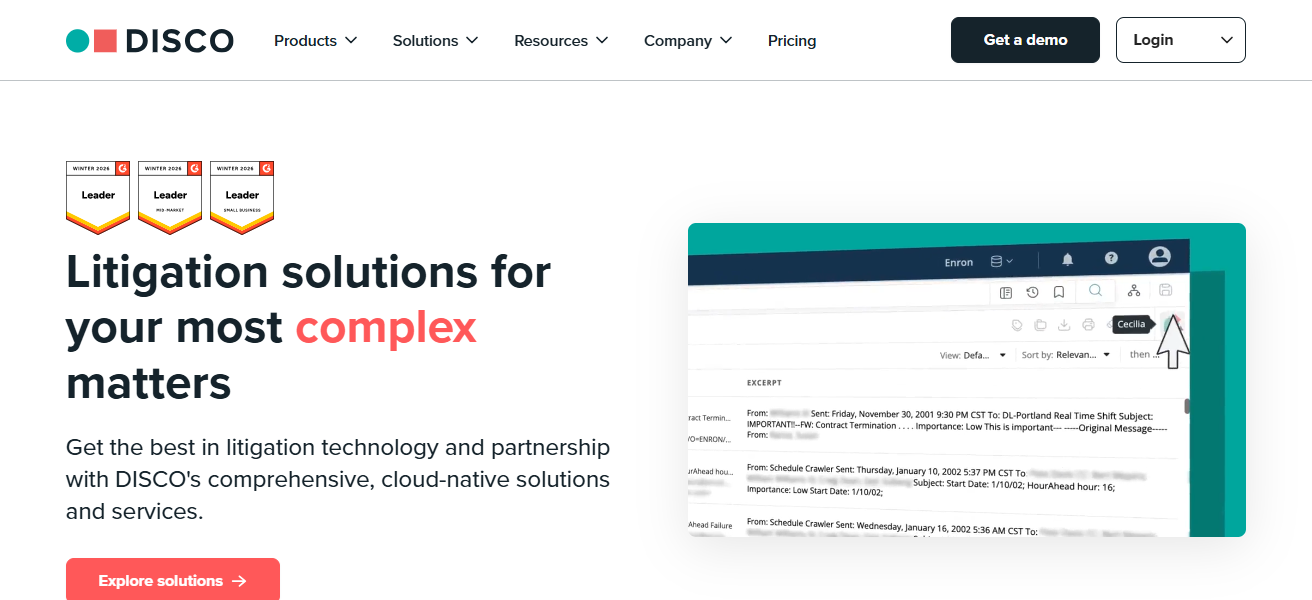
DISCO is an end-to-end legal discovery platform that uses AI to drive automation in investigation and discovery with a computer voice on the collected documents for human consumption — decreasing workloads spent on manual document review.
Cecilia — its AI assistant enhances any legal workflow by producing summarised documents, finding relevant evidence, and expediting early case assessments.
Demand for corporate legal departments with more and more regulatory complexity turns to DISCO’s focus on scalable cloud-based offerings and clever analytics.
In 2026, DISCO experienced rapid growth in the competitive legal technology landscape as the platform’s ongoing investment in machine learning and workflow automation enables legal professionals to save money while speeding up litigation preparedness.
| Pros | Cons |
|---|---|
| Cecilia AI assistant improves early case assessments and evidence analysis. | Enterprise pricing structure may discourage budget-conscious legal departments initially. |
| Cloud automation reduces manual review workloads and operational costs effectively. | Platform customization remains limited for highly specialized legal workflows sometimes. |
| Fast processing speeds accelerate investigations and litigation readiness significantly. | Advanced AI features may require additional user training sessions frequently. |
| Intelligent analytics enhance legal team productivity and review efficiency greatly. | Smaller firms might find enterprise-focused tools unnecessarily complex occasionally. |
| Continuous AI innovation strengthens modern legal discovery capabilities rapidly. | Limited global market presence compared with larger legal technology competitors. |
4. Reveal
By marrying best-in-class AI analytics and smart evidence visualization with advanced features of modern e-discovery workflows, Reveal has successfully positioned itself as a leader in legal technology.
To be sure, the company emphasizes generative AI-assisted investigations that rapidly enhance litigation strategy and discover previously unseen data relationships.
Reveal has a highly scalable architecture ideal for corporations dealing with complicated compliance requirements and investigations across multiple jurisdictions.

By continuously advancing AI-powered review precision and visual intelligence capabilities for legal professionals at scale, it allows them to deal with digital evidence sooner
While yielding greater insights within the context of strategic goals, without creating increased operational demands in global high-volume data-rich legal scenarios.
| Pros | Cons |
|---|---|
| The initial onboarding process can become time-consuming for large organizations. | Advanced analytics tools may overwhelm inexperienced legal professionals initially. |
| Multilingual search improves international investigations and compliance management significantly. | Certain premium AI functionalities increase overall subscription expenses noticeably. |
| Scalable architecture handles massive enterprise legal datasets efficiently worldwide. | Initial onboarding process can become time-consuming for large organizations. |
| Generative AI enhances litigation strategy and evidence interpretation workflows greatly. | Complex integrations may require dedicated IT resources for deployment. |
| Strong analytics improve review accuracy across data-intensive investigations consistently. | AI-powered visualization tools uncover hidden evidence relationships quickly and effectively. |
5. Logikcull
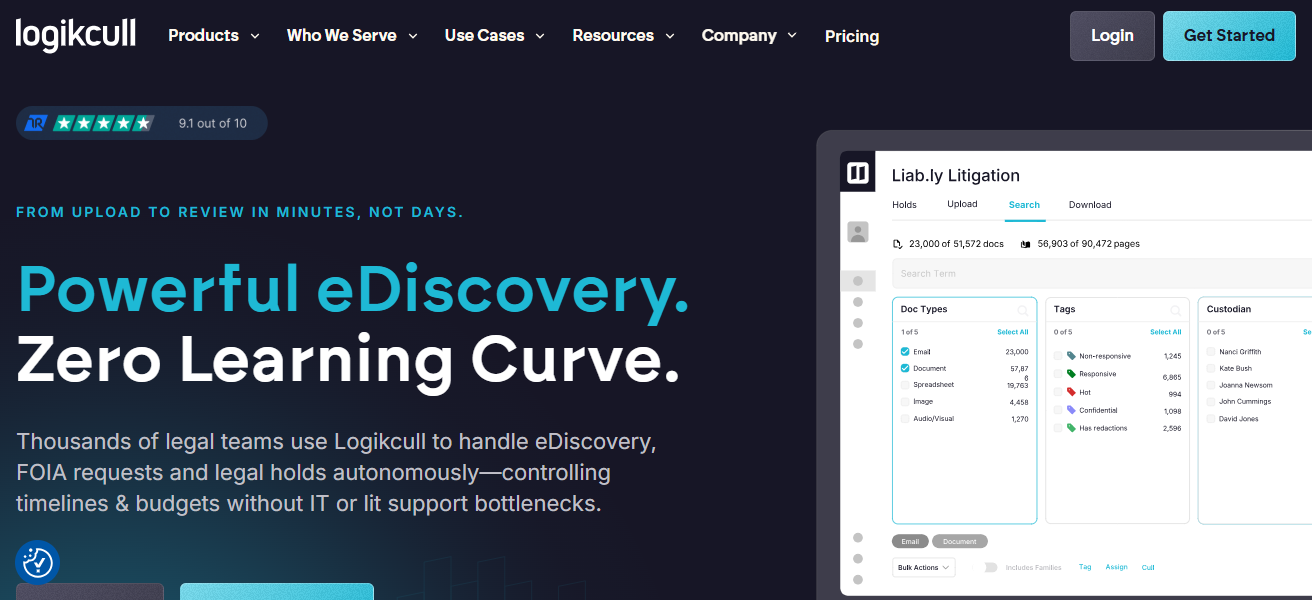
Logikcull — which appeals primarily to corporations and mid-sized legal teams with its user-friendly self-service e-discovery tools, ideal for non-technical staff.
It leverages cloud infrastructure to easily manage your legal holds, document collection, review, and production processes.
Logikcull has become well known for cutting down on the reliance of costly forensic vendors and aiding organizations with their trade compliance investigations.
The increased focus on accessibility, cybersecurity, and rapid remote collaboration supports modern hybrid legal operations.
With its use in fast-moving litigation for large, multi-national companies of all sectors around the world, Logikcull becomes a solution that more businesses are adopting to continue to efficiently manage these reviews while controlling legal spend.
| Pros | Cons |
|---|---|
| Easy self-service platform requires minimal technical expertise for operations. | Limited advanced analytics compared with enterprise e-discovery competitors available. |
| Affordable pricing attracts smaller businesses and legal teams effectively. | Less suitable for highly complex multinational legal investigations globally. |
| Automated legal holds simplify compliance and evidence management workflows efficiently. | AI capabilities remain less advanced than premium enterprise platforms currently. |
| Cloud accessibility supports remote legal collaboration and investigations smoothly. | Large-scale customization options may feel restrictive for enterprises sometimes. |
| Fast deployment reduces implementation time and operational complexity significantly. | Enterprise-level integrations can appear limited for complex infrastructures occasionally. |
6. OpenText
With AI-enhanced Information Governance and Robotic Process Automation (RPA) capabilities, OpenText is continuing to build its already-strong enterprise e-discovery ecosystem through existing acquisitions of MILS and machine learning.
It provides platforms that enable enterprises to store, extract insights from, and review millions of unstructured data hosted over cloud, mobile, and enterprise communication channels.
Core to OpenText, moving purposefully into doing more cybersecurity-driven investigative and compliance-based workflows primarily for multinational enterprises with sensitive legal-aware information.
In response, OpenText is building enterprise-scale data management infrastructure to pair with its AI analytics, offering robust solutions for digital forensics, governance, and legal risk reduction as it further solidifies its global leadership in highly-regulated corporate legal technology markets.
| Pros | Cons |
|---|---|
| Enterprise-grade governance supports complex regulatory compliance requirements globally. | The user interface may appear outdated compared with modern competitors sometimes. |
| Strong cybersecurity integration enhances secure digital investigations and compliance tasks. | User interface may appear outdated compared with modern competitors sometimes. |
| Handles massive unstructured datasets across enterprise communication platforms efficiently. | Deployment complexity often requires experienced technical teams for management. |
| AI-driven analytics improve legal risk reduction and information governance greatly. | Training employees on advanced features may consume additional resources. |
| Trusted infrastructure supports multinational corporations and regulated industries worldwide. | Implementation costs may become significantly more expensive for smaller legal organizations. |
7. Thomson Reuters
CoCounsel and Westlaw innovations push legal research and e-discovery with AI at Thomson Reuters. Built for professional legal teams, the Company combines generative AI with smart litigation workflows, contract analysis, and compliance monitoring and drafting.
Market analysts have come to see Thomson Reuters as a central player in the legal ecosystem that is rapidly changing with the advent of AI — especially now, with competition from a wave of new legal AI providers on the rise.

Its extensive data prowess, deep legal databases, and growing automation solutions continue to pull enterprise clients looking for faster research, predictive insights, and smart litigation support across complicated legal operations.
| Pros | Cons |
|---|---|
| CoCounsel AI enhances legal research and document drafting efficiency significantly. | Subscription pricing can become costly for smaller law firms frequently. |
| Extensive legal databases provide reliable global research capabilities consistently. | Strong brand reputation successfully attracts enterprise legal teams worldwide. |
| Strong brand reputation attracts enterprise legal teams worldwide successfully. | Advanced features occasionally involve additional licensing and premium costs separately. |
| Automation tools simplify compliance monitoring and litigation support processes effectively. | Platform complexity may challenge users unfamiliar with enterprise legal systems. |
| Continuous AI investment strengthens future legal technology competitiveness rapidly. | Some AI-generated insights may still require careful manual verification. |
8. vLex
With an intelligent assistant that combines legal research, document analysis, and multilingual litigation insights in a single tool, vLex is receiving global attention with Vincent AI.
Additionally, the platform connects detailed international legal databases with generative AI technology to help lawyers quickly find relevant precedents and develop more robust case strategies in less time.

The ability to obtain cross-border legal intelligence via vLex is especially beneficial for firms dealing with matters that involve international disputes and regulatory investigations.
By 2026, vLex will be a highly disruptive competitor creating global upheaval in digital legal research and e-discovery markets through an aggressive AI expansion strategy and a keen concentration on contextual legal understanding.
| Pros | Cons |
|---|---|
| Vincent AI delivers intelligent multilingual legal research capabilities efficiently worldwide. | Some regional legal databases may offer limited localized information occasionally. |
| Cross-border legal analytics strengthen international litigation strategies significantly. | Advanced AI tools may require learning time for legal professionals. |
| Generative AI improves case preparation and precedent discovery workflows rapidly. | An extensive global legal database enhances contextual legal understanding effectively. |
| Extensive global legal database enhances contextual legal understanding effectively. | Smaller organizations may not utilize all advanced research capabilities fully. |
| Fast AI-powered search simplifies complex legal investigations and reviews greatly. | Premium subscriptions may become significantly more expensive for independent legal practitioners. |
9. ZyLAB
ZyLAB offers AI-powered investigations and multilingual e-discovery and information governance designed for government entities and regulated industries.
Leveraging deep analytics, the company identifies key evidence across various channels of communication, such as emails, chats, and enterprise collaboration tools.
ZyLAB builds upon its AI-Assisted Compliance Monitoring to support companies and governments in adhering to global data privacy laws & moving towards deploying end-to-end compliance solutions for internal investigations.

ZyLAB can further burst the national and legal boundaries to address multiple geographies globally, with an emergence
As a trustworthy global partner in helping companies meet increasing scrutiny by regulators and plaintiffs, locally insuring against rising cybersecurity risks, and ensuring better compliance with regulatory reporting requirements.
| Pros | Cons |
|---|---|
| Multilingual e-discovery tools support international compliance investigations effectively worldwide. | Interface design may appear less modern than newer competitors today. |
| AI analytics identify critical evidence across communication platforms efficiently rapidly. | Smaller legal teams may face complexity during initial implementation phases. |
| Enterprise-focused pricing may discourage budget-conscious organizations from adopting initially. | Enterprise-focused pricing may discourage budget-conscious organizations from adoption initially. |
| AI analytics identify critical evidence across communication platforms efficiently and rapidly. | Limited mainstream market recognition compared with larger legal technology providers. |
| Advanced governance features improve digital evidence organization and reporting significantly. | Ideal for government agencies handling sensitive legal investigations securely and consistently. |
10. Nuix
Nuix is still a prominent player in digital investigations with its market-leading forensic processing and unstructured data analysis functionalities.
The platform quickly mines an array of evidence from emails, mobile devices, cloud applications, and encrypted data sets to help investigators quickly expose legal risks that are otherwise hidden.

Nuix has done a lot to integrate its AI analytics with cybersecurity intelligence capabilities in order to enable investigations of fraud, insider threats, and regulatory compliance reviews.
High-Speed Processing Engine One of the reasons why Nuix is valuable to law enforcement, multinationals, and global legal teams wrangling massive digital evidence collections around the planet is its high-speed processing engine and enterprise-grade investigative infrastructure.
| Pros | Cons |
|---|---|
| Powerful forensic engine processes massive unstructured datasets extremely quickly worldwide. | Advanced platform complexity requires highly trained investigation professionals frequently. |
| Excellent cybersecurity investigation capabilities support fraud detection and compliance efficiently. | Premium enterprise pricing may limit accessibility for smaller organizations significantly. |
| The user onboarding process can become lengthy for new teams initially. | Trusted by law enforcement and multinational corporations globally. |
| Handles encrypted files, cloud data, and mobile evidence effectively. | Resource-intensive deployments may require strong hardware infrastructure support continuously. |
| Trusted by law enforcement and multinational corporations globally successfully. | Rapid evidence extraction improves digital investigation efficiency dramatically and consistently. |
Conclusion
To summarize, the e-discovery field is ever-evolving with large legal technology names integrating artificial intelligence, automation, and cloud-based investigation tools.
Companies like Relativity, Everlaw, DISCO, Reveal, and Nuix are changing the way that legal professionals around the world manage digital evidence, compliance, and litigation workflows.
With the growth of data volumes and evolution of regulations in recent times, such forward-thinking platforms would continue to be indispensable across law firms, enterprises, and investigators looking for faster, smarter, and more secure legal discovery solutions globally.
FAQ
What is e-discovery software?
E-discovery software helps legal teams collect, review, and analyze digital evidence efficiently.
Why is Relativity popular in legal technology?
Relativity offers advanced AI workflows, scalable cloud infrastructure, and multilingual legal analytics capabilities.
What makes Everlaw different from competitors?
Everlaw provides intuitive cloud-native collaboration tools with powerful AI-driven document review features.
How does DISCO improve legal investigations?
DISCO automates document analysis using AI, reducing manual review workloads and investigation time.