
In this article, I will discuss the Legal Automation Brands With Explosive Growth, transforming modern legal services through artificial intelligence and smart workflow automation.
These rapidly growing companies are helping law firms improve productivity, automate contracts, simplify compliance, and accelerate legal research efficiently.
From Harvey AI to Clio and Everlaw, these innovative platforms are reshaping the future of legal technology with advanced AI-powered solutions globally.
Key Points & Legal Automation Brands With Explosive Growth
Harvey AI automates complex legal workflows using advanced AI agents for global law firms.
Ironclad simplifies contract lifecycle management through intelligent automation, approvals, and compliance tracking systems.
Clio streamlines legal practice management with cloud-based automation, billing, and client communication tools.
Everlaw accelerates eDiscovery processes using AI-powered document review and litigation preparation features.
Spellbook enhances legal drafting speed with AI-powered contract review and clause recommendation technology.
Darrow AI identifies high-value legal cases using predictive analytics and artificial intelligence automation tools.
Luminance improves due diligence accuracy through machine learning-powered legal document analysis systems.
SpotDraft automates contract creation, approvals, and legal collaboration for enterprise teams efficiently.
Paxton AI supports lawyers with fast legal research, drafting, and compliance automation capabilities.
LawVu centralizes legal operations management with automated workflows, matter tracking, and analytics dashboards.
10 Legal Automation Brands With Explosive Growth
1. Harvey AI
Harvey AI is one of the fastest-growing legal automation companies in the world, with a valuation of roughly $11 billion in funding rounds for 2026.
The platform now supports over 25,000 custom legal AI agents automating due diligence, litigation research, compliance reviews, and contract drafting for firms.

Harvey is relied on for enterprise-grade legal workflows by its vast array of major international law firms.
Harvey’s rapid growth, integrations into the fabric of AI, and strong investor confidence ensure that it is quickly becoming the leading force redefining legal operations globally.
| Pros | Cons |
|---|---|
| Advanced AI agents automate complex legal research and contract drafting efficiently | Premium enterprise pricing unsuitable for smaller independent law firms |
| Trusted by major global law firms and corporate legal departments worldwide | Requires strong data governance and compliance management systems |
| Rapid innovation with continuous generative AI feature expansion | AI-generated outputs still require human legal verification |
| Handles high-volume litigation and due diligence tasks accurately | Learning curve exists for traditional legal teams adopting automation |
| Strong investor backing supports long-term platform scalability and development | A learning curve exists for traditional legal teams adopting automation |
2. Ironclad
Ironclad leverages automation of contract lifecycle and AI-powered approval systems to continue attracting enterprise legal teams.
In 2026, Ironclad solidified integrations with large language models in this emerging new category of AI infrastructure
Such as Anthropic’s Claude for Legal, which helped businesses automate negotiations, clause management, and compliance tracking significantly faster than legacy legal software.
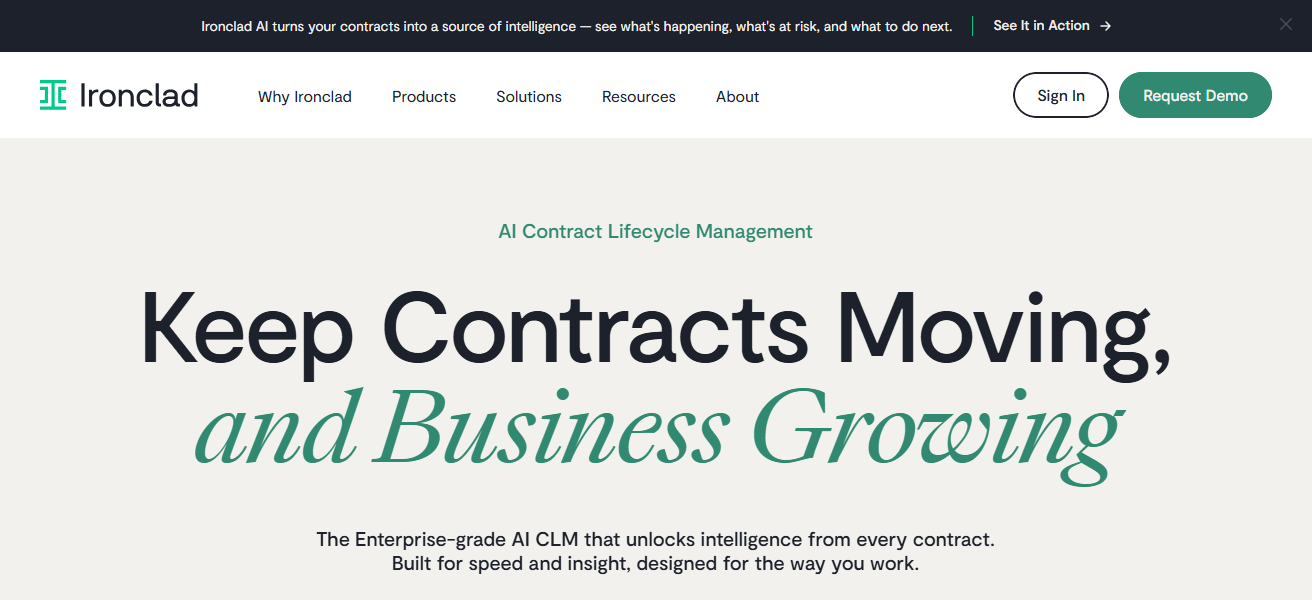
Ironclad is growing because it automates manual contract delays while uniting legal, finance, and procurement teams.
With an automation strategy that leans towards the enterprise, it keeps the brand competitive in the fast-growing legal technology space.
| Pros | Cons |
|---|---|
| Excellent contract lifecycle automation for enterprise legal operations | Best features primarily designed for large enterprise organizations |
| Strong integrations with AI ecosystems and business software platforms | Initial implementation may require technical onboarding assistance |
| Improves collaboration between legal, finance, and procurement departments | Advanced customization can increase deployment complexity |
| Reduces approval delays and manual contract review processes | Premium plans may become expensive for growing businesses |
| User-friendly dashboard simplifies contract tracking and compliance monitoring | Smaller firms may not utilize all enterprise-level capabilities |
3. Clio
Clio is still a giant among independent firms and mid-sized law offices in growing their cloud-based legal practice management solutions continually.
In 2026, the company added AI-assisted billing, automated client intake, document management, and productivity analytics.
Clio’s ecosystem is simple to use and helps law firms streamline day-to-day tasks while enhancing client communication effectiveness.
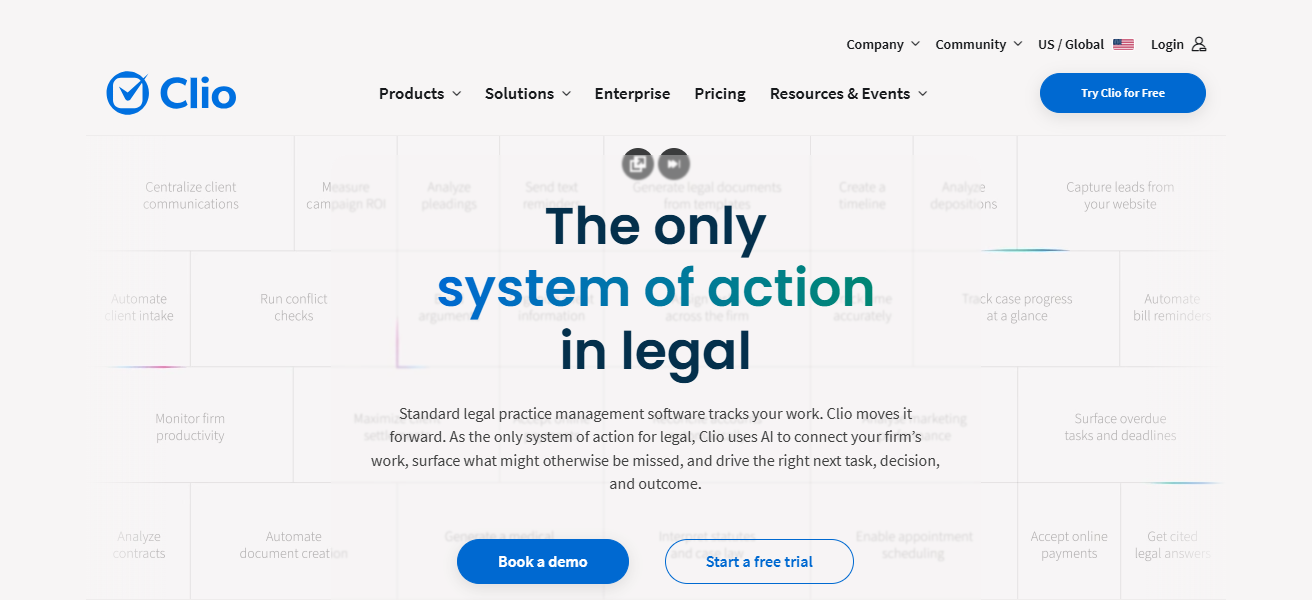
As legal professionals seek ways to run more efficient digital-first law firms, Clio is increasingly the platform of choice–because it gives every firm size a single scalable solution
for affordable cloud flexibility and automation tools while navigating a dramatically changing business landscape with evolving client expectations.
| Pros | Cons |
|---|---|
| Cloud-based platform accessible from anywhere with strong flexibility | Some advanced AI features require higher-tier subscription plans |
| Affordable pricing appeals to small and mid-sized law firms | Internet dependency may affect workflow during connectivity issues |
| Automated billing and client intake improve operational efficiency | Limited enterprise customization compared to larger competitors |
| User-friendly interface reduces training and onboarding challenges | Integrations sometimes require third-party application support |
| Strong mobile accessibility for lawyers managing remote legal work | Reporting tools may feel basic for complex enterprise analytics |
4. Everlaw
The explosion in demand for faster AI-powered eDiscovery and document review by litigation teams is driving explosive growth at Everlaw.
Integrations of the platform with more advanced AI ecosystems that facilitate automated legal research and case preparation have recently brought it wider visibility.

Everlaw is a cloud-native platform for analyzing huge datasets of evidence quickly with intelligent search technology for legal professionals.
Driven by powerful innovation in litigation, with scalable cloud performance, Everlaw has become one of the most impactful systems transforming modern digital investigation and enterprise litigation management around the globe.
| Pros | Cons |
|---|---|
| Powerful AI-driven eDiscovery and litigation review capabilities | Primarily focused on litigation rather than complete legal management |
| Cloud-native infrastructure handles massive evidence datasets efficiently | Pricing can increase significantly for large-scale document reviews |
| Intelligent search tools accelerate legal investigations dramatically | Requires specialized litigation workflow knowledge for best usage |
| Strong collaboration features support legal teams and investigators | Smaller firms may find platform features overly advanced |
| High-speed analytics improve case preparation and evidence management | Heavy document processing may require additional storage costs |
5. Spellbook
Spellbook has captured attention fast for using generative AI to transform contract drafting right in Microsoft Word.
Legal teams are increasingly using Spellbook because it improves the speed at which clause suggestions, redlining, negotiation analysis, and contract reviews are completed without changing the workflows.
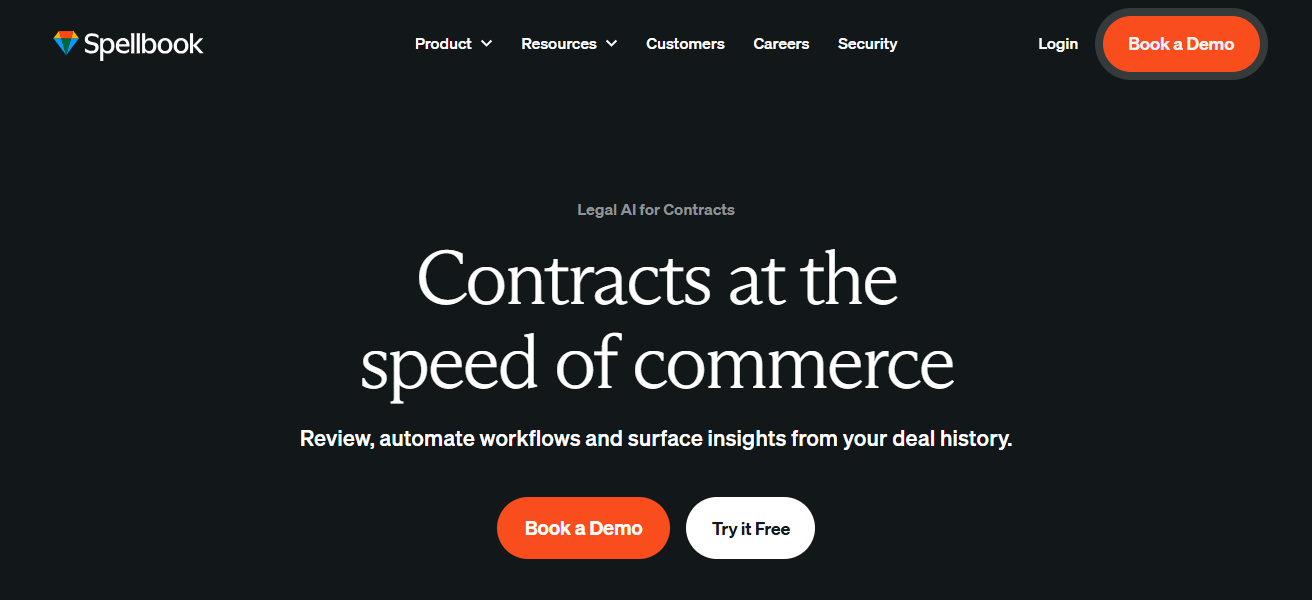
In 2026, the platform will launch enterprise-grade automation features focused on in-house counsels and contract-heavy businesses.
Spellbook is one of the fastest-growing legal drafting automation companies in the world because of its seamless workflow integration, lawyer-friendliness, and productivity-driven AI capabilities.
| Pros | Cons |
|---|---|
| Integrates directly within Microsoft Word for familiar workflows | Heavily dependent on Microsoft Word ecosystem compatibility |
| Accelerates contract drafting and clause recommendations effectively | AI suggestions may occasionally require detailed manual revisions |
| Reduces repetitive legal drafting tasks for busy professionals | Limited functionality outside contract-focused legal operations |
| Easy adoption for lawyers without technical AI expertise | Advanced enterprise features may require premium subscriptions |
| Improves negotiation speed and contract review productivity significantly | Smaller legal teams may underutilize advanced automation features |
6. Darrow AI
It does so with artificial intelligence, uncovering vast swathes of potential legal violations and class-action opportunities buried in litigation discovery that would otherwise go unnoticed.
It extracts high-value legal cases from public datasets, regulations, consumer complaints, and corporate behavior patterns before competitors do.
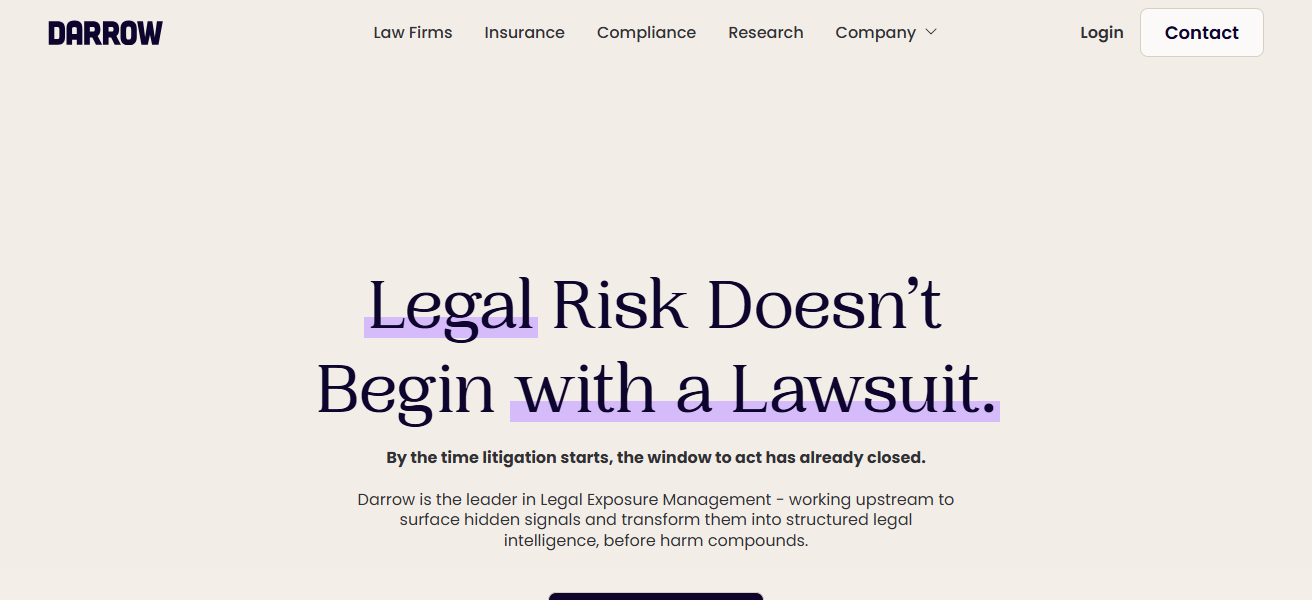
Its predictive legal intelligence model enables law firms to more effectively target profitable litigation opportunities.
Darrow AI focuses on being a data-driven solution and is the first of a new generation of proactive legal automation that has garnered immense international interest from litigation firms as well as investors with a focus on technology.
| Pros | Cons |
|---|---|
| Identifies hidden class-action opportunities using predictive analytics | Primarily focused on litigation discovery rather than general legal tasks |
| Analyzes large public datasets with strong automation capabilities | Requires accurate external data sources for reliable case identification |
| Helps firms discover profitable legal opportunities faster and more efficiently | Specialized litigation focus may limit broader legal adoption |
| Innovative AI-driven legal intelligence improves strategic decision-making | Human legal validation still necessary before pursuing identified cases |
| Strong growth potential within legal analytics and litigation markets | Limited appeal for transactional or corporate legal departments |
7. Luminance
Luminance is on a trajectory of rapid growth, delivering new machine learning solutions for contract analysis, due diligence, and compliance automation.

It is built on its own proprietary AI trained specifically on legal language, and claims organizations can quickly identify loose clauses, potentially risky promises, and hidden obligations in their documents significantly quicker than by conducting a manual review.
In 2026, more enterprises were adopting Luminance for cross-border transactions and complex mergers needing rapid document intelligence.
By integrating explainable AI with multilingual analysis and enterprise scalability, it has cemented its position as a formidable player in the competitive legal automation market.
| Pros | Cons |
|---|---|
| Advanced machine learning improves contract review speed significantly | Enterprise-focused pricing may challenge smaller legal firms financially |
| Multilingual analysis supports international legal transactions efficiently | Full deployment may require substantial onboarding and training |
| Detects risky clauses and anomalies with high accuracy | AI outputs still depend on quality legal document inputs |
| Strong due diligence automation for mergers and acquisitions | Advanced features may overwhelm non-technical legal professionals |
| Scalable platform handles enterprise-level document workloads smoothly | Custom integrations may require additional technical support resources |
8. SpotDraft
SpotDraft is one of the fastest-growing legal tech startups in India, with more than a million contracts processed each year in 2026.
The VerifAI system uses AI to perform risk scoring, clause extraction, and automated contract edits with tight data privacy controls.

SpotDraft is increasingly the choice of enterprises seeking end-to-end contract lifecycle management across their legal, procurement, and sales teams.
SpotDraft is among the fastest-growing contract automation technology companies in the world, thanks to its unmatched customer growth and strong enterprise adoption of its innovative privacy-focused AI product.
| Pros | Cons |
|---|---|
| Strong contract automation with AI-powered VerifAI risk analysis | Enterprise customization may require dedicated onboarding assistance |
| Processes high contract volumes with strong operational efficiency | Smaller businesses may find advanced features unnecessary initially |
| Excellent privacy-focused automation for enterprise legal teams | Limited brand recognition compared to older global competitors |
| Supports collaboration across sales, procurement, and legal departments | Some advanced integrations may involve additional configuration complexity |
| Rapid growth reflects strong adoption within modern legal technology markets | Heavy contract-focused approach limits broader legal functionality |
9. Paxton AI
Paxton AI is gaining traction and assisting lawyers to improve the way legal research, document drafting, compliance analysis, and case preparation processes are automated using conversational AI systems.
The emphasis on productivity for small firms and solo practitioners that want enterprise-level automation but do not want the overhead expense of large-scale systems is a diligent effort.

Paxton AI provides a simple assistant-based environment, enabling legal professionals to obtain summaries and relevant citations in just minutes after obtaining legal insights.
Its innovation, which focuses on accessibility and is designed to be used by both lawyers and non-lawyers alike, continues to propel it in the legal AI marketplace.
| Pros | Cons |
|---|---|
| Conversational AI simplifies legal research and drafting workflows | Emerging platform still building long-term enterprise trust globally |
| Affordable automation tools benefit solo lawyers and small firms | Advanced enterprise integrations remain limited compared to competitors |
| Fast document summarization improves lawyer productivity significantly | AI-generated legal analysis requires professional human verification |
| Easy-to-use interface reduces technical learning challenges | Smaller ecosystem compared to established legal software providers |
| Supports compliance analysis and legal citation generation quickly | Limited global market penetration currently affects widespread adoption |
10. LawVu
LawVu is fast becoming recognised globally as the leader in bringing together legal operations, matter management, contract workflows, and collaboration into a single workspace.
LawVu is increasingly adopted by corporate legal departments as a single solution to manage legal requests, approvals automation, and spend tracking, while providing insights into productivity across teams.
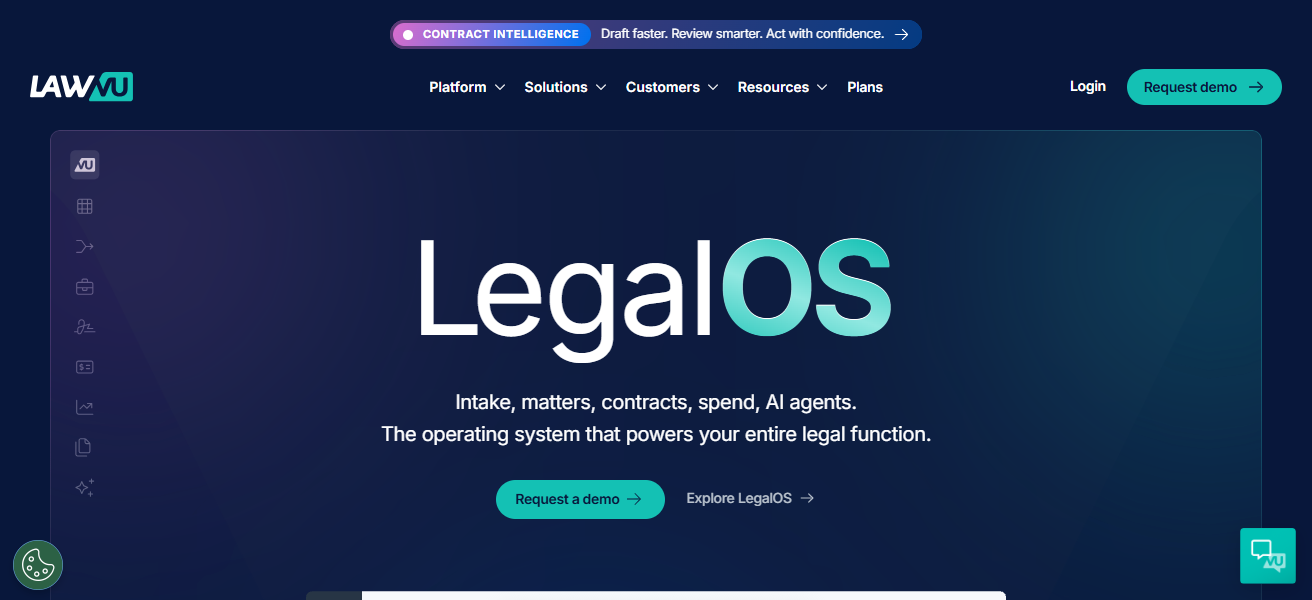
In 2026, the platform added an enterprise-wide capability for AI-assisted workflow automation to facilitate the modernization of an enterprise’s legal operations.
With an integrated operational model, its fast driving business transformation to consolidate disconnected legal processes and making LawVu a high growth leader in transforming legal operations & automating digital workflows.
| Pros | Cons |
|---|---|
| Centralizes legal operations into one unified management workspace | Enterprise deployment may require workflow restructuring internally |
| Strong matter management and collaboration automation capabilities | Advanced modules can increase subscription and implementation costs |
| AI-assisted workflows improve productivity and reporting accuracy | Smaller firms may find platform functionality overly enterprise-focused |
| Streamlines legal requests and approval management efficiently | Learning curve exists for teams transitioning from fragmented systems |
| Excellent visibility into legal spending and operational performance | Custom enterprise integrations may require additional technical support |
Conclusion
In short, Legal Automation Brands With Explosive Growth are changing the world to perform based on AI drives solution and workflow automation technologies.
Innovators such as Harvey AI, Clio, Everlaw, and Ironclad will lead the way with efficiencies focused on achieving more productivity and lowering operational costs while simplifying legal processes.
As technology progresses at an unprecedented pace, we will see legal technology platforms become more prominent in determining the future of global legal services.
FAQ
What are legal automation brands?
Legal automation brands develop AI-powered software simplifying legal research, contracts, compliance, and workflow management.
Why are legal automation companies growing rapidly?
Law firms demand faster workflows, reduced costs, and AI-driven productivity improvements across legal operations.
Which legal automation brand is growing fastest?
Harvey AI currently leads growth with massive enterprise adoption and strong investor backing.
What does Ironclad mainly specialize in?
Ironclad focuses on contract lifecycle management and enterprise approval workflow automation.