In this article, I evaluate the Best Identity and Access Management (IAM) Platforms for Remote Enterprise Teams. These IAM platforms are designed for organizations looking to secure their remote work environments.
These IAM tools offer distributed teams an extensive range of authentication, access controls, and identity governance.
This article helps you understand how the best of the best IAM platforms optimize security, ease user management, and enable the flexible and scalable enterprise operations that today’s cloud-based, remote-first business environments demand.
How We Select the Best Identity and Access Management (IAM) Solutions for Remote Enterprise Teams
- First, we analyze multi-factor authentication (MFA) and passwordless security features.
- Second, we focus on the implementation of zero-trust architecture and adaptive access control.
- Third, we examine the scalability for remote enterprise teams of all sizes and locations.
- Fourth, we analyze the seamless interoperability of the IAM system with SaaS, cloud, and legacy solutions.
- Fifth, we look at automation and identity lifecycle management of IAM systems with respect to onboarding and offboarding.
- Sixth, we review the IAM system’s automation of compliance for GDPR, HIPAA, and SOC 2.
- Seventh, we score user experience with emphasis on employees and admins.
- Eighth, we analyze advanced threat detection with artificial intelligence and behavioral analytics.
- Ninth, we evaluate the flexibility and ease of use of APIs for developers and enterprise customization.
- Tenth, we factor in the pricing structure and total cost of ownership vs enterprise value.
Key Poinst & Best Identity and Access Management (IAM) Platforms for Remote Enterprise Teams
| IAM Platform | Explanation |
|---|---|
| Okta | Cloud identity platform enabling a secure single sign-on access management solution |
| Microsoft Entra ID | Enterprise identity service providing secure access across the Microsoft ecosystem platform |
| Ping Identity | Identity management platform delivering secure authentication and authorization services globally |
| IBM Security Verify | IBM enterprise IAM solution enabling unified identity lifecycle management system |
| OneLogin | Cloud IAM platform simplifying secure access for enterprise applications users |
| Auth0 | A developer-friendly identity platform providing authentication and authorization APIs securely |
| Cisco Duo | Zero trust security platform delivering strong multi-factor authentication protection |
| SailPoint | Identity governance platform managing user access and compliance controls effectively |
| CyberArk | Privileged access management platform securing critical enterprise accounts safely now |
| ForgeRock | ForgeRock identity platform offering scalable access management solutions globally trusted |
10 Best Identity and Access Management (IAM) Platforms for Remote Enterprise Teams
1. Okta
Designed to serve modern remote businesses, Okta’s cloud Identity and Access Management system is among the best on the market. Its Single Sign-On (SSO) and Multi-Factor Authentication (MFA) offerings are partnered with adaptive policies for behavioral and device risk.

Flexible and robust, Okta is integrated with thousands of SaaS applications. Okta’s recent product iterations have put an emphasis on AI for threat detection and a reduction of credential-based
attacks through the implementation of passwordless authentication, all while maintaining a strong focus on the end-user experience through identity governance.
Okta Pros & Cons
| Pros | Cons |
|---|---|
| Strong Single Sign-On across thousands of apps | Can be expensive for small organizations |
| Advanced Multi-Factor Authentication (MFA) support | Setup complexity for advanced configurations |
| Highly scalable for global remote teams | Occasional integration latency issues |
| Strong API and automation capabilities | Limited offline identity functionality |
| Continuous innovation in passwordless security | Requires training for full feature utilization |
2. Microsoft Entra ID
Built with the hybrid and remote worker in mind, Microsoft Entra ID is Microsoft’s cloud identity solution. It provides safe access to Microsoft 365, Azure, and a multitude of third-party applications.
Conditional Access policies allow the system to dynamically dictate the level of security to be employed based on the user’s location, device compliance, and risk evaluation.
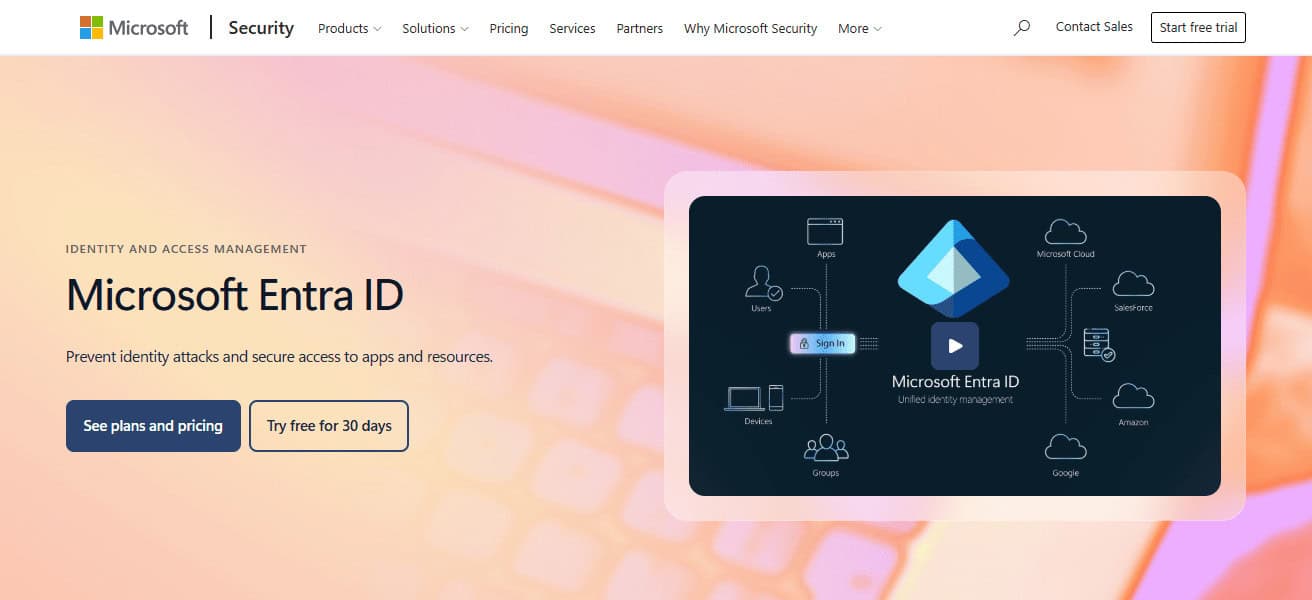
Features based in machine learning have also been introduced recently to assist in the protection of enterprise-level identities, simplifying and strengthening security in remote work environments and integrating further into the Zero Trust architecture.
Microsoft Entra ID Pros & Cons
| Pros | Cons |
|---|---|
| Deep integration with Microsoft 365 ecosystem | Complex licensing structure |
| Strong Conditional Access security policies | Best features locked in premium tiers |
| AI-driven identity protection and risk detection | Non-Microsoft integrations may need extra setup |
| Excellent hybrid cloud identity support | Interface can be overwhelming for beginners |
| Highly reliable enterprise-grade infrastructure | Advanced features require Azure expertise |
3. Ping Identity
Built on a foundation of secure digital identity, Ping Identity’s products have been designed for large enterprise environments with complex user needs. Authentication, identity federation, and access management are all managed seamlessly within Ping Identity’s offerings.
Financial services and healthcare verticals are among a few that have focused their access solutions around Ping Identity’s compliance-first architecture.
Seamless experiences have been the focus of Ping Identity’s latest products, which include cloud-based identity verification and advanced detection of fraud.
Ping Identity Pros & Cons
| Pros | Cons |
|---|---|
| Strong identity federation across systems | Higher cost for enterprise deployment |
| Excellent for regulated industries | Complex initial implementation process |
| Supports hybrid IT environments effectively | UI less intuitive compared to competitors |
| Advanced fraud detection features | Requires skilled IT teams for optimization |
| Strong compliance support (finance, healthcare) | Slower updates compared to cloud-native tools |
4. IBM Security Verify
IBM Security Verify provides regulated industries with enterprise-grade identity governance and access management. It offers AI-based identity analytics, lifecycle management, and risk-based authentication.
The platform aims to consolidate workforce and consumer identity systems within a securely unified framework.
IBM Security Verify’s identity orchestration features for hybrid cloud environments and Zero Trust focused updates are optimal for enterprises with extensive compliance needs and security automation for geographically distributed employees.
IBM Security Verify Pros & Cons
| Pros | Cons |
|---|---|
| Strong AI-driven identity governance | High enterprise pricing |
| Excellent compliance and audit capabilities | Complex deployment and configuration |
| Unified workforce and customer identity support | Steep learning curve for new users |
| Strong Zero Trust integration features | Heavy resource requirement for full deployment |
| Advanced lifecycle management automation | Less flexible UI customization |
5. OneLogin
OneLogin provides a simplified IAM platform that stresses ease of use without sacrificing enterprise security. It provides remote employees with fast onboarding through integrated Single Sign-On, MFA, and directories.
OneLogin’s SmartFactor Authentication provides a context-aware security risk by continuously evaluating user location and the trust level of the user’s device.
Recently, OneLogin has strengthened its API integration and user provisioning, encouraging organizations to utilize OneLogin to eliminate the burdens of complex identity management.
OneLogin Pros & Cons
| Pros | Cons |
|---|---|
| Easy-to-use IAM platform for enterprises | Limited advanced customization options |
| Fast employee onboarding process | Smaller feature ecosystem than top competitors |
| Strong Single Sign-On capabilities | Reporting tools are less advanced |
| SmartFactor risk-based authentication | Occasional performance lag under heavy load |
| Good API integration support | Not ideal for highly complex infrastructures |
6. Auth0
Auth0, now part of Okta, is a modular identity platform catering to developers for authentication and authorization through a variety of flexible methods. Organizations use Auth0, with its embedded secure login, APIs, and SDKs, to integrate identity services into their applications.
Auth0 has support for passwordless and social logins. Auth0 has also implemented enterprise authentication and extensibility through serverless identity actions and observability for security.
Auth0 is most popular for its use by SaaS companies to easily construct a secure authentication framework to address their customer’s identity needs.
Auth0 Pros & Cons
| Pros | Cons |
|---|---|
| Developer-friendly APIs and SDKs | Pricing increases with scale |
| Highly customizable authentication flows | Requires developer expertise |
| Supports passwordless and social login | Not ideal for non-technical teams |
| Strong multi-tenant architecture support | Dependency on external configuration |
| Excellent for SaaS application identity | Can become complex for enterprise governance |
7. Cisco Duo
Cisco Duo is an IAM and MFA solution. Duo is a Zero Trust solution used to secure access for remote workers. Cisco Duo verifies a user’s identity through health checks of a user’s device and by collecting biometric data.
Duo utilizes contextual authentication signals to strengthen verification. Duo employs a “trusted access” model. This model permits access to enterprise systems for users and devices that have been verified and validated.

Some improvements and additions to Cisco Duo include enhanced passwordless authentication and deeper connections to Cisco Secure. This makes Duo a protective layer against phishing and credential theft for users in remote environments.
Cisco Duo Pros & Cons
| Pros | Cons |
|---|---|
| Strong Zero Trust security model | Limited identity governance features |
| Excellent Multi-Factor Authentication | Requires Cisco ecosystem for full benefits |
| Device health verification security | Basic IAM features compared to competitors |
| Easy deployment for remote workforce | Limited customization options |
| Strong phishing resistance protection | Reporting analytics can be improved |
8. SailPoint
SailPoint offers a robust solution for Identity Governance and Administration (IGA). Sailpoint automates access reviews and role assignments. It also automates compliance reporting for complex IT systems.
SailPoint utilizes an AI-driven approach to identity and access that helps identify abnormalities in a system and mitigates “over entitlement” access.
SailPoint has made improvements to its cloud-native identity governance, and has better visibility into SaaS offerings. SailPoint is an optimal solution for enterprises that have a distributed workforce and want to streamline their compliance and oversight functions.
SailPoint Pros & Cons
| Pros | Cons |
|---|---|
| Advanced identity governance capabilities | High implementation complexity |
| Strong compliance and audit readiness | Expensive for small businesses |
| AI-driven access risk detection | Requires long deployment cycles |
| Automated role and access reviews | Interface can feel enterprise-heavy |
| Strong SaaS visibility controls | Needs skilled administrators |
9. CyberArk
CyberArk focuses on targeting restricted access to enterprise systems and infrastructure. CyberArk helps secure privileged accounts that are sensitive to Cloud Environment Administrators, DevSecOps, and user accounts.
CyberArk employs a style of threat mitigation that vaults credentials and monitors user sessions. CyberArk enforces the “least privileged” style of access to help prevent insider threats.
CyberArk’s latest innovations are AI cloud privilege security and detection of threats in privileged sessions. CyberArk is a solution that many enterprises use in a remote workforce environment to help secure highly sensitive systems.
CyberArk Pros & Cons
| Pros | Cons |
|---|---|
| Industry-leading Privileged Access Management | High cost of ownership |
| Strong protection for sensitive accounts | Complex architecture setup |
| Advanced session monitoring tools | Requires specialized security teams |
| Excellent insider threat prevention | Not a full IAM solution alone |
| Strong cloud privilege security | Integration can be time-consuming |
10. ForgeRock
Designed specifically for large enterprises and customer identity scenarios, ForgeRock offers a scalable digital identity platform. The platform employs identity orchestration, adaptive authentication, and centralized access management that spans both cloud and on-prem systems.

Its AI-based identity insights enhance fraud prevention and optimize user journeys. Recently, ForgeRock has focused its efforts on decentralized identity and API-first architecture. This makes ForgeRock an optimal choice for enterprises dealing with thousands of identities.
ForgeRock Pros & Cons
| Pros | Cons |
|---|---|
| Scalable identity platform for enterprises | Complex deployment process |
| Strong API-first architecture | Higher learning curve |
| Supports decentralized identity trends | Expensive enterprise licensing |
| Excellent customer identity management | Requires skilled configuration |
| Strong fraud prevention tools | Not ideal for small organizations |
Conclusion
In Conclusion Best Identity and Access Management (IAM) platforms for remote enterprise teams provide a vital service to organizations with a distributed workforce and the need to protect sensitive data.
For example, Okta, Microsoft Entra ID, and Ping Identity offer strong, scalable, and compliant authentication. These solutions integrate Zero Trust security while simplifying access and mitigating cybersecurity concerns.
For optimal productivity, control, and security across the remote enterprise, the most effective IAM system is the best choice.
FAQ
Why is Microsoft Entra ID popular for remote companies?
Microsoft Entra ID enables secure access across Microsoft 365, Azure, and third-party apps. It uses conditional access policies, enhancing security. Remote enterprises trust it for seamless hybrid cloud identity management and strong Zero Trust enforcement.
What makes Ping Identity suitable for large enterprises?
Ping Identity offers strong authentication, identity federation, and secure hybrid IT access. It supports complex enterprise environments, ensuring compliance and fraud protection. It is widely used in banking, healthcare, and global organizations requiring strict identity governance.
How does IBM Security Verify help identity management?
IBM Security Verify delivers AI-driven identity governance, lifecycle automation, and risk-based authentication. It helps enterprises unify workforce identities securely. It supports Zero Trust architecture and improves compliance for remote and hybrid enterprise environments.
What is OneLogin mainly used for?
OneLogin simplifies secure access with single sign-on, multi-factor authentication, and user provisioning. It helps organizations onboard remote employees quickly. It also improves security using real-time risk-based authentication and centralized identity management.
Why do developers prefer Auth0?
Auth0 provides flexible APIs, SDKs, and customizable authentication flows. Developers use it to build secure login systems quickly. It supports social login, passwordless authentication, and enterprise federation for scalable applications.