In this article I’ll be going over the Top Mass Tort Lawsuit Settlement Loan Desks including their funding options, eligibility requirements, benefits and possible downsides.
You’ll learn how different providers assist plaintiffs and law firms with complex litigation, what fees and repayment terms to examine, and how to carefully assess funding alternatives to make wise financial choices as you await possible lawsuit settlements.
Key Points & Top Mass Tort Lawsuit Settlement Loan Desks
| Company | 12-Word Explanation |
|---|---|
| Tribeca Lawsuit Loans | Provides pre-settlement funding to plaintiffs awaiting compensation from qualifying lawsuits and claims. |
| USClaims | Offers pre-settlement funding solutions for plaintiffs pursuing compensation through eligible personal injury lawsuits. |
| Burford Capital | Provides legal finance solutions supporting law firms, businesses, and complex commercial litigation. |
| Legal-Bay Lawsuit Funding | Helps eligible plaintiffs access lawsuit advances while awaiting potential settlements or verdicts. |
| Rockpoint Legal Funding | Offers lawsuit funding options designed to help plaintiffs manage expenses during litigation. |
| Peachtree Financial Solutions | Provides structured settlement purchasing and financial solutions for eligible settlement recipients. |
| Mustang Funding | Offers pre-settlement advances to qualifying plaintiffs facing financial pressures during litigation proceedings. |
| LawCash | Provides lawsuit funding intended to help eligible plaintiffs cover expenses before settlements. |
| Pravati Capital | Specializes in legal finance solutions for law firms and commercial litigation matters. |
| Nova Legal Funding | Offers pre-settlement funding options for plaintiffs awaiting resolution of qualifying legal claims. |
| Mayfield Settlement Funding | Provides funding solutions for plaintiffs seeking financial support before lawsuit settlements are finalized. |
| Mass Tort Funds | Focuses on funding options for plaintiffs involved in qualifying mass tort litigation. |
| Esquire Bank | Provides banking and financial services supporting attorneys, law firms, and legal businesses. |
| RapidFunds | Offers financial assistance options for eligible plaintiffs awaiting potential lawsuit settlement proceeds. |
14 Top Mass Tort Lawsuit Settlement Loan Desks
1. Tribeca Lawsuit Loans
Tribeca Lawsuit Loans is a legal finance company that offers lawsuit funding to qualified plaintiffs who have a mass tort or other civil litigation claim. On its mass tort funding page, it lists cases involving defective medical devices, pharmaceutical products and other allegedly harmful products. The firm considers applications on the basis of strength of the case, potential compensation and attorney involvement.
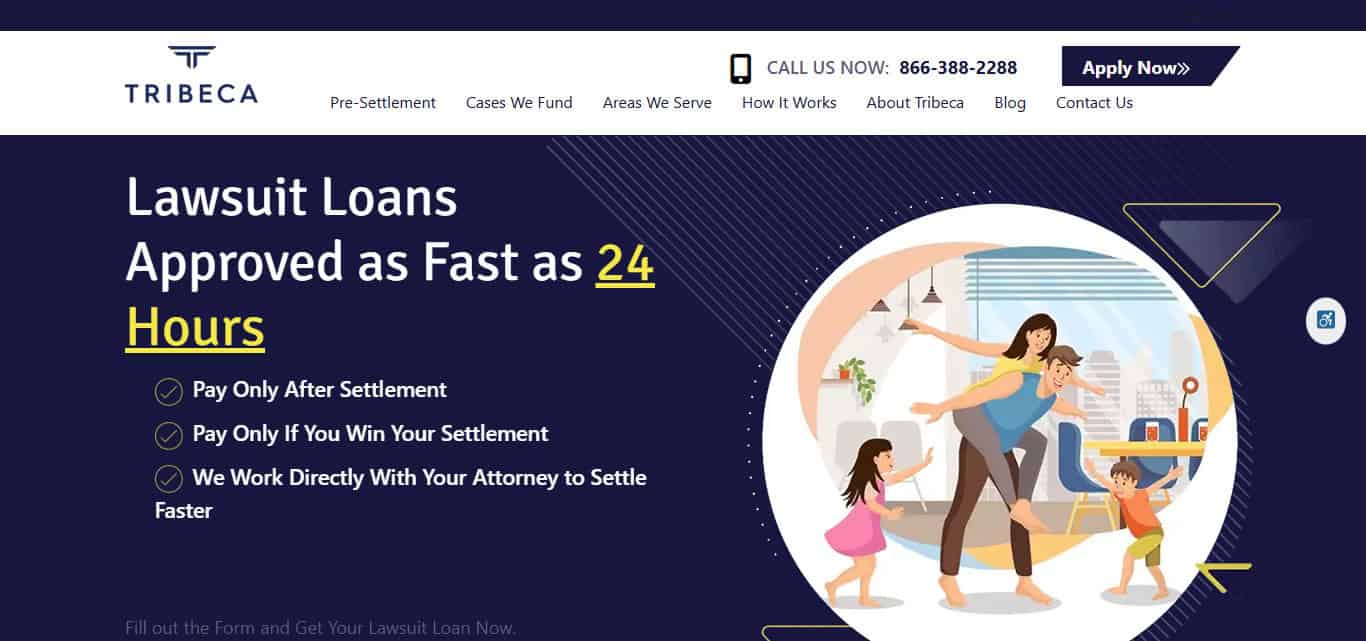
Available information shows that the amount of funding and costs reflect each applicant’s circumstances, and that approved applicants could receive funds shortly after they sign the necessary agreement. Applicants should review the repayment calculation, applicable fees and state-specific conditions with their attorney prior to accepting an advance.
Tribeca Lawsuit Loans Pros & Cons
| Pros | Cons |
|---|---|
| Offers pre-settlement advances for eligible plaintiffs with pending legal claims. | Approval depends on case merits and anticipated recovery. |
| May help cover urgent household and medical expenses. | Funding costs can reduce the final settlement proceeds. |
| Repayment may depend on a successful legal recovery. | Not every mass tort claim or jurisdiction may qualify. |
2. USClaims
USClaims offers pre-settlement funding to eligible plaintiffs in need of financial assistance during the pendency of a lawsuit. Its application process includes a review of the legal claim and the collection of relevant information through the applicant or their attorney.

Potential funding is based on the facts of the case, the projected recovery and the criteria for approval, not just the personal income of the claimant. USClaims says that once a contract is fully executed, approved funding can be released, although processing times and restrictions may vary.
Applicants should verify whether their particular mass tort claim qualifies, request a written breakdown of the total repayment amount, and ensure the service is available in their state.
USClaims Pros & Cons
| Pros | Cons |
|---|---|
| Offers non-recourse pre-settlement funding for eligible plaintiffs. | Funding is unavailable in certain states and jurisdictions. |
| Advertises a 2X repayment cap for qualifying agreements. | The cap may not apply to every case or jurisdiction. |
| Works with attorneys during the application process. | The amount owed can increase while the case remains unresolved. |
3. Burford Capital
Burford Capital is a legal finance company that offers services to businesses and law firms involved in commercial litigation and arbitration. It offers services such as financing legal costs, turning expected claims or judgments into cash, and underwriting portfolios of legal cases.
That means that Burford is relevant to conversations about mass tort financing on a law firm or litigation portfolio level, rather than by default as a source of small personal advances for individual claimants. Funding decisions are made on the basis of detailed legal and financial assessments, the economics of the dispute and the proposed transaction structure.
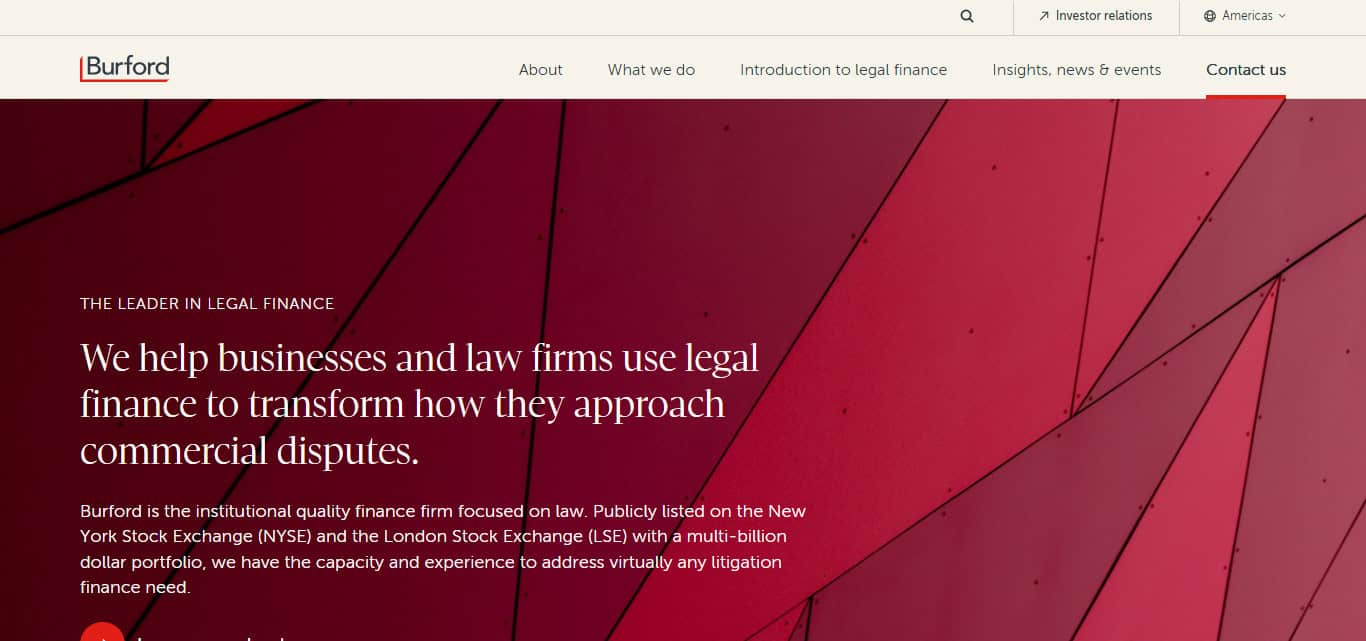
For law firms that are looking at Burford, they should look at the capital requirements, the repayment arrangements, the risk allocation and if their particular litigation portfolio fits into its investment criteria.
Burford Capital Pros & Cons
| Pros | Cons |
|---|---|
| Provides capital for complex commercial litigation and arbitration. | Primarily targets businesses and law firms, not individual claimants. |
| Can finance individual disputes or litigation portfolios. | Funding decisions involve detailed legal and financial due diligence. |
| Offers solutions for legal expenses and expected recoveries. | May not suit people seeking small personal settlement advances. |
4. Legal-Bay Lawsuit Funding
Lawsuit Legal-Bay Funding is a name you can compare as it pertains to providers of pre-settlement financial advances for those pursuing legal claims. With a mass tort applicant, the key is whether the company is currently accepting that category of litigation, whether the claimant has a lawyer, and what case documentation is required.

Applicants should ask how the potential advance is calculated, whether the provider considers expected proceeds from a settlement and how repayment will vary if the case takes longer than expected. Before you sign an agreement, ask for the complete fee schedule, examples of repayment and the restrictions that apply by state. Assume not all mass torts are eligible. Confirm current services directly.
Legal-Bay Lawsuit Funding Pros & Cons
| Pros | Cons |
|---|---|
| Can be considered when comparing pre-settlement funding providers. | Current mass tort eligibility should be confirmed directly. |
| Potential funding may help cover expenses during litigation. | Approval depends on the claim and applicable requirements. |
| Applicants can request case-specific funding terms. | Fees and repayment terms need careful review before signing. |
5. Rockpoint Legal Funding
Rockpoint Legal Funding provides legal funding products such as pre-settlement advances and law firm financing. Consumer legal funding is non-recourse, meaning repayment depends on the outcome and terms of the legal claim as opposed to regular monthly loan payments, according to its published information.
If you are involved in mass tort litigation, check your specific case and jurisdiction for eligibility. Important factors include estimated claim value, stage of litigation, attorney cooperation, and proposed repayment amount.

Applicants should compare the total cost against other options available and ensure they understand how the funding agreement will affect their eventual net settlement.
Rockpoint Legal Funding Pros & Cons
| Pros | Cons |
|---|---|
| Offers non-recourse legal funding products for eligible cases. | Not all claims or jurisdictions will qualify. |
| Provides a confidential application and case evaluation process. | Funding costs may reduce the claimant’s eventual net recovery. |
| Describes both pre-settlement and post-settlement funding options. | Applicants must verify which product matches their case status. |
6. Peachtree Financial Solutions
Peachtree Financial Solutions is known for purchasing structured settlement payment rights for a lump sum payment. Unlike pre-settlement funding, the payments here usually relate to cases that have already been settled, not an unliquidated mass tort claim.

A claimant with an approved settlement may want to consider whether they can sell future scheduled payments to pay immediate needs. The amount offered is dependent upon the payment schedule and terms of the transaction.
Applicants should review the discount being applied, the total future payments being relinquished and any court approval requirements. Peachtree should not be assumed to be a direct funder of ongoing mass tort litigation.
Peachtree Financial Solutions Pros & Cons
| Pros | Cons |
|---|---|
| Offers options for converting structured settlement payments into lump sums. | Selling future payments can reduce long-term financial security. |
| May provide access to money before scheduled payments arrive. | The lump sum may be lower than the total payments surrendered. |
| Can be relevant to recipients with established settlement rights. | It is not necessarily an option for unresolved mass tort claims. |
7. Mustang Funding
Mustang Funding, or Mustang Litigation Funding, provides financial solutions to plaintiffs and law firms litigating qualifying legal disputes. Its pre-settlement funding information says an advance can assist plaintiffs with living expenses during the pendency of a case.

The questions for mass tort claimants are whether the company will take the specific litigation, how it values the expected recovery and the terms of the funding.
Mustang also points out that there is funding available for legal cases outside of individual consumer advances, so applicants should specify what product they need. Before you accept funding, read the agreement closely, particularly the sections on fees, repayment terms and what happens if the claim is not successful.
Mustang Funding Pros & Cons
| Pros | Cons |
|---|---|
| Offers non-recourse advances for eligible pending lawsuits. | Funding costs may be higher than conventional borrowing. |
| Generally does not require routine monthly repayments during litigation. | The eventual settlement proceeds may be reduced. |
| Approval focuses on the legal claim rather than only credit history. | Case approval and funding amounts are not guaranteed. |
8. LawCash
LawCash is one of many legal funding companies that can be added to a list, but applicants should check that its current mass tort offerings are applicable before assuming that a given claim qualifies. The most helpful information to obtain would include eligible case categories, attorney verification requirements, available advance amounts and the states in which funding is offered.

Claimants should also want to know whether the proposed arrangement is a non-recourse advance and how the company will determine repayment from a future recovery.
Mass tort proceedings may take a long time and the individual compensation may be uncertain, so it is important to compare the written cost of funding with the amount that the claimant may ultimately receive after deductions for settlement.
LawCash Pros & Cons
| Pros | Cons |
|---|---|
| Can be researched as an option for eligible lawsuit funding. | Current mass tort products should be verified directly. |
| Funding may help plaintiffs manage expenses before resolution. | Eligibility can vary by case type and jurisdiction. |
| Applicants can compare written terms before accepting an advance. | Repayment costs may reduce the final compensation received. |
9. Pravati Capital
Pravati Capital is a litigation finance company that works with law firms, attorneys, commercial litigants and investors. It describes its published information as funding law firms’ general and case-specific expenses, and mature personal injury and mass tort matters that meet its investment criteria.

This is especially true when researching funding for legal practices dealing with complex cases or groups of claims. Pravati looks at issues on the basis of their legal merit, the potential for recovery and the likelihood of success. Before proceeding, applicants should confirm the minimum case requirements, the proposed capital structure, risk-sharing arrangements and repayment terms.
Pravati Capital Pros & Cons
| Pros | Cons |
|---|---|
| Specializes in litigation finance for legal and commercial matters. | May be unsuitable for individuals seeking small cash advances. |
| Can support eligible law firms and litigation portfolios. | Funding arrangements can involve complex contractual terms. |
| Evaluates financing opportunities based on case-specific factors. | Approval depends on investment criteria and due diligence. |
10. Nova Legal Funding
Nova Legal Funding is another provider to investigate when comparing potential sources of financial assistance during litigation. Mass tort claimants should first establish whether the company currently funds their specific type of claim and operates in their jurisdiction.

The next step is to understand its application requirements, attorney verification process, and method for estimating the amount available against an anticipated recovery. Applicants should request written details about fees, repayment calculations, and any conditions that apply if the case remains unresolved for an extended period.
A provider’s general personal injury funding service does not necessarily mean that every mass tort claim is accepted, so eligibility should be confirmed directly.
Nova Legal Funding Pros & Cons
| Pros | Cons |
|---|---|
| Can be considered when comparing legal funding options. | Specific mass tort eligibility requires direct confirmation. |
| Potential advances may provide financial flexibility during litigation. | Funding availability and amounts are not guaranteed. |
| Applicants can request written repayment examples. | Costs can reduce the net settlement received. |
11. Mayfield Settlement Funding
People looking for financial assistance related to legal settlements may want to look into Mayfield Settlement Funding as one possible choice. As a mass tort funding provider, before you present it, check to see what services it offers, eligibility requirements and if it advances against pending claims or purchases payments from completed settlements.

These arrangements have different purposes and different financial consequences. Prospective applicants should ask about, among other things, how the amount of funding is determined, whether legal representation is required, and whether there are any fees or repayment requirements.
It is also important to confirm that the state is available and to obtain a written agreement showing the amount payable from the settlement. Do not assume any specific funding ceilings or approval timeframes based on previous knowledge.
Mayfield Settlement Funding Pros & Cons
| Pros | Cons |
|---|---|
| Can be investigated for settlement-related financial assistance. | Current services and business terms require verification. |
| May be relevant to certain settlement payment needs. | Pending claims and completed settlements require different funding products. |
| Written terms can help applicants assess potential costs. | Do not assume that every mass tort claim qualifies. |
12. Mass Tort Funds
If you’re looking for financial assistance for class action lawsuits involving pharmaceuticals, medical devices or other allegedly harmful products, Mass Tort Funds is a good name to consider. But claimants should verify that the provider is still operating, and whether it provides individual pre-settlement advances directly or refers applicants to another funding company.

This distinction is important because eligibility criteria, fees, repayment arrangements and servicing responsibility of the agreement can differ. Applicants should ask about what types of litigation are accepted, what documentation is required from attorneys, and how the proposed advance would affect net compensation. Verify all terms in writing prior to release of sensitive financial or legal information.
Mass Tort Funds Pros & Cons
| Pros | Cons |
|---|---|
| The name is directly relevant to mass tort funding research. | Current operating details and direct funding services need confirmation. |
| May be worth investigating for qualifying mass tort claims. | Available funding amounts and eligibility rules may be unclear. |
| Applicants can ask about attorney verification and repayment terms. | Verify the actual contracting company before sharing sensitive information. |
13. Esquire Bank
Esquire Bank provides financial services to law firms, settlement administrators and qualifying plaintiffs. Its settlement services include qualified settlement fund solutions, common benefit fee loans and financing against certain settled-case fees.

The bank also has an Early Access Loan for eligible claimants who have settled their cases but have not yet received settlement payments. Its published terms provide for advances up to 50% of the net settlement value for this plaintiff product subject to applicable requirements.
Esquire is especially applicable to settlement administration and post-settlement financing, but it is necessary to verify eligibility and product terms with the provider.
Esquire Bank Pros & Cons
| Pros | Cons |
|---|---|
| Provides banking and settlement-related financial solutions for legal businesses. | Many services are designed for law firms rather than individual claimants. |
| Offers qualified settlement fund and common benefit fee loan solutions. | Eligibility depends on the product and transaction structure. |
| Provides financing against certain eligible law firm fee receivables. | It is not a universal source of advances for pending individual claims. |
14. RapidFunds
RapidFunds is a legal fee accelerator for contingency fee cases such as class actions, multidistrict litigation, product liability and mass torts. The published process is submitting an application, completing due diligence, signing an agreement, and receiving funds if approved.
RapidFunds is said to be purchasing a portion of future legal fees or fees from settled cases, not primarily giving an individual claimant an advance against a pending personal settlement.

The distinction is particularly important for law firms with delayed fee collection and cash flow. Firms should review the transaction structure, eligible fee interests, costs and repayment conditions before entering into an agreement.
RapidFunds Pros & Cons
| Pros | Cons |
|---|---|
| Specializes in legal fee acceleration for contingency-fee practices. | Primarily serves law firms rather than individual plaintiffs. |
| Supports eligible class action, mass tort, and multidistrict litigation fees. | Funding depends on due diligence and eligible fee interests. |
| Reports that approved transactions can be funded quickly. | Selling part of anticipated fees reduces future fee proceeds. |
Conclusion
To summarize, deciding on the Best Mass Tort Lawsuit Settlement Loan Desks involves a thorough review of financing options, qualification requirements, charges, and repayment conditions. Providers differ in what they offer, with some supporting individual plaintiffs and others more geared toward law firm litigation finance.
Have your attorney review the agreement, check out the provider’s credibility and calculate how repayment might affect your final settlement proceeds and overall financial stability before you accept funding.
FAQ
What are mass tort lawsuit settlement loan desks?
Mass tort lawsuit settlement loan desks are providers that may offer financial advances to eligible plaintiffs or financing to law firms involved in mass tort litigation. These services help address financial needs while cases remain unresolved or settlement payments are delayed. Terms and eligibility vary by provider.
How does mass tort lawsuit funding work?
The provider reviews the legal claim, anticipated recovery, attorney information, and other eligibility requirements. If approved, the applicant receives an advance under a written agreement. Repayment conditions depend on the contract and applicable law, so applicants should understand the total cost before accepting funds.
Who qualifies for mass tort settlement funding?
Eligibility typically depends on having a qualifying legal claim, an attorney representing the claimant, and sufficient information to evaluate the case. Some providers specialize in particular lawsuits or jurisdictions. Approval is not guaranteed, and each provider may apply different requirements.
How much money can plaintiffs receive from lawsuit funding companies?
The amount depends on factors such as the case’s estimated value, litigation stage, potential recovery, and provider limits. There is no universal funding amount for mass tort claims. Applicants should request a written offer and confirm the repayment amount before signing an agreement.