In this article, I discuss the most innovative AI companies supported by Google and how they are shaping various industries. Generative AI, Enterprise Automation, Coding, Legal Tech, and Creative tools are some of the fields that they operate in.
You will learn about the tool, its standout features, strengths, disadvantages, and reasons that Google’s backing makes these tools special in the fast-paced world of artificial intelligence.
What Are Google-Backed AI Companies?
Google-backed AI companies refer to companies that develop Artificial Intelligence technologies and are offered funding, cloud services, and technical support from Google, as collaboration partners.
These companies target a variety of domains and industries, such as the development of software and dedicated solutions for the healthcare, legal tech, content generation, and tools for the automation of enterprises.
Additionally, The support from Google allows these companies to develop and offer more sophisticated solutions at a global level, by using Google’s cloud services and AI expertise.
Numerous companies that are supported by Google are at the edge of developing technologies regarding Generative AI, Machine Learning, AI Safety, and Intelligent Automation.
Reasons For Google’s Investments In AI Firms (Best AI Companies Backed by Google)
- Speeding up AI development – Invests in emergent companies that enhance AI and quicken the pace of new models and research.
- Building the Google Cloud AI ecosystem – Makes Google Cloud better equipped to function at its best by embedding more powerful AI and developer services for enterprise customers.
- Encouraging enterprise AI – Builds the capacity of companies around the world to use scalable AI to enhance productivity, automation, and effectiveness.
- Building safer AI infrastructures – Funds research that develops AI in a safer, more transparent and fairer way that considers all the industries that may use it.
- Improving AI infrastructure – Builds AI technology and frameworks that complement Google services by building alliances with emergent AI companies, thus improving Google’s competitive advantage.
Key Points & Best AI Companies Backed by Google
| AI Company | Explanation |
|---|---|
| Anthropic | Advanced AI research company developing safe, reliable language models with Google’s strategic investment support. |
| Hugging Face | Open-source AI platform enabling developers to build, share, and deploy machine learning models efficiently. |
| Runway | Creative AI startup delivering powerful video generation, editing, and multimedia production tools globally. |
| Character.AI | Builds conversational AI companions offering personalized, interactive experiences across multiple digital applications daily. |
| Magic | Develops AI coding assistants helping programmers automate software development tasks with greater efficiency. |
| Hebbia | Enterprise AI platform enabling professionals to analyze complex documents and extract valuable insights quickly. |
| Replit | AI-powered coding platform simplifying software creation, collaboration, and deployment for developers worldwide daily. |
| SynthID | Google’s AI technology helping identify AI-generated content through secure digital watermarking methods effectively. |
| Adept AI | Develops AI agents automating workplace tasks across software applications using natural language instructions. |
| Harvey AI | Legal AI platform assisting law firms with research, document drafting, and workflow automation. |
10 Best AI Companies Backed by Google
1. Anthropic
Anthropic, a Google-backed AI company, prioritizes the development of safe and reliable AI systems. Competitors of Google’s Claude family of AI models cite their advancement in reasoning and coding, as well as their ability to generate content.

Enhancements to Anthropic’s research and cloud infrastructures as a result of Anthropic’s multi-billion Project fund enable Anthropic to focus on expanding enterprise AI solutions. Anthropic retains a focus on AI safety and its altruistic commitment to the development and deployment of AI technologies.
Anthropic – Key Features
- Claude AI Models – Reasoning, coding, content generation
- AI safety and ethics as a responsibility and focus area
- Secure Google Cloud based Enterprise Ready APIs
- Long-context capabilities
- Models are continually enhanced, focusing on accuracy and reliability
| Pros | Cons |
|---|---|
| Strong focus on AI safety and responsible development. | Premium features require paid subscription plans. |
| Claude models excel in reasoning and coding tasks. | Smaller public ecosystem than some competitors. |
| Backed by Google with enterprise-grade cloud infrastructure. | API usage costs can increase for large businesses. |
| Trusted by enterprises for secure AI deployments. | Availability of newest features may vary by region. |
2. Hugging Face
Hugging Face is an open source AI platform that houses a collaborative community of developers and hosts a repository of thousands of machine learning models and datasets. Backed by Google in addition to several large tech companies, its importance to the demystification of AI technologies is unparalleled.
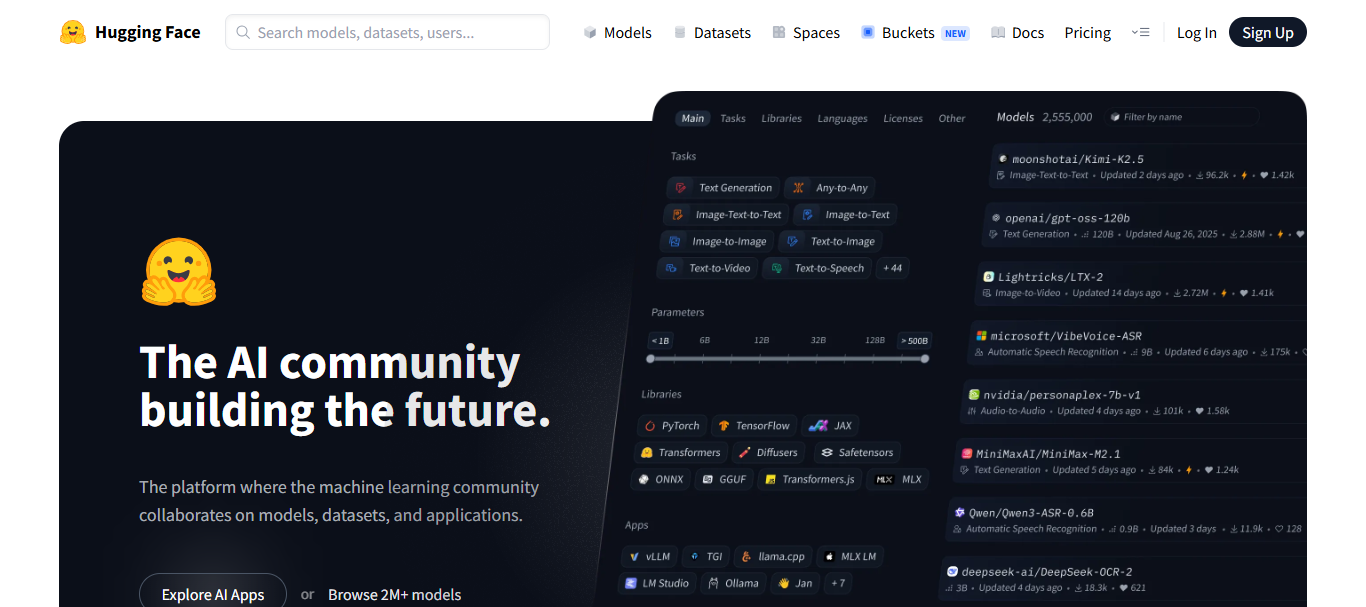
Hugging Face’s Transformer library has become an industry standard and has spurred the rapid, flexible design and deployment of AI systems and applications to diverse fields and industries.
Hugging Face – Key Features
- Huge repository of open source AI models and datasets
- Leading machine learning library with Transformers
- Easy model sharing and collaboration
- TensorFlow, PyTorch, and JAX compatible
- Easy to use deployment tools
| Pros | Cons |
|---|---|
| Massive collection of open-source AI models. | Beginners may face a steep learning curve. |
| Excellent developer community and documentation. | Model quality differs across community contributions. |
| Supports multiple machine learning frameworks. | Enterprise features often require paid services. |
| Ideal for research and AI experimentation. | Large models require powerful computing resources. |
3. Runway
Runway combines generative AI with image and video editing to create tools that refresh digital content creation. Google’s investment signals their growing belief in the future of AI media technology.

Runway democratizes the creation of high quality video media by allowing users to write text prompts and instantly generate video edits. Runway AI continues to innovate by integrating new paradigms and advanced features that integrate and elevate modern editing and video media.
Runway – Key Features
- AI tools for text to video with hyper-real visuals
- Advanced image editing powered by Generative AI
- Background removal and replacement of objects is automated
- Cloud based collaborative workspace for teams
- Newer models that generate videos continue to be released
| Pros | Cons |
|---|---|
| Creates professional AI-generated videos quickly. | High-end plans can be expensive. |
| Easy text-to-video generation tools. | Rendering complex projects may take time. |
| Regularly introduces innovative creative features. | Free plan includes limited credits. |
| Suitable for marketers and filmmakers. | Output quality depends on prompt quality. |
4. Character.AI
Character.AI is known for developing intelligent characters that can engage users in conversation. As a Google-backed business, they have found success with AI characters that fit a wide range of use cases, like entertainment, education, and even productivity and business clientele.

Character.AI is consistently advancing its product for its community of millions with an improved memory, contextual understanding, and broader avenues for conversation. Users of Character.AI can build as many as they would like and powerful language models will maintain responsiveness.
Character.AI – Key Features
- Design your own character with adjustable custom AI
- Conversational and context aware
- Remembers things for longer conversations
- Supports a variety of use cases including entertainment, learning, and productivity
- Multi-device with conversation history stored in the cloud
| Pros | Cons |
|---|---|
| Highly engaging AI conversations and roleplay. | Less suitable for professional business tasks. |
| Users can build custom AI characters. | Responses may occasionally become repetitive. |
| Large active user community. | Advanced features require premium subscription. |
| Supports entertainment and educational use cases. | Accuracy varies for factual information. |
5. Magic
Magic offers coding and software related AI systems that aim to transform the automation of a coder’s tasks and boost productivity and efficiency. Magic combines large language models with the software development life cycle

workflows, and enterprise development environments and seeks to enhance the overall quality of code. Magic focuses on the creation, comprehension, debugging, and maintenance of large, complex, and enterprise-scale software code collections.
Magic – Key Features
- Software code generation with AI assistance
- AI skills for code and enterprise software debugging
- Large scale enterprise codebase comprehension
- Automation of tedious coding tasks
- AI-Enhanced software engineering
| Pros | Cons |
|---|---|
| Automates complex software development tasks. | Limited public availability compared to rivals. |
| Improves developer productivity significantly. | Primarily designed for software engineers. |
| Handles large codebases efficiently. | Enterprise adoption is still expanding. |
| Reduces repetitive coding work. | Few consumer-focused features available. |
6. Hebbia
Hebbia simplifies advanced analysis for large sets of documents for the legal and financial services sectors and provides corporate solutions as well. Document analysis in these fields can be very time consuming and laborious.
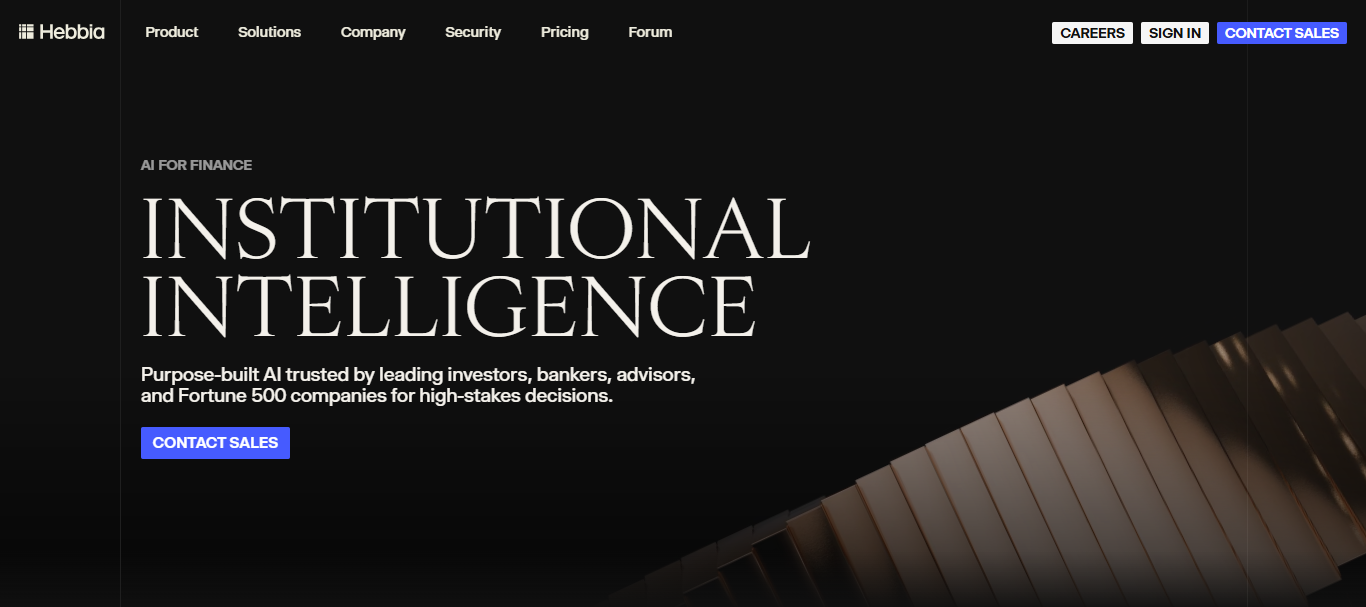
Supported by a Google investment, Hebbia has immensely improved the adoption of AI to analyze collections of documents and make decisions based on research done in a fraction of the time.
Hebbia – Key Features
- AI designed for enterprise document searching and analysis.
- Extract complex insights quickly.
- Made for finance, legal, and research.
- Natural language search over multiple datasets.
- Knowledge intelligence improves decision-making.
| Pros | Cons |
|---|---|
| Excellent enterprise document analysis capabilities. | Mainly targets large organizations. |
| Saves significant research time. | Pricing may not suit small businesses. |
| Delivers accurate knowledge extraction. | Limited consumer accessibility. |
| Useful for finance and legal industries. | Requires quality data for best performance. |
7. Replit
Replit takes Software as a Service (SaaS) applications and combines them with AI coding tools to offer an application building solution to developers of any experience. Google’s investment helps fuel Replit’s goal of increasing the accessibility of coding with more automation.

This AI coding assistant builds code, teaches coding, explains concepts of coding, identifies bugs, and reduces the time spent on debugging.
Replit’s in-browser software development solution helps developers build and publish code quickly and easily without the hassle of complicated software on their own systems and aids collaboration.
REPLIT – Key Features
- Code in the browser, no need for download.
- AI helps write and debug.
- Real time collaboration.
- Deploy to the cloud in one click.
- Multiple languages and frameworks supported.
| Pros | Cons |
|---|---|
| Browser-based coding from any device. | Advanced AI tools require paid plans. |
| Built-in AI coding assistant. | Performance depends on internet connection. |
| Simple collaboration for development teams. | Resource limits exist on free accounts. |
| Fast deployment of applications. | Complex enterprise projects may need external tools. |
8. SynthID
SynthID is an AI content authentication tool developed by Google that uses a digital watermark, which is embedded and invisible to the naked eye, to ‘mark’ AI generated content (i.e., images, audio, videos, and text). SynthID strikes a balance between synthetic content detection and quality assurance by providing content authentication.
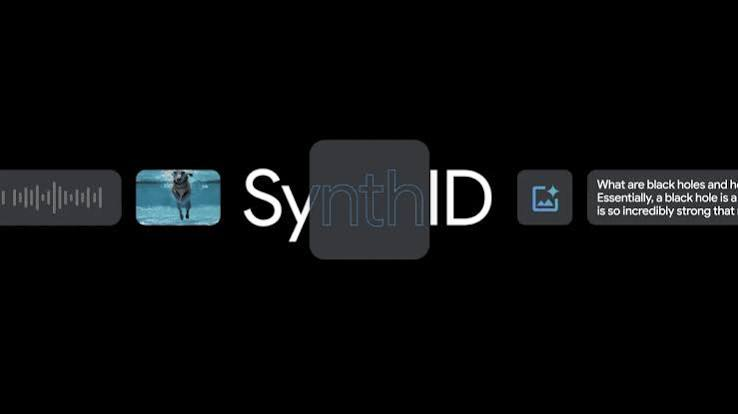
Trust and transparency are key in digital communications; as generative AI tools flood the digital economy, SynthID helps their responsible use by providing verifiability for AI generated content and addressing the manipulation of digital content and the spread of anti-logic content.
SythID – Key Features
- Watermarks for authentication of AI content.
- Images, videos, text, and audio.
- Content quality remains the same post watermarks.
- Detects Synthetic Media.
- Supports the responsible use of AI.
| Pros | Cons |
|---|---|
| Helps identify AI-generated content reliably. | Mainly supports Google’s AI ecosystem. |
| Invisible watermark preserves content quality. | Limited public implementation currently. |
| Promotes responsible AI usage. | Cannot prevent all forms of manipulation. |
| Strengthens digital content authenticity. | Adoption depends on platform integration. |
9. Adept AI
Intelligent AI agents that Adept AI develops are intended to tackle real world problems that require making use of workplace software. Google’s investment is a vote of confidence for AI agents that will do more than talk.
Adept’s technology translates natural language into a computer instruction that helps users bypass the tedium of manual work. They prioritize the development of AI systems that integrate seamlessly into the digital workspace and enterprise software.
Adept AI – Key Features
- AI Agents automate tasks in Software.
- Natural Language to control multiple apps.
- Integrates easily to suite of tools.
- Automation of mundane tasks and workflows.
- Designed for real business operations.
| Pros | Cons |
|---|---|
| Automates repetitive workplace software tasks. | Enterprise deployment may require customization. |
| Uses natural language instructions effectively. | Still evolving in competitive AI agent market. |
| Improves operational efficiency. | Limited public consumer access. |
| Integrates with existing business software. | Complex workflows may need manual adjustments. |
10. Harvey AI
Harvey’s transformative AI technology for law firms, corporate legal departments, and professional service organizations is disrupting the legal technology market. Harvey, funded by Google investors, creates efficiencies by incorporating AI technology into legal research, contract review, document drafting, and compliance with the accuracy necessary in the legal space.

The power of language models enables legal practitioners to automate and complete complex tasks, create efficiencies, and use the technology to offer better, more quality legal services and practicing law in a technology-forward legal marketplace.
Harvey AI – Key Features
- AI for legal research and case prep.
- Drafting and reviewing contracts automated.
- Compliance for legal and corporate AI.
- Secure by design for legal workflows.
- Advanced legal AI models for workflow automation.
| Pros | Cons |
|---|---|
| Designed specifically for legal professionals. | Primarily focused on legal industry only. |
| Automates legal research and drafting. | Requires human review for sensitive documents. |
| Increases law firm productivity. | Enterprise pricing may be expensive. |
| Supports compliance and contract analysis. | Limited usefulness outside legal workflows. |
Future of Google-Backed AI Companies
- AI agents – As powerful intelligent agents proliferate automated workflows, productivity will climb in all sectors.
- Enterprise AI – More companies will begin to use AI to enhance efficiency as AI becomes more commonplace.
- Multimodal AI – AI that integrates and can understand text, images, audio, and video will be the standard.
- AI safety – AI solutions will be more focused on safety, and governance will be a priority.
- Open source AI – The use of open-source AI will innovate new practices, and result in a faster, more advanced AI.
- Generative AI – Use of generative AI will be more common in businesses for content, codes, marketing, and automation.
Conclusion
In Conclusion, backed by Google, the best AI companies are changing artificial intelligence with innovation, enterprise solutions, and responsible AI development. These companies provide strong technologies to businesses and individuals from coding assistants and legal AI
To generative media and open-source. While Google continues to invest in accelerating AI, these startups are ready to create the next generation of smart applications.
FAQ
Which is the best AI company backed by Google?
Anthropic is widely considered one of the leading Google-backed AI companies due to its advanced Claude AI models.
Does Google own these AI companies?
No. Google primarily invests in or partners with these companies rather than owning them outright.
Why does Google invest in AI startups?
Google invests to accelerate AI innovation, expand Google Cloud, and strengthen its AI ecosystem.
Which Google-backed AI company is best for developers?
Hugging Face and Replit are excellent choices for developers building AI and software applications.
Which Google-backed AI company focuses on video creation?
Runway specializes in AI-powered video generation, editing, and creative content production.