This article focuses on the Top Low-Code Workflow Automation Solutions for Larger Financial Networks.
Modern financial institutions are able to automate their operations with sophisticated tools and intelligent automation.
Discover the benefits these flexible platforms bring to regulatory compliance, operational agility, the time-consuming and manual nature of business processes, and their ability to interoperate with the enterprise ecosystem.
They will assist you in selecting the optimal financial workflow automation platform for your specific needs.
Key Poinst & Best Low-Code Workflow Automation Platforms for Large Financial Networks
| Platform | Explanation |
|---|---|
| ServiceNow | Enterprise workflow automation platform for complex financial institutions operations efficiently |
| Microsoft Power Automate | Microsoft’s cloud-based automation tool integrates apps across enterprise systems seamlessly |
| Pega Platform | AI-driven workflow platform optimizing financial process automation at scale |
| Appian | Low-code platform enabling rapid financial workflow application development efficiency gains |
| UiPath | Robotic process automation platform streamlining financial operations tasks end-to-end efficiency |
| Automation Anywhere | Intelligent automation platform enhancing banking workflow productivity and compliance controls |
| Kissflow | Simple low-code workflow platform for financial team collaboration quick deployment |
| Nintex | Workflow automation tool enabling document-heavy financial processes with integration support |
| Workato | Integration-led automation platform connecting financial applications and data in real-time |
| Zoho Creator | Low-code app builder supporting financial workflow automation at enterprise scale |
10 Best Low-Code Workflow Automation Platforms for Large Financial Networks
1. ServiceNow
ServiceNow is the most popular enterprise-level workflow automation solution in the financial industry for IT, risk, and service operations. Its recent addition of AI for the Automatic Optimization of Processes helps banks deal with the challenges of ticketing and compliance requests.
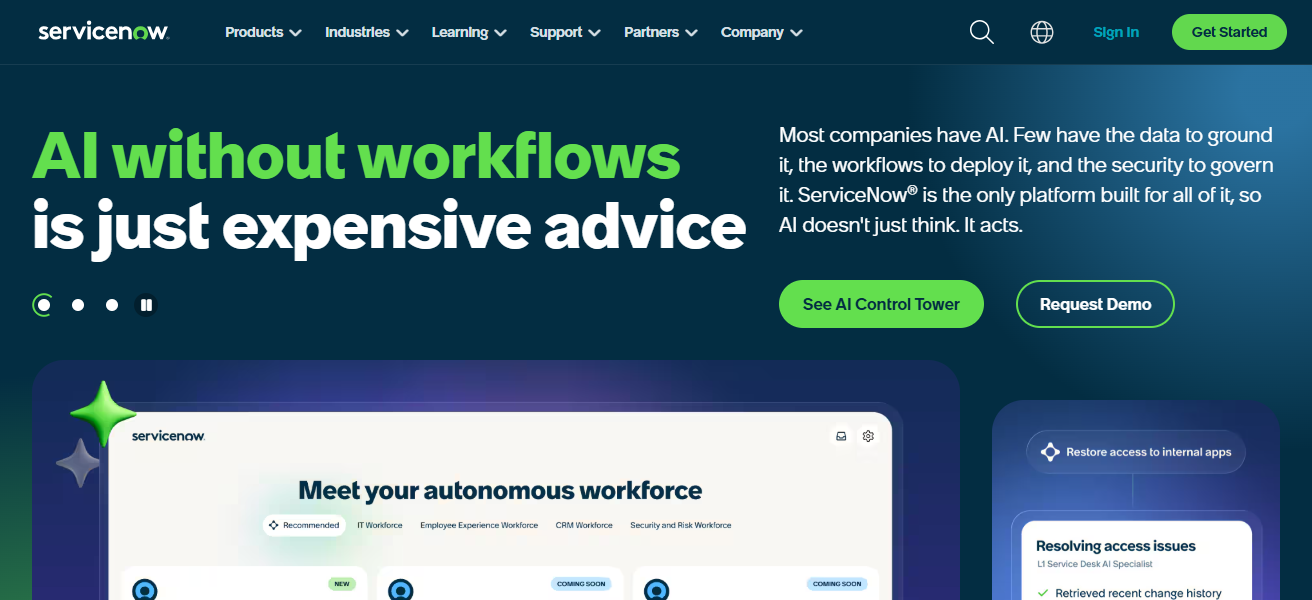
Its recent additions of Predictive Intelligence, real-time case routing, and enhanced control for regulatory workflows provide banks with the tools necessary to unify their operations.
Large financial institutions use ServiceNow for creating a consistent customer experience, improving audit preparedness, and unifying operational workflows while protecting the bank’s information during their digital transformation.
ServiceNow Features
| Pros | Cons |
|---|---|
| Strong enterprise-grade workflow automation | High licensing and implementation cost |
| Excellent compliance and audit capabilities | Complex setup for small teams |
| AI-powered predictive intelligence | Requires skilled developers for customization |
| Scalable for global financial institutions | UI can feel heavy for simple workflows |
2. Microsoft Power Automate
Microsoft Power Automate is a low-code, cloud-based automation tool that integrates financial applications, enterprise resource planning (ERP) systems, and line-of-business applications. Its advanced AI Builder features help banks automate the processing of documents, invoice approvals, and alerts for fraudulent activities.
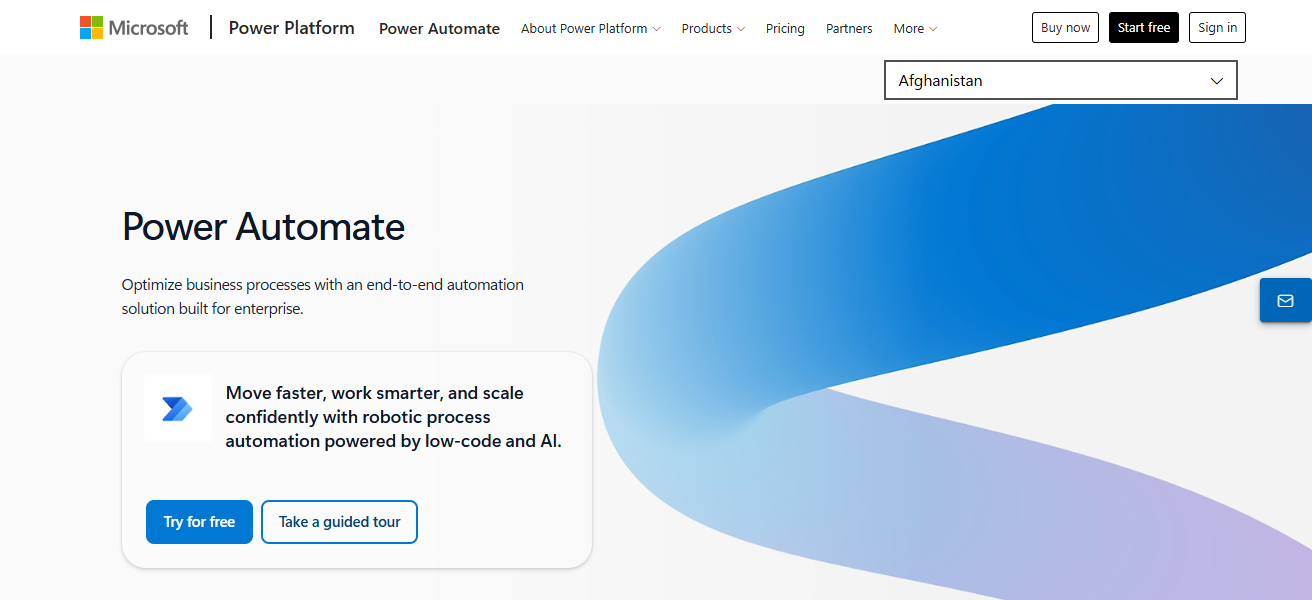
Because of its comprehensive integration with Microsoft 365 and Azure, it is the best automation solution for financial enterprises that have an established digital workspace using Microsoft products.
The platform enables secure automation of cross-organizational workflows and reduces operational friction, and facilitates compliance automation.
Microsoft Power Automate Features
| Pros | Cons |
|---|---|
| Deep Microsoft 365 and Azure integration | Performance depends on the Microsoft ecosystem |
| Easy low-code workflow creation | Limited advanced customization options |
| Strong AI Builder capabilities | Can become costly at enterprise scale |
| Wide connector library for financial apps | Governance setup required for large deployments |
3. Pega Platform
Pega Platform is an AI-based, highly automated, and flexible business process automation solution tailored to the automation of large-scale financial systems. It features state-of-the-art customer journey and decisioning automation for banking and insurance.
Its latest version adds Hyperautomation and advanced AI capabilities for real-time decisioning, helping institutions quickly tailor customer-focused financial services.
Its advanced governance capabilities aid institutions in maintaining compliance with applicable regulations while streamlining complex workflows across multiple enterprise applications such as KYC, loan approvals, and fraud detection.
Pega Platform Features
| Pros | Cons |
|---|---|
| Advanced AI decisioning for finance workflows | Very expensive enterprise licensing |
| Excellent for customer lifecycle automation | Steep learning curve for new users |
| Strong regulatory compliance support | Complex implementation process |
| Real-time hyperautomation capabilities | Requires experienced technical teams |
4. Appian
Appian is a low-code development platform that emphasizes financial workflows and rapid deployment. Built to help banks develop secure and scalable process automation, Appian’s low-code development is even more flexible with the addition of AI-powered process mining and a better data fabric to speed up decision-making.

Financial businesses use Appian to help them bring their legacy systems up to date, automate their onboarding processes, and handle workflows associated with various regulations.
Appian’s unified approach helps to accelerate development and decreases the burden on IT, all while increasing operational transparency.
Appian Features
| Pros | Cons |
|---|---|
| Fast low-code development for finance apps | Limited deep customization vs coding platforms |
| Strong process mining and automation tools | Pricing not ideal for smaller firms |
| Good data integration via data fabric | Needs training for full utilization |
| Excellent for legacy system modernization | Dependency on the Appian ecosystem |
5. UiPath
UiPath is one of the primary platforms for robotic process automation (RPA) that helps financial enterprises automate back-office tasks. Recently, UiPath made AI agents and document understanding part of their platform, making next-generation automation much easier.

Process automation for reconciliation, compliance reporting, and transaction processing is commonplace in banks that utilize UiPath. Newer features in the enterprise version like orchestration hubs and process intelligence
That complement automation helps to make workflows efficient and, in turn, make UiPath a platform in high demand for large financial networks that wish to decrease operational burden.
UiPath Features
| Pros | Cons |
|---|---|
| Best-in-class robotic process automation (RPA) | Not a full workflow platform alone |
| Strong AI document understanding tools | Maintenance required for bots |
| Excellent for repetitive finance tasks | Scaling bots can become complex |
| Good orchestration and analytics features | Requires governance for enterprise use |
6. Automation Anywhere
Automation Anywhere is an intelligent automation platform that meshes RPA with AI and analytics and is uniquely positioned for the composed nature of banking and financial operations.
The latest version of cloud-native automation 360 includes an enterprise, secure, and faster automation framework.

Financial Businesses rely on Automation Anywhere for Credit Processing, Fraud Detection, and RegTech Reporting. The strong focus on governance and security of Automation Anywhere enhances its suitability within the highly regulated financial sphere.
Automation Anywhere Features
| Pros | Cons |
|---|---|
| Cloud-native scalable automation platform | Can be expensive for large deployments |
| Strong AI + RPA combination | Set up complexity for beginners |
| Excellent compliance and security features | Requires trained automation specialists |
| Good for banking-grade workflows | Heavy infrastructure dependency |
7. Kissflow
Kissflow is a user-friendly low-code solution that financial teams can easily deploy. Some of its newest updates include workflows that are suggested by AI and more sophisticated analytics dashboards.
Kissflow is popular among large and medium-sized financial enterprises because it brings cross-departmental collaboration and fully eliminates delays in the approval process. Kissflow is used by several financial institutions to increase efficiency and to easily implement the application in their company.
Kissflow Features
| Pros | Cons |
|---|---|
| Very easy low-code workflow builder | Limited advanced enterprise customization |
| Quick deployment for finance teams | Not ideal for very large complex systems |
| Good collaboration features | Fewer AI capabilities than competitors |
| Affordable compared to enterprise tools | Limited deep analytics features |
8. Nintex
Nintex is a process management and workflow automation system that is excellent for document-centric work, like the work done by most large, multinational banks.
It offers banks a streamlined digital path for contracts, approvals, and compliance. This leading system is the most modern, with AI and cloud automation enhancements.
The design is very flexible and integrates easily with most HRMS and ERPs. This makes Nintex a preferred system in heavily regulated environments, like the Finance sector.
Nintex Features
| Pros | Cons |
|---|---|
| Strong document and approval automation | UI feels outdated in some modules |
| Good integration with enterprise tools | Licensing can be expensive |
| AI-assisted process mapping | Limited real-time analytics depth |
| Excellent for compliance-heavy workflows | Requires onboarding for full usage |
9. Workato
Workato is a low-code, integration-centric, process automation system that is used in real-time to connect financial services, apps and cloud services. Some of its enhancements include a more sophisticated event-driven architecture and AI-embedded automation.
Financial Services that have core banking solutions utilize Workato to improve processing times and to increase visibility on the operations of the bank. Its elasticity is perfect for financial ecosystems of large Enterprises that process large volumes of data at high speeds.
Workato Features
| Pros | Cons |
|---|---|
| Powerful integration-led automation | Not purely low-code for beginners |
| Real-time data synchronization | Can become costly at scale |
| Strong event-driven architecture | Requires technical understanding for setup |
| Excellent for multi-system financial workflows | Limited UI workflow customization |
10. Zoho Creator
An enterprise-scale solution for automating financial workflows, Zoho Creator is a low-code, user-friendly development platform. Organizations can use Zoho Creator to develop custom financial apps to satisfy their operational and compliance reporting efforts.
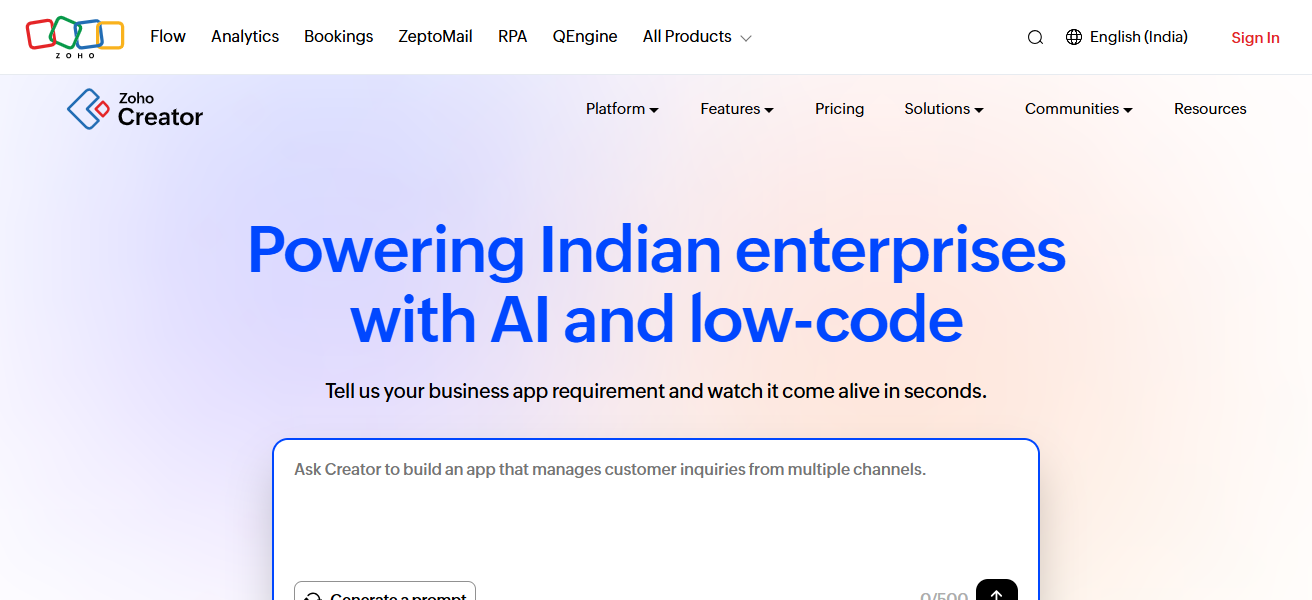
Zoho Creator recently expanded its services with tools to assist app builders with AI (Zia AI) and methods to protect data. Financial companies replace their outdated financial spreadsheets and workflows with Zoho Creator.
For large financial companies that want to digitally transform their client experience, the low-code solution framework is appealing because it can be rapidly adopted without a large engineering team.
Zoho Creator Features
| Pros | Cons |
|---|---|
| Affordable low-code platform | Limited enterprise-grade depth |
| Fast app development for finance use cases | Scaling limitations for huge enterprises |
| Strong AI assistant (Zia) support | Fewer advanced automation features |
| Easy migration from spreadsheets | Less powerful than high-end competitors |
Criteria for Selecting the Best Low-Code Workflow Automation Platforms for Large Financial Networks
- Enterprise Scalability: Platforms were selected based on their ability to accommodate large scales of workloads across banking and financial business units.
- Security & Compliance: Platforms were selected based on the tools’ ability to maintain strong encryption, provide audit logs, and assist in meeting regulatory compliance.
- AI & Automation Capabilities: Platforms were selected based on their capabilities to offer AI to automate and optimize workflow.
- Integration Flexibility: Tools that offered easy and flexible integrations to ERP, CRM, and core banking systems were also selected.
- Low-Code Usability: Platforms that made development easier, requiring little to no code, were also selected.
- Process Automation Depth: Platforms were assessed based on their ability to automate complex financial processes end-to-end, as opposed to only basic task automation.
- Real-Time Data Handling: Platforms were assessed for their ability to support real-time data and facilitate real-time decision-making.
- Industry Adoption: Solutions with high trust and usage across global financial networks were assessed.
- Cost Efficiency at Scale: Corporate deployment and expansion pricing were assessed.
- Innovation & Updates: Platforms with ongoing AI and automation improvements were selected.
Conclusion
In conclusion, the Best Low-Code Workflow Automation Platforms for Large Financial Networks help large financial institutions enhance operational efficiency, compliance, and scalability.
The offerings s of ServiceNow and Zoho Creator, to name just a few, have respective strengths in automation, integration, and AI-based workflows.
The right product may vary with enterprise size, security, and complexity of the workflows, but all offer quicker, smarter, and more reliable digital transformations for the financial ecosystems of today.
FAQ
Why are banks adopting low-code automation tools?
Banks adopt low-code platforms to accelerate digital transformation, reduce operational costs, and improve process accuracy. These tools help automate repetitive tasks, enhance compliance tracking, and support faster decision-making in highly regulated financial environments.
Which is the most popular low-code platform for enterprises?
ServiceNow is widely considered one of the most popular enterprise workflow platforms due to its strong IT service management, automation capabilities, and advanced compliance features used in global financial institutions.
Can Microsoft Power Automate be used in large financial organizations?
Yes, Microsoft Power Automate is widely used in financial enterprises because it integrates deeply with Microsoft 365, Azure, and enterprise apps, making it ideal for automating approvals, reporting, and document workflows securely.
Is low-code automation secure for financial data?
Yes, most enterprise-grade platforms like Pega Platform and Appian offer strong security frameworks, encryption, role-based access, and compliance tools designed specifically for sensitive financial data.
How does RPA help financial institutions?
Robotic Process Automation tools like UiPath reduce manual workload by automating repetitive tasks such as reconciliation, transaction processing, and compliance reporting, improving speed and reducing human errors.