In this post, I’ll talk about how blockchain VPNs are revolutionizing peer-to-peer privacy and how their decentralized networks are changing contemporary internet security.
You will discover how blockchain-based VPNs facilitate peer-to-peer encrypted communication, enhance privacy, and eliminate central control.
We will also look at the major initiatives that are propelling this innovation and why, in the Web3 era, they are increasingly crucial for users who are concerned about their privacy.
Key Points & Blockchain VPNs Revolutionizing Peer-To-Peer Privacy
Mysterium Network (MYST) provides decentralized VPN services, enabling private peer-to-peer browsing
Orchid (OXT) Network enables probabilistic VPN with blockchain payments for private browsing access
Sentinel (DVPN) DVPN offers a decentralized bandwidth marketplace ensuring censorship-resistant secure internet connectivity
NymVPN (NYM) provides a mixnet-based privacy infrastructure, hiding metadata through a layered routing system
Deeper Network (DPR) builds a decentralized VPN firewall combining blockchain security and web privacy
Qubetics (TICS) delivers Web3 VPN infrastructure enabling scalable, decentralized, secure connectivity solutions for a network
KelVPN (KEL) offers decentralized, encrypted networking with tokenized incentives for bandwidth sharing globally
HOPR Network (HOPR) enables metadata privacy through mixnet routing and incentive based relays
ZeroVPN provides a zero-knowledge VPN architecture, ensuring complete anonymity and secure tunneling
GenX AI integrates intelligent VPN optimization using machine learning privacy automation tools
10 Blockchain VPNs Revolutionizing Peer-to-Peer Privacy
1. Mysterium Network (MYST)
Through widely dispersed residential nodes, the Mysterium Network (MYST) is a decentralized VPN and Web3 privacy infrastructure that enables users to access the internet.
Peer-to-peer bandwidth sharing is made possible while centralized control is eliminated and censorship resistance is strengthened.
Mysterium has improved latency and reliability in recent Web3 growth trends by expanding node deployment across more than 100 countries.
By rewarding node operators with MYST tokens, the ecosystem serves as a decentralized income-generating productivity network for digital workers as well as a privacy tool.
| Pros | Cons |
|---|---|
| Fully decentralized VPN network improves privacy | Node quality can vary by region |
| Earn MYST tokens by running nodes | Setup can be complex for beginners |
| Strong censorship resistance globally | Speed depends on peer availability |
| A fully decentralized VPN network improves privacy | Open-source and community-driven |
2. Orchid (OXT)
Orchid (OXT) is a decentralized bandwidth marketplace that offers scalable VPN services using probabilistic nanopayments.
It is based on Ethereum and lets users use OXT tokens to pay for internet privacy without being locked into a subscription.
By linking users via random global providers, its multi-hop routing architecture improves anonymity. Faster cross-node routing and enhanced WireGuard integration are the main features of recent releases.
Professionals and developers who are concerned about privacy and want safe, pay-as-you-go internet access with robust cryptography protection frequently utilize Orchid.
| Pros | Cons |
|---|---|
| Pay-as-you-go VPN model using OXT | Requires crypto wallet usage |
| Strong encryption with multi-hop routing | Can be expensive during high usage |
| No subscription lock-in | Network performance varies |
| Built on Ethereum security | Limited beginner-friendly UX |
3. Sentinel (DVPN)
Peer-to-peer bandwidth marketplaces are powered by the decentralized VPN ecosystem Sentinel (DVPN), which is built on Cosmos.
Anyone can operate nodes and safely sell internet capacity thanks to it. The platform places a strong emphasis on blockchain-based governance, open-source transparency, and resilience to censorship.

Increasing multi-chain interoperability and AI data-layer support for secure communication are the main goals of recent updates.
Sentinel is becoming more and more popular among developers creating privacy-focused applications, making it an essential infrastructure layer for Web3 communication systems and decentralized connectivity globally.
| Pros | Cons |
|---|---|
| Cosmos-based scalable architecture | Smaller user base compared to VPN giants |
| Open bandwidth marketplace | Node reliability inconsistency |
| Strong censorship resistance | Complex staking system |
| Multi-chain expansion potential | Learning curve for setup |
4. NymVPN (NYM)
By using mixnet technology, which obscures metadata instead than just encrypting traffic, NymVPN (NYM) offers superior privacy.
It makes tracking and spying very challenging by distributing internet traffic among several random nodes.
Scaling the mixnet for enterprise-grade privacy applications and integrating it with Web3 identity tools are the main recent advancements.
Journalists, researchers, and cybersecurity experts who need robust anonymity guarantees beyond conventional VPN encryption models may find Nym especially useful.
| Pros | Cons |
|---|---|
| Advanced mixnet metadata privacy | Higher latency due to multi-hop routing |
| Strong anonymity beyond VPN encryption | Still in growing adoption phase |
| Ideal for journalists & researchers | Limited commercial integrations |
| Cutting-edge privacy technology | Requires technical understanding |
5. Deeper Network (DPR)
Deeper Network (DPR) integrates hardware-based cybersecurity routers with decentralized VPN technologies.
With its integrated firewall security and encrypted traffic routing, it makes whole-home protection possible.
AI-driven threat detection, ad-blocking, and malware prevention systems integrated at the network layer are examples of recent improvements.
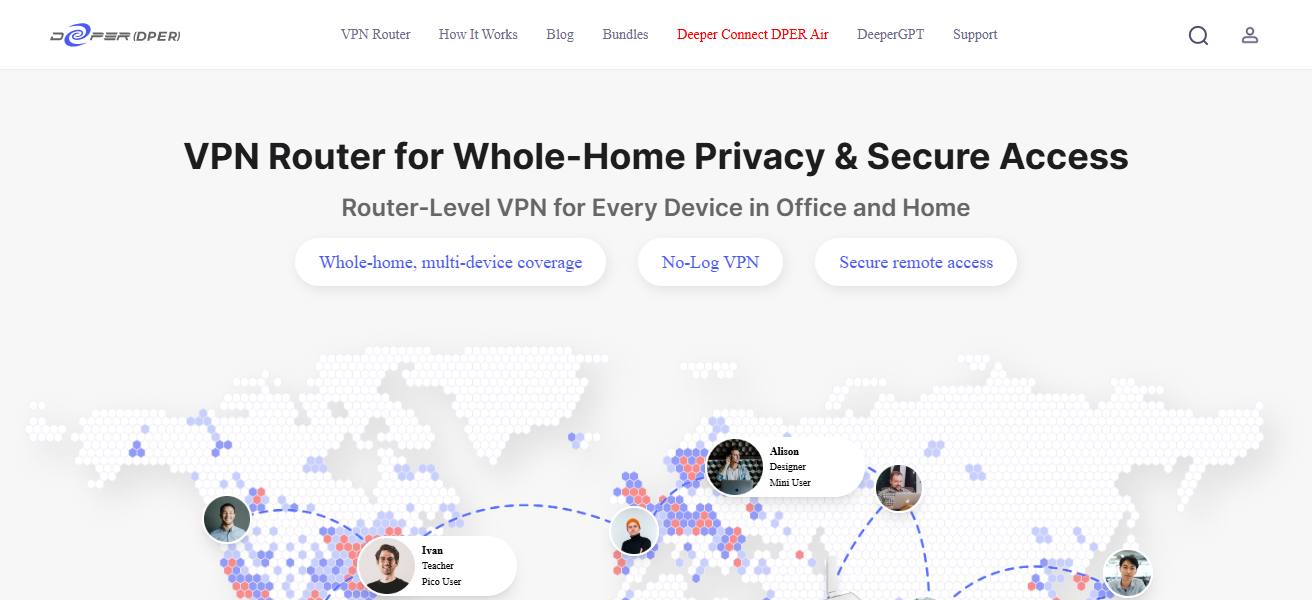
Deeper is a useful productivity solution for homes and organizations looking for always-on, subscription-free internet privacy and infrastructure-level security because of its decentralized node network, which facilitates worldwide bandwidth sharing.
| Pros | Cons |
|---|---|
| Hardware + software security solution | Hardware cost may be high |
| AI-based threat detection system | Setup not fully plug-and-play |
| Whole-home protection coverage | Requires device dependency |
| Decentralized node incentives | Less flexible than pure software VPNs |
6. Qubetics (TICS)
Next-generation Layer 1 blockchain Qubetics (TICS) combines cross-chain interoperability, AI tools, and a decentralized VPN.
Transparency and privacy are simultaneously ensured via its dVPN layer, which sends encrypted traffic through verified blockchain nodes.
For smooth, secure communication, recent versions prioritize Web3 wallet integration and multi-hop routing.
Developers, solvers, and businesses may create privacy-preserving applications across decentralized infrastructure networks using Qubetics’ productivity-first blockchain environment.
| Pros | Cons |
|---|---|
| AI + blockchain integrated ecosystem | Early-stage ecosystem development |
| Multi-chain interoperability vision | Limited real-world adoption data |
| dVPN with secure routing layers | High complexity architecture |
| Developer-friendly Web3 tools | Competitive market space |
7. KelVPN (KEL)
Next-generation Layer 1 blockchain Qubetics (TICS) combines cross-chain interoperability, AI tools, and a decentralized VPN.
Transparency and privacy are simultaneously ensured via its dVPN layer, which sends encrypted traffic through verified blockchain nodes.

For smooth, secure communication, recent versions prioritize Web3 wallet integration and multi-hop routing.
Developers, solvers, and businesses may create privacy-preserving applications across decentralized infrastructure networks using Qubetics’ productivity-first blockchain environment.
| Pros | Cons |
|---|---|
| Fast, decentralized, encrypted VPN | Smaller global node network |
| Incentivized bandwidth sharing | Limited brand recognition |
| Lightweight user experience | Less enterprise adoption |
| Token-based rewards system | Fast decentralized, encrypted VPN |
8. HOPR Network (HOPR)
Metadata protection and anonymous data transfer across decentralized networks are made possible by the privacy-focused mixnet protocol known as HOPR Network (HOPR).
Relay nodes are rewarded for safely passing encrypted packets through token incentives. Improved Web3 message scalability and decentralized application integration are examples of recent advancements.

For developers creating privacy-first applications in AI, DeFi, and Web3 infrastructure ecosystems, HOPR is crucial since it is well known for safeguarding communication patterns.
| Pros | Cons |
|---|---|
| Strong metadata privacy protection | Not a full traditional VPN replacement |
| Mixnet-based anonymization | Network still scaling |
| Incentivized relay system | Technical setup required for nodes |
| Web3 messaging integration | Adoption still emerging |
9. zerovpn
Zerovpn is a blockchain-based VPN idea that emphasizes anonymous, encrypted tunneling and a zero-knowledge architecture.
By using decentralized routing, it seeks to do away with data records, centralized servers, and user traceability.
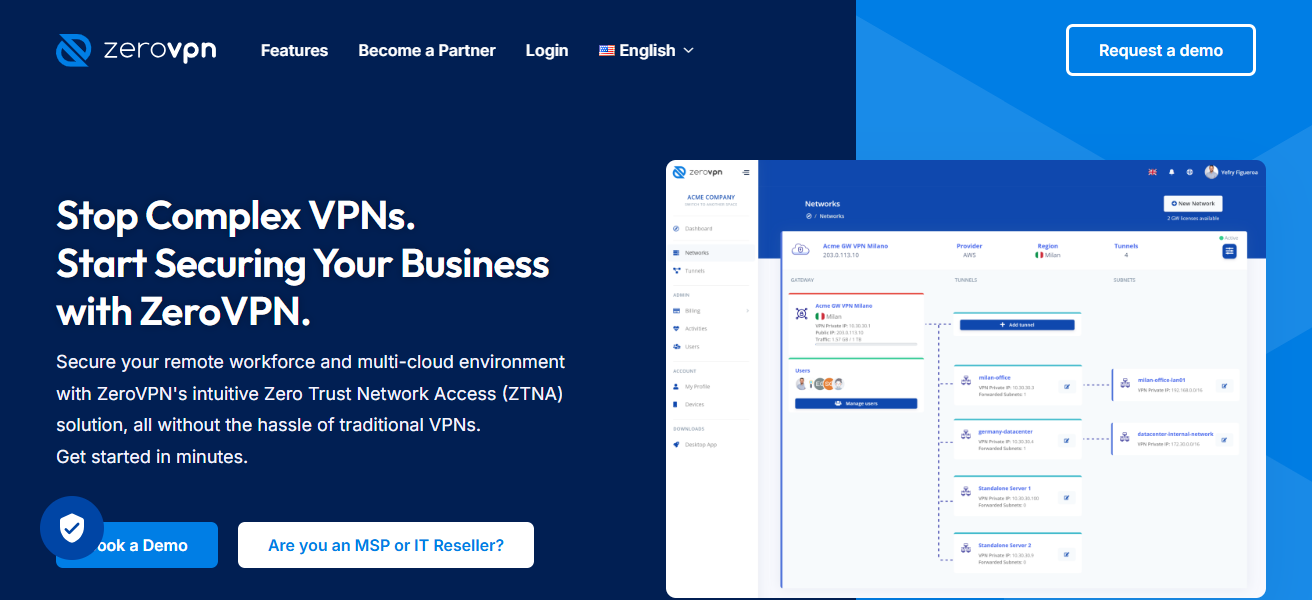
Lightweight node deployment and enhanced privacy methods for peer-to-peer communication are two recent innovations.
Zerovpn is a growing option for developers, traders, and remote professionals in Web3 ecosystems who are concerned about their privacy because it is made for users who seek the highest level of anonymity in digital environments.
| Pros | Cons |
|---|---|
| Zero-knowledge privacy architecture | Limited ecosystem maturity |
| High anonymity focus | Fewer public integrations |
| No centralized logging system | Early-stage development risks |
| Lightweight encrypted tunneling | Performance data limited |
10. GenX AI
To maximize VPN routing and network efficiency, GenX AI combines artificial intelligence with a decentralized privacy architecture.
It improves user experience in real time by dynamically choosing the fastest and safest nodes using machine learning algorithms.

Adaptive traffic management and automated privacy optimization over international networks are the main topics of recent revisions.
GenX AI is a hybrid productivity solution that combines blockchain-based privacy with AI intelligence to make safe connectivity more intelligent and effective.
| Pros | Cons |
|---|---|
| AI-driven VPN optimization | Dependence on AI accuracy models |
| Smart node selection improves speed | New and evolving technology |
| Automated privacy routing | Limited long-term track record |
| Adaptive performance tuning | Still building global infrastructure |
Cocnlsuion
Blockchain VPNs are revolutionizing digital privacy by substituting decentralized peer-to-peer networks for centralized servers.
Data routing, encryption, and protection are being redefined by initiatives like Mysterium, Orchid, Sentinel, and Nym.
Users benefit from improved anonymity, resistance to censorship, and safe worldwide connectivity with blockchain-based incentives.
These VPNs will be crucial in creating a future internet ecology that is more transparent, private, and user-controlled as Web3 use increases.
FAQ
What are blockchain VPNs?
Blockchain VPNs are decentralized privacy networks that route internet traffic through peer-to-peer nodes instead of central servers, improving anonymity and censorship resistance.
How does Mysterium Network (MYST) work?
Mysterium Network uses global residential nodes to route encrypted traffic, rewarding node operators with tokens for providing bandwidth and privacy services.
Is Orchid (OXT) a traditional VPN?
No, Orchid is a decentralized VPN marketplace where users pay for bandwidth using crypto with pay-as-you-go privacy access.
What makes Sentinel (DVPN) unique?
Sentinel operates on the Cosmos blockchain, allowing users to buy and sell bandwidth in a decentralized, censorship-resistant VPN ecosystem.