
In this article, I will discuss the Smartest Ways to Invest Your First $1,000 Right Now and how beginners can turn a small amount into long-term wealth.
You will learn simple, practical, and low-risk to high-growth investment options, including stocks, ETFs, gold, crypto, and skills.
This guide is designed to help you make smart financial decisions with confidence in today’s changing global market.
Key Points & Top Smartest Ways To Invest Your First $1,000 Right Now
| Investment Option | Explanation |
|---|---|
| Index Funds (S&P 500 / Nifty 50) | Low-cost, diversified funds that track the overall market. Ideal for beginners who want steady long-term growth without picking individual stocks. |
| ETFs (Exchange-Traded Funds) | Similar to index funds but traded like stocks. They offer diversification with flexibility and usually have low fees. |
| High-Yield Savings Account | A safe option where your money earns interest while staying fully liquid. Best for emergency savings and short-term goals. |
| Mutual Funds (SIP style) | Professionally managed funds where you invest small amounts regularly. Good for disciplined long-term wealth building. |
| Blue-Chip Stocks | Shares of strong, established companies with stable earnings. Higher risk than funds but better growth potential. |
| Gold (Digital or Physical) | A hedge against inflation and market uncertainty. Works as a safe-value store during economic instability. |
| Cryptocurrency (Small Allocation Only) | High-risk, high-reward digital assets like Bitcoin or Ethereum. Suitable only for a small portion of your $1,000. |
| Skill Development / Courses | Investing in yourself (coding, marketing, finance) can generate higher long-term returns than markets. |
| Emergency Fund | Setting aside 3–6 months of expenses in a safe account ensures financial security before risky investments. |
| Peer-to-Peer Lending / Bonds | Earn interest by lending money to individuals or governments. Offers fixed returns but carries credit risk. |
Top 10 Smartest Ways To Invest Your First $1,000 Right Now
1. Index Funds (S&P 500 / Nifty 50)
One smart option to invest your first $1000 is index funds. Index funds provide excellent diversification by investing in multiple companies and tracking market performance against the S&P 500 and Nifty 50.

Currently, low-cost, passive investing is performing better than most active funds around the world. For new investors, index funds provide a long-term, stable, and wealth-building investment strategy without needing a lot of knowledge and without the hassle of frequent monitoring.
Index Funds (S&P 500 / Nifty 50) Pros & Cons
| Pros | Cons |
|---|---|
| Highly diversified across top companies | Market risk still exists during downturns |
| Low expense ratios and passive management | No chance to outperform the market significantly |
| Long-term stable returns | Requires patience (5–10+ years horizon) |
| Easy for beginners to invest | Limited flexibility in stock selection |
2. ETFs (Exchange-Traded Funds)
ETFs have quickly become a popular investment. They follow the same structure as a stock, but as a more diversified investment similar to mutual funds. They can track different sectors and asset classes, including gold and technology.

A reason why ETFs are becoming more popular is the improvement of trading fees and the flexibility of being able to buy/sell them during market hours. With ETFs, new investors can take advantage of a diversified international investment including cheap trading costs.
ETFs (Exchange-Traded Funds) Pros & Cons
| Pros | Cons |
|---|---|
| Traded like stocks with high flexibility | Brokerage fees may apply per trade |
| Low cost and transparent structure | Requires basic trading knowledge |
| Diversified across sectors or assets | Market volatility still affects value |
| Real-time buying and selling | Can be confusing for beginners |
3. High-Yield Savings Account
High-yield savings accounts are good places to store your first $1000 and earn better interest than traditional savings accounts. There are a lot of digital banks that offer competitive annual percentage yields with no locks on your money.

Although your savings won’t grow rapidly like a stock investment, it helps to provide peace of mind when the markets are riskier.
With how interest rates are today, this is a great way to save for an emergency, have a short-term goal, and maintain financial stability before venturing into more investments.
High-Yield Savings Account Pros & Cons
| Pros | Cons |
|---|---|
| Very low risk and capital safety | Very low returns compared to stocks |
| Easy liquidity (withdraw anytime) | Inflation can reduce real value |
| Ideal for emergency savings | Interest rates may fluctuate |
| No market knowledge required | Limited wealth-building potential |
4. Mutual Funds (SIP Style)
Mutual funds using SIP (Systematic Investment Plan) allow consistent investing with small amounts over time. Professional fund managers handle stock selection and portfolio balancing.
Recent market data shows SIP investing improves long-term wealth creation by reducing risk through rupee cost averaging.
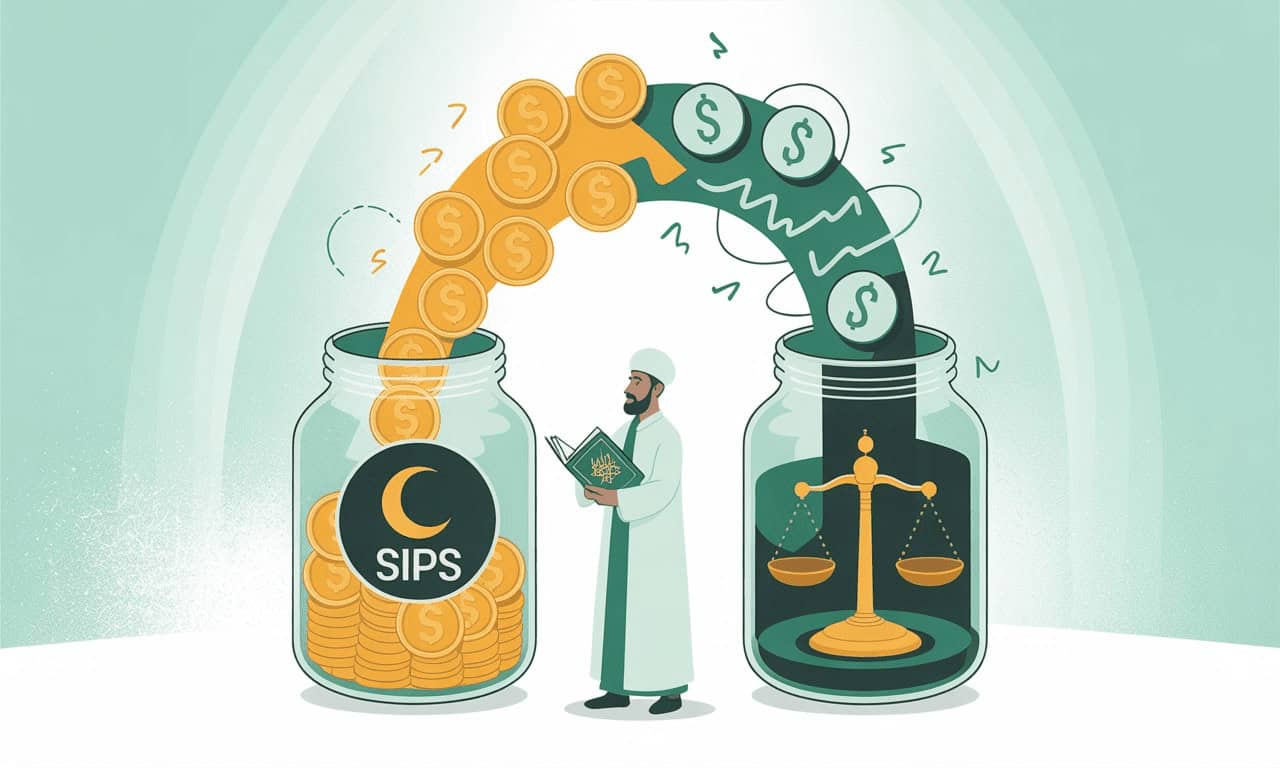
This method is perfect for beginners who want disciplined investing without tracking markets daily. It builds strong financial habits while targeting long-term capital appreciation across sectors.
Mutual Funds (SIP Style) Pros & Cons
| Pros | Cons |
|---|---|
| Professional fund management | Management fees reduce returns |
| Rupee cost averaging reduces risk | Market-linked losses possible |
| Disciplined long-term investing | Lock-in in some fund types |
| Easy monthly investment option | Performance depends on fund manager |
5. Blue-Chip Stocks
Blue-Chip Stocks: A significant investment opportunity lies in buying blue-chip stocks of big companies with a track record of strong financial performance.
With a first investment of $1,000, you not only target capital growth but also generate dividend income.

Compared to smaller companies, blue-chip stocks are relatively insulated from economic turbulence, though they are not immune to market fluctuations.
In the fast-evolving tech economy, blue-chip companies in AI, energy, and finance are extremely profitable and should form an essential part of any investment portfolio.
Blue-Chip Stocks Pros & Cons
| Pros | Cons |
|---|---|
| Strong, stable companies | Still exposed to market volatility |
| Regular dividend income | Slower growth compared to small caps |
| Long-term wealth creation | Requires stock selection knowledge |
| Lower risk than small companies | No guaranteed returns |
6. Gold (Digital or Physical)
Gold (Digital or Physical) Gold has always been a reliable investment in times of high inflation and global crisis.
In 2026, because of rising Gold’s safe-haven status, more people have started investing in Gold Digital Certificates and Gold ETFs instead of buying physical gold.

While gold keeps a stake during a market downturn, it does not provide returns. Investors typically invest a small part of their portfolio into gold to provide an avenue of investment to protect wealth and ensure financial stability during times of volatility.
Gold (Digital or Physical) Pros & Cons
| Pros | Cons |
|---|---|
| Hedge against inflation | No passive income generation |
| Safe during economic crises | Price growth is usually slow |
| High liquidity in digital form | Storage/security issues (physical gold) |
| Portfolio diversification asset | Affected by global demand cycles |
7. Cryptocurrency (Small Allocation Only)
Small Allocation Only – Crypto Investing 1% of capital in Turbulent Assets, such as Crypto, entails significant risks, albeit with potential major rewards.
The landscape for crypto has changed in the past few years with bipartisan acceptance, ETFs, and the introduction of most regulatory structures.

That being said, the volatility is still off the charts. Most analysts suggest that these funds offer massive returns, and an equally potential crash.
For a person’s portfolio of $1,000, I think the best guess here is about $100. Crypto investments work best for the long-term tech trend investor and those individuals who understand the game of investments and its risks.
Cryptocurrency (Small Allocation Only) Pros & Cons
| Pros | Cons |
|---|---|
| Very high return potential | Extremely volatile prices |
| Growing institutional adoption | Regulatory uncertainty in many regions |
| 24/7 global trading | High risk of loss |
| Innovative blockchain technology | Requires strong risk management |
8. Skill Development / Courses
Skill development. Courses: Investing $1,000 in skills is one of the best investment strategies today. I think that digital marketing, finance, and even coding and AI, are all lucrative skills.
Today’s economy has seen many outperform with skill-based income over even the most established form of investing.

The marketing landscape for your income has diminished the return potential for even the best investments. Skills are a lifelong income opportunity and are essentially a self-investing strategy.
Skill Development / Courses Pros & Cons
| Pros | Cons |
|---|---|
| Highest long-term ROI potential | No immediate financial returns |
| Increases earning capacity | Requires time and effort |
| Future-proof investment | The quality of courses varies |
| Builds career independence | Needs discipline and consistency |
9. Emergency Fund
Emergency Funds: Always create an emergency fund before a risky investment. They help mitigate the unforeseen costs of medical expenses, job loss, urgent property issues, etc.
Most experts suggest saving 3 to 6 months’ worth of expenses. Having $1,000 as an emergency fund means no financial impact when you are in a crisis.

In an unpredictable economy, having an emergency fund is as important as the returns. Ultimately, this fund is great for financial security and peace of mind for new investors.
Emergency Fund Pros & Cons
| Pros | Cons |
|---|---|
| Financial security during crises | No investment growth |
| Prevents debt dependency | Money stays idle |
| Easily accessible cash | Inflation reduces value over time |
| Essential for financial planning | Opportunity cost of not investing |
10. Peer-to-Peer Lending / Bonds
Bonds and peer-to-peer lending allow investors to set loan terms and earn fixed interest. Lending to P2P entities, or governments, provides more predictable returns than equities, but incurs credit risk.
P2P lending uses multi-tiered security and risk-smoothing protocols to make lending easy, while government bonds remain the safe option.

Recently, due to the increasing interest rates, more fixed-income assets are seen as a better option for investors looking for ongoing and consistent financial returns.
Peer-to-Peer Lending / Bonds Pros & Cons
| Pros | Cons |
|---|---|
| Fixed or predictable returns | Credit/default risk exists |
| Better yields than savings accounts | Less liquidity in some cases |
| Portfolio diversification | Interest rates may fluctuate |
| Government bonds are relatively safe | P2P platforms can be risky |
How We Choose The Top Smartest Ways to Invest Your First $1,000 Right Now
- For beginner investors, we look for a balance between low risk and high growth.
- We look for proven long-term options that perform well.
- We make sure our options have diversification across all asset classes (stocks, gold, cash, skills).
- We look for options that let you invest $1,000 or less.
- We make sure our options have a degree of liquidity and can be accessed when necessary.
- We look for options that have a favorable return-to-risk ratio.
- We look for options that have passive income and active growth opportunities.
- We look for our options with global trends (2025-2026 buying behavior).
- We look for options that require little to no technical knowledge.
- We ensure long-term building and financial wellness are in place.
Conclsuion
In conclusion, what you should do with your first $1,000 investment will be determined by your specific goals, risk appetite, and time frame.
You’ve got to put together the low-risk savings and bond options with the growth investments like stock and index fund ETFs to create a balanced portfolio.
Investing in yourself and disciplined investing will be key to wealth creation and financial stability that will allow you to thrive in a global economy that is rapidly changing.
FAQ
What is the safest way to invest $1,000 as a beginner?
High-yield savings accounts and index funds are considered the safest beginner-friendly options.
Can I really grow $1,000 into a large amount?
Yes, with long-term investing in stocks, ETFs, and mutual funds, wealth can grow significantly.
Are index funds better than individual stocks?
For beginners, index funds are safer due to diversification and lower risk than single stocks.
Is cryptocurrency a good investment for $1,000?
Crypto is high-risk and should only be a small portion of your portfolio.