In this article, I will evaluate the Best A.I Medical Billing and Coding Software for Large Hospitals. These sophisticated systems leverage AI technologies to fully automate billing, enhance coding precision, minimize claim denials, and facilitate revenue cycle management.
The right software choice can help hospitals achieve operational efficiency and revenue maximization with coding and billing. It also helps to maintain the integrity of the compliance environment and optimize overall profitability.
Why Large Hospitals Should Use AI-Enhanced Medical Billing Software
- Minimize Claim Denials and Rejections – Detecting billing discrepancies early can limit expensive claim denials.
- Better Coding Accuracy – AI can help choose the right codes with fewer mistakes and lesser compliance issues.
- Speed Up Reimbursement Cycles – Claims can be processed and paid sooner, improving cashflow.
- Automate Revenue Cycle Management – Billing workflows are enhanced with less manual work.
- Better Compliance – Coding and healthcare regulations are continually changing. AI can help with compliance.
- Less Administration Work – Processes that are repetitive are automated and allow staff to reallocate other important work.
- Improve Financial Health – Insights gained from automated analytics help AI make better financial decisions.
- Enhanced Profitability – Operational and billing costs can be reduced with AI while maximizing revenues.
Key Points & Best AI-Powered Medical Billing and Coding Softwares for Large Hospitals
- Epic Systems – Automates coding workflows, improves accuracy, and reduces claim denials.
- Cerner Revenue Cycle – Uses AI analytics to streamline billing and revenue management.
- 3M CodeFinder – Enhances coding precision through intelligent AI-assisted code suggestions.
- Optum360 – Simplifies complex billing processes with advanced AI automation tools.
- athenaCollector – Optimizes reimbursements by identifying billing errors before submission.
- TruCode Encoder – Accelerates coding tasks using AI-driven clinical documentation analysis.
- nThrive Revenue Systems – Improves financial performance through automated billing intelligence solutions.
- CureMD Medical Billing – Reduces administrative burden with smart billing automation features.
- AdvancedMD Billing Software – Enhances claim accuracy and speeds reimbursement processing significantly.
- Waystar Revenue Platform – Leverages AI insights to maximize collections and minimize denials.
10 Best AI-Powered Medical Billing and Coding Softwares for Large Hospitals
1. Epic Systems
Epic Systems continues to be a popular choice for large hospitals. This is due to its excellent automation features, which help healthcare systems drastically cut down on manual coding, help ensure coding accuracy and help reduce claim denials.
The platform is made to integrate with EHR systems and facilitates the transfer of clinical data to the financial department in real time.
With its latest AI features, Epic Systems focuses on improved predictive claim validation and optimizes hospital workflows to identify coding discrepancies prior to submission.
This helps enhance revenue cycle performance for large healthcare networks and provides faster, more consistent, compliant reimbursements.
Epic Systems Pros & Cons
| Pros | Cons |
|---|---|
| Seamless EHR integration improves clinical and financial coordination. | High implementation costs for large healthcare organizations. |
| AI-powered claim validation reduces billing errors significantly. | Requires extensive staff training during deployment phases. |
| Strong compliance tools support regulatory requirements effectively. | Customization can increase project complexity and expenses. |
| Advanced automation accelerates reimbursement and revenue cycles. | Smaller facilities may find features unnecessarily extensive. |
2. Cerner Revenue Cycle
Cerner Revenue Cycle simplifies the complicated billing processes of large hospitals using artificial intelligence and advanced analytics.
This software provides tools to help healthcare systems identify lost revenue opportunities, make more optimal claims to payers, and receive reimbursements more consistently.
AI-powered features analyze huge amounts of patient and billing data for patterns that may result in delays or denials of payment.
Large healthcare systems rely on the automated management of workflows, financial reports that are created in real time, and coding support that is also automated.
With Cerner, healthcare systems avoid the administrative burden of managing revenue while ensuring that patient care can remain the primary focus.
Cerner Revenue Cycle Pros & Cons
| Pros | Cons |
| AI analytics identify revenue leakage opportunities efficiently. | Initial setup can be time-consuming and resource-intensive. |
| Real-time reporting improves financial decision-making capabilities. | Advanced features may require specialized technical expertise. |
| Automated workflows reduce administrative workload considerably. | System upgrades can occasionally disrupt existing workflows. |
| Strong reimbursement optimization enhances hospital profitability. | Licensing and maintenance costs may be substantial. |
3. 3M CodeFinder
3M CodeFinder is an advanced AI-driven solution that tackles precision and efficiency coding challenges for large healthcare organizations.
3M CodeFinder employs smart code suggestions and natural language processing to interpret clinical documentation.
This allows coders to rapidly and accurately code healthcare documentation while ensuring compliance with the relevant coding guidelines and regulations.
Emerging AI techniques for documentation review have adapted to minimize human error while ensuring optimal/recommended reimbursement.
Hospitals leveraging 3M CodeFinder see naturally rapid coding, more productive staff, and positive financial impacts for various hospital services.
3M CodeFinder
| Pros | Cons |
| AI-assisted coding improves documentation accuracy dramatically. | Focuses primarily on coding rather than full billing. |
| Natural language processing accelerates coder productivity. | Requires high-quality clinical documentation for best results. |
| Supports regulatory compliance and coding standard updates. | Learning curve exists for inexperienced coding teams. |
| Reduces human coding errors and claim rejections. | Premium functionality may increase operational costs. |
4. Optum360
Optum360 is an automated AI solution for fast and efficient billing and coding for large hospitals. This solution provides large healthcare firms with more accurate coding, fewer claim denials, and a more efficient revenue cycle.
Optum360 employs AI technology to analyze submitted claims, identify documentation and billing deviations, and suggest adjustments before claim submission.
Optum360 naturally helps large healthcare firms comply with government regulations with its automated, intelligent auditing and reporting features.
Meeting the requirements for adequate healthcare reimbursement is a complex and rapidly evolving challenge for large hospitals, but Optum360 provides the necessary automation and advanced analytics to improve large hospital operations and collect revenue.
Optum360
| Pros | Cons |
| Comprehensive revenue cycle management capabilities available. | Enterprise deployment may require significant investment. |
| AI detects billing risks before claim submission. | A complex interface may overwhelm new users initially. |
| Strong auditing tools enhance compliance management. | Custom integrations can extend implementation timelines. |
| Reduces claim denials through predictive analytics. | Ongoing support costs can be relatively high. |
5. athenaCollector
AthenaCollector is a revenue cycle management solution. It’s cloud-based and uses AI to help improve billing workflows and maximize reimbursement rates.
It detects potential coding issues, documentation, and other claim problems before they are sent to payers.
The intelligent rules engine learns from past billing results and improves future claim acceptance rates.
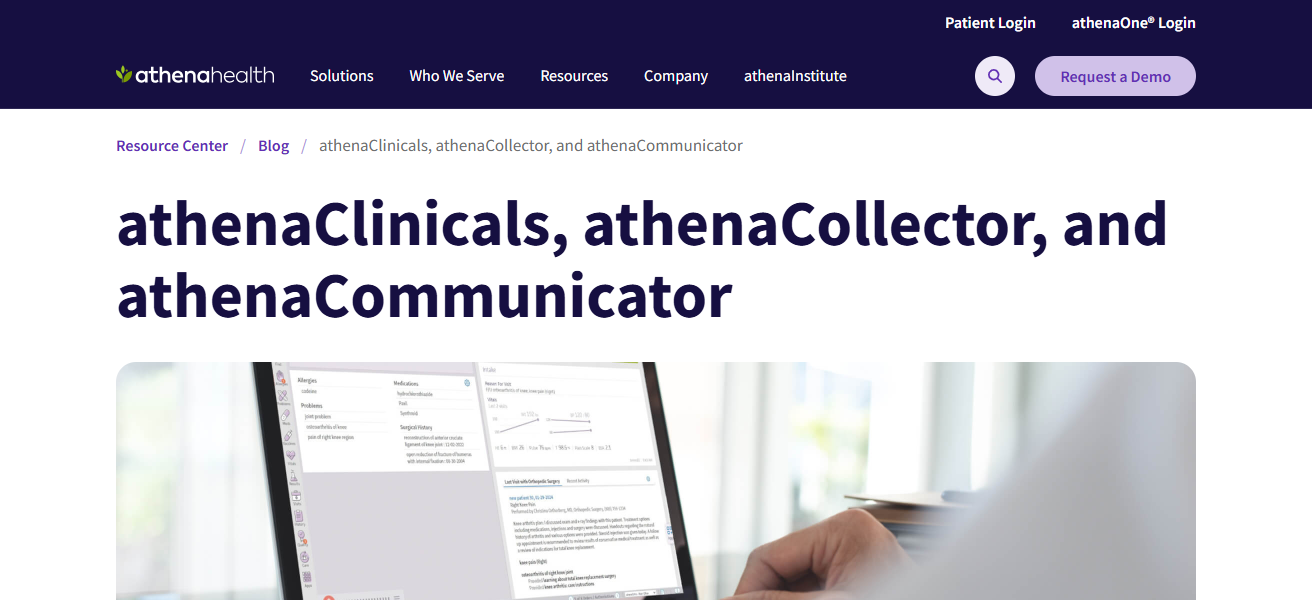
Large hospitals can take advantage of real-time monitoring of billing performance, automated follow-up, and insights into the hospital’s financial health.
athenaCollector improves financial health and operational efficiency by shortening the time to reimbursement and minimizing manual workforce intervention.
athenaCollector
| Pros | Cons |
| Cloud-based platform offers flexible remote accessibility. | Internet connectivity issues can affect system performance. |
| Intelligent claim scrubbing improves reimbursement success rates. | Limited customization compared to some enterprise solutions. |
| Automated follow-ups reduce manual collection efforts. | Pricing may increase as organizational needs expand. |
| Continuous learning engine enhances claim acceptance rates. | Certain advanced features require premium subscription plans. |
6. TruCode Encoder
TruCode Encoder is a medical coding solution that utilizes AI and the analysis of clinical documentation to help large healthcare organizations improve the speed and efficiency of medical coding.
The software reads physician documentation and patient records to offer coding suggestions, which improves the efficiency of coding significantly.
Automated code selection helps improve the accuracy of the selected code. Recent improvements in natural language processing have significantly improved the platform’s ability to understand complex and advanced medical terminology.
Hospitals benefit from an improvement in coder productivity, coding compliance, and income from medical claims due to improved revenue cycle performance.
TruCode Encoder
| Pros | Cons |
| Accelerates coding through AI-powered documentation analysis. | Primarily focused on coding rather than revenue management. |
| Improves coding consistency across hospital departments. | Integration requirements may vary among healthcare systems. |
| Supports accurate code selection for complex cases. | May require periodic updates for coding standards. |
| Enhances coder productivity and operational efficiency. | Some advanced capabilities involve additional licensing fees. |
7. nThrive Revenue Systems
nThrive Revenue Systems provides automated and predictive revenue cycle management. Their solutions help financial outcomes and revenue management by identifying reimbursement requests and reducing denial management.
Automated and AI applications look at patient, billing, and payer data to find revenue and management gaps. These solutions are especially beneficial to large healthcare systems.
nThrive solutions help hospitals improve and stabilize cash flow and revenue, and maintain the transparency and flexibility of operations with predictive and advanced reporting.
nThrive Revenue Systems
| Pros | Cons |
| Predictive analytics identify hidden revenue opportunities effectively. | Implementation can be complex for large organizations. |
| Comprehensive reporting improves financial transparency. | Training requirements may increase onboarding timelines. |
| Automation reduces administrative workload significantly. | Premium pricing may challenge budget-conscious hospitals. |
| Helps minimize claim denials and payment delays. | Customization option |
8. CureMD Medical Billing
CureMD Medical Billing is an integrated solution that incorporates billing with task management and workflow automation.
This solution provides healthcare systems with ease in claim management and helps maintain coding accuracy.
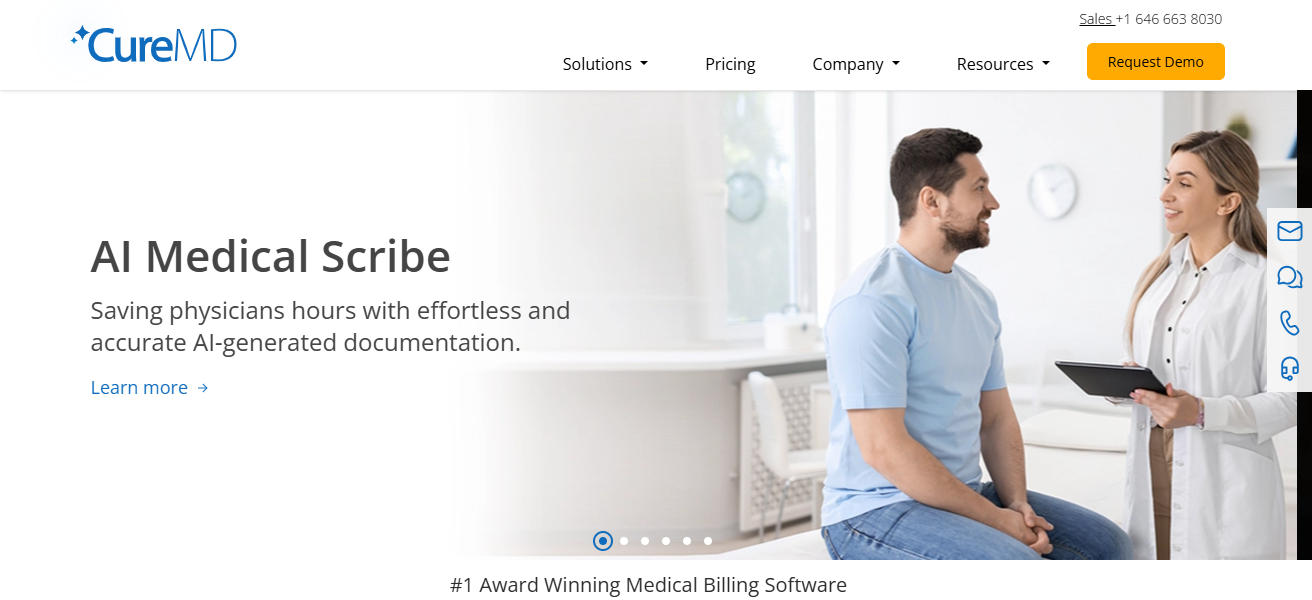
By billing and submitting claims, and verifying insurance and potential reimbursement gaps, CureMD Medical Billing reduces the workload of large healthcare systems.
CureMD Medical Billing helps healthcare systems to focus more on patient care by reducing administrative loading and repetitive care billing tasks.
CureMD Medical Billing
| Pros | Cons |
| User-friendly interface simplifies billing management tasks. | Enterprise-level customization options may be limited. |
| Automated insurance verification reduces administrative errors. | Some integrations require additional configuration efforts. |
| Smart billing tools improve operational efficiency. | Large hospitals may need supplemental advanced modules. |
| Cloud accessibility supports flexible workflow management. | Feature-rich environments can increase subscription expenses. |
9. AdvancedMD Billing Software
AdvancedMD Billing Software uses AI to improve efficiency during the revenue cycle. This program assists hospitals with increasing the accuracy of claim submissions and improving the speed of claim reimbursement.
AdvancedMD Billing uses a smart claim feature that identifies the issues pertaining to the claim’s code and identifies any errors prior to submission.
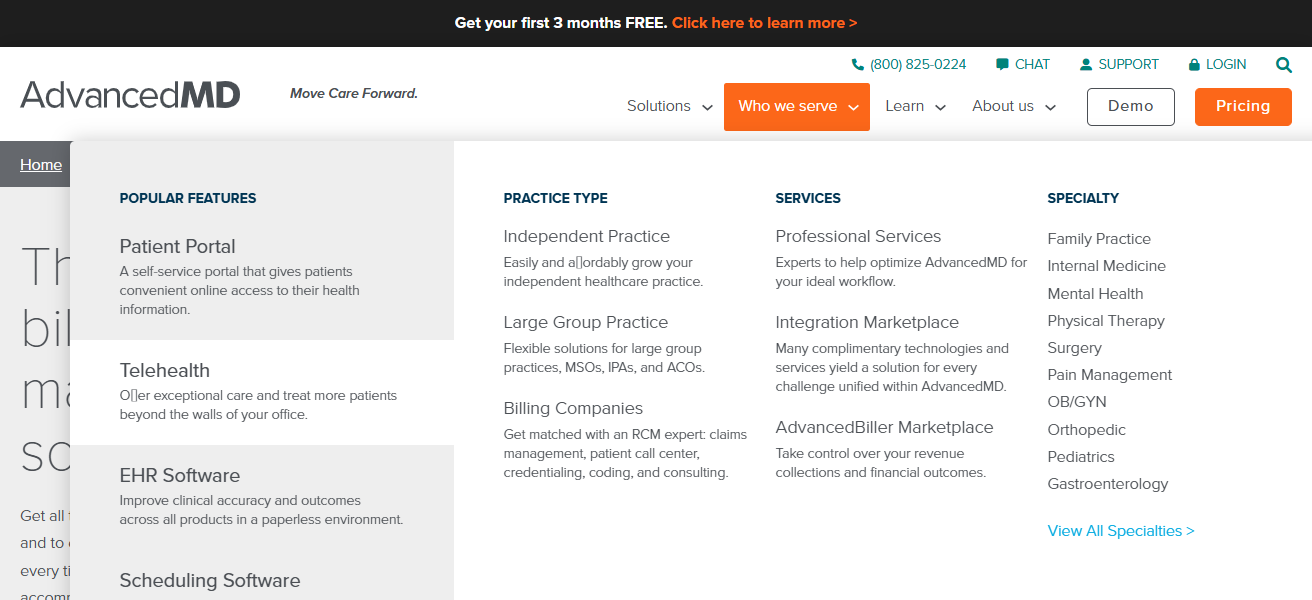
The feature of performance analytics and real-time reporting casts light on billing and revenue for healthcare administrators.
AdvancedMD Billing’s automated payment tracking and denial management features are especially beneficial to large healthcare systems.
The overall result of these features is faster payments, decreased administrative expenses, and an increased bottom line.
AdvancedMD Billing Software
| Pros | Cons |
| Intelligent claim scrubbing improves submission accuracy. | Advanced reporting tools may require user training. |
| Automated payment tracking enhances revenue visibility. | Initial configuration can be time-intensive. |
| Real-time analytics support informed financial decisions. | Certain integrations involve additional implementation costs. |
| Reduces administrative burden through workflow automation. | Large-scale deployments may require dedicated support resources. |
10. Waystar Revenue Platform
Like AdvancedMD, the Waystar Revenue Platform is an AI solution that seeks to decrease claim denials and increase collections for large hospitals.
The Waystar Revenue Platform uses automation and predictive analytics to diagnose potential issues of claim reimbursement during the initial stage of the claim submission process.

Advanced AI creates smart workflows for healthcare systems to submit better claims, receive payment faster, and lessen the administrative workload.
Waystar’s features provide healthcare systems with the ability to improve operational techniques and gain a competitive edge for fiscal growth.
Waystar Revenue Platform
| Pros | Cons |
| Predictive analytics help reduce claim denials proactively. | Enterprise pricing may not suit smaller organizations. |
| Strong payer connectivity improves reimbursement efficiency. | Setup complexity varies depending on existing systems. |
| AI-driven insights optimize revenue collection strategies. | Advanced functionality may require specialized training. |
| Automated workflows accelerate payment processing cycles. | Ongoing maintenance costs can impact overall budgets. |
How We Chose the Top Medical Billing and Coding Software
- AI Automation – We reviewed the software’s ability to use AI and other automation to increase efficiency and effectiveness of the workflows related to billing and coding.
- Coding Accuracy and Compliance – We reviewed how exact the coding was and how compliant the software was with the laws and regulations of the healthcare industry.
- Revenue Cycle Management – We evaluated the software’s ability to positively and effectively impact the coding of claims and the maximization of revenue.
- EHR Integration – We reviewed how easily and quickly the software could integrate with Electronic Health Records.
- Analytics and Reporting – We reviewed the software’s ability to easily and quickly generate reports of the financial position and the ability to report on metrics with actionable insights.
- Ultra Large Hospital Scalability – We reviewed how scalable the software was to meet the needs of operating an ever-expanding ultra large hospital.
- Customer Support and Training – We reviewed the quality of the vendor’s support and the training offered.
- ROI and Cost Analysis – We reviewed the cost and pricing of the software compared to its potential value and offered features.
Conclsuion
In conclusion, AI-driven medical coding and billing software is revolutionizing the ways big hospitals handle revenue cycle management, claims, and compliance.
Software solutions like Optum360, Waystar, Epic Systems, and Cerner Revenue Cycle offer increasingly sophisticated automation of complex processes, higher coding accuracy, and fewer claim denials.
Healthcare companies can choose the appropriate software solution and soon realize operational benefits, faster reimbursement cycles, and revenue growth while continuing to practice compliant medicine focused on improving healthcare activities for patients.
FAQ
What is AI-powered medical billing software?
AI-powered medical billing software automates claim processing, coding, reimbursement management, and revenue cycle workflows using artificial intelligence technologies.
Which medical billing software is best for large hospitals?
Epic Systems, Cerner Revenue Cycle, Optum360, and Waystar are among the best options for large healthcare organizations.
How does AI improve medical coding accuracy?
AI analyzes clinical documentation, suggests accurate codes, identifies inconsistencies, and reduces manual coding errors.
Can AI reduce claim denials?
Yes. AI-powered claim validation tools identify errors before submission, significantly reducing claim denials and payment delays.
Is cloud-based medical billing software better?
Cloud-based solutions offer greater accessibility, automatic updates, lower infrastructure costs, and easier scalability for growing healthcare organizations.