

In this article, I will break down the Best Intent-Based DEXs for Zero-Slippage Swaps, detailing intent-based trading, and how it improves the swapping experience, as well as the trade execution and price impact for the user.
I will look at major players, and examine key features, benefits, disadvantages, liquidity, solver competition, MEV protection, and how efficient they are when routing. This way, traders can understand better how each of these factors can work to fulfill their needs when swapping.
What are intent-based DEXs?
Intent based DEXs allow users to instruct the exchange system to put in the order to execute an output at a price of their choosing in return for them providing input. Users are not required to choose and navigate different liquidity pools and routes. Instead, users provide their trading request to the system.
Multiple specialized solvers, fillers or market makers will attempt to efficiently fulfill each such request. Thus, this framework can reduce execution burden, improve execution, minimize price impact, shrink MEV exposure and trading complexity, and give more convenient decentralized swap services to the users.
Key Points
| Intent-Based DEX | explanation |
|---|---|
| 1inch Fusion | Solvers compete through Dutch auctions for gasless, MEV-protected swaps. |
| UniswapX | Fillers compete to execute trades using aggregated liquidity efficiently. |
| CoW Swap | Batch auctions match traders while reducing MEV and price impact. |
| Velora | Intent-based Delta mode enables competitive execution across multiple liquidity sources. |
| Jupiter | Solana’s leading aggregator routes swaps across extensive decentralized liquidity. |
| Across | Intent-based relayers provide fast cross-chain swaps with competitive execution. |
| Relay | Solver-based execution simplifies fast cross-chain swaps for users efficiently. |
| LiFi | Aggregates multiple intent protocols to search for optimal execution. |
| 0x / Matcha | Aggregates liquidity and uses RFQ systems for competitive trade execution. |
| Eco Routes | Stablecoin-focused routing selects efficient cross-chain settlement rails automatically. |
10 Best Intent-Based DEXs for Zero Slippage Swaps
1. 1inch Fusion
1inch Fusion is an intent-based trading system designed to put professional resolvers up against each other to see who can complete the transaction with the best offer.
Unlike other systems that entirely rely on conventional on-chain routing, Fusion uses a mechanism where resolvers go against each other to execute orders.

This allows users of Fusion to get the best pricing while having possibilities to eliminate some gas costs and MEV (Maximal Extractable Value) problems. Best Intent-Based DEXs for Zero Slippage Swaps love 1inch Fusion as it combines decentralized liquidity with solver-based execution.
But slippage shouldn’t be perceived as zero. The final execution can depend on several external variables and is largely based on liquidity and market conditions.
1inch Fusion Features
- Intent-Based Swaps: Users place orders , and the platform’s resolvers are in charge of order execution.
- Dutch Auction Model: Competing resolvers offer the best execution for the orders placed by the users.
- MEV Protection: The architecture of the system may potentially reduce some trading risks related to MEV.
- Gasless Trading: Eligible orders can be executed without users having to pay gas.
| Pros | Cons |
|---|---|
| Solver competition can improve execution prices. | Final execution depends on available resolvers. |
| Dutch auctions encourage competitive order fulfillment. | Not every trading pair has equal liquidity. |
| Gasless execution can simplify the trading experience. | “Zero slippage” is not guaranteed. |
| Design can reduce certain MEV risks. | Complex architecture may confuse beginners. |
2. UniswapX
UniswapX is a sister product of Uniswap that allows its users to put a swap request and have multiple executors compete to fill the order. Compared to other automated market making (AMM) systems, the UniswapX model can potentially give better execution by sourcing order-filling liquidity from multiple sources.
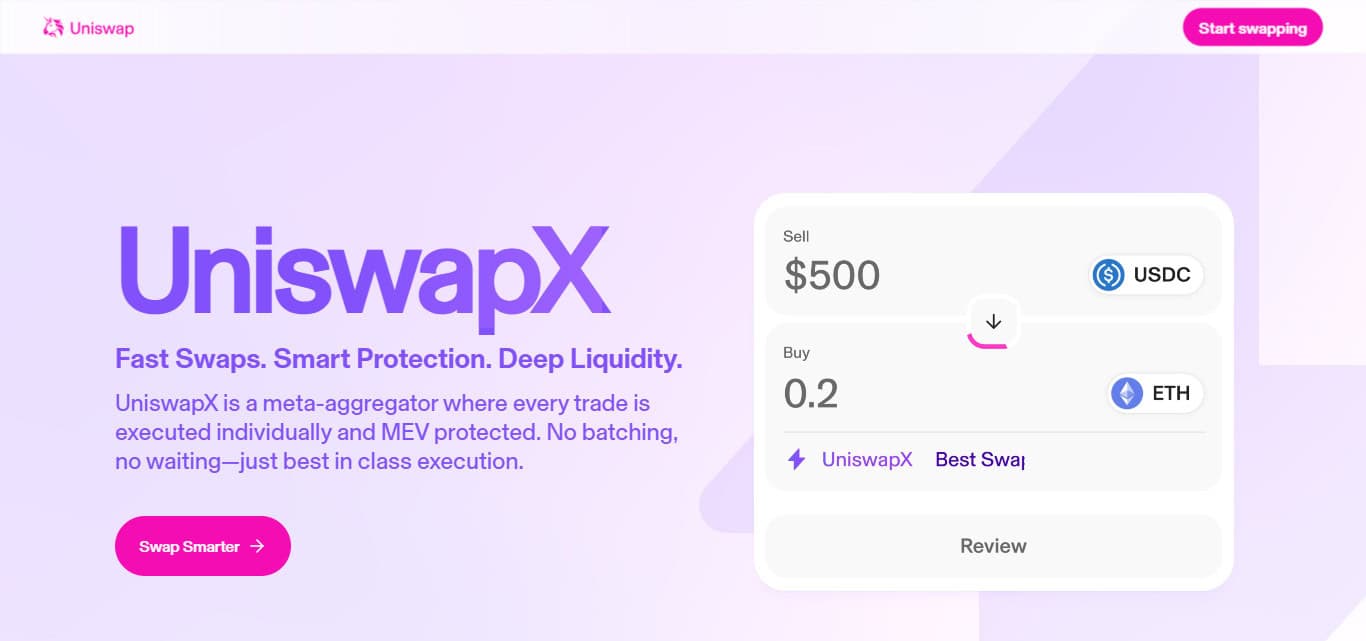
The pole-and-hole model of UniswapX should result in simplification, improvement, and cost efficiency in the swapping process. Best Intent-Based DEXs for Zero Slippage Swaps tend to include UniswapX as it is a liquidity-focused model.
However, similar to most of the systems, actual execution is subject to market conditions, liquidity, volatility, and of course the order conditions, which makes zero slippage more of an optimization goal than a delivery guarantee.
UniswapX Features
- Filler Competition: Users’ swaps are executed by multiple competing fillers.
- Aggregated Liquidity: Fillers can conduct trades using liquidity provided by multiple decentralized and external venues.
- Flexible Execution: Orders can be filled using various liquidity sources and execution pathways.
- Improved Pricing: Competing fillers may offer better trade executions.
| Pros | Cons |
|---|---|
| Fillers compete to execute user orders. | Execution depends on active filler participation. |
| Accesses liquidity from multiple sources. | Supported assets and networks can vary. |
| Can potentially improve swap pricing. | Market volatility can still cause price impact. |
| Simplifies the swapping experience for users. | Advanced execution mechanics may be less familiar. |
2. CoW Swap
CoW Swap utilizes batch auctions and competition among solvers to carry out trades in a decentralized way. Users submit their transactions in the form of “intents” to the network. Solvers search the network for optimal trade settlement opportunities.
When two users’ transactions are aligned or “Coincident of wants,” there is no need to interact with external liquidity pools. Solver competition limits the market execution slippage and automatically coordinates the settlement of trades.

Because of batch auctions and competition among solvers, CoW Swap is repeatedly accused of offering the best execution with zero slippage in several discussions. That said, the quality of execution is volatile and dependent on several factors, including the liquidity, token pairs, the size of the order, and market conditions.
CoW Swap Features
- Batch Auctions: Orders are grouped together and are settled via periodic auction mechanisms.
- Solver Competition: Different independent solvers compete for executing orders.
- MEV Protection: Da design of CoW Swap auctions may help reduce MEV.
- Peer Matching: Orders can be directly matched without the use of external liquidity.
| Pros | Cons |
|---|---|
| Batch auctions can improve trade efficiency. | Orders may depend on auction settlement timing. |
| Solver competition encourages better execution. | Execution quality varies by trading pair. |
| Helps protect against certain MEV strategies. | Less suitable for users seeking instant execution. |
| Peer-to-peer matching can reduce liquidity costs. | Some trades still require external liquidity. |
4. Velora
Velora focuses on intent-based execution and cross-chain liquidity. Users have the means needed to express their desired transaction, while specialized technologies help determine the best way to carry out the transaction.
Velora’s Delta technology connects users with the best liquidity and execution providers; it does not funnel trades through a single liquidity provider. Velora may be included in Best Intent-Based DEXs for Zero Slippage Swaps discussions.

However, prior to assuming a transaction will have zero slippage, users need to consider the supported chains, the assets available, the fees, the conditions of the bridge, liquidity, and the guarantees of execution.
Velora Features
- Intent-Based Execution: Users specify their desired trade outcomes rather than select multiple trade components.
- Competitive Liquidity: Different execution providers offer trade execution across varying liquidity.
- Cross-Chain Support: Works across various networks to enable asset transfer and transaction transcend boundaries.
- Delta Architecture: Velora’s system uses its Delta mechanism to improve liquidity and trade execution
| Pros | Cons |
|---|---|
| Intent-based execution simplifies transaction routing. | Cross-chain transactions introduce additional complexity. |
| Competitive liquidity can improve execution opportunities. | Available liquidity differs between networks. |
| Supports cross-chain transaction use cases. | Bridge and network fees can affect final output. |
| Delta architecture improves access to liquidity sources. | Users should verify supported assets and chains. |
5. Jupiter
Jupiter provides the option for users to trade and aggregate liquidity from different markets within the Solana ecosystem. Jupiter scans trading markets to identify the swiftest and most efficient trading routes, and has begun constructing its trading framework to enable users to execute more intricate trades.
Jupiter’s aggregation technology makes it so users do not have to manually check and compare trading markets and trading routes.
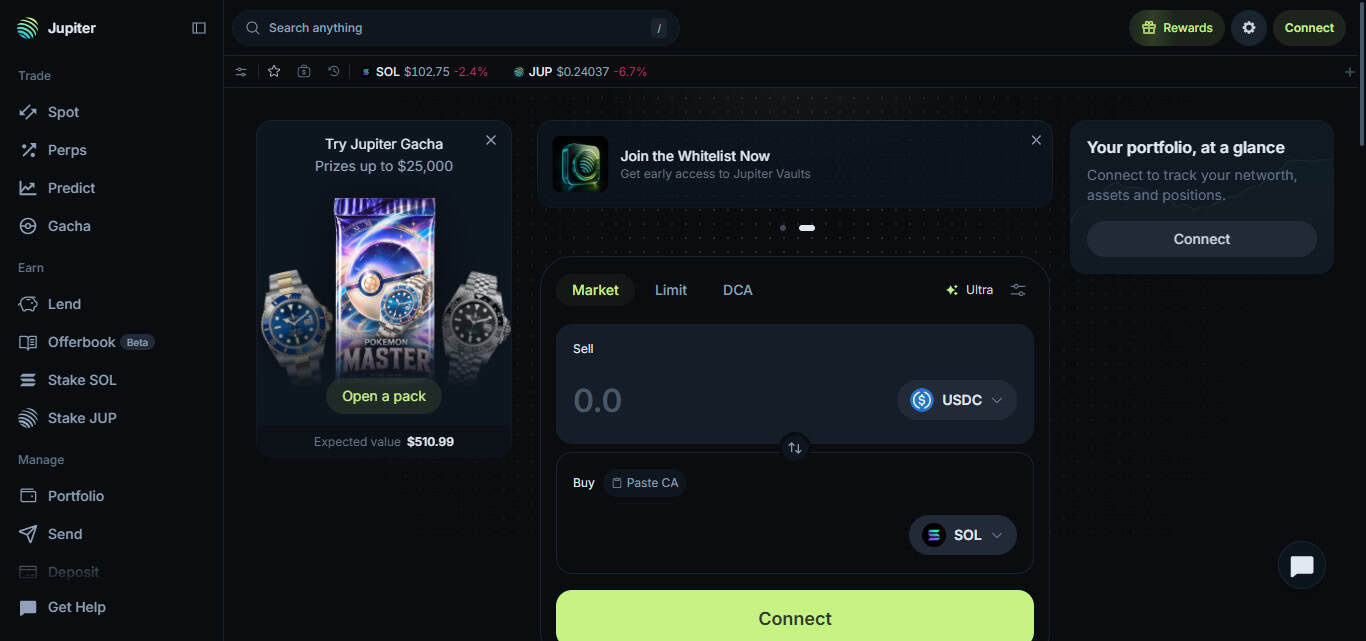
As per Best Intent-Based DEXs for Zero Slippage Swaps, Jupiter may be included in these lists, as competitors employing automated routing reduce or minimize slippage on Solana swaps.
Jupiter, however, does not offer slippage-free swaps. Jupiter’s execution is reliant on liquidity, token volatility, the size of the transaction, the trading route, and the slippage tolerance the user has set.
Jupiter Features
- Liquidity Aggregation: Automatically scans Solana for the most efficient liquidity paths to execute swaps.
- Smart Routing: Picks the route that maximizes the amount returned to the user.
- Solana Ecosystem: Has direct access to a majority of Solana’s tokens and Decentralized Liquidity.
- Price Impact Reduction: Route optimization results in lower price impact.
| Pros | Cons |
|---|---|
| Aggregates liquidity across the Solana ecosystem. | Primarily focused on Solana-related trading. |
| Smart routing can improve swap execution. | Large trades can still experience price impact. |
| Provides access to extensive token liquidity. | Highly volatile tokens may remain difficult to trade. |
| Fast Solana transactions can improve user experience. | Actual execution depends on available liquidity. |
6. Across
Across is perhaps best known for its cross-chain bridging technology. Like Jupiter, Across employs intent routing architecture, meaning a user states a destination for an asset, and multiple parties (relayers) compete to fulfill the destination request, leading to the settlement of the request through Across’s infrastructure.

When users employ intent-based routing technologies on-chain, they can execute cross-chain transfers, albeit in a single transaction, without the burden of executing a multi-step transaction. Per Best Intent-Based DEXs for Zero Slippage Swaps, Across may be included given the scope extends beyond same chain swaps to cross-chain execution.
Cross-chain transactions introduce risk factors that include, but are not limited to, the liquidity of the bridge, relayer presence, destination-chain factors, fees, and the assets supported, thus slippage execution can never be guaranteed.
Across Features
- Intent-Based Bridging: Allows the user to set a desired outcome for a cross-chain transfer.
- Relayer Network: Relayers try to compete for the fastest transfer over the supported networks.
- Fast Settlement: Built for expedited cross-chain transfers that eliminate complex tasks.
- Cross-Chain Liquidity: Leverages available liquidity and relayer networks to facilitate transactions
| Pros | Cons |
|---|---|
| Intent-based architecture simplifies cross-chain transfers. | Primarily designed for cross-chain transactions. |
| Relayers can provide fast transaction fulfillment. | Relayer availability can affect execution. |
| Reduces the need for complicated manual bridging. | Cross-chain fees can vary by network. |
| Supports efficient movement between supported chains. | Not designed as a traditional spot DEX. |
7. Relay
Infrastructure for intent-based cross-chain transactions. Relay lets users state an outcome. Specialist execution providers handle the outcome. Relay’s infrastructure automates the steps traditionally done by users, such as bridging assets and transacting across several junctures.

This facilitates transactions across several discrete networks. For applications that aim for seamless transactions, Relay’s infrastructure may be sought out by the best Intent-Based DEXs for Zero Slippage Swaps, as additional execution mechanisms may speed up and improve convenience in cross-chain transactions.
Relay is a cross-chain execution infrastructure, not a DEX. The actual price, fees, and execution are a function of available liquidity, execution paths or networks, and the execution providers.
Relay Features
- Cross-Chain Intents: Transactions have desired results across blockchain networks.
- Automated Execution: Infrastructure handles the trade execution.
- Fast Transactions: Built to boost cross-chain transactions.
- Developer Infrastructure: Relay’s infrastructure allows applications to offer cross-chain transactions.
| Pros | Cons |
|---|---|
| Simplifies cross-chain transaction execution. | Depends on supported networks and assets. |
| Automated execution reduces manual transaction steps. | Cross-chain infrastructure adds technical complexity. |
| Can provide fast transaction experiences. | Execution depends on available providers. |
| Useful for applications integrating cross-chain functionality. | More infrastructure-focused than a conventional DEX. |
8. LI.FI
LI.FI provides cross-chain aggregation and routing infrastructure that connects disparate DEXs and bridges. LI.FI’s routing technology is able to analyze various paths, and thus users and applications are able to pick the best paths for swapping and moving assets across multiple networks.
This style of aggregation aligns well with cross-chain swaps. LI.FI may be sought out by the best Intent-Based DEXs for Zero Slippage Swaps since the combined use of aggregated routing technology, and intent-based infrastructure may be able to execute transacts across fragmented liquidity.

LI.FI is not a backstop for pricing with zero slippage. The impact of price may be influenced by bridge costs, the volatility of the token, liquidity of the DEX, the routes available, and the methodology of the execution.
LI.FI Features
- Route Aggregation: Includes various bridges, DEXs, and liquidity sources through a single interface.
- Cross-Chain Swaps: Enables APIs for cross-chain token swaps.
- Route Optimization: Assesses the available paths to find the most efficient route.
- Unified Experience: Unifies cross-chain transactions for both users and applications.
| Pros | Cons |
|---|---|
| Aggregates multiple bridges and DEXs. | More underlying routes can increase complexity. |
| Helps identify potentially efficient cross-chain paths. | Route availability changes with market conditions. |
| Supports multiple blockchain networks. | Bridge fees can affect the final received amount. |
| Provides unified cross-chain infrastructure for applications. | Execution is not guaranteed to have zero slippage. |
9. 0x / Matcha
0x builds the decentralized exchange infrastructure. Matcha builds the UI and operation layer for an aggregated liquidity trading system. The ecosystem can combine liquidity from many resources and can implement other mechanisms such as request-for-quote systems to provide better prices for certain orders.
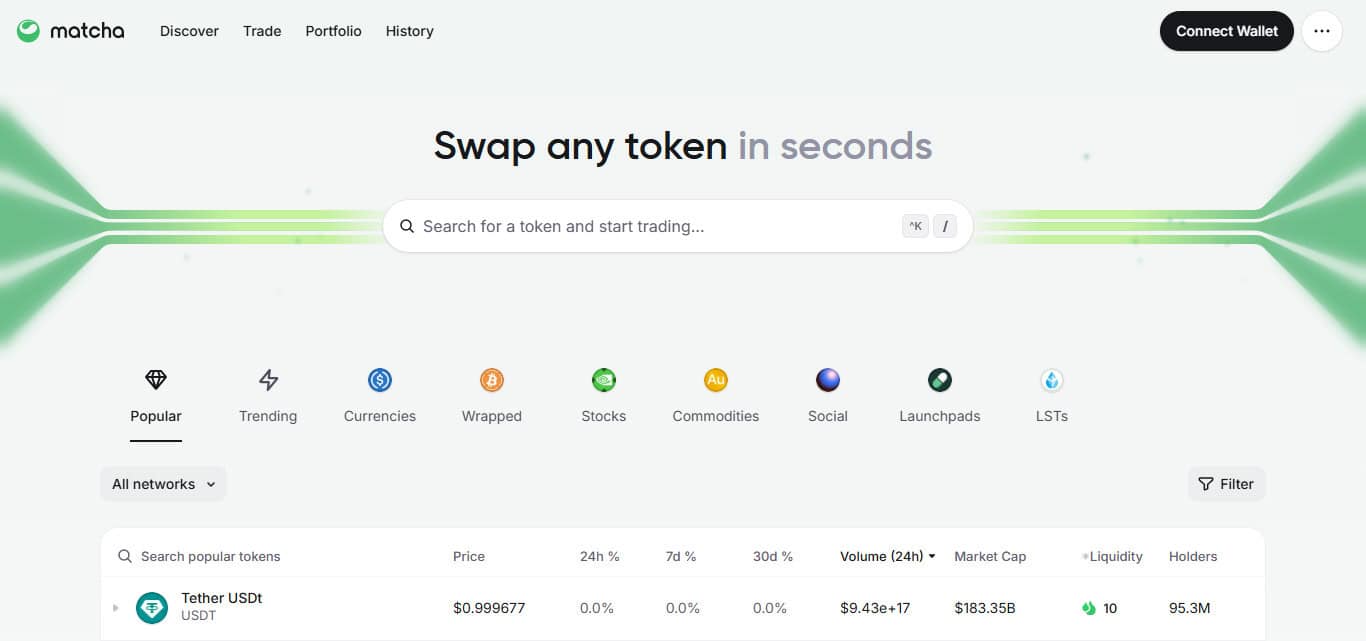
If just one liquidity pool cannot provide the best execution, this mechanism is useful. The Best Intent-Based DEXs for Zero Slippage Swaps Lists might cite 0x and Matcha since aggregation and extra market-maker liquidity help in decreasing price impact.
However, a platform should not describe its purpose as providing Zero Slippage. Depending on many factors such as the trading pair, market conditions, available liquidity, order size, and selected trade parameters, the amount of price slippage will vary.
0x / Matcha Features
- Liquidity Aggregation: Integrates liquidity from decentralized trading as well as professional trading sources.
- RFQ Execution: Trade execution at best price is possible via the RFQ mechanism.
- Smart Routing: Seeks the best execution opportunity by utilizing all available trading sources.
- User-Focused Interface: The trading interface eases access to DEX liquidity aggregation.
| Pros | Cons |
|---|---|
| Aggregates liquidity from numerous trading sources. | Pricing depends on available liquidity providers. |
| RFQ systems can provide competitive quotes. | RFQ availability varies across trading pairs. |
| Smart routing can improve execution efficiency. | Large orders can still experience price impact. |
| Matcha offers a relatively simple trading interface. | Advanced routing may be difficult for beginners to understand. |
10. Eco Routes
Eco’s routing infrastructure is focused on efficiently implementing intent-based transactions and cross-chain settlement, especially for stablecoins.
Rather than making the user understand the intricacies of every underlying bridge or settlement mechanism, Eco’s routing infrastructure automates the process of settlement across liquidity providers and networks.

is a more user-centric approach to the problem. Best Intent-Based DEXs for Zero Slippage Swaps should consider Eco Routing Infrastructure for intent-based stablecoin transactions and cross-chain routing. Stablecoins will provide relatively stable pricing in comparison to volatile assets.
However, fees, liquidity constraints, network conditions, and execution routes can still lead to a difference in the final amount received, so “zero slippage” should be the goal rather than a guarantee.
Eco Routes Features
- Intent Based Routing: Users create transaction goals, and automated routing systems execute the transactions.
- Stablecoin Hierarchy: It is especially handy for swift stablecoin transactions and cross-chain swaps.
- Cross-Chain Settlement: Connects distinct blockchains and settlement networks for more seamless transactions.
- Straightforward Execution: Decreases the routing complexities, hence transaction ease for users.
| Pros | Cons |
|---|---|
| Intent-based routing simplifies transaction execution. | Primarily suited to specific routing use cases. |
| Stablecoin-focused transactions can offer predictable pricing. | Stablecoin liquidity varies across networks. |
| Cross-chain settlement can simplify asset movement. | Network and settlement fees can reduce returns. |
| Abstracts complex routing from end users. | Zero slippage cannot be guaranteed in every transaction. |
How We Select the Best Intent Based DEXs for Zero Slippage
- Slippage Control: Swap protocols designed to minimize price impacts for users
- Solver Competition: Evaluates how well solvers, fillers, or liquidity providers compete for orders.
- Liquidity Depth: Focuses on the quantity of orders available.
- MEV Protection: Analyzes protocols focused on preventing liquidity from being extracted.
- Execution Speed: Considers how quickly orders can be fulfilled.
- Cross Chain Support: Considers how quickly swaps can occur across multiple blockchains.
- Trading Cost: Lower gas fees, protocol fees, and execution costs increase the value for the user.
- Routing Efficiency: Assesses how well protocols find liquidity and how quickly they perform trades.
- Security & Reliability: Assesses how secure a protocol is and how reliable the infrastructure is when performing a trade.
- User Experience: Trading interfaces and how quickly orders are performed are important factors.
Conclusion
Conclusio The Best Intent-Based DEXs for Zero Slippage Swaps allow users to navigate slippage with competitive solution solvers that offer optimal execution with deep liquidity, efficient routing, and MEV shielding.
Other solutions like 1inch Fusion, UniswapX, CoW Swap, Jupiter, and Velora apply different frameworks to enhancing swaps for users. While zero slippage remains elusive, these protocols and frameworks offer users more efficient trading.
FAQ
Can intent-based DEXs guarantee zero slippage?
No, actual slippage depends on liquidity, volatility, trade size, and execution conditions.
Which DEX is best for intent-based swaps?
The best choice depends on liquidity, supported networks, fees, and execution requirements.
How do solvers improve swap execution?
Solvers compete for orders, encouraging better routes, pricing, and efficient transaction settlement.
Does intent-based trading reduce MEV risks?
Many intent protocols include mechanisms designed to reduce certain MEV-related trading risks.