
In this article, we will examine some of the Best Privacy focused Decentralized Exchanges based on Fully Homomorphic Encryption, and how FHE is reshaping privacy-centric DeFi. We will cover leading projects, their most important features, privacy solutions, benefits, trade-offs, the ecosystems they support, and their potential.
This article will provide readers with a high level understanding of how a DAX may be able to offer more private, confidential trading and how they intend to address the security, liquidity, scalability, and usability challenges.
Key Points & Top FHE Privacy Decentralized Exchanges
- Lunarys — Confidential AMM using Zama’s fhEVM; encrypts swap amounts, balances and pool reserves.
- FHESwap — FHE-based DEX design that moves AMM pricing and trading logic into an encrypted environment.
- ZEX-P2P — Confidential P2P DEX using Zama FHE and ERC-7984, designed to hide trade amounts.
- Confidex — Experimental confidential order-book DEX using Inco’s FHE stack; deployed on Base Sepolia.
- Fhenix DEX ecosystem — FHE infrastructure targeting confidential DeFi, including private trading, balances and dark-pool-style applications.
- Inco DEX ecosystem — Confidential-computation infrastructure intended to support private swaps and DeFi applications.
- Zama / fhEVM ecosystem — One of the major FHE stacks for Ethereum-compatible confidential applications and DEX development.
- fhEVM DEXs — A broader category of emerging exchanges using encrypted balances, orders and trading logic rather than a single DEX.
- PrivacyPad — FHE-based private launchpad rather than a conventional DEX, but it is relevant to the emerging confidential-trading stack and currently supports Uniswap V3 liquidity.
- Sedona + Fhenix — Not a conventional DEX, but an emerging private trading platform integrating FHE to encrypt balances, positions and agent limits.
10 Top FHE Privacy Decentralized Exchanges
1. Lunarys
The Zama FHE technology made Lunarys an initial confidential AMM DEX. It encrypts swap quantities, balances, liquidity positions, and pool reserves to limit information leakage and MEV. Along with Ethereum and Sepolia, its paper mentions ERC-7984 confidential tokens as currently used technology.

Estimated launch date: 2025 (founding); a beta was launched in 2026 on Arbitrum and the Ethereum testnet. There are no known publicly accessible fixed trading fees. It supports ERC-7984 tokens. It does not support trade by country; users must comply with local laws.
Lunarys — Features
- FHE-powered privacy. Transactions within Lunarys are done using Zama’s fhEVM. This encrypts sensitive information during blockchain operations.
- Private AMM. Information concerning trade amounts, balances, and liquidity and pool information do not have to be publicly visible.
- MEV protection. It is more difficult for bots to detect and take advantage of trading opportunities by front running if the trading information is encrypted.
- EVM compatibility. The technology used is designed to fit within the Ethereum compatible framework so that confidential assets and DeFi applications can be used within the entire EVM ecosystem.
| Pros | Cons |
|---|---|
| FHE-powered privacy: Zama’s fhEVM can encrypt sensitive trading information during computation. | Early-stage ecosystem: Lunarys is much newer than established DEXs such as Uniswap. |
| Private AMM: Trade amounts, balances and pool information can be protected from ordinary public visibility. | Potentially higher computational costs: FHE operations are more complex than conventional transparent smart-contract calculations. |
| MEV protection potential: Encrypted trade information can make certain front-running and information-extraction strategies harder. | Limited liquidity: Confidential DEXs generally have a smaller liquidity base during their early development. |
| EVM compatibility: Its technology can interact with the broader Ethereum-compatible development ecosystem. | Limited confidential-token adoption: The availability of assets designed for confidential trading is still developing. |
2. FHESwap
FHESwap is a DEX built on the likeness of the Uniswap AMM, but utilizing Zama’s fhEVM to move the trading process into FHE. With FHESwap, inputs and balances, and even pool reserves and intermediate trade details, can be encrypted.

Estimated launch date: listed as 2024 founding; no public date for a mainnet launch. There are no publicly accessible trading fees. Its whitepaper suggests using trading fees as a source of revenue. It is built to support EVM-based and confidential tokens. There is currently no published country list.
FHESwap — Features
- Encrypted AMM calculations. The FHESwap team aims to perform all important AMM calculations within the framework of encrypted databases.
- Private trading. It is possible to protect trade amounts and other sensitive information from typical blockchain data viewers.
- FHE architecture. Fully Homomorphic Encryption (FHE) enables complex calculations to be performed on encrypted data.
- Confidential DeFi. The technology aims to integrate the privacy-oriented atomic swaps/trades to the DeFi space.
| Pros | Cons |
|---|---|
| Encrypted AMM calculations: The design aims to perform important AMM operations using encrypted information. | Experimental maturity: FHESwap does not have the established track record of major production DEXs. |
| Private trading: Sensitive trade amounts can potentially remain hidden from ordinary blockchain observers. | FHE complexity: Implementing AMM pricing over encrypted values is technically demanding. |
| Strong privacy architecture: Privacy is incorporated directly into the trading mechanism. | Performance considerations: Encrypted computation can increase processing requirements and transaction complexity. |
| Confidential DeFi potential: The architecture could support private swaps and other financial applications. | Liquidity uncertainty: Limited liquidity can result in wider spreads and less efficient execution. |
3. ZEX-P2P
ZEX-P2P is an experimental peer-to-peer DEX made for ETHGlobal’s 2025 ecosystem using Zama FHE and OpenZeppelin’s ERC-7984. ZEX-P2P uses ERC-7984 to encrypt trade quantities. It allows confidential ERC-20 assets to be traded using ERC-7984.
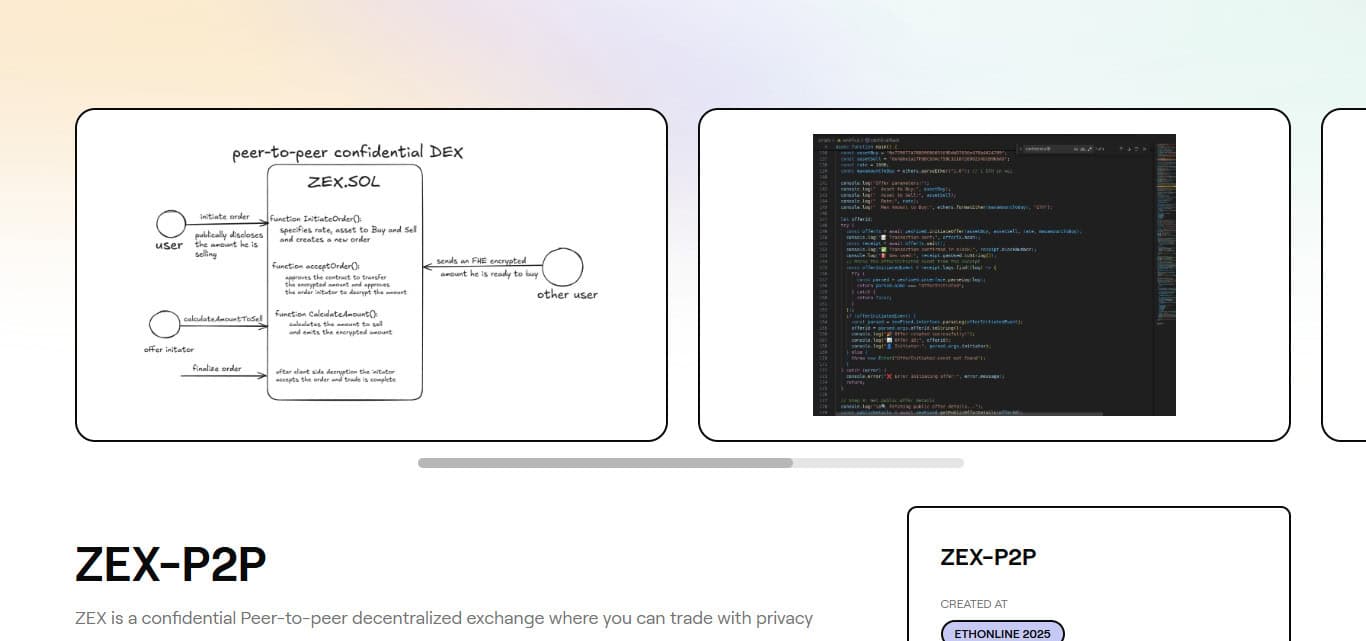
Estimated launch date: created at ETHOnline 2025; this should be treated as a project/demo rather than a real exchange. There are no known publicly accessible trading fees. It supports ERC-20/ERC-7984 assets. Country support: no listed regions; conditions relating to legality are jurisdictional.
ZEX-P2P —Features
- Peer-to-peer trading. Rather than relying on a public AMM, ZEX-P2P focuses on facilitating confidential asset trading on a peer to peer basis.
- Zama FHE. ZEX-P2P utilizes Zama’s FHE to process sensitive trade info and maintain certain values as encrypted.
- ERC-7984 support. ERC-7984, the confidential-token standard, is used to represent assets whose transaction info can be shielded.
- Hidden Trade Amounts: One of its key privacy objectives is for observers to have difficulty determining the trade amount for each individual trade.
| Pros | Cons |
|---|---|
| P2P trading model: Users can potentially trade confidential assets without depending entirely on a traditional public AMM. | Limited production history: ZEX-P2P is an emerging project rather than a mature high-volume DEX. |
| Zama FHE integration: FHE provides a mechanism for processing sensitive trade information while keeping values encrypted. | Smaller user base: Early confidential P2P markets may have fewer counterparties and less liquidity. |
| ERC-7984 support: The confidential-token standard provides infrastructure for representing private assets. | Emerging standard: ERC-7984 adoption across wallets, exchanges and DeFi protocols is still developing. |
| Hidden trade amounts: Concealing trade quantities can reduce the information available to external observers. | Potential UX complexity: Confidential tokens and encrypted transactions can be less familiar to ordinary DeFi users. |
4. Confidex
There is a test version of an experimental confidential DEX partially based on Inco’s technology. The test version was deployed on Base Sepolia, and uses confidential ERC-20 tokens to try to reduce front running and MEV attacks.
The test DEX was created on the 7th of May 2025 and developed until the 17th of May 2025. There are currently no published schedules for trading fees.
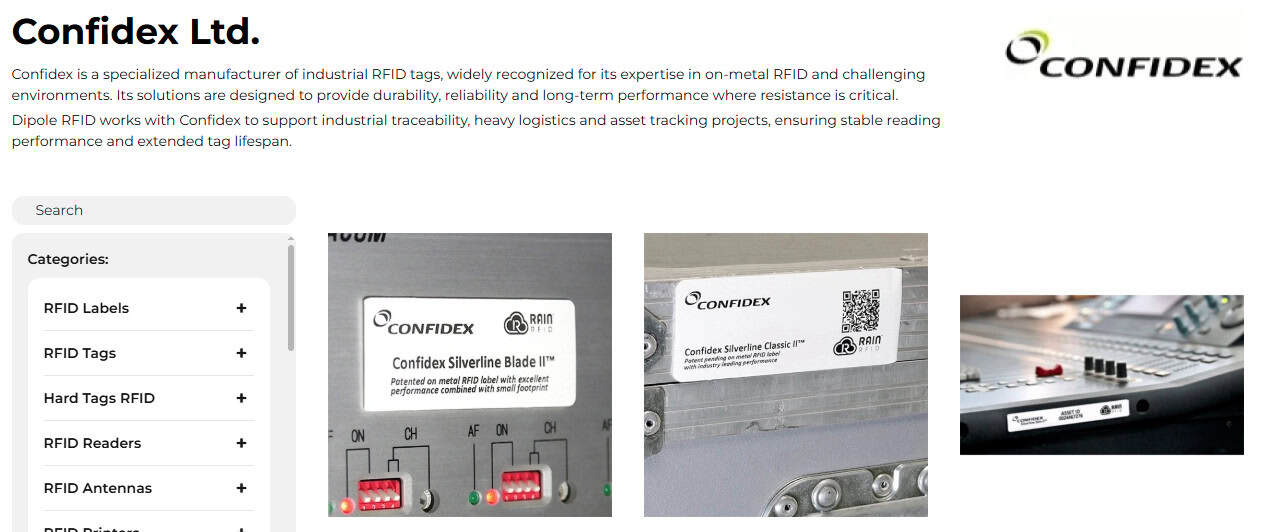
Confidential cUSDC and cCMF tokens have been tested. There are currently no country restrictions published, because it is a testnet and not a regulated exchange.
Confidex –Features
- Private Order Book: Confidex is actively exploring uses of an order book in which sensitive orders and trading data are kept private.
- Inco FHE Technology: Uses Inco’s confidential computation framework to enable secure data processing.
- Base Sepolia Deployment: The project has been implemented on Base Sepolia, and as such, is primarily an experimental/testnet implementation as opposed to an established production exchange.
- Resistance to Front Running: Privacy protection of order information may reduce the informational edge that bots and other market participants use.
| Pros | Cons |
|---|---|
| Private order book: Sensitive order information can potentially remain hidden from other market participants. | Testnet-focused: Its Base Sepolia deployment makes it primarily an experimental implementation. |
| Inco FHE technology: Uses confidential-computation technology for processing sensitive trading information. | Limited real liquidity: A testnet environment does not provide the liquidity available on established mainnet exchanges. |
| Front-running resistance: Concealing orders can reduce some information advantages available to bots. | Order-book complexity: Maintaining decentralized private orders and matching them securely is technically difficult. |
| Alternative to AMMs: Demonstrates how FHE can potentially be applied to private order-book markets. | Limited asset selection: Experimental confidential tokens are far fewer than the assets available on conventional DEXs. |
5. Fhenix DEX Ecosystem
As an FHE confidentiality infrastructure ecosystem, Fhenix operates in a manner distinct from most traditional DEXs. Fhenix provides encrypted smart contracts and confidential DeFi applications, such as private trading, concealed balances, and potentially dark pools.
Fhenix launched its Helium public testnet in June 2024. Fhenix is currently describing CoFHE as available on public testnets, with mainnet still scheduled for release.
There are currently no standard trading fees for DEXs, since Fhenix is infrastructure. Testnets support EVM-based assets and applications. There are currently no country restrictions across all of the applications.
Fhenix DEX Ecosystem – Features
- FHE Infrastructure: Fhenix technology provides builders of blockchain applications and services that require confidentiality of data used in their applications.
- Private Trading: Its technology enables the creation of confidential trading applications that encryption balances, positions and trading transactions.
- Dark Pools: FHE can create dark-pool trading markets where participants have no obligation to expose their orders.
- EVM Ecosystems: Fhenix technology brings confidentiality to smart contracts and DeFi infrastructure.
| Pros | Cons |
|---|---|
| FHE infrastructure: Developers can use Fhenix technology to create applications with confidential blockchain data. | Not a standalone DEX: Fhenix itself should not be viewed as one conventional exchange. |
| Private trading potential: Applications can be designed to protect balances, positions and transaction information. | Dependent on developers: The ecosystem’s success depends on third-party applications adopting the technology. |
| Dark-pool potential: FHE can support designs where trading information is not completely exposed to the public. | Computational overhead: FHE can require more resources than conventional blockchain computation. |
| EVM-oriented architecture: Ethereum-compatible developers can potentially build confidential DeFi applications using familiar concepts. | Early adoption: Confidential DeFi remains considerably smaller than conventional transparent DeFi. |
6. Inco DEX Ecosystem
Unlike most other DEXs, Inco is not trying to build traditional DEXs, rather Inco is developing confidential computation infrastructure.
This technology would ultimately enable the balances and transaction amounts to be concealed and process smart contracts. There are several public demonstrations of Inco Swap, a confidential swapping project.
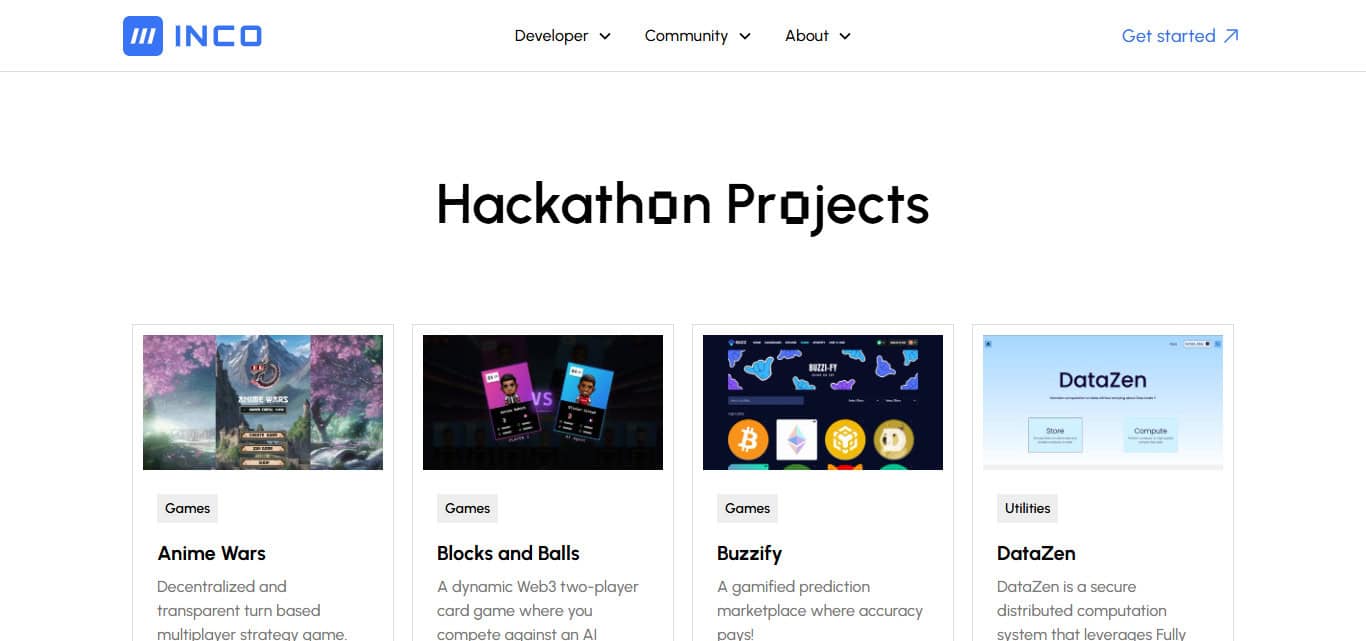
Launch date: Inco Lightning was launched in March 2025 on Base Sepolia testnet with an upgraded version released in January 2026. There are no universal DEX fee and fees vary among different projects. It supports confidential ERC-20-style assets. There is no published country list.
Inco DEX Ecosystem – Features
- Encrypted DeFi Data: Inco’s technology enables applications to process sensitive blockchain data without disclosing sensitive data.
- Private Swaps: Its technology enables builders of confidential trade and swap applications.
- Composable Privacy: Rather than creating one standalone DEX, Inco offers confidentiality infrastructure that other DeFi applications integrate.
| Pros | Cons |
|---|---|
| Encrypted DeFi data: Applications can process sensitive information while limiting public exposure of the underlying values. | Infrastructure rather than DEX: Inco provides technology for applications rather than operating one dominant exchange. |
| Private swaps: Developers can build confidential swap and trading applications on top of its infrastructure. | Integration dependency: Adoption depends on other protocols integrating Inco’s technology. |
| Composable privacy: Confidential computation can potentially be incorporated into multiple DeFi applications. | Development complexity: Developers must understand the additional architecture required for confidential computation. |
| Multiple use cases: The technology can extend beyond trading to other applications requiring protected data. | No automatic liquidity: Infrastructure does not itself guarantee deep liquidity or active markets. |
7. Zama / fhEVM Ecosystem
Zama’s fhEVM is one of the main technologies enabling confidential EVM applications rather than being a DEX itself. It supports transactions and state on-chain and incorporates a cryptography-based approach to allow contracts to perform computations on encrypted data.

Launch date: Zama released its fhEVM coprocessor in December 2024; its ZAMA token had its launch on February 2, 2026. Fees: Zama mentions that its economics of the protocol includes a charge for the encryption/decryption service, but individual projects may charge their own fees. Crypto support: EVM-compatible confidential tokens. Country support: no universal country list.
Zama / fhEVM Ecosystem —Features
- Fully Homomorphic Encryption: The core of Zama’s technology is the ability for smart contracts to compute on encrypted information.
- Confidential smart contracts: Users need not publish their sensitive input or the state of the contract.
- DEX development: Zama’s technology aids in building confidential automated market-makers (AMM), confidential order books, and private swaps.
- ERC-7984 ecosystem: Zama’s ecosystem focuses on confidential-token standards and helps define encrypted assets in EVM-compatible applications.
| Pros | Cons |
|---|---|
| Advanced FHE capability: Smart contracts can be designed to compute over encrypted information. | Not a DEX: Zama is primarily an infrastructure and technology ecosystem, not a conventional trading platform. |
| Confidential smart contracts: Sensitive inputs and contract state can potentially remain protected. | High technical complexity: FHE development can be significantly more complicated than traditional Solidity applications. |
| DEX development: Developers can use the technology for private AMMs, order books and swaps. | Performance overhead: FHE computation can introduce additional latency and resource requirements. |
| ERC-7984 ecosystem: Confidential-token standards can help applications work with encrypted assets. | Emerging ecosystem: Confidential-token infrastructure still needs broader adoption across wallets and DeFi applications. |
8. fhEVM DEXs
“fhEVM DEXs” is a category of emerging confidential decentralized exchanges built on Zama’s FHE technology. Depending on the implementation, balances, orders and swaps as well as AMM calculations can be executed on smart contracts while remaining confidential.
Launch date: there is no specific launch date as each project is independent. Fees: there is no standardized fee; individual DEXs determine their own rates.

Crypto support: usually EVM/ERC-7984 or confidential-token assets. Country support: no centralized policy; each application and jurisdiction determines availability.
fhEVM DEXs — Features
- Encrypted balances: Implementation of DEXs using FHE technology enables users to have confidential balances while smart contracts are still able to execute the necessary calculations.
- Private orders: DEXs using FHE can potentially support orders that have trade quantities and other sensitive parameters that are encrypted and do not need to be published on a blockchain for all to see.
- Encrypted trading Logic: The computations that define an AMM, settlement and trading can be designed to operate on encrypted values.
- MEV reduction: FHE DEXs offer a design that can potentially reduce a number of front-running MEV and information-based attacks.
| Pros | Cons |
|---|---|
| Encrypted balances: FHE-based designs can keep user balances confidential while allowing required computations. | Not one specific exchange: fhEVM DEXs represent a broad category rather than one identifiable platform. |
| Private orders: Trade quantities and order parameters can potentially remain encrypted. | Early-stage market: Many implementations are still experimental or under development. |
| Encrypted trading logic: AMM pricing, settlement and trading calculations can operate on encrypted values. | Higher resource requirements: FHE can make blockchain computation more demanding. |
| Potential MEV reduction: Less publicly available trading information can reduce certain information-based attacks. | Liquidity fragmentation: Multiple small confidential markets can divide liquidity among different platforms. |
9. PrivacyPad
PrivacyPad can be considered a confidential Private Token Launchpad, rather than a traditional DEX. It is relevant to confidential DeFi because it uses Zama FHE to conceal token purchase contributions.
Each contributor sends their WETH privately, and information is made public once the sale closes. Launch Date: its public repository makes it clear that it is an MVP/demo, and no verified production-mainnet launch date was found. Fees: no public standard fee schedule.

Crypto support: ERC-20 Assets and cWETH. Users are currently able to add liquidity through Uniswap V3. Country support: No published country list.
PrivacyPad —Features
- Private token launches: PrivacyPad offers FHE-based launchpads where token sales can be executed privately.
- Confidential contributions: Using PrivacyPad, users can contribute to a token sale without disclosing their contribution to blockchain observers.
- Uniswap V3 liquidity: For one, it is linked to the Uniswap V3 liquidity protocols. Hence, its links to the broader confidential-DeFi ecosystem.
- FHE-based allocation: As participants in confidential protocols cannot observe the contributions of others, encrypted information would help in constructing more equitable private sale mechanisms.
| Pros | Cons |
|---|---|
| Private token launches: FHE can enable token-sale participation with greater confidentiality. | Not a conventional DEX: Its primary function is private token launches rather than continuous token swapping. |
| Confidential contributions: Individual contribution amounts can be protected from public observers. | Narrower use case: It is more specialized than a general-purpose DEX. |
| Uniswap V3 connection: Integration with Uniswap V3 liquidity mechanisms connects the project to established DeFi infrastructure. | Early ecosystem: It does not have the scale and liquidity of established launchpads or major DEXs. |
| Fairer allocation potential: Hiding contributions can reduce strategies based on observing other participants. | FHE complexity: Private sale mechanisms require additional cryptographic and smart-contract infrastructure. |
10. Sedona + Fhenix
Sedona is a self-custodial trading platform that combines spot trading, perpetuals and structured products. In July 2026, Sedona announced its partnership with Fhenix to move from TEE-based privacy to Fhenix’s FHE infrastructure on Arbitrum.

Launch: The Fhenix integration was announced on July 16, 2026 and is still being implemented. Fees: no FHE-specific public fee schedule was communicated. Crypto support: digital assets and stablecoins, with the list of supported assets changing. Country support: No universal country list; regulatory availability changes.
Sedona + Fhenix – Features
- Private trading: Sedona, together with Fhenix, is building a broader trading platform instead of the usual standalone DEX to enhance trading privacy.
- FHE-balanced positions: In this context, FHE helps conceal balance information while allowing necessary calculations to be performed.
- Confidential trading: Financial positions and other financial information can be designed to be completely invisible to external parties.
- Confidential AI trading: FHE helps conceal private trading AI trading agents and trading parameters.
| Pros | Cons |
|---|---|
| Broader trading platform: Sedona aims to provide a wider financial platform rather than only a traditional AMM. | Not a pure DEX: Its broader financial model differs from a standard decentralized exchange. |
| FHE-based privacy: Fhenix technology can potentially protect sensitive financial information during computation. | Developing integration: The Fhenix privacy integration is an emerging initiative rather than a long-established system. |
| Private positions: FHE can help protect balances, positions and other sensitive trading information. | Regulatory complexity: Broader financial products can create additional regulatory considerations across jurisdictions. |
| Confidential AI trading: FHE can potentially protect AI-agent strategies, limits and trading parameters. | Technical complexity: Combining FHE, automated trading and AI introduces additional engineering and security challenges. |
How We Chose The Top FHE Privacy Decentralized Exchanges
- FHE Technology: Projects adopting real-world FHE privacy transaction technology were preferred.
- Privacy: We evaluated balances, orders, trades and information fields.
- Security: We evaluated the architectures of encryption and smart contracts and resistance to attacks.
- Decentralization: We evaluated trading infrastructure and interface controls.
- Innovation: We chose projects that brought new ways of privacy in DeFi and trading.
- EVM Compatibility: We valued projects built to interact with the EVM-based ecosystem.
- Trading Potential: We analyzed how they provide privacy for swaps, automated markets, and order books.
Advantages Top FHE Privacy Decentralized Exchanges
- Improved Transaction Confidentiality: FHE lets DEXs process encrypted trading information without exposing sensitive values to the public.
- Decreased MEV: Hidden trade amounts and orders can obstruct some forms of front-running and information based MEV.
- Private Institutional DeFi: FHE allows institutions to maintain a greater degree of financial privacy whilst retaining trading services provided by programmable, blockchain based systems.
- Confidential Order Books and Dark Pools: FHE can conceal orders and allow for trading where market intentions and quantities are not revealed.
Challenges Top FHE Privacy Decentralized Exchanges
- Added Computational Overhead: There can be a significant increase in the required resources to perform computations.
- Reduced Liquidity: New privacy focused DEXs run the risk of having low liquidity, fewer market makers, and increased spreads.
- New Standards: Compatibility can be an issue due to the rapidly evolving standards of confidential tokens and FHE based development.
- Increased Complexity of Use: Concealed transactions may impact users by increasing the number of required steps, waiting, and potentially technical complexity.
Conclusion
Conclusion The Top FHE Privacy Decentralized Exchanges show how Fully Homomorphic Encryption can transform confidential DeFi trading. Several projects, including Lunarys, FHESwap, ZEX-P2P, Confidex, Fhenix, Inco, and Zama, are working on private transactions, encrypted balances, and less exposure to MEV.
As FHE matures, these challenges will be resolved in the near future, liquidity, scalability, computational costs, likely adoption and, as a result, high privacy standards for decentralized financial markets.
FAQ
What are FHE privacy decentralized exchanges?
FHE privacy DEXs use encrypted computation to protect sensitive trading information.
How does FHE improve DEX privacy?
FHE allows blockchain applications to compute data without exposing underlying information.
Which FHE privacy DEXs are most notable?
Lunarys, FHESwap, ZEX-P2P, Confidex, and emerging FHE ecosystems stand out.
Can FHE DEXs hide transaction amounts?
Yes, FHE technology can encrypt transaction amounts from public blockchain observers.