In this article, I’ll talk about the Top R&D Tax Credit Software for Startups. I will highlight platforms that assist businesses in identifying qualifying research costs, compiling supporting documentation, calculating potential credits, and streamlining claim preparation.
I’ll compare their main features, benefits, limitations, automation, integrations, pricing considerations, and suitability for startups to help readers understand which tools are appropriate for different R&D tax-credit needs.
Key Points
| Software | Explanation |
|---|---|
| Boast.AI | AI-powered platform automating R&D tax credits, claims, and compliance processes. |
| Kipsi | Streamlines R&D tax documentation, tracking expenses, and maximizing refunds. |
| Neo.tax | Automates startup tax credits, integrating financial data for accuracy. |
| Taxnova | Simplifies R&D claim preparation with expert guidance and automation tools. |
| Kreoh | Helps startups identify eligible activities and optimize tax benefits. |
| Daribatech | Provides digital tax incentive management for innovative startup businesses. |
| Instead | Supports tax credit applications through automated workflows and reporting. |
| Clarus R+D | Delivers expert-driven R&D tax credit solutions with compliance support. |
| Pilot.com | Combines bookkeeping and tax credit services for startup growth. |
| TaxRobot | Automates tax credit calculations, documentation, and submission for startups. |
10 Top R&D Tax Credit Software for Startups
1. Boast AI
Boast.AI is one of the Top R&D Tax Credit Software for Startups, automates the entire R&D tax credit process using AI-driven analysis. The platform identifies qualified R&D activities by reviewing software development, engineering projects, product innovation, technical experimentation and research initiatives.
These can be employee salaries, payments to contractors, cloud infrastructure, and development expenses. Credit calculations depend on payroll records, accounting data, project management systems and employee time tracking.

Boast.AI automates documentation and audit-ready evidence collection and provides assistance with claim preparation and filing. Workflows are easier with QuickBooks, Xero & payroll integrations. Custom subscription pricing. Available in the United States and Canada. Best for: Fast-growing technology startups looking for automation and compliance.
Pros & Cons Boast AI
| Pros | Cons |
|---|---|
| AI-assisted identification of potentially qualifying R&D activities | Best suited to businesses that can provide structured business and technical data |
| Integrations can reduce manual data collection | Some advanced workflows may require additional setup |
| Supports technical documentation and claim preparation | Pricing may depend on claim size or service requirements |
| Provides support around the R&D credit process | Businesses with unusual R&D structures may still need expert review |
2. Kipsi
Kipsi is a modern Top R&D Tax Credit Software for Startups help companies identify eligible innovation activities and maximize tax incentives. It looks at software engineering, product development, technical research, testing procedures and experimentation projects to find qualifying R&D work.
Examples of qualifying expenses include payroll, payments to contractors, cloud hosting fees and research-related expenses. Kipsi calculates credits using payroll data, expense data, accounting systems, and project tracking.

Centralized documents and supporting evidence for efficient record keeping and compliance. The platform further enables you to prepare and file claims. Accounting software integrations result in more accurate reporting. Kipsi is primarily based on a subscription pricing model and is most useful for tech-focused startups managing complex development projects.
Pros & Cons Kipsi
| Pros | Cons |
|---|---|
| Strong focus on automating R&D tax-credit workflows | More oriented toward tax professionals and firms than individual founders |
| Centralized client questionnaires and document collection | Initial configuration can take time |
| Automated reminders can reduce follow-up work | Effectiveness depends on clients submitting complete information |
| Useful for managing multiple R&D credit engagements | May provide more workflow functionality than a small startup needs |
3. Neo.tax
Neo.tax is one of the best Top R&D Tax Credit Software for Startups that focuses on automated tax credit identification and payroll tax offset opportunities. The platform identifies qualifying R&D by analyzing software development, product engineering, resolution of technical uncertainty, innovation activities and research activities.
Eligible expenses generally include compensation for employees, salaries for engineering, development costs and payments to contractors. Neo.tax pulls credits from payroll systems, accounting, financial reports and operational expenses data.

Automation has helped startups cut down considerably on the time they spend on documentation and evidence generation. The platform helps you prepare and submit claims and connects to your accounting and payroll systems. Neo.tax typically utilizes service-based or success-fee pricing models and is especially beneficial for venture-backed startups in the US.
Pros & Cons Neo.tax
| Pros | Cons |
|---|---|
| AI can analyze engineering and financial data for R&D claims | Requires access to multiple business data sources for maximum value |
| Connects with common developer and accounting platforms | Integration setup may require technical coordination |
| Generates data-backed R&D documentation | AI-generated outputs still benefit from professional review |
| Useful for technology-heavy startups with frequent development activity | Less relevant for businesses with minimal technical R&D records |
4. Taxnova
Taxnova is an all-in-one Top R&D Tax Credit Software For Startups that assists businesses to find eligible research expenses and innovation activities. It evaluates product development, technical enhancement projects, prototype development, testing activities and software engineering work to identify qualifying R&D activities.
Available credits are calculated based on payroll records, accounting systems, project tracking data and expense management information. Taxnova also simplifies documentation by collecting evidence, project records and supporting materials required during audits.

Claim preparation and filing assistance enables startups to remain compliant with tax regulations. Integrated accounting and financial tools for seamless workflows. Pricing is generally on subscription or service based models. Taxnova is perfect for growing startups that need structured R&D tax credit management.
Pros & Cons Taxnova
| Pros | Cons |
|---|---|
| Automates identification of R&D projects and contributors | Complex organizations may need additional configuration |
| Connects technical activity with financial information | Results depend on the quality of connected source data |
| Provides evidence-linked claim narratives | Advisor review can still be necessary before submission |
| Can support organizations with distributed R&D teams | May be more infrastructure than a very small startup requires |
5. Kreoh
Kreoh is recognized as a valuable Top R&D Tax Credit Software for Startups focused on innovation incentives and tax credit optimization. The platform identifies qualifying activities by reviewing technical research, software development, prototype design, engineering projects, and experimentation work.
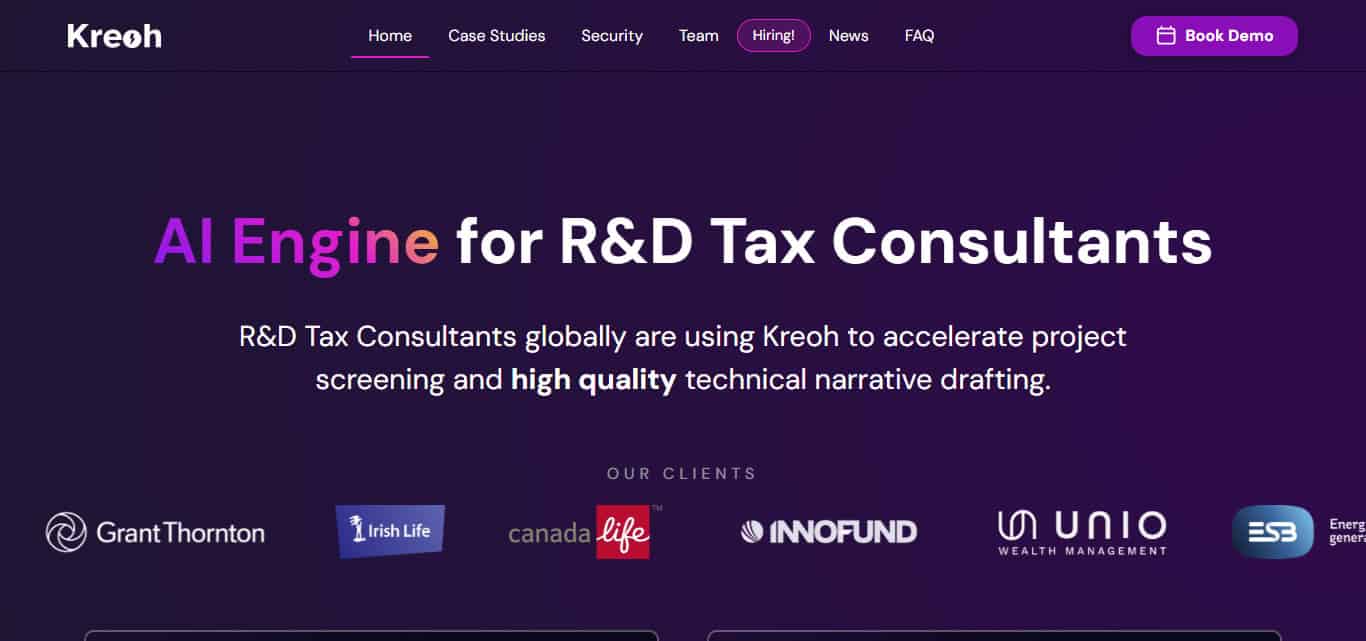
Eligible expenses frequently include payroll costs, contractor fees, project expenses, and research investments. Kreoh calculates credits using payroll records, accounting data, project budgets, and operational spending information. Documentation and evidence collection features help startups organize records necessary for audits and compliance reviews.
The software also supports claim preparation and filing processes. Integrations with business and accounting platforms improve data synchronization. Kreoh generally offers customized pricing models and is well suited for startups pursuing innovation-driven growth strategies.
Pros & Cons Kreoh
| Pros | Cons |
|---|---|
| AI assistance can accelerate technical narrative preparation | AI-generated narratives still require human validation |
| Useful for organizing technical evidence | Technical teams may need to provide detailed project information |
| Supports workflows across different R&D tax jurisdictions | International requirements can make setup more complex |
| Can help identify missing information in R&D documentation | Some capabilities may be more relevant to professional tax firms |
6. Dariba Tech
Daribatech, a digital platform that identifies tax incentive opportunities, is among the Top R&D Tax Credit Software for Startups. The software assesses engineering activities, product innovation efforts, research programs and software development projects for R&D eligibility.
Eligible expenses may include payroll, development costs, contractor services and project investments. Credits are calculated based on payroll data, accounting data, financial data, and tracked expenses.

Daribatech brings all documentation and evidence collection under one platform, so startups stay audit ready. It also helps you prepare claims and provides compliance support. Integrations with financial software boost operational efficiency. The price depends on the scope of services. A good option for forward-looking startups seeking scalable tax credit solutions.
Pros & Cons Dariba Tech
| Pros | Cons |
|---|---|
| Focuses on R&D tax-credit processes relevant to the UAE | Its regional focus may be less useful for companies filing only outside the UAE |
| Helps organize technical and financial evidence | Companies may need substantial source documentation |
| Can structure information for claim preparation | Eligibility depends on the applicable local tax rules |
| Relevant for startups seeking structured R&D incentive support | Smaller startups may need professional guidance alongside the software |
7. Instead
Instead is an agile Top R&D Tax Credit Software for Startups that automates R&D credits identification and claiming workflows. The platform evaluates software development, engineering improvements, experimentation programs and innovation projects to determine qualifying R&D activities.
Eligible expenses may include employee wages, cloud infrastructure costs, operational spending, and contractor fees. Rather, it calculates tax credits based on payroll information, accounting transactions, expenses and project management data.

Digital workflows facilitate documentation and evidence collection, reducing compliance burdens. The platform also helps with claim preparation and filing support. It gets more efficient with integrations with accounting and financial apps. High-growth startups find subscription-based or customized pricing models appealing.
Pros & Cons Instead
| Pros | Cons |
|---|---|
| AI-based screening can reduce manual eligibility assessment | Automated screening does not replace final tax-professional judgment |
| Helps estimate potential R&D tax-credit savings | Estimates can change after detailed documentation review |
| Supports federal and state R&D credit workflows | U.S.-focused functionality limits international use cases |
| Produces preparer-ready information | Startups without organized records may need extra preparation first |
8. Clarus R+D
Clarus R+D offers consulting expertise, software functionality, and is in the Top R&D Tax Credit Software for Startups. The platform assesses eligibility by considering software development, product innovation, engineering research and experimental development projects.
Generally, qualifying expenses are payroll, contractor costs, research spending and project-related costs. The calculations of credits are based on payroll systems, accounting records, expense reports and project documentation.

Clarus R+D is very strong on documentation collection and compliance-driven evidence management. Tax experts also oversee comprehensive claim preparation and filing assistance. The integration with accounting software enhances the accuracy of data and reporting. Pricing tends to be custom, so the platform is well-suited to startups that want automation and expert help.
Pros & Cons Clarus R+D
| Pros | Cons |
|---|---|
| Dedicated focus on R&D tax-credit qualification | More service-oriented than a purely self-service software model |
| Supports project and expense qualification | Businesses may need to provide detailed project information |
| Can prepare supporting documentation for tax filings | Professional involvement can make the process less instantaneous |
| Useful for startups working with CPAs or tax professionals | May be less attractive to founders seeking a completely automated workflow |
9. Pilot.com
Pilot.com is a financial operations platform that combines bookkeeping, accounting, and tax credit services to be ranked among the Top R&D Tax Credit Software for Startups. It identifies qualifying R&D activities through financial analysis of software development, engineering efforts, product innovation and research projects.
Eligible costs include payroll, employee compensation, operating costs and payments to contractors. Credits are calculated by Pilot.com with the use of accounting records, payroll systems, financial statements and transaction data.

It has workflows for bookkeeping such as collecting documentation and easing compliance requirements. The platform provides claim preparation and filing help and connects with QuickBooks and other financial software. Subscription pricing works especially well for early stage and venture-backed startups.
Pros & Cons Pilot.com
| Pros | Cons |
|---|---|
| Combines R&D credit support with broader accounting services | R&D credit functionality is part of a wider tax/accounting ecosystem |
| Can identify qualifying expenses from company financial information | Businesses may need to use or coordinate with Pilot’s accounting workflow |
| Supports preparation and filing of the credit | Service availability and pricing depend on the selected Pilot offering |
| Payroll-tax credit support can be valuable for eligible startups | Primarily designed around U.S. tax requirements |
10. TaxRobot
TaxRobot is an automated solution that made it to the Top R&D Tax Credit Software for Startups list by simplifying claim preparation and tax credit calculations. The platform monitors software engineering, innovation projects, research programs and technical development activities to identify eligible R&D activities.
Eligible expenses can include employee salaries, payroll costs, contractor fees and project costs. TaxRobot calculates credits from payroll records, expense management data, accounting information and workforce activity reports.

Automated templates and structured workflows organize documentation and evidence collection. Faster filing and improved accuracy with claim preparation support.
Operational efficiency is enhanced through integration with accounting software. TaxRobot typically works on a success-fee or performance-based pricing model, making it a great choice for startups looking for low-risk tax credit recovery.
Pros & Cons TaxRobot
| Pros | Cons |
|---|---|
| Automates substantial parts of R&D credit analysis | Automated analysis still depends on accurate company information |
| System connections can streamline data gathering | Integration requirements may add setup work |
| Provides supporting documentation for the claim | Businesses with complicated R&D structures may require additional review |
| Offers audit-defense support | The service model may be more than very small claims require |
Conclusion
To summarize, selecting the appropriate R&D tax credit software can empower startups to identify eligible expenditures, manage documentation, determine potential credits, and simplify the entire claim process.
The platforms reviewed in this article provide different approaches to automation, integrations, professional support and compliance.
Startups should compare features, pricing, jurisdiction coverage, and documentation requirements to select a solution that meets their R&D activities and financial workflow.
FAQ
How does R&D tax credit software work?
It analyzes expenses, employee activities, projects, and documentation for qualifying research activities.
Why should startups use R&D tax credit software?
It reduces manual work while improving documentation, calculations, and claim preparation.
What expenses can R&D tax software identify?
It can identify qualifying wages, contractor costs, supplies, and research-related expenses.
Can R&D software calculate potential tax credits?
Yes, many platforms estimate credits using qualifying expenses and applicable tax rules.