In this article I will review the Best Factom Alternatives for Blockchain Records and other platforms for data verification, secure storage, timestamping and immutable record management.
You’ll learn about their major technologies, security features, scalability, main use cases and differences to Factom. These alternatives can help businesses and developers select the right solutions for trusted, verifiable and long-term blockchain records.
Key Points
| Blockchain Records Alternative | Explanation |
|---|---|
| Accumulate Network | Decentralized identity and data infrastructure designed for secure, verifiable blockchain records. |
| Tierion (Chainpoint) | Creates blockchain-anchored proofs that verify data integrity, timestamps, and authenticity. |
| Hyperledger Fabric | Permissioned enterprise blockchain supporting private transactions, trusted participants, and auditable records. |
| R3 Corda | Enterprise distributed ledger enabling secure, private, and legally verifiable transaction records. |
| Hedera Hashgraph | High-throughput distributed network providing fast, secure, and timestamped transaction records globally. |
| ConsenSys Quorum | Enterprise Ethereum platform supporting permissioned networks, private transactions, and transparent record management. |
| OriginTrail | Decentralized knowledge graph connecting trusted data across organizations and blockchain-based ecosystems. |
| Solana | High-performance blockchain offering fast transaction processing and immutable on-chain record storage capabilities. |
| Arweave | Permanent decentralized storage network designed to preserve data and records long-term securely. |
| Amazon QLDB | Managed ledger database providing immutable, cryptographically verifiable transaction histories without blockchain networks. |
10 Best Factom Alternatives for Blockchain Records
1. Accumulate Network
Accumulate Network is a modular architecture of chain-of-chains built on digital identities called ADIs. Records are managed by independent identity-based chains . Cryptographic structures ensure verifications of transactions and data integrity .
It’s mainly used for digital identity, asset management, inter-chain communication, and auditable records. Security comes from its architecture’s cryptographic verification and distributed consensus.
Its modular design seeks to increase scalability through the separation of network functions. Factom is focused on data anchoring and record integrity, whereas Accumulate offers broader identity and blockchain-interoperability features.
Network Accumulation Features
- It is based on a modular identity-based blockchain architecture.
- Allows for decentralized identity and verifiable digital documents.
- Enables asset management and cross-chain communications.
Built for scalable enterprise and data applications
| Pros | Cons |
|---|---|
| Simplifies blockchain access through human-readable digital identities. | Smaller ecosystem compared to major enterprise blockchain platforms. |
| Supports interoperable digital asset and identity management solutions. | Limited mainstream adoption across global enterprises currently. |
| Multi-chain architecture enhances flexibility and integration capabilities. | Developer resources and community remain relatively niche. |
| Focuses on secure decentralized identity and compliance features. | Complex architecture may require specialized implementation expertise. |
2. Tierion (Chainpoint)
Tierion’s Chainpoint is a dedicated solution for anchoring and timestamping data on the blockchain. The system generates cryptographic hashes of data, pools hashes through Merkle trees, and pins the resulting proof to a blockchain for independent verification. It is primarily used for document time-stamping, audit trails, accounting records, IoT data integrity and compliance.

Security is based on cryptographic proofs and the anchoring of the blockchain without the need for a trusted third party. Chainpoint manages proof in large quantities. It is more directly focused on verifiable timestamp proofs and data anchoring than Factom.
Tierion (Chainpoint) Features
- Generates cryptographic proofs to prove data.
Uses Merkle trees for efficient proof aggregation. - Data proofs are anchored on public blockchains.
- Supports timestamping, auditing and data integrity applications
| Pros | Cons |
|---|---|
| Provides reliable timestamping and data verification services. | Primarily focused on proof generation rather than full DLT. |
| Anchors proofs to public blockchains for transparency. | Limited smart contract and application development capabilities. |
| Efficient method for document integrity validation. | Dependence on external blockchain networks for verification. |
| Useful for audit trails and compliance requirements. | Smaller market visibility compared with enterprise platforms. |
3. Hyperledger Fabric
Hyperledger Fabric is a permissioned enterprise blockchain that provides channels, intelligent contracts, and configurable endorsement policies. Authorized organizations endorse records and validate transactions to update the ledger .
Private-data collections restrict sensitive data to licensed participants . Its primary applications are supply chains, trade processes, enterprise transactions and shared business records.
Security relies on identity-based permissions, cryptographic signatures, endorsement rules and controlled distribution of data. Its modular architecture allows for enterprise scalability.
Fabric focuses more on permissioned multi-organization workflows and privacy, as opposed to Factom which emphasizes public data anchoring.
Hyperledger Fabric Features
- Offers a permissioned blockchain for businesses.
- supports private channels and private business data
- Uses smart contract technology to automate transaction workflows.
Modular architecture and configurable governance
| Pros | Cons |
|---|---|
| Permissioned architecture ensures enterprise-grade privacy and control. | Deployment and management can be technically complex. |
| Supports modular components and customizable consensus mechanisms. | Requires significant infrastructure and operational expertise. |
| High transaction throughput for business applications. | Integration costs may be higher for small businesses. |
| Strong support from Linux Foundation ecosystem. | Less decentralized than public blockchain alternatives. |
4. R3 Corda
R3 Corda is based on a distributed-ledger architecture that is designed for business networks requiring selective privacy of transactions. Records are maintained through Corda’s UTXO-style ledger and validated through notary services that perform validation and uniqueness checks.
The main use cases include asset workflows, financial transactions, enterprise agreements and trade. Security combines permissioned participation, cryptographic signatures, transaction privacy and notary validation.

Corda’s architecture is designed to allow transaction workloads to scale across infrastructure. Corda is more geared toward private enterprise transactions and contractual workflows in comparison to Factom which is more about general purpose data anchoring.
R3 Corda Features
- Provides privacy-centric distributed ledger infrastructure.
It uses notaries to confirm and ensure the uniqueness of the transactions. - Supports enterprise contracts, assets and finance workflows.
- Allows for secure data sharing between authorized participants.
| Pros | Cons |
|---|---|
| Designed specifically for regulated business environments. | Ecosystem smaller than leading public blockchain networks. |
| Shares data only with authorized participants. | Limited public-chain interoperability in some deployments. |
| Strong support for financial services use cases. | Licensing and enterprise costs may be significant. |
| Enables private and legally enforceable transactions. | Fewer developers compared to mainstream blockchains. |
5. Hedera Hashgraph
Hedera Hashgraph uses a DAG-based Hashgraph consensus algorithm, using gossip-about-gossip and virtual voting, instead of the traditional blockchain block creation. Records are given consensus timestamps and deterministic ordering to create verifiable transaction histories without the need to directly store each application dataset on the network.

Main uses: timestamps, payments, supply-chain data and enterprise applications. Security is built on asynchronous Byzantine fault tolerance, cryptographic signatures and consensus mechanisms. Hedera is optimized for high throughput and fast finality. Unlike Factom, Hedera is a broader public distributed-consensus platform, not just data anchoring.
Hashgraph (Hedera) Features
- Uses distributed consensus tech, Hashgraph.
- Provides quick consensus time-stamps and transaction finality.
- Supports tokenization, payments and enterprise apps.
- Provides distributed security and high transaction processing
| Pros | Cons |
|---|---|
| High transaction speed with low operational costs. | Governance model may appear centralized to critics. |
| Energy-efficient consensus compared to traditional blockchains. | Permissioned governance limits full decentralization perceptions. |
| Enterprise-focused network with strong global governance council. | Ecosystem remains smaller than Ethereum-based platforms. |
| Supports tokenization, identities, and decentralized applications. | Learning curve differs from traditional blockchain systems. |
6. ConsenSys Quorum
ConsenSys Quorum, previously an Ethereum-based permissioned ledger, supported private transactions, private contracts, and alternative consensus mechanisms for consortium networks. Records were validated through Ethereum-compatible transaction processing and permissioned consensus, with privacy features partitioning sensitive transaction data across authorized participants.
It was mainly used for enterprise blockchain networks, financial workflows, and private business transactions. Security was based on permissioned participation, cryptographic signing of transactions, and privacy mechanisms.
However, GoQuorum is now an archived project and is no longer actively maintained by Consensys. Quorum wasn’t so much about blockchain-based data anchoring like Factom, but more about private Ethereum-compatible enterprise networks.
ConsenSys Quorum Features
- Offers a permissioned blockchain framework compatible with Ethereum.
- Enables confidential transactions between authorized network members.
- Features customizable consensus algorithms for enterprise networks.
- Suitable for financial and business transaction applications.
| Pros | Cons |
|---|---|
| Enterprise Ethereum platform with privacy-focused features. | Requires expertise in Ethereum ecosystem technologies. |
| Compatible with Ethereum tools and smart contracts. | Enterprise deployment can involve significant maintenance effort. |
| Supports permissioned networks for regulatory compliance. | Not ideal for organizations seeking non-Ethereum frameworks. |
| Flexible consensus mechanisms suit various business requirements. | Network scaling may require careful infrastructure planning. |
7. OriginTrail
OriginTrail uses a Decentralized Knowledge Graph to link data, provenance, and contextual information across a distributed network. Knowledge Assets can preserve source information, lineage and provenance in a tamper-resistant structure so that users and applications can verify where information came from and how it changed.

It is primarily used for supply chain, trusted data sharing and AI knowledge infrastructure. Security is provided by decentralized nodes and verifiable provenance. It uses a distributed architecture that allows organizations to share knowledge. OriginTrail is much more focused on interconnected knowledge, provenance and data context as opposed to Factom.
OriginTrail (TRAC) Features
- Leverages a decentralized knowledge graph for trusted data.
Links information across organizations and distributed networks. - Offers data provenance and supply chain transparency.
- Infrastructure for trusted knowledge and trusted AI applications
| Pros | Cons |
|---|---|
| Specialized for supply chain and knowledge graph solutions. | Niche focus limits broader blockchain application usage. |
| Enhances data discoverability and interoperability. | Adoption concentrated within specific industries. |
| Supports trusted data sharing across organizations. | Implementation may require domain-specific expertise. |
| Integrates blockchain with decentralized knowledge networks. | Smaller developer community than major blockchain ecosystems. |
8. Solana
Solana is a high-performance public blockchain, using Proof of History as part of its consensus and transaction processing architecture. Records are kept via signed transactions and ledger entries and cryptographic hashes provide evidence of ordering and historical state.
Its primary use cases are decentralized apps, financial transactions, tokenized assets, and on-chain data. Security is based on cryptographic signatures, validator verification and distributed consensus.

Solana’s high-throughput transaction processing and optimized architecture is designed to scale. Factom was primarily built around data integrity and record anchoring, while Solana is a general-purpose execution blockchain.
Solana (SOL) Features
- Offers high-performance public blockchain infrastructure.
- Allows quick transaction processing and low cost applications.
- Uses cryptographic validation and consensus of distributed network *
- Supports decentralized applications, NFTs, tokens and DeFi
| Pros | Cons |
|---|---|
| Extremely high transaction throughput and low fees. | Network outages have occurred historically. |
| Strong ecosystem for DeFi and Web3 applications. | Higher hardware requirements for validators. |
| Fast settlement suitable for large-scale applications. | Centralization concerns due to validator infrastructure costs. |
| Robust developer tools and growing adoption. | Ecosystem complexity can challenge new developers. |
9. Arweave
Arweave is a decentralized storage network designed for long-term preservation of digital data, rather than for the primary purpose of processing financial transactions. The data is stored on a distributed network and cryptographic mechanisms are used to guaranty the availability and the data that is stored.
Main use cases are permanent archives, web sites, documents, data sets, application data. The data is protected using cryptographic proofs, decentralized storage and economic incentives.
It’s architecture is optimized for durable data storage at scale. Arweave is more focused on permanent data storage than Factom, which was primarily about proving and anchoring data integrity.
Arweave Features
- Provides decentralized long-term digital data storage.
- Verifies stored data using cryptographic proofs.
- Enables permanent archives, web sites, and data sets.
- Designed for long-term data storage with resistance against censorship
| Pros | Cons |
|---|---|
| Permanent data storage through decentralized infrastructure. | Storage costs paid upfront can be unpredictable. |
| Ideal for archiving documents and digital assets. | Not optimized for high-frequency transactional workloads. |
| Strong immutability and data preservation guarantees. | Retrieval performance varies depending on network conditions. |
| Supports Web3 applications requiring permanent records. | Smaller ecosystem compared to cloud storage providers. |
10. Amazon QLDB
Amazon QLDB is a managed ledger database that provides an immutable and cryptographically verifiable transaction log. It records changes in a journal which can be independently verified, making it useful for applications needing reliable audit trails.
Primary uses include financial records, inventory histories, supply-chain tracking and enterprise transaction auditing. It favors security by cryptographic verification and controlled AWS access instead of a decentralized blockchain consensus model.
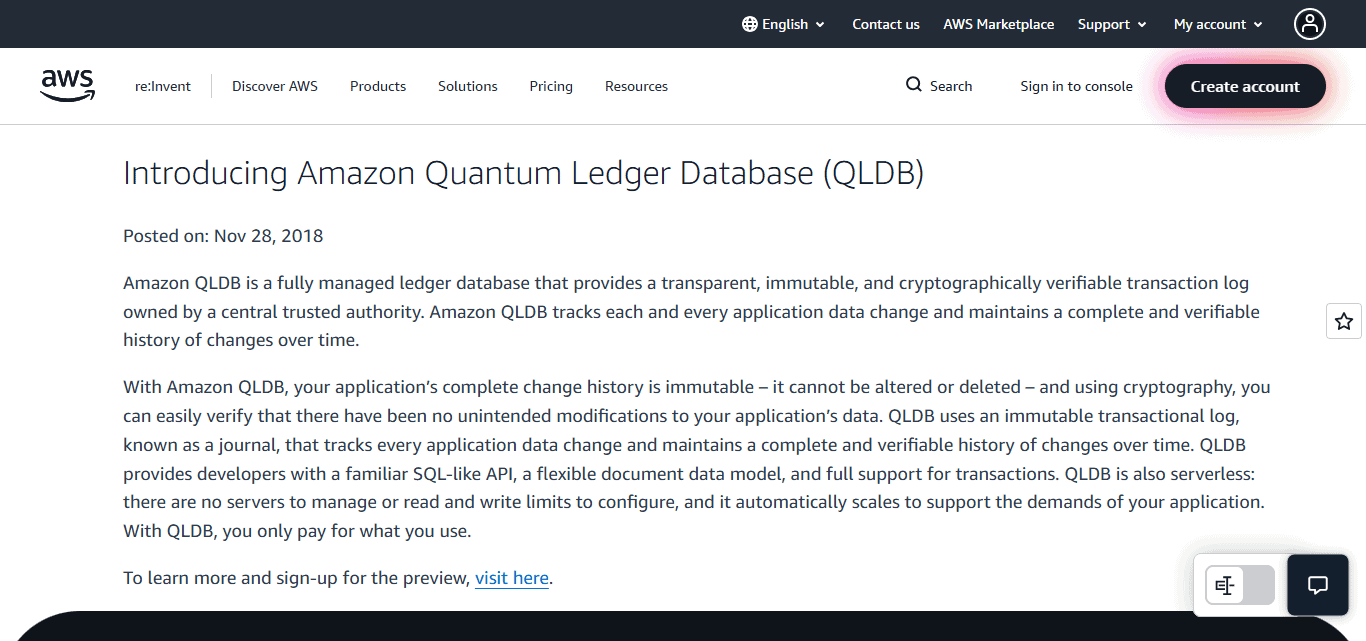
QLDB scales as a managed cloud database. Compared to Factom, QLDB prefers centralized enterprise ledger management and auditability over decentralized blockchain based data anchoring.
Amazon QLDB Features
- Provides a managed centralized ledger DB.
- Is a store of immutable and cryptographically verifiable transaction histories.
- Support for financial and inventory records and enterprise auditing.
- Integrates with AWS services to support scalable cloud applications.
| Pros | Cons |
|---|---|
| Managed ledger service reduces operational overhead. | Not a decentralized blockchain solution. |
| Cryptographically verifiable transaction history. | Vendor lock-in concerns with AWS ecosystem. |
| Easy integration with existing AWS services. | Limited interoperability with external blockchain networks. |
| Suitable for audit logs and regulated records. | Less flexibility than open-source distributed ledgers. |
Conclusion
To summarize, the best Factom alternatives for blockchain records offer different solutions in terms of data verification, storage, privacy, and scalability. Different platforms like Accumulate, Chainpoint, Hyperledger Fabric, Corda, Hedera, OriginTrail, Solana, Arweave, and Amazon QLDB cater to different business and technical requirements.
Organizations can compare their technologies, security models, record-management methods, scalability and use cases to find a suitable alternative for reliable digital records and data integrity.
FAQ
What are the best alternatives to Factom for blockchain records?
Accumulate, Chainpoint, Hyperledger Fabric, Corda, Hedera, and Arweave offer alternatives.
Which Factom alternative focuses on permanent data storage?
Arweave focuses on decentralized, permanent, and long-term digital data storage.
Which alternative provides permissioned enterprise blockchain records?
Hyperledger Fabric provides permissioned infrastructure for private enterprise record management.
Which platform offers cryptographic data timestamping?
Tierion Chainpoint provides cryptographic proofs and blockchain-based data timestamping.