In this article, I will discuss the Best DeFi Liquidation Automation Platforms in 2026. I will also discuss their key features, automation capabilities, supported protocols, and security measures.
These platforms allow developers, liquidators, and DeFi users to automate liquidation-related processes, monitor collateral positions, and increase operational efficiency. Understanding the differences between them will help you select the right solution for your decentralized finance needs.
Key Points
| Platform | Explanation |
|---|---|
| DeFi Saver | Automates collateral management and liquidation protection for supported DeFi lending protocols. |
| Gelato Network | Enables developers to automate smart contract transactions and execute predefined DeFi workflows. |
| Chainlink Automation | Triggers smart contract functions reliably when predefined onchain conditions are satisfied. |
| Keep3r Network | Connects decentralized projects with external keepers for executing essential blockchain maintenance tasks. |
| OpenZeppelin Defender | Automates smart contract operations, monitoring, and transaction execution for development teams. |
| Hummingbot | Supports automated trading strategies that can complement liquidation monitoring and risk management systems. |
| Furucombo | Simplifies DeFi transaction automation through configurable workflows across supported decentralized finance protocols. |
| Instadapp | Provides DeFi asset management tools and automation features for supported lending positions. |
| Enso | Helps developers build automated DeFi strategies across multiple protocols using composable blockchain actions. |
| Beefy Finance | Automates yield optimization strategies across supported blockchain networks and decentralized finance protocols. |
10 Best DeFi Liquidation Automation Platforms In 2026
1. DeFi Saver
Founded in 2018, DeFi Saver is among the most popular tools to save positions from liquidation. It’s automated so users can set triggers that will pay off debt or add collateral when a position nears its liquidation ratio. It works with Ethereum, Arbitrum, Optimism and Base. Supported protocols include Maker/Sky, Aave, Compound, Spark, Liquity, Morpho and Curve USD.

It supports ETH, wrapped BTC, liquid staking tokens and major stablecoins such as DAI and USDC. No membership required. Users pay network gas + small automation or service fee. Historically ~0.25% on automated actions. Varies by action & chain.
DeFi Saver Feature
| Feature | Explanation |
|---|---|
| Liquidation Protection | Automatically adjusts supported lending positions when configured collateralization thresholds are reached. |
| Automated Repayment | Repays debt automatically to help maintain safer collateral ratios during market volatility. |
| Leverage Management | Boosts or reduces leveraged positions according to user-defined conditions and strategy settings. |
| Stop-Loss Automation | Closes supported positions when configured price conditions trigger predefined loss-management strategies. |
2. Gelato Network
Gelato was founded around 2019 and launched in 2020 as a decentralized automation layer for intelligent contracts. Developers use it to perform liquidation, rebalancing, and goalkeeper operations without having to run their own bots.
It supports Ethereum and 30+ EVM chains including Polygon, Arbitrum, Optimism, Base and Avalanche. It is protocol-agnostic and so it can automate tasks on Aave, Compound, Uniswap and custom contracts. It works with native tokens and ERC20 assets.

Fees are the gas used for execution plus a small service premium, paid through a prepaid balance (1Balance, usually funded in USDC). The cost is proportional to the frequency and complexity of the task.
Gelato Network
| Feature | Explanation |
|---|---|
| Smart Contract Automation | Executes predefined smart contract functions when specified conditions are satisfied. |
| Event-Based Triggers | Initiates workflows in response to blockchain events and configured execution schedules. |
| Off-Chain Data Integration | Connects external APIs and data sources to automated onchain transaction workflows. |
| Transaction Execution | Provides automation infrastructure for executing predefined DeFi transactions without manual intervention. |
3. Chainlink Automation
Chainlink was founded in 2017 and launched its service Goalkeepers in 2021, which was later rebranded as Chainlink Automation. It does time-based, custom-logic and log-triggered maintenance tasks via a decentralized oracle node network.
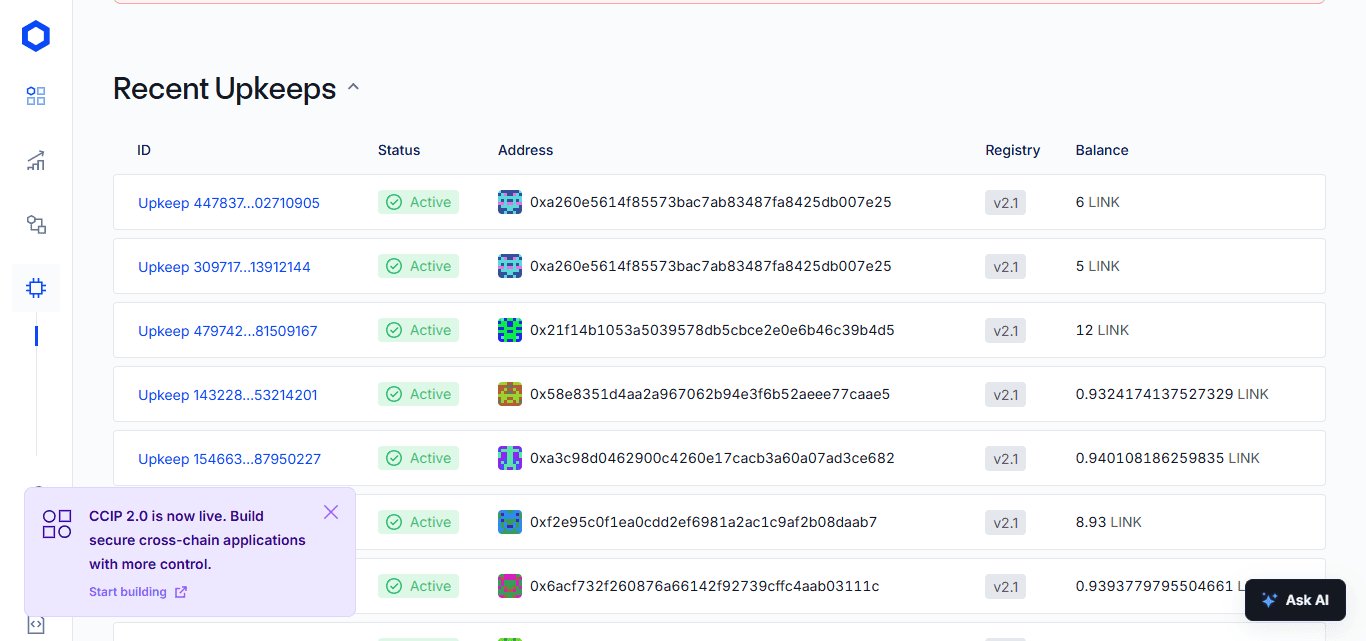
It supports Ethereum, Polygon, Arbitrum, Optimism, Avalanche, BNB Chain, Base and others. It can be integrated by any protocol so lending, derivatives and vault projects use it for liquidation checks and position management. It works with any on-chain asset the contract deals with.
Users fund upkeeps with LINK. Expenses depend on chain congestion and execution frequency, with costs equaling the gas used plus a premium that varies by network.
Chainlink Automation Feature
| Feature | Explanation |
|---|---|
| Condition-Based Execution | Triggers compatible smart contract functions when predefined onchain conditions become true. |
| Decentralized Infrastructure | Uses decentralized node infrastructure to support reliable smart contract automation. |
| Contract Monitoring | Checks registered contracts for conditions that require automated transaction execution. |
| Developer Integration | Provides tools for integrating automated execution into supported smart contracts and applications. |
4. Keep3r Network
Keep3r Network was created by Andre Cronje in 2020 as a decentralized marketplace for projects that need jobs done (“jobs”) and independent goalkeepers. Bots are able to compete to post and execute liquidation and maintenance jobs. It’s primarily on Ethereum but also has deployments on other EVM chains such as Optimism and Polygon.
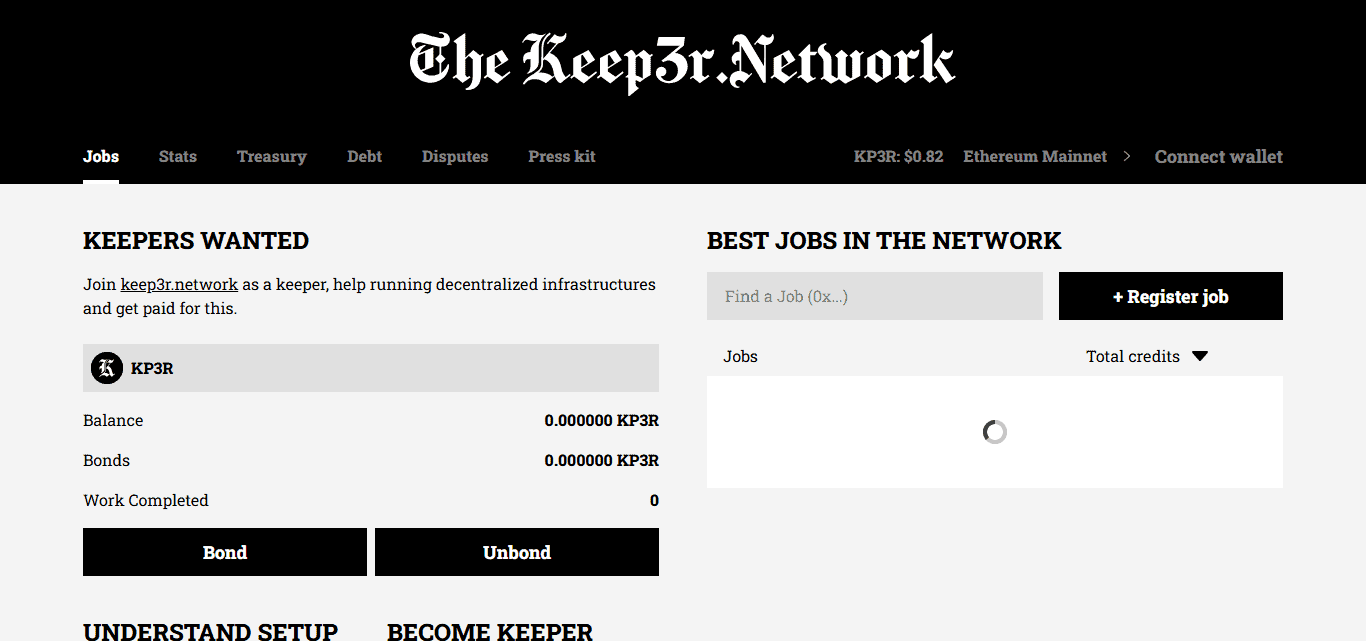
Supported protocols are those that have integrated Keep3r jobs, much like early Yearn and Sushi-ecosystem contracts. It supports ERC-20 assets, using KP3R and liquidity-pool tokens for bonding and payment. Goalkeepers have to lock KP3R to participate. Job owners reward in KP3R or other tokens, plus gas. There is no set fee schedule, so costs vary based on the reward terms of each job.
Keep3r Network
| Feature | Explanation |
|---|---|
| Decentralized Keepers | Connects projects with external operators who execute registered smart contract jobs. |
| Job Registration | Allows compatible smart contracts to register tasks for external keeper execution. |
| Keeper Rewards | Supports compensation for eligible keepers performing registered jobs under defined rules. |
| Custom Execution Logic | Enables keepers to execute tasks requiring simple transactions or complex external logic. |
5. OpenZeppelin Defender
Founded in 2015, OpenZeppelin created Defender in 2021 as a smart contract operations platform. Its Monitor and Relayer tools enable teams to detect risky positions and submit liquidation or protective transactions automatically and securely. It supports Ethereum, Polygon, Arbitrum, Optimism, Avalanche, BNB Chain, Base and other EVM networks.

It’s protocol-agnostic and works with Aave-, Compound-, and Maker-style systems through custom contract logic. It supports native tokens and ERC-20 assets. Pricing used to be free tier + paid plans, charged monthly, plus gas fees. OpenZeppelin have announced the sunset of Defender and are moving toward open-source alternatives so check the current status before you rely on it.
OpenZeppelin Defender Feature
| Feature | Explanation |
|---|---|
| Transaction Automation | Supports automated transaction workflows for compatible smart contract operations. |
| Event Monitoring | Monitors contract events and supports workflows triggered by relevant blockchain activity. |
| Relayer Infrastructure | Provides transaction-submission infrastructure for configured applications and automated workflows. |
| Security Operations | Supports development and operational workflows designed to improve smart contract management. |
6. Hummingbot
Founded in 2019, CoinAlpha is an open-source framework for algorithmic trading and market making. It’s not a dedicated liquidation tool, but traders use custom strategies to manage margin, hedge, and avoid liquidation.
It supports multiple centralized exchanges (such as Binance) and decentralized ones, including Uniswap, PancakeSwap, dYdX, and Hyperliquid, across Ethereum, BNB Chain, Arbitrum, and Solana-based venues. Supported assets are trading pairs on exchanges you are connected to.
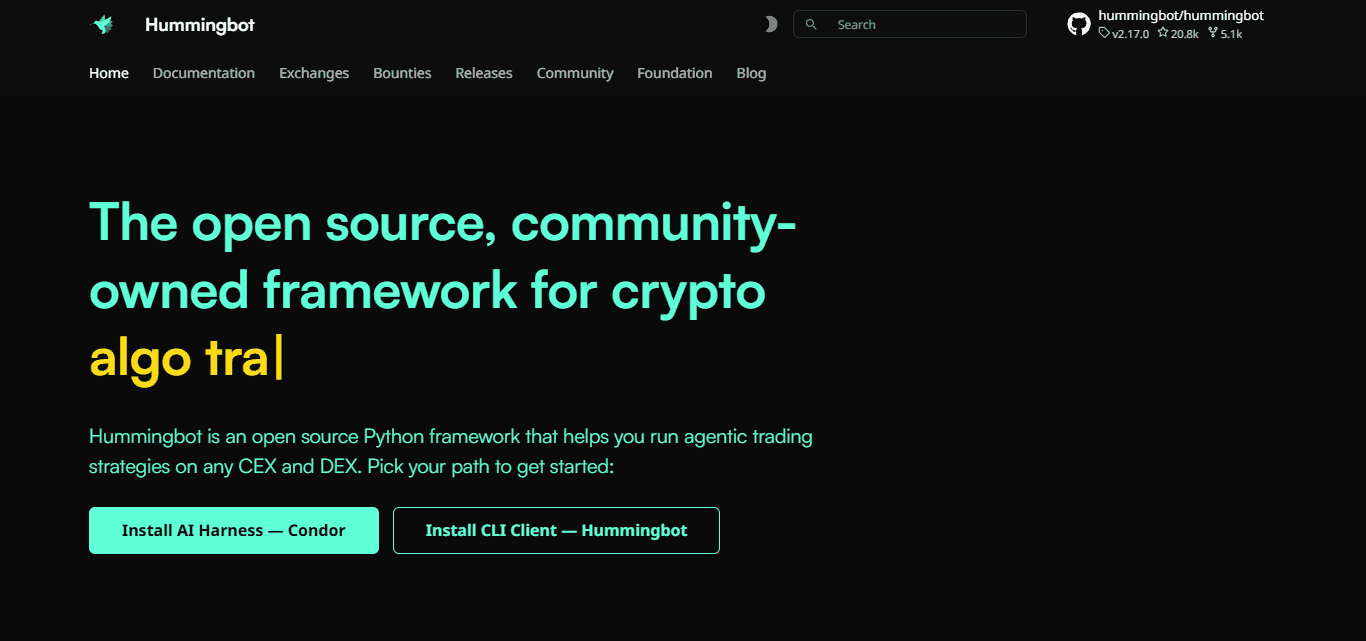
The software is free, but users pay fees for exchange trading, gas and server hosting. It also powers community liquidity-mining initiatives with its HBOT governance token.
Hummingbot Feature
| Feature | Explanation |
|---|---|
| Automated Trading Bots | Provides configurable bots for executing algorithmic trading strategies across supported exchanges. |
| Market Making | Automates quoting strategies designed to provide liquidity in supported trading markets. |
| Strategy Customization | Allows users to configure trading logic and adapt strategies to different markets. |
| Open-Source Framework | Offers an extensible framework for developers building automated trading applications and integrations. |
7. Furucombo
Launched in 2020 by Dinngo, Furucombo was a drag-and-drop DeFi “combo” builder. It also has use cases such as manually de-risking or restructuring a position near liquidation by allowing users to string together actions such as flash loans, repayments, swaps, and collateral top-ups in one transaction. Ethereum, Polygon, Arbitrum, Optimism, BNB Chain and Avalanche are supported.

The integrated protocols are Aave, Compound, Uniswap, Curve, Balancer, and 1inch. It supports major ERC-20 tokens, stablecoins and liquid staking assets. The interface is free, and the user pays for the network gas and any underlying protocol or flash-loan fees. There is less automation than with dedicated goalkeeper platforms.
Furucombo Feature
| Feature | Explanation |
|---|---|
| Visual Workflow Builder | Simplifies DeFi transaction creation through a visual interface for supported actions. |
| Transaction Bundling | Combines compatible DeFi operations into streamlined transaction workflows. |
| Protocol Integrations | Enables users to compose transactions using supported decentralized finance protocols. |
| Strategy Customization | Helps users configure multi-step DeFi operations without manually constructing every transaction. |
8. Instadapp
Instadapp was founded in 2018 and is based on DeFi Smart Accounts (DSA) that enable users to execute multi-step strategies in a single transaction. It offers debt refinancing, collateral management, and leverage adjustment to mitigate liquidation risk.
It supports Ethereum, Polygon, Arbitrum, Optimism, Avalanche, Base and Gnosis. Integrated protocols are Aave, Compound, Maker, Uniswap, Curve and Lido. It supports ETH, stablecoins, wrapped BTC and staked assets.

No platform fee And gas fee for creating and using a DSA. Performance fees on earnings from Instadapp’s managed vault products. Flash-loan routes may include small provider fees.
Instadapp Feature
| Feature | Explanation |
|---|---|
| DeFi Position Management | Provides tools for managing supported lending positions and decentralized finance strategies. |
| Lending Integrations | Connects users with supported protocols for managing collateral and borrowing positions. |
| Leverage Management | Supports leveraged DeFi strategies through compatible smart contract infrastructure and workflows. |
| Smart Account Infrastructure | Uses programmable account infrastructure to facilitate complex DeFi operations and integrations. |
9. Enso
Enso was launched in 2020 as a developer-focused DeFi execution and integration layer and later launched its ENSO token. Rather than a consumer dashboard, it provides an API and “shortcuts” that aggregate actions across protocols. Builders use it to build liquidation protection, rebalancing and automated exit logic.

It supports Ethereum and a growing list of EVM chains like Arbitrum, Base and Polygon. It includes 100+ protocols like Aave, Compound, Uniswap, Curve and Lido. It supports ERC-20 tokens, LP tokens, and yield-bearing assets. Fees are determined by the amount of API usage, as well as any gas and fees from the underlying protocol. Refer to its docs for the current pricing tiers.
Enso Feature
| Feature | Explanation |
|---|---|
| DeFi Action Routing | Helps developers coordinate compatible actions across supported decentralized finance protocols. |
| Cross-Protocol Strategies | Enables applications to combine multiple DeFi operations into integrated workflows. |
| Smart Contract Integration | Provides infrastructure for connecting applications with supported onchain actions and protocols. |
| Strategy Composition | Simplifies building complex DeFi transactions from reusable protocol interactions. |
10. Beefy Finance
Launched in 2020 on BNB Chain, Beefy Finance is a… It’s a multi-chain yield optimizer that auto-compounds vault rewards. It’s not a liquidation tool, but its automated vaults and lending-based strategies reduce the manual position management that leads to liquidations. It supports 20+ chains like BNB Chain, Ethereum, Polygon, Arbitrum, Optimism, Base, Avalanche and Fantom.
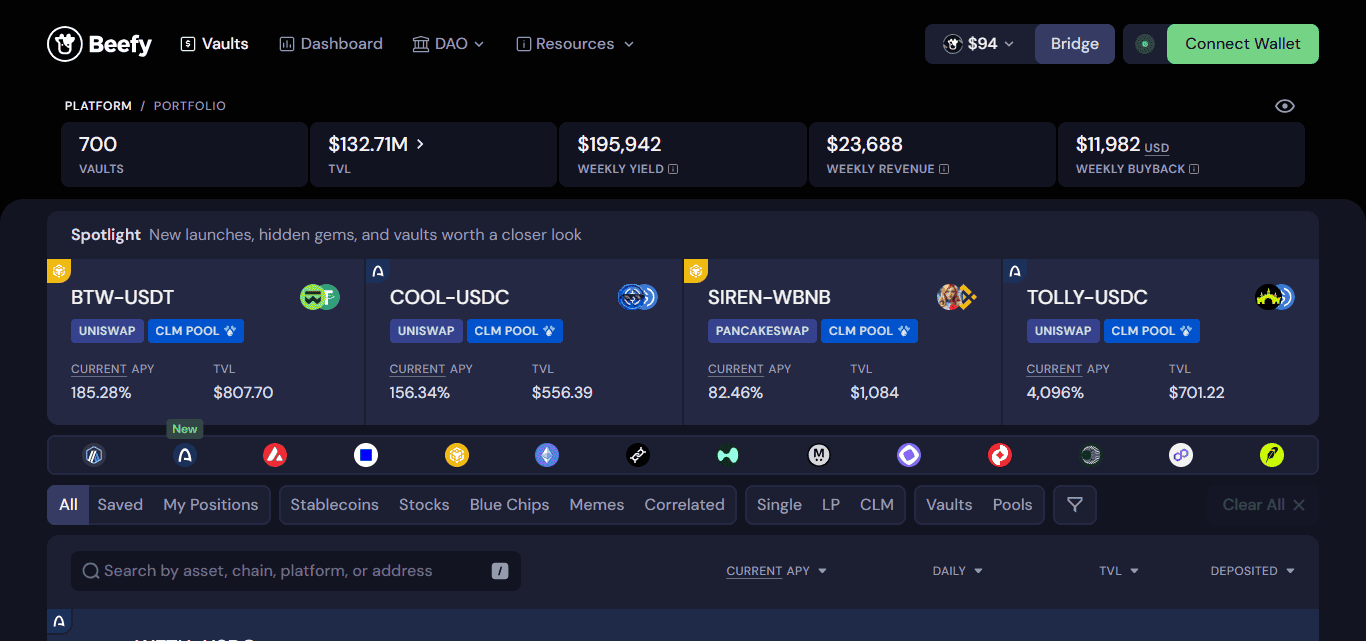
It has been integrated with protocols such as PancakeSwap, Uniswap, Curve, Aave and Convex. Supported assets include LP tokens, stablecoins and single sided tokens . Fees are mostly a performance fee on harvested yield (usually in the low to high single digit percent range, depending on vault), plus network gas on deposits and withdrawals.
Beefy Finance Feature
| Feature | Explanation |
|---|---|
| Automated Compounding | Automatically reinvests eligible farming rewards to compound returns over time. |
| Yield Optimization | Provides vault strategies designed to optimize returns across supported DeFi opportunities. |
| Multichain Support | Offers yield optimization products across multiple supported blockchain networks. |
| Automated Vault Strategies | Uses smart contracts to manage deposits and execute predefined yield-farming strategies. |
Conclusion
Conclusion The Best DeFi Liquidation Automation Platforms help to streamline the liquidation process, monitor collateral positions and improve operational efficiency in decentralized finance. Platforms like DeFi Saver, Gelato Network and Chainlink Automation offer automation capabilities for different needs.
Before picking a solution, check for protocol compatibility, security, transaction fees, and supported blockchains to find the best platform for your DeFi needs in 2026.
FAQ
How do DeFi liquidation automation platforms work?
They monitor collateral ratios and execute predefined liquidation transactions when conditions trigger.
Which DeFi liquidation automation platform is best in 2026?
The best platform depends on protocol compatibility, automation features, security, and costs.
Are DeFi liquidation automation platforms secure?
Security depends on smart contract audits, execution safeguards, infrastructure, and risk management.
Can liquidation automation reduce financial risks?
Automation improves execution speed but cannot eliminate market volatility or liquidation risks.